Three Mal of Rice
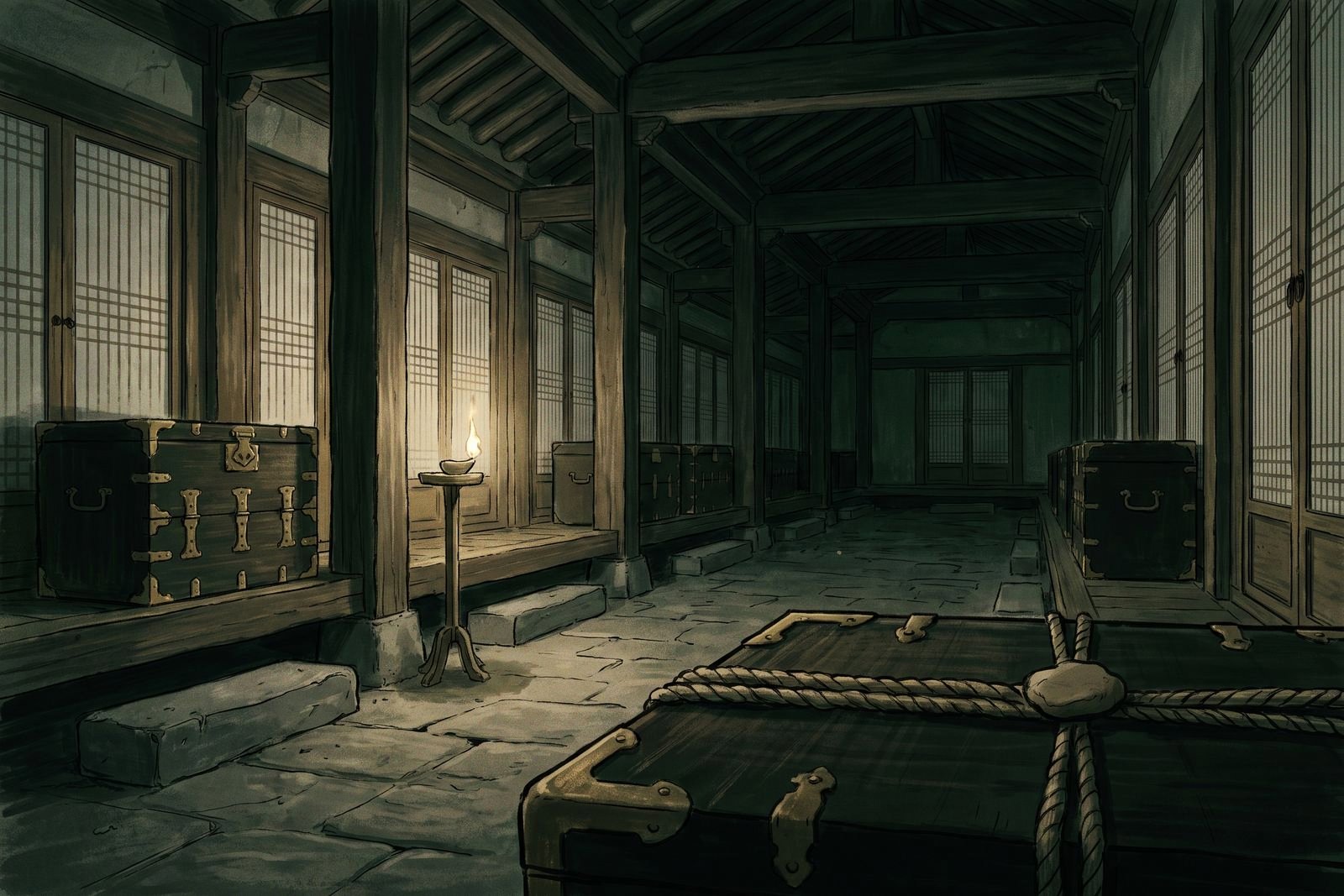
The order that closes the matter is short and administrative: the work is to be set aside and not further circulated.
1444–1460Set Aside and Not Further Circulated
No argument accompanies the order. The twenty-eight forms and the working drafts go into a chest in the inner storehouse under seal, within the month; the Crown Prince and the few junior scholars who had carried the project outside the regular bureaux are moved to the rime work and to the annals office. Because nothing is promulgated, nothing is printed. Because nothing is printed, there is no commentary, no table of articulation, no worked example of a sound written down. What survives is a line in a register and a box.
The objection that does the work is the first of the six. A country that serves the Ming court cannot invent letters without the invention being reported there, and the company such an invention would put it in is named in the memorial itself: Mongols, Jurchen, Japanese, Tibetans. The king answers on the day, 20 February 1444, and answers harshly; one of the signatories is told that such a speech is not worthy of a man of virtue. Choe Manri, deputy head of the Hall of Worthies, is dismissed in the evening and reinstated the following day. He keeps the post. Granted leave for illness in the summer of 1445, he dies at Anseong in the tenth month of that year, a serving officer, having won the only argument of his life.
The rime project goes on without him and without a notation. The table of corrected Sino-Korean readings appears in 1447 and can express a sound only by pairing two Chinese characters, one for the onset and one for the rest, which is the method the reform was meant to replace. It is issued to the interpreters' office and to the examination schools, praised in the preface, and consulted by almost nobody. Customary pronunciation is never disturbed.
Sejong dies in 1450 and his elder son two years after him. The compilers who sit between the second month of 1452 and the third month of 1454 copy into the annals both the entry saying that in the twelfth month of 1443 the late king made new letters, and, a few folios on, the full text of the memorial against them with the king's reply. The abandonment is therefore better documented than the invention. Later readers inherit a month without a day, a dispute they cannot settle, and no object to check it against.
The usurpation of 1455 and the failed restoration of the following year kill three of the men who had done the technical work and leave two in office. There is no commentary volume, so there is no group of eight signatories with a collective name; there is one surviving phonologist, Sin Sukchu, who has the Chinese rime learning and remembers the sealed sheets. The Hall of Worthies is abolished in 1456 as a nest of the plot and its functions pass to bureaux answering directly to the throne.
Twice, in the eleventh month of 1459 and again in the spring of 1460, he and the compilers preparing the great scripture office petition that the chest be opened under warrant. Not for common use: as a technical notation, to fix sutra readings and the sounds the 1447 table failed to deliver. This is the branch the history most wants to take, and it is refused for a reason stated from the throne. A king who came to the throne over his nephew's ministers depends on Ming investiture, and imperial good opinion is the one asset he cannot spend. The sixteen-year-old first objection is quoted back as the crown's own argument. The chest is re-sealed and its custody moved to the palace storehouse.
1461–1555The Formulary and the Three Mal
The scripture bureau founded in the capital in 1461 prints sutras in editions no private house could match, and with them a royal standard of glossing: abbreviated Chinese graphs set beside the text to mark Korean particles and verb endings, sponsored in the preface by the two senior survivors of the old Hall and presented as the orthodox alternative to what the late king laid aside. The series runs to 1471. Its method is the first Korean notation ever approved by a throne, and it is approved precisely because every sign in it is Chinese.
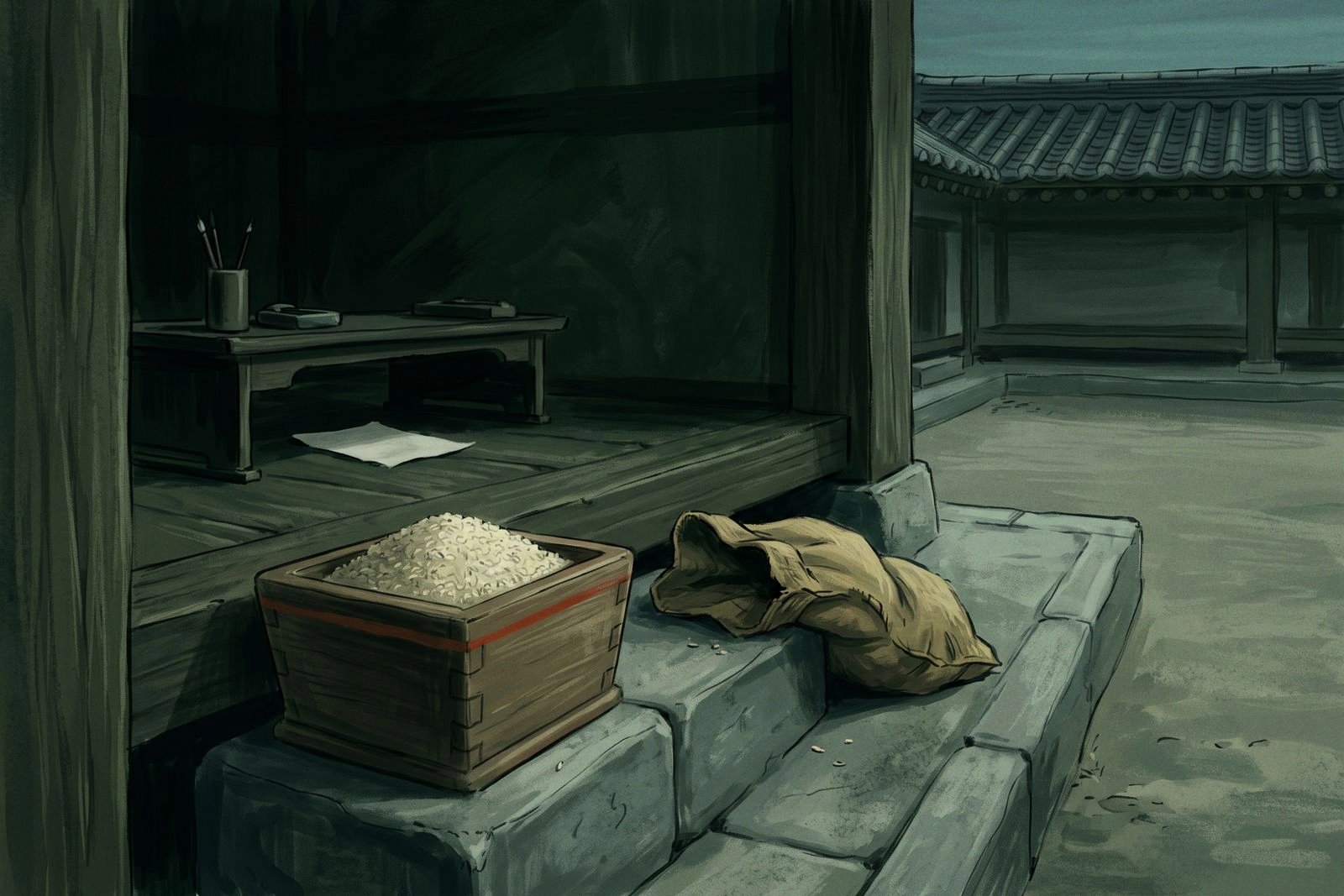
The codification closed in 1485 fixes the rest. Printed books may carry no notation but the authorised gloss. Land deeds, loan bonds, wills and commoners' petitions must be composed on the county formulary by a county clerk, and the fee in the schedules is three mal of rice an instrument, the same for a paddy of thirty negi as for a strip behind a house. Against a large parcel this is nothing. Against a small one it is a tax on the transaction itself, and small holdings begin to move by witness and memory, partitioned within lineages and never written. Within two generations the registers in the county office and the ground outside it are describing different countries. The censorate complains in the 1480s of deeds fabricated after the fact; the complaint recurs, in the same words, for four hundred years.
A man who wishes to accuse the office must hire the office to compose the accusation. That is the ordinary fear of the period, and it is not tigers.
In 1504 placards abusing the king appear on the capital gates, written not in plain Literary Chinese but in clerkly abbreviations. The notation registers of the capital bureaux are examined, hands are compared against county formularies, several clerk households are punished on suspicion, and nothing is proved. The durable effect is on the writing. It is never taught openly, never standardised in print, never signed, never submitted for approval. It has no author and no promulgation, so there is nothing for a memorial to be written against.
The inner palace burns in the ninth month of 1553 and the storehouses burn with it, the sealed chest among them. The loss is not recorded as a loss. Copies made during the two months when the forms were known outside the king's circle survive in two places: a dozen shapes traced without sound values in a miscellany kept by the Haeju Choe, and eight shapes with a marginal note in an interpreters' notebook. Since no commentary was ever compiled, the shapes are undecipherable in principle rather than in practice. They are letters with no attested values, and nothing written anywhere in the world supplies them.
The famine of 1554 is answered by an excellent relief compendium, printed in Literary Chinese for magistrates: which wild roots are safe, how to boil pine-bark gruel, how the grain loans are issued and on what terms repaid. What reaches a village is a placard drawn by a clerk and a crier. The placards carry the ration list and omit the repayment schedule, the schedule being the office's business. Arrears accumulate against households that were never told the terms, and the magistrates' reports of the following years say that the commoners do not know the law of the loan and blame the office.
1592–1812The Century of the Clerk's Chest
In 1592 Japanese armies land in the south-east. Every copy of the annals of Sejong's reign is destroyed except the set at Jeonju, which is duplicated four times over between 1603 and 1606; the 1443 entry and the memorial against it survive by that one accident of storage. Through the war, royal proclamations to commoners can be cried aloud or posted by county offices and by no other means, and requisition lists, refugee registers and militia musters all run through clerk lineages who learn during those six years that they are indispensable.
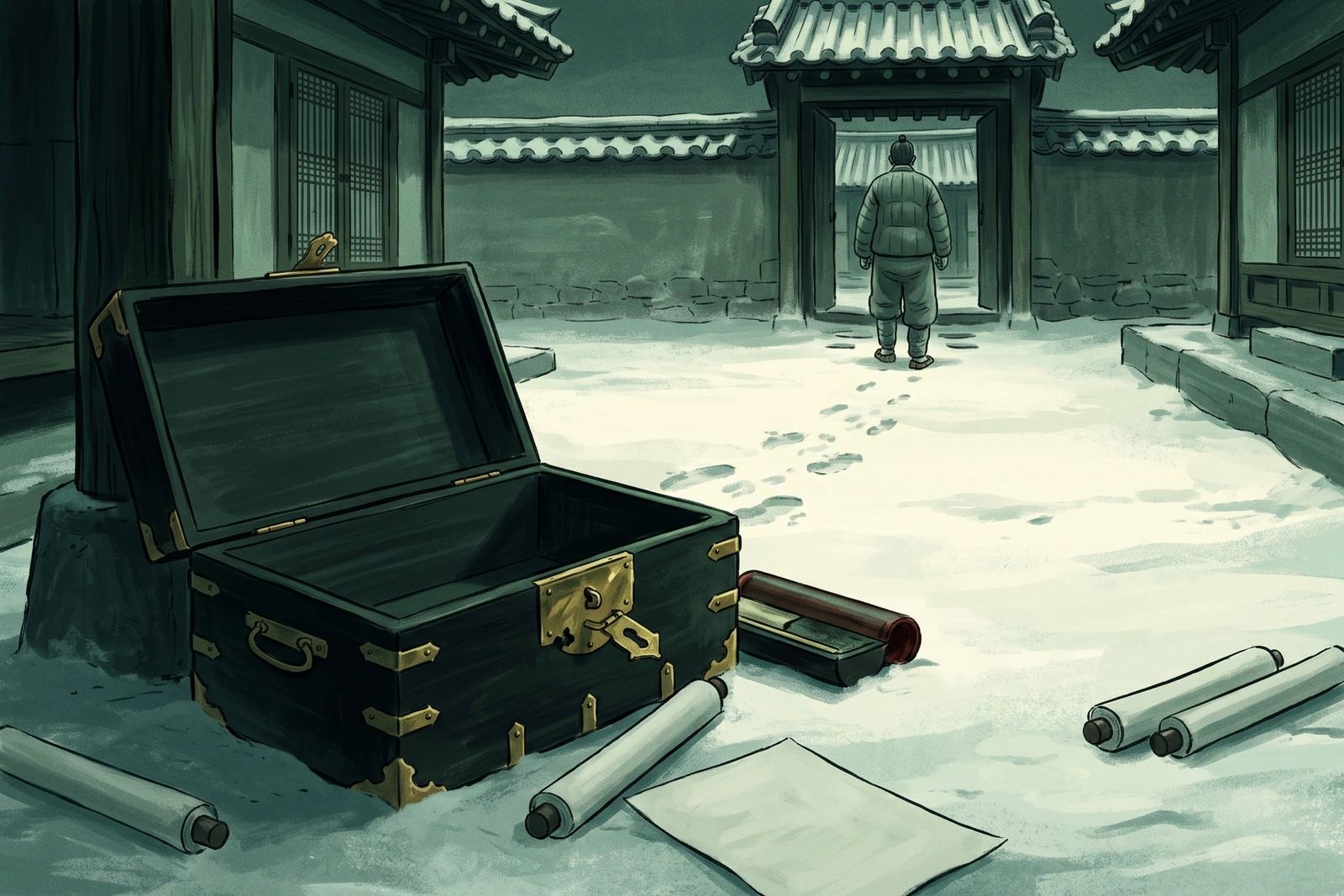
From about 1600 the royal gloss and the fixed formulary harden into a single working inventory, roughly seventy abbreviated graphs for particles, endings and part of the syllable-final set. Nobody legislates it. Its carriers are hereditary clerk households, temple printers, shopkeepers' ledgers and the dictated letters of gentry women, and it acquires the name it still has: the county hand. Its limits are honest. Korean syllables defeat a clean set built from graph abbreviations, so Chinese characters must still carry the stems; it differs between Chungcheong and Gyeongsang; no examination paper, memorial or statute may use it. Why the inventory settled at about seventy signs rather than forty or two hundred, the record of this world does not explain.
Beijing falls in 1644 to a people cited in the memorial of 1444 as proof that letters are the mark of a barbarian, and who had given themselves letters in 1599. Joseon's claim to be the last standing ground of civilisation is argued out of its own archives, and the refusal is entered as evidence: this dynasty never once took the road of the Jurchen and the Japanese in writing. Revanchism runs hotter for it. The northern expedition mobilises through 1657 and crosses in the seasons of 1658 and 1659, and breaks on transport, forage and the rivers before meeting a Qing army in the field. The terms are punitive and are paid: hostages from the royal house and the ministries, an indemnity in grain and silver over twelve years, a resident commissioner in the capital for a generation. The indemnity is assessed off household and land registers that only the clerks can read or amend. Those assessment years make them. Brokerage, tax-farming and effective possession of the cadastre pass into their hands a full century earlier than the same shift occurred elsewhere.
Relief and epidemic texts stay magistrates' books. The famines of 1670 and 1671, and of 1695 to 1699, and the smallpox of the following century, each cost more than they would in a peninsula with cheap vernacular print; inoculation and later vaccination spread by demonstration from practitioner to practitioner. The peninsula enters 1900 with about fourteen million people instead of seventeen, and everything scales with it: thinner market calendars, smaller tax-grain tonnages, shorter muster rolls, a later and smaller movement north into Manchuria.
Three attempts are made on the problem and three fail for reasons on the record. In the 1750s a gentry petition from a Gyeongsang county kills a proposal to regularise the clerks' notation, on the ground that uncertified instruments would multiply lawsuits; the composition fee and the households living on it go unmentioned. In the 1790s a phonetic-table project in the royal library is refused because the Ministry of Punishments will not certify documents no clerk can vouch for. In 1801 a private reconstruction of the twenty-eight letters of the twelfth month is seized in a Catholic house in the capital and burnt with the rest of the household's books as foreign writing.
The north-western rising of 1811 keeps its causes, which are regional exclusion from office, the grain trade of Pyongan and a bad harvest. What it lacks is a manifesto, because there is no cheap way to print one. It circulates men instead, and in each county its first act is to seize the clerk's formulary chest and the seals, those being the only written politics available. The siege and the pacification run their course, and the same households are restored to the same desks, the court having no other way to reach a village.
1836–1945A Price, a Survey, and a Reader with Diacritics
The fee is still three mal of rice an instrument in 1836, unchanged since 1485, and on a small field it now exceeds the annual tax on it. Around that price everything else arranges itself. The French mission, working from the 1830s and needing catechisms that no gentry intermediary has to read aloud, prints Korean in Latin letters; sheets of it are produced in evidence at the trials of 1839 and of 1866, which gives the alphabet a martyr's provenance and a permanent Catholic smell. A Protestant version on north-western speech follows from across the northern border in 1882. Neither becomes national, and the reason is not persecution: the county hand already occupies that place, is made of Chinese parts, and is respectable in a way a foreign alphabet is not. The mission letters survive as church, emigrant and eventually export spelling.
A widow in a Gyeongsang county in 1858 sues her husband's cousins over four paddies. The petition is composed, at the schedule rate, by the clerk who is the cousins' kinsman, and she signs it with a fingerprint. She loses, and the case is recorded as settled by agreement.
The registers are acknowledged as fiction by the men who keep them. The risings of 1862 are broader than in our world and harder to contain; the treaty of 1876 is cheaper for Tokyo to obtain from a poorer court; the rising of 1894, whose scripture travels in mouths rather than in tracts, concentrates slowly and disperses badly, and in county after county it names the clerk before it names the magistrate. Japan lands anyway, for its own reasons, into a country in revolt, so the war of 1894 and 1895 is a counterinsurgency as well, and the reform decrees are issued by an army over provinces it does not hold. The reform club's newspaper of 1896 appears in Literary Chinese with the county hand for endings, sells a few thousand copies to men who already hold office, and reaches nobody else. The land survey of 1898 to 1904 fails as every survey since 1485 has failed, auditing clerk-written paper against ground no one has documented. The protectorate of 1905 and the annexation of 1910 arrive on time, decided in capitals where Korean orthography is not a consideration, over fourteen million people.
From 1912 the Government-General does what no Korean throne would do. Finding the county hand in every county office and cheaper to teach than characters, it standardises the sign list, supplies the missing codas and the aspirate contrasts with diacritics borrowed from kana, and prints it in the common-school readers as a Korean sister-syllabary. Korea's first fixed orthography is promulgated by an occupying administration, and that is the permanent injury. A girl of nine near Haeju, Chun-ok, learns her letters out of that reader in 1939 and is taught that they are hers.
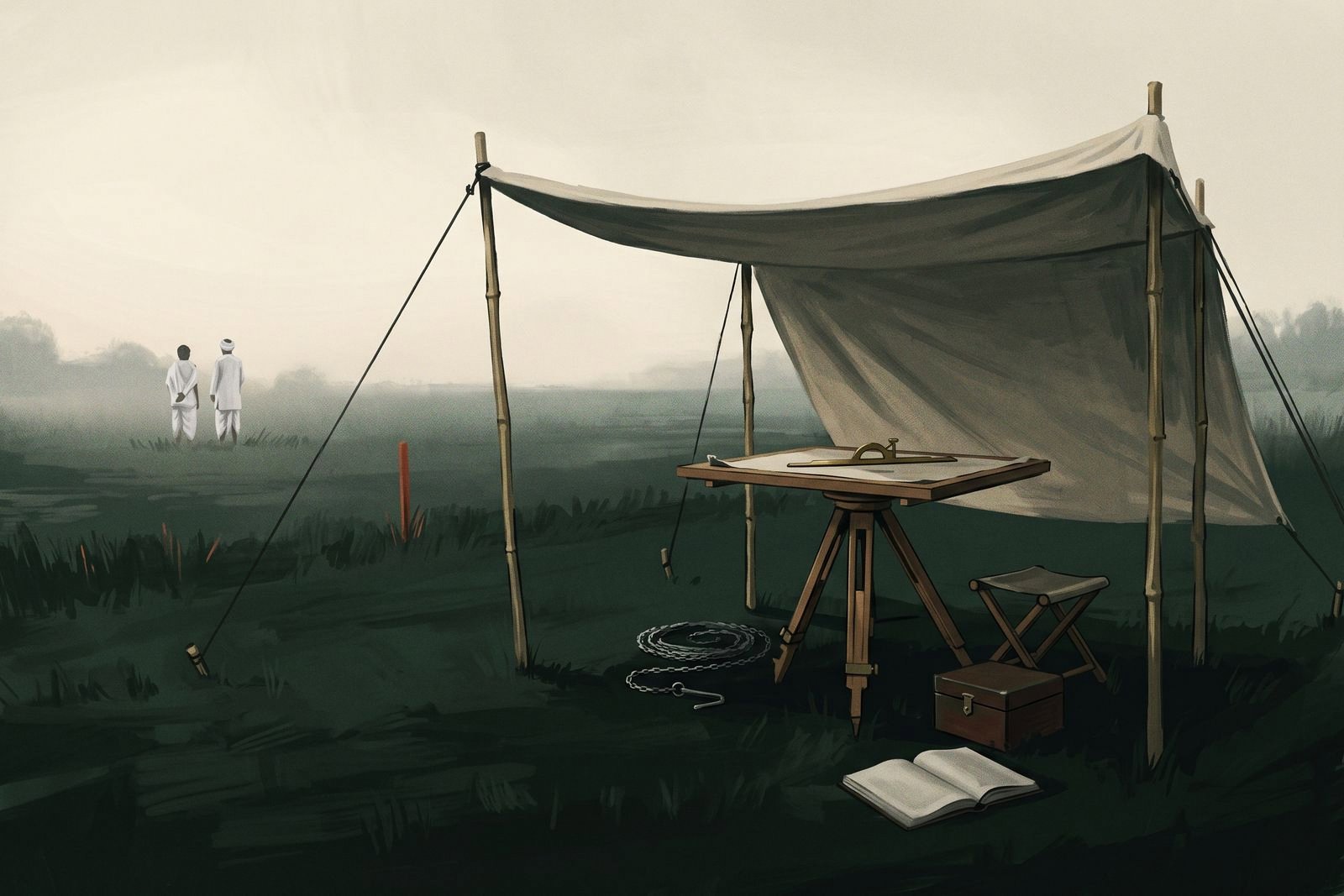
At a survey table under an awning outside a Naju village, at about nine in the morning in the spring of 1916, a Japanese adjudicator with a chain and a ledger asks who holds a strip of upland. The claim on paper is produced from a lacquered chest by a clerk of the Yun house, forty-one years old, whose family has composed the instruments of that county since before the invasions. The men who worked the strip have witnesses and no document. The survey of 1910 to 1918 converts four centuries of one caste's paper into freehold, and confirms to clerk lineages and to the colonial land company far more ground than any other reading of the evidence would. Tenancy runs higher for it, and the rural left is harder and earlier.
The movement of March 1919 spreads slowly, through churches and religious orders rather than through handbills, and is decapitated with less difficulty; the concessions that follow come late and thin. The Pacific war is unchanged in origin and in outcome. Korea supplies less of it off the smaller base, and the administration that elsewhere banned Korean schooling from 1938 cannot ban a syllabary it fixed itself, so the savings drives, the air-raid notices and the name-change ordinance all go out in the regularised county hand. By August 1945 it is the script of every requisition slip in living memory.
1948–2026Two Alphabets, One Peninsula
In a normal school outside Haeju, in the winter of 1949, an adult class learns its second alphabet in ten years. The orthography decree of that year puts Korean into Cyrillic on Soviet presses with free type, against both the missionaries' letters and the characters of the gentry, and Chun-ok, nineteen, relearns to read from a primer whose vowels she will use for the rest of her life. The campaign competes with land reform and conscription for the same clerks and the same paper, is interrupted by the war of 1950 to 1953, and is finished by it. In 1966 a committee in Pyongyang adds four invented letters for sounds it holds Russian ones to render badly, and states in print that it has completed the work a king began in the twelfth month of 1443 and a court abandoned in the spring of 1444.
The Republic in the south keeps the regularised mixed script, characters carrying the stems and the county hand carrying the grammar, because no ministry can invent a national orthography in the emergency of 1948 and the schooled generation already reads it. The retention is a standing humiliation. A reform bill reaches the Assembly about every decade and none passes; the drive of 1963 to 1971 teaches mass literacy in letters the ministry's own committee calls colonial in origin, and the bills of 1972 and 1983 die in committee. Everything else in the Republic's calendar belongs to the Republic: the coup of May 1961 and General Ko Sang-jin's government to 1979, the normalisation capital of 1965, the dispatch to Vietnam, the heavy industries, the accord of October 1988 negotiated under the eyes of the Games. The signage in Seoul that year is in three writings.
The war's propaganda had split along the decree. Southern leaflets in mixed script fell on soldiers schooled in Cyrillic, northern leaflets were illegible below the parallel, and at the screening tables a man's hand told you where he went to school faster than his papers did. The southern police kept a card on it into the 1970s.
When the banknotes are redesigned in the 1970s, the committee argues for a year. The general who took the northern rivers and built the six garrisons has the stronger military case; the admiral of the 1590s already has the plinth on the great avenue in the capital. Sejong wins the ten-thousand on the rain gauge, the agricultural manuals and the expedition of 1419, and the note carries its denomination in characters on the face and in mission letters on the back.
The crisis of 1997 arrives through dollar debt and hits a domestic market of forty million rather than fifty. Reconciling the national character set with the international standard takes until a clerical-glosses block is accepted in 2001, and offices computerise a decade behind Japan; the same barrier keeps foreign search and messaging out long enough for domestic firms to own both outright. The football tournament of 2002 is co-hosted, its shirts and boards lettered in the mission spelling, the only Korean a visitor can sound out.
Chun-ok's granddaughter crosses in 2011. On a Tuesday afternoon in a resettlement centre south of Seoul, twenty-three years old and fully literate in her own country, she works through a first-grade workbook of character stems with the glosses printed above them, nine months budgeted for the course. The joint script-reconciliation committee promised in the thaw of 2018 meets twice, in 2019 and 2020, and publishes nothing. Northern technical schools teach Russian easily, their alphabet being half of it already, which smooths the traffic of labour and munitions after 2022 and the treaty of 2024.
Nobody ever purged the southern vocabulary, there being no native script to purge it for, so official Korean in Seoul carries an unlevelled load of Sino-Korean and colonial-era words and a provincial variation no orthography society ever flattened before 1912; the north has been purifying since the 1960s, and the two formal registers are further apart than the two alphabets. The national dictionary labels its pre-modern etymologies conjecture, which they are.
The emergency decrees of March 2020 go out in statutory style with the mandatory glosses, and the complaints produce the Plain Public Notice Act of 2021, the first law permitting a government text without them. The broader gloss-reduction bill fails in 2024 and again in 2025, opposed by the licensed scriveners' federation, whose Naju member firm is held by the Yun in the eleventh generation of the same trade, and by the teachers' unions. Language models trained on a corpus the law requires to be glossed perform poorly; the export studios caption in mission letters. Middle-schoolers still copy out the memorial of 1444 as the model of loyal remonstrance heeded. Twelve traced shapes sit in a lit case at the national palace museum under a label saying their sounds cannot be recovered, and in 2026 the international register of documentary heritage accepts the annals of Sejong's reign, catalogued for the memorial of the Hall of Worthies against the letters that were never issued.
1444Sejong sets aside the new letters and keeps his critic in post
The memorial centred on Choe Manri reaches the throne on 20 February 1444 and the king answers the same day, including the rebuke to Jeong Chang-son that such a speech is not worthy of a man of virtue; Choe is dismissed and reinstated within a day. But the first objection lands: an invention of letters by a country that serves Ming would be reported to the imperial court, and the Mongols, Western Xia, Jurchen, Japanese and Tibetans are the company it would put Joseon in. Within the month Sejong orders the work 'set aside and not further circulated'. The drafts and the twenty-eight forms are sealed in the inner storehouse; the Crown Prince and the junior cadre who had carried the project outside the regular bureaucracy are reassigned to the rime work and the annals office. Choe Manri retains the post of bujehak, retires in ill health in 1445 and dies at Anseong on 23 October 1445, having won the only argument of his life.
9 SOURCED CAUSES
1447The rime reform survives without a notation and dies as an instrument; the record preserves the letters as a rumour
The Yunhui project still yields the Tongguk chongun in 1447, but with no phonetic signs it can only give reformed Sino-Korean readings as fanqie spellings in Chinese graphs — a table that presupposes the learning it was meant to supply. It is issued to the Office of Interpreters and the examination schools, praised, and used by almost no one; the corrected readings never displace customary pronunciation. Sejong dies in 1450, Munjong in 1452. The Veritable Records of Sejong, compiled between the second month of 1452 and the third month of 1454, carry both the twelfth-month 1443 entry announcing letters that were never promulgated and the full text of the 1444 memorial with the king's retort. The abandonment is thus better documented than the invention: later readers have a month without a day, a dispute they cannot settle, and no artefact to check it against.
6 SOURCED CAUSES
1455Sejo's usurpation kills half the technical cohort and spares the phonologist
The succession crisis runs as it did: Sejo takes the throne from his nephew in 1455, and the 1456 restoration plot ends with Song Sammun, Pak Paengnyon and Yi Kae executed. Sin Sukchu and Chong Inji serve the new throne. Because no commentary volume was ever compiled, the men who in another world would have signed one jointly are never a group with a name; what survives of the 1440s phonetic work is carried privately by Sin Sukchu, the one man at court who has both the Chinese rime learning and the memory of the sealed sheets. The Hall of Worthies is abolished in 1456 as a nest of the plot, and its functions pass to bureaux that answer more directly to the throne.
3 SOURCED CAUSES
1459The petition to unseal the sheets, and the usurper's reason for refusing
Preparing the great sutra-translation office, Sin Sukchu and the compilers who will staff it petition twice — in the eleventh month of 1459 and again in the spring of 1460 — that the sealed forms be brought out under royal warrant, not for common use but as a technical notation to fix sutra readings and the Sino-Korean sounds the 1447 table failed to deliver. Sejo, who has read the file, refuses for a stated reason: a king who came to the throne over his nephew's ministers is investiture-dependent, and the Ming court's good opinion is the one asset he cannot spend. The memorial's first objection, sixteen years old, is quoted back from the throne as the throne's own argument. Sin Sukchu accepts the refusal and turns to the glossing project instead; the sheets are re-sealed and their custody transferred to the palace storehouse.
5 SOURCED CAUSES
1461Royal gugyeol, a code clause against unauthorised notation, and a fee on every deed
Sejo founds the scripture bureau in 1461 and issues with it a royal standard of gugyeol glossing — abbreviated Chinese graphs set beside the text to mark Korean particles and verb endings — sponsored in the preface by Chong Inji and Sin Sukchu and presented explicitly as the orthodox alternative to the project his father laid aside. The sutra series runs to 1471. The same reign's codification, promulgated in stages and closed in the Gyeongguk daejeon of 1485, adds two clauses of lasting weight: printed books may carry no notation but the authorised gloss, and land deeds, loan bonds and commoner petitions must be composed on the fixed idu formulary by a county clerk, at a composition fee set in the county schedules at three mal of rice per instrument irrespective of the size of the parcel. The fee is a flat tax on small transactions: modest holdings begin to move inside lineages by witnessed word and unrecorded partition, the cadastre drifts out of correspondence with the ground, and land quietly concentrates where paper is cheap relative to acreage.
4 SOURCED CAUSES
1504Anonymous placards, and the hand learns to stay unsigned
Placards abusing Yeonsangun appear on the capital's gates written in clerkly abbreviations rather than plain hanmun. The king orders the notation registers of the capital bureaux examined, sets calligraphic comparison against county formularies, and punishes several clerk households on suspicion. Nothing is proved. The durable effect is on the notation itself: it is never taught openly, never standardised in print, never signed, and never submitted to the throne for approval. It has no author and no promulgation, and therefore nothing exists against which a memorial could be written — which is exactly why it will outlive every objection that killed the king's letters.
3 SOURCED CAUSES
1553The palace fire, and twelve shapes that can never be read
The fire in the inner palace destroys storehouses along with the sealed 1443 chest; the original sheets and the drafts burn. Copies made in the two months when the forms were known to the Crown Prince and a technical cadre survive in two places: a dozen forms, traced without sound values, in a miscellany kept by the Haeju Choe of Choe Manri's line, and eight forms with a marginal note in an Office of Interpreters notebook. Because no explanatory commentary was ever compiled in this world — there is no Haerye, no table of articulation, no worked examples — the shapes are undecipherable in principle and not merely in practice: they are letters with no attested values, and no amount of later scholarship can supply what was never written down.
6 SOURCED CAUSES
1554A famine manual the famished cannot read
The relief compendium of 1554 is printed in Literary Chinese for magistrates, as all such texts are: which wild roots are safe, how to prepare pine-bark gruel, how the grain loans are to be issued and repaid. What reaches the villages is a clerk-drawn placard and a crier, and the placards consistently carry the ration list and omit the repayment schedule, because the schedule is the clerk's business. Arrears accumulate against households that were never told the terms; magistrates' reports in the following years complain that commoners 'do not know the law of the loan and blame the office'. The pattern is set for three centuries: medical and relief knowledge travels to the county seat in print and onward only by mouth and demonstration.
3 SOURCED CAUSES
1592War, the single surviving archive, and the hardening of the county hand
The Imjin War destroys every copy of Sejong's Veritable Records but the Jeonju set, duplicated four times over between 1603 and 1606; the 1444 memorial survives by that one accident. During the war royal proclamations to commoners can only be cried aloud or posted through county offices, and requisition, refugee registers and righteous-army musters run through clerk lineages who become indispensable and know it. From about 1600 the royal gugyeol of 1461–71 and the fixed formulary of 1469–85 harden by sheer institutional repetition into a closed working inventory of roughly seventy abbreviated Chinese graphs for particles, verb endings and a partial coda set — ajeon-gugyeol, 'the clerks' gloss', known in the countryside as the county hand. Its carriers are hereditary hyangni households, head-temple hymn and ritual printing, shop ledgers and the dictated letters of gentry women. Its limits are honest ones: Korean phonotactics defeat a clean syllabary built from graph abbreviations, so it cannot write connected Korean without Chinese characters carrying the stems; it varies from province to province; and no examination paper, memorial or statute may use it. It offends nobody's sense of sadae, because every sign in it is Chinese.
5 SOURCED CAUSES
1644After the Ming fall, the northern expedition is launched — and fails at the Yalu
With Beijing gone in 1644, Joseon's claim to be the last standing ground of civilisation is argued from its own documents, and the refusal of 1444 is cited in memorials as proof that the dynasty never once took the road of the Jurchen and the Japanese in letters. Bukbeol ideology accordingly runs hotter than a merely rhetorical revanchism. Hyojong mobilises through 1657 and crosses in the campaigning seasons of 1658 and 1659; the force breaks on transport, forage and the rivers before any general engagement, and withdraws. The Qing terms are punitive and are paid: hostages from the royal house and the leading ministries, an indemnity in grain and silver over twelve years, and a resident commissioner at Hanseong for a generation. The indemnity levies are assessed off household and land registers that only the clerk lineages can read or amend, and the assessment years are the making of them: brokerage, tax-farming and effective control of the cadastre pass into hyangni hands roughly a century earlier than they otherwise would.
5 SOURCED CAUSES
1670Famines that cost more, a population that grows less, and three revivals killed by interests
Relief and epidemic texts remain magistrates' books in Literary Chinese; the villages get placards and criers. The famines of 1670–71 and 1695–99 and the smallpox century are each measurably costlier than in a peninsula with a cheap vernacular print, and variolation, and later vaccination, diffuse by demonstration from practitioner to practitioner rather than by pamphlet. The peninsula enters 1900 with roughly fourteen million people rather than seventeen: a thinner periodic-market calendar, smaller tax-grain tonnages, shorter military rolls, and later and smaller outward movement into Manchuria and the Maritime Province. Three attempts on the problem fail for named reasons. In the 1750s a Gyeongsang county gentry petition kills a proposed regularised clerkly notation on the ground that uncertified instruments would multiply lawsuits — the composition fee and the lineages living on it are the unstated argument. In the 1790s a phonetic-table project in the royal library is refused because the Ministry of Punishments will not certify documents no clerk can vouch for. In the persecution of 1801 a silhak scholar's private reconstruction of 'the twenty-eight letters of the twelfth month' is seized in a Catholic household in the capital and burnt with the house's books as foreign writing.
5 SOURCED CAUSES
1836Two missionary alphabets, a broader peasant war, and a war Tokyo wanted
The Paris Foreign Missions, working from the 1830s and needing catechisms no gentry intermediary can read, print a French-based romanisation of Korean; sheets of it are produced in evidence at the trials of 1839 and 1866, which gives the letters a martyr's provenance and a permanent Catholic identity. A Presbyterian romanisation on north-western merchant speech follows from Mukden in 1882. Neither becomes a national script, for a stated reason: the county hand already occupies the vernacular niche, is made of Chinese graphs, and is therefore respectable in a way a foreign alphabet is not. The romanisations survive as church, diaspora and eventually export orthographies, and Protestantism grows at roughly the rate it did in our world — its advantage is schools, presses and clinics, not a monopoly on reading. Meanwhile the fiscal machinery decays visibly: registers acknowledged as fiction, commoners able to petition only through the clerks they are complaining of. The risings of 1862 are broader and less containable than ours; the court of the 1860s and 1870s is poorer and more preoccupied, Ganghwa in 1876 is cheaper for Japan to obtain, and the Qing residency after 1882 sits heavier. The 1894 rising, whose scripture is carried in mouths rather than in cheap tracts, concentrates more slowly and settles less cleanly: there is no Jeonju armistice on schedule and the court's appeal to Qing troops comes later and from a worse position. Japan lands anyway — Tokyo wanted the war — but into a country in open revolt, so 1894–95 is a counterinsurgency as well as a war, and the Gabo reforms are decreed by an occupying army over provinces it does not hold.
5 SOURCED CAUSES
1912The coloniser fixes Korea's only orthography
From 1912 the Government-General, finding the county hand in every county office and cheaper to teach than characters, standardises it: a regularised sign list with kana-derived diacritics supplying the codas and the aspirate and tense contrasts the inherited inventory handled inconsistently, taught as a Korean sister-syllabary to kana in the common schools. Korea's first and only fixed orthography is thus promulgated by an occupying administration, and that is the permanent wound. Without cheap vernacular print the March First movement of 1919 is slower to spread, narrower, led by churches and Chondogyo through their own networks, and more easily decapitated; 'cultural rule' concessions come late and thin and effective military rule runs into the mid-1920s. The cadastral survey of 1910–18, adjudicating paper claims in a country where one hereditary caste has composed every deed since the fifteenth century, confirms far more land to hyangni lineages and to the Oriental Development Company than it otherwise would; tenancy rates run higher, the rural left is harder and earlier, and the same ledger worsens the autumn uprising of 1946 and the Jeju rising, and changes both the scale and the beneficiaries of land reform in both zones after 1948.
4 SOURCED CAUSES
1948An alphabet border: mixed script south, Cyrillic north
The Republic in the south keeps the Government-General's regularised mixed script — Chinese characters carrying the stems, the county hand carrying the grammar — because no ministry can invent a national orthography during the emergency of 1945–50 and the schooled generation already reads it; the retention is a standing humiliation that produces a script reform bill in the Assembly about every decade and passes none of them. In the north, an orthography decree of 1949 promulgates Cyrillic Korean on Soviet presses and free type, in bloc alignment and against both 'the missionaries' letters' and 'the characters of the yangban'; re-literacy for an adult generation competes for the same 1946–50 administrative capacity as land reform and conscription, and the war of 1950–53 interrupts the campaign and then completes it. In 1966 an orthography committee of the Academy of Sciences, under the language-purification campaign, adds four native-invented letters to the Cyrillic base for sounds it holds Russian letters to render badly, and states in print that the committee has completed the work a king began in the twelfth month of 1443 and a court abandoned in the spring of 1444.
4 SOURCED CAUSES
1980A costly keyboard, a protected internet, and a museum case that is full and unreadable
Mechanical typewriters for the mixed script arrive late and badly; a domestic character-encoding standards war runs through the 1980s and offices computerise a decade behind Japan. The same localisation barrier then protects the market: domestic portals, messaging services and webtoon platforms hold the peninsula against foreign incumbents who cannot cheaply render the script. Chinese characters are never abolished — the native-script nationalism that carried abolition elsewhere has no object here, and the county hand is itself Chinese-derived — so the recurring legal fight is a bill to reduce mandatory character glosses in statutes and land instruments, opposed each session by the licensed-scrivener and notarial associations descended from the hyangni lineages and by the teachers' federations. Exported entertainment is subtitled and branded in the mission romanisation, the one Korean orthography foreigners can read. Domestic politics since the 1960s has run its own calendar of governments, crises and a democratic transition, carried by its own officeholders. In 2008 a miscellany from an Andong collection surfaces containing a dozen unvalued forms answering the description of the 1443 letters; authenticity is disputed for four years, ownership litigated for six, and the sheets now sit in a lit case at the National Palace Museum under a label admitting that the sounds are unrecoverable — a case that is full and unreadable rather than empty. North and south cannot read each other's print at all; arriving defectors are functionally illiterate and need months, not weeks, of schooling, and the joint script-reconciliation committee announced in a thaw year has met twice and published nothing.
6 SOURCED CAUSES
1811The north-western rising takes the county seals before the granaries
Hong Gyeongnae's rebellion happens on schedule — its drivers are regional exclusion from office, the Pyongan grain trade and a bad harvest, none of them touched by a script that was never issued. What is altered is its grammar. With no cheap vernacular tract, the rebels cannot circulate a manifesto; they circulate men. Their first act in each county is to seize the clerk's formulary chest and the seals, because the instruments of tax and tenure are the only written politics available [f_objection_idu_sufficient][fo_literati_monopoly_of_letters]. Confinement at Jeongju and the four-month siege run as in our world, but the pacification restores the same hyangni households to the same desks: the court has no other way to reach a village.
2 SOURCED CAUSES
1896A reform press nobody outside the yamen can read, and an annexation on time
The Independence Club's paper of 1896 appears — but in hanmun with the county hand for endings, priced and pitched at men who already hold office; its circulation is a few thousand, not a popular instrument. The Gwangmu land survey of 1898–1904 fails for the reason every survey since 1485 has failed: it audits clerk-written paper against ground nobody has documented. Protectorate 1905 and annexation 1910 are unchanged in cause and date — they are decided in Tokyo, St Petersburg and Portsmouth, and Japanese naval and continental ambition is indifferent to Korean orthography — but the patriotic-enlightenment movement that resisted them is smaller, more clerical and easier to police, and the peninsula it is annexed with holds some fourteen million people rather than seventeen.
3 SOURCED CAUSES
1937The empire's war, fought with the empire's Korean script
The Pacific War is unchanged in origin and outcome: its drivers are China, oil and the American embargo. Korea's part in it is smaller in absolute terms — a thinner conscription and labour pool off a fourteen-million base — and different in texture. Where our Government-General banned Korean-language schooling from 1938, this one cannot ban a syllabary it standardised itself in 1912; instead it prints wartime savings drives, air-raid notices and the name-change ordinance in the regularised county hand, which is by 1945 the script of every requisition slip in living memory. Liberation in August 1945 and the 38th-parallel division are unchanged, being decided in Washington and Moscow; what arrives with liberation is an orthography no one can celebrate.
2 SOURCED CAUSES
1950Two armies, two alphabets, one armistice
The war happens as it did — Soviet clearance, Chinese intervention, Panmunjom — because none of its causes touch letters. The propaganda war splits along the 1949 decree: American and ROK leaflets in mixed script fall on a population schooled in Cyrillic since the war's start and are largely ornamental, while the North's Cyrillic leaflets are illegible in the South. At the POW screening tables, and later in the refugee registrations, script-literacy becomes the fastest test of where a man was schooled, and the practice sticks: the Southern police keep a 'hand card' on displaced persons into the 1970s. Reconstruction-era adult literacy campaigns run twice over on the same peninsula, in two incompatible systems.
1 SOURCED CAUSE
1961Export industrialisation, a literacy drive in the coloniser's letters, and a transition on its own calendar
The developmental state is a process the divergence does not reach: the alliance, Japanese normalisation capital in 1965, the Vietnam dispatch, heavy-and-chemical industry, and a democratic transition all arrive. The personnel and the dates are the Republic's own — the May 1961 coup brings General Ko Sang-jin, whose government runs to 1979; the Constitutional Accord of October 1988 is negotiated under the eyes of the Seoul Olympics, which the IOC awarded in 1981 on bid economics and which proceed. The regime's mass-literacy drive of 1963–71 teaches the regularised mixed script while the ministry's own committee calls it colonial in origin: the third script reform bill dies in committee in 1972, the fourth in 1983. Seoul's Olympic signage is trilingual — characters, county hand, mission romanisation.
2 SOURCED CAUSES
1997The IMF year, the encoding settlement, and a walled garden that pays
The Asian financial crisis strikes unchanged — short-term dollar debt and a pegged-in banking system — and the 1997 programme, chaebol workouts and mass layoffs follow, over a domestic market of forty million rather than fifty. The recovery is built on broadband, and here the script pays: reconciling the 1987 national character set with Unicode takes until the Clerical Glosses block of 2001, offices computerise a decade behind Japan, and the same barrier keeps foreign portals and messengers out long enough for domestic ones to own search, mail and chat outright. The 2002 World Cup is co-hosted as in our world; the stadium boards and the squad shirts carry the Paris Missions romanisation, because it is the only Korean writing a visitor can sound out.
2 SOURCED CAUSES
2006Pyongyang's bomb, Pyongyang's Cyrillic, and a committee that publishes nothing
The Northern nuclear programme runs unchanged in cause and calendar — regime survival after the Soviet subsidy ended — through the 2006 test, the 2018 summitry and the Hanoi failure of 2019; the 2008 crash passes through the same currency channel as everywhere and is held by the swap line. The script border does its quiet work throughout. Pyongyang's 1949 Cyrillic and its 1966 native additions make Russian the easy second language of the technical schools, which smooths the labour and munitions traffic that follows the invasion of Ukraine in 2022 and the treaty of 2024. The joint script-reconciliation committee promised in the 2018 thaw meets in Kaesong in 2019 and in Geneva in 2020, and has published nothing; the South's defector-resettlement centres now budget nine months of basic literacy per adult.
2 SOURCED CAUSES
2020Plain notices, thin corpora, and the memorial in the world register
COVID-19 arrives unchanged and is met with the region's tracing and testing apparatus, but the emergency decrees of March 2020 are issued in statutory style, with mandatory character glosses, and the ensuing complaints produce the Plain Public Notice Act of 2021 — the first statute in the Republic's history permitting a government text without them. The scriveners' and notarial federations, and the teachers' unions, defeat the broader gloss-reduction bill again in 2024 and 2025. In the language-model years the barrier that protected the portals now bites: global systems handle the mixed script badly, domestic ones train on a corpus that is legally required to be glossed, and the export industries caption in the mission romanisation. In 2026 UNESCO's Memory of the World register accepts the Veritable Records of Sejong, catalogued for the 1444 memorial of the Hall of Worthies.
4 SOURCED CAUSES
Every one of these worlds was weighed against the one you have just read. Here is where each of them breaks.
King Sejo, needing exact readings for the sutras his new scripture bureau is printing, has the sealed chest opened in the 1460s, and Korean phonetic printing resumes about twenty years behind the schedule of our world.
We weighed this one longest, because it is the road the 1460s most naturally take: the technical need is real, the one surviving phonologist is in office, and the petitions to open the chest are made twice. It breaks on the same force that shut the matter in 1444. A king who took the throne over his nephew's ministers holds it by Ming investiture, and the good opinion of that court is the single asset he cannot spend on a notation the Ming would hear about within the year. The king with no minister able to stop him is exactly the king who cannot afford the first line of the memorial. Beyond that, the road costs us the world: by 1550 it returns the peninsula to the one outside the window with a two-decade lag, and we owed this history something larger than a delay.
Korea writes nothing of its own for four centuries, with no Korean notation of any kind between the palace fire of 1553 and the arrival of the French mission presses.
We tested a full vacuum and it will not hold past the seventeenth century, because the throne itself installs the machinery that fills it. Royally sponsored particle glosses in mass-printed sutras from 1461 to 1471, and a fixed clerks' formulary in every county office after 1485, are precisely the conditions out of which katakana crystallised in Japan and chu nom persisted in Vietnam. The scholars' contempt explains why such a thing is never called writing; it does not explain why it would fail to exist. The households that live off illegible paper can smother a royal promulgation, but they cannot smother their own working shorthand, which they have every reason to shorten and stabilise. So the county hand stays, and the vacuum goes.
Both Koreas write in the missionaries' Latin letters in 2026, divided only by vowel spellings, spacing and where words break.
We set this aside as too small a world, and it rests on a factual slip besides. Soviet advisers arriving in 1945 carried Cyrillicisation, not latinisation: that had been the policy since the turn of 1936 to 1940 and was applied to Mongolia between 1941 and 1946. A northern state defining itself against American missionaries and Japanese administrators has the widest choice of scripts available anywhere, precisely because no native orthography is entrenched to defend. A border made of spelling conventions is the least this premise can produce. A border made of two alphabets costs nothing extra and is harder to live with, so we took that road.
The southern Republic keeps the Government-General's kana-diacritic orthography intact after 1945 and makes it the national script, as Taiwan kept certain colonial conveniences.
This fails between 1945 and 1948, on the founding politics of a new state. No sovereign ministry survives promulgating the coloniser's syllabary under the coloniser's name, whatever the pedagogical case for it. We kept the substance and dropped the fatality: the Republic retains the regularised county hand, which is Korean in use and Chinese in its parts even though a colonial bureau fixed its final shape. The price of that compromise is paid in full and in public, in a reform bill roughly every decade from the 1950s onward and not one of them passing.
Korean is written into the present in Chinese characters and an elaborate clerks' notation alone, with no phonetic element ever entering the language at all.
It breaks between the 1900s and the 1930s, on the plain cost of teaching people to read. Conscription rolls, mass primary schooling, railway timetables and factory floor instructions cannot be run at Korean wage levels on a script that takes a decade to acquire, and both the mission boards and the Government-General had their own reasons to supply a phonetic notation whether Koreans wanted one or not. We kept it, but as the losing argument: it is the position defended and costed in the education budget quarrels between 1894 and 1912, and it loses there for reasons of money rather than sentiment.
A usable specimen of the twenty-eight letters survives with its sounds attached, recovered from a Japanese or Chinese collection or kept alive as a technicians' cipher, and a twentieth-century government adopts it.
This converges, which is the one thing we could not allow. Any surviving key hands half the peninsula something very close to the alphabet of our world by 1950, and the whole history arrives at its real destination a few decades late. We took the causal benefit and refused the convergence: shapes survive in a family miscellany and an interpreters' notebook, values do not, and because the explanatory commentary was never compiled there is no key in any archive on earth. Twelve traced forms sit in a museum case with a label conceding that their sounds cannot be recovered.
The Qing, after the submission of 1637, impose Manchu or Chinese writing obligations on Joseon as a term of vassalage.
We found no precedent of the right kind. Qing demands on tributary courts ran to hostages, tribute goods, troops for the Amur campaigns and ritual submission; the empire never legislated what a tributary wrote among itself. We kept the beat the road was reaching for, and kept it where the record supports it: the Jurchen, named in the memorial of 1444 as proof that inventing letters is the mark of a barbarian, give themselves a script in 1599 and take Beijing with it in 1644, and Joseon reads its own refusal back out of the archives as evidence of virtue.
A mission monopoly on reading produces a Christian-majority southern Korea by the twentieth century.
We took the other road once the county hand was in place. The mechanism here is the one that worked for the Pollard script among the Miao: the church must be the only door through which literacy passes. In this peninsula a Chinese-derived demotic has held that door since the seventeenth century, respectable in a way a foreign alphabet is not. The mission letters therefore acquire a martyr's provenance at the trials of 1839 and 1866 and remain church, emigrant and export spelling. The churches grow on schools, presses and hospitals at about the scale they reached in our world, not vertically.
The modern stretch is sharpened by naming the living Korean figures of the crises of 2016 and 2017 and of December 2024.
We do not put living people into histories they did not live. It is also unnecessary here, since the southern Republic's domestic calendar diverges from about 1960 and the offices after that date are filled by officeholders who exist only in this history, General Ko Sang-jin among them. The modern voice of the memorial is a descendants' association of the Haeju Choe, which is an association and not a man. Nothing is lost: the 1858 widow, the Naju survey table of 1916 and the resettlement classroom of 2011 carry the weight that naming would have carried.
Everything before the hinge rests on these readings. Under each title, the passage retained.
- Language Log: Ch'oe Manli, anti-Hangul Confucian scholar
Ch'oe Malli was (in essence) fired by King Sejong after his memorial, then reinstated a day later
- King Sejong's Leadership and the Politics of Inventing the Korean Alphabet (Review of Korean Studies)
Choe Man-ri, deputy chief of the Hall of Worthies
- Ch'oe Malli - Wikipedia
an associate professor (부제학; 副提學) in the Hall of Worthies who spoke against the creation of hangul
- Ch'oe Malli (biographical entry)
Born: Haeju, Punghae Province, Goryeo - Died: October 23, 1445 Anseong, Gyeonggi Province, Joseon
- Hangul Day - Wikipedia
Hangul was officially published in the 9th month of 1446 via the text Hunminjeongeum
- Hunminjeongeum - Wikipedia
The postface to the Haerye is dated to the first ten days (상한; 上澣) of that month
- Hunminjeongeum Haerye - Wikipedia
The text's postface was written by Chŏng Inji.
- Veritable Records of Sejong - Wikipedia
The books were compiled between the 22nd day, 2nd month of 1452 and the 30th day
A life in this world — an archival fiction
LOST. One ox, grey, six years, horn split on the left from a fall, answers to nothing because it has never been called anything. Strayed from the west gate road on the ninth day. A mal of barley to the man who brings it to the barley stall behind the Grain Exchange. Ask for the Kim woman there; she is fat and will not cheat you.
Three doe of rice for the cutting, which took Pak Un-gil the better part of a morning because the man wanted the ox mentioned twice, and a doe of barley to the Choe boy who stood under the board at noon and called it out three times, and again at the hour the porters came off the grain boats. The board itself was scrap. Un-gil charged for the board anyway.
WANTED, a wet-nurse, for a house in the north ward, second alley off the Pine Well. No smallpox in the family within three years and none in the nurse's family either, and she must say so to the steward's face. Rice, two mal the month, and her food, and cloth at the new year. Widows preferred.
That one paid a whole mal because the steward stood over him while he cut, breathing through his nose. The steward could read. He had Un-gil chalk the graphs on the plank first and squinted along them with his chin down, then had two of them changed, and the changing cost a fresh face on the plank.
Three days out of the ten, and a mal four doe. He counted it walking home with his hands in his sleeves. A finer knife would have made the steward's job an hour instead of three. A finer knife, a bevel that held, and pear stock that did not fight the grain.
The neighbour woman Yun came at dusk with barley in her apron and a message for her married daughter in Hwanghae-do.
"Tell her the pig died but we got the price of it from the butcher at the crossroads and it was more than the pig was worth. Tell her her father's leg is the same. Tell her if the husband's mother is still like that she is to say nothing and wait, because that sort does not live long, I have seen it. Tell her the second boy of the Hong house drowned. She will want to know that."
He said it back to her twice. She corrected him on the pig and let the rest stand.
"It will come out different," she said. "It always does. The pedlar will say it his own way and she will hear it her own way. Let it come out different, only let it come."
Two doe of barley, and the Gaeseong pedlar went north on the eleventh with the words in his head, and he wanted two doe of his own for carrying them, which the woman found for him out of her store.
Above all of these, nailed higher than a man's reach, hung the county's board about the winter river work, the digging on the bank. A clerk from the magistracy had brushed the thin paper for it and Un-gil had cut it for four doe and cut it well, because he knew those shapes the way he knew the way to the well. Fifty-odd of them, the clerks' formula-graphs, the ones that come in every deed and every order in the kingdom. His hands ran on them like a cart in a rut. He had no idea what the board said. Shapes, and the run of them, and the hooked ones the clerks put at the tails of things.
A man who cuts must know his wood. A clerk knows only what another clerk taught him, and takes two bolts of cotton for a paper that says a paddy changed hands when everybody in the village knows it changed hands last spring for a debt and a quarrel. In Yangju when he was a boy the magistrate came and went and nobody looked up, but you took your hat off to the ajeon who drew the deeds, and Un-gil tells that as a joke and men laugh at it.
The widow's man came on the twelfth. He stood in the lane and did not come in, because of the smell of the room.
"She says the eleven yang stands."
"It stands," said Un-gil.
"She says she is patient. She says she is not dead."
"Tell her I have the Namsan work coming."
The man looked at the roof, at the place over the door where the thatch had gone dark and slumped, and went away.
Eleven yang. If the Namsan work came in at three boards, and if the Gwangju temple sent for the sutra faces again, and if the roof held to the fourth month, then.
It rained in the night, the kind that comes in off the river and sits. Un-gil lay listening to it find the same place it always found and tick onto the mat.
In the morning seven blocks were past truing. The grain had lifted on four of them and two had opened along a check, and when he planed a test face the shaving came off in a tear. He split one with the flat of the adze to see how far it had gone and it went all the way. Tok-su had stacked them on their ends against the wall where the water comes down, the way he had been told not to, twice, in the autumn, and Un-gil hit him on the ear. The boy's head went sideways and came back. He picked up the strop and went on with the knife he had been doing.
Fourteen. Hands already better than they had any right to be, a steady left, and no notion of how a stack keeps dry.
FOR SALE. Pear stock, sound, seasoned two years, planed both faces, ready for the brush. Suitable for shop signs, grave-goods boards, temple work. Cheap for rice, cheaper for cloth. Ask for the carver in the lane behind the Exchange, by the well with the broken lip.
And a smaller board under it: split blocks, good burning, half the price of oak kindling.
He paid the Choe boy a doe of barley a day to call both of them for three days. On the first day a man stopped and asked whether the stock would do for a butcher's block, and Un-gil said it would not, and the man went on. On the second day nobody stopped. On the third day it rained again in the afternoon and the Choe boy went home early and Un-gil docked him the day and the boy's mother came and said something about that and Un-gil gave it back.
Nobody came for the kindling either. Half the price of oak, and nobody came. In the lane behind the Grain Exchange there are eleven households and not one of them would spend on pear what they can pick up as bark on the hill.
It is the eleventh month to the second that kills a man. The cold gets into the hands and the glue and nobody wants work done in the cold; that is all it is, and every carver from here to Gaeseong will tell you the same. What comes in the slack is the county's exemplars when the county has money, the filial ones, the man cutting the flesh off his own thigh to feed his mother in the picture above and the words underneath. Un-gil has cut that block three times in nine years. He knows the mother's face better than his own mother's, the two strokes of the closed eyes and the mouth that wants doing with the small knife or it goes fat on you. Somebody in the magistracy decides it is time and they come to the shop, and that is the one order a man can set his year by.
The knife. If he had the sort they have at the foundry, the cranked ones the type-cutters use, the handle swelled to sit in the palm, he could take on temple work at a speed that would make the shop keep him all winter. It is always the tool.
He totalled what the seven blocks had cost him standing green in the yard at Yangju two summers back, and it came past a yang, and he stopped totalling.
The Yi household sent down from under Namsan on the nineteenth. The gentleman's man wanted margin rules and two cover-boards cut for a set of collected works come up from a Yeongnam academy for reprint, and he wanted to know the price before the gentleman was troubled with it.
Un-gil named four mal the board. The man's face did not move. Un-gil said that for a house like that, he would say three, and that it would be an honour to have his cut in such a book, and that the honour of it was the greater part of the thing. He heard himself say honour a second time and did not mind.
Three was under his wood and under his time and he knew it while the man was still in the doorway.
That evening he ate two bowls and sat back on his heels and told his wife the figure.
"Twelve yang for the boy's place at the school," he said. "Twelve, and something for the instructor at the new year, and he goes in. Two years at the county school and then he is at somebody's elbow with a brush in his hand and never lifts anything heavier again."
Lady Chi was turning the wick down. Her mother was already asleep along the wall with her mouth open.
"Twelve," said Lady Chi.
"Twelve."
It had been twelve in the third month and twelve at the Harvest Moon. Chungju women. Her mother's people had a mill and a temper and no conversation whatsoever.
Tok-su stropped the knife. Six strokes each way, which is right, and then he held it up to the lamp and looked along it and said nothing at all.
The academy's man came himself to the shop to see the volumes handled, because they were the master's collected works and he had carried them up from Yeongnam wrapped in oiled paper in a straw box, and he did not trust the capital.
He turned the leaves for Un-gil with a bamboo splint, not his fingers.
"Here, the prefaces. Here, the memorials, these are the ones they'll want cut clean, there'll be men going through them with their noses on the page. And here." He stopped. "The song cycle."
Un-gil looked where the splint was. Eight lines, and eight again, and eight, down the page, the graphs sitting square and even. Whoever brushed the pattern for the first cutting had an even hand and had not crowded the bottoms.
"Nine pieces," said the academy's man. "He made them on the hill above the shrine when he was put out of office. The students sing them still. There isn't a boy in the hall who can't give you all nine."
"And these are them."
"These are the master's own rendering. Eight lines to a piece. He did them into proper words himself, later, or they'd not be in a book at all." The man was pleased. "He was strict about it. Some who do that sort of thing get loose and add, and then where are you. He kept the sense."
"And the tune?"
"The tune they have by ear from the shrine hall. It comes down." He shrugged, and turned two more leaves, and stopped again out of habit rather than interest. "The music office's book has a preface that says a good many of the old pieces can't be got back now. The men who held them died and that was that. Nothing to be done."
On the bench along the wall two students from the Office of Interpreters were waiting on notebook covers. They had their books open on their knees and were arguing in undertones about a merchant's phrase, and the margins of their pages crawled with the looping marks the interpreters use, and down one edge somebody had put in the Japanese scratchings, the ones like hooks and grass. Three of these a year for ten years, four doe a cover. Technicians' scratchings.
He said, because it had come into his head while the man was talking about the shrine hall: "Could a song be cut?"
"Cut?"
"Blocked. Sold. There's people who'd give a doe of barley for a sheet if it had a song on it they knew."
The academy's man took the splint off the page. He looked at Un-gil's apron, and at the shavings round his feet, and then over at the students on the bench.
"Cut in what?"
"In graphs."
"Then it's in graphs, and then it's Chinese, and then it's a poem and no longer a song, and a gentleman has to make it, and then it's his." He closed the volume and pressed the cords flat. "Which is what the master did, and it took him a winter, and he was a man who could do it. What would your commoner's song be, put into that? Eight lines about mud."
He laughed, and it was a friendly enough laugh, from up there, and he went on to say that the shrine cycle is called for at every feast in the county and that a fellow had been up from Sangju last year who could do all nine and the eight-line renderings besides, and that there was some old business, some Haeju fellow, a Choe of Haeju, the Gonghye man, who had stopped the whole matter of the barbarian letters back in Sejong's time and saved the kingdom a great deal of embarrassment at the Ming court, and how that is a thing to think about when men talk about loosening this and that.
Gentlemen's talk. Un-gil nodded and thought about four doe a cover-board.
Four customers a year. The temples, the academies, the county with its exemplars, the Yi household when it feels like it. Twenty-five years he has put it down to the knife, and to the damp, and to the men at the Jujaso who knew somebody and got taken on at eighteen. He stood in the shop with the oiled paper smelling and the two students murmuring on the bench, and for the space of about four breaths there was a draught on him out of a wall with no window in it. He went over and shifted the straw box off the bench end and squared it up against the wall.
The Pak house two doors down lost its grandfather on the twenty-fourth, and there was a wake with millet wine and a hired chanter who was no good.
Late on, when the chanter had been paid off and the men were arguing about the river ice, Lady Chi's mother sat up straighter on her heels and began the lament she carries, which she had from her own mother's sister at Chungju, and which Un-gil has heard perhaps forty times in seventeen years and never once listened to.
It runs long. Forty lines, or thereabouts; he counted them off on his fingers against his thigh in the dark, losing the count twice and starting again, because the turns are not where you expect and the line about the water comes round three times with a change in it each time.
Twice the old woman's breath went out from under her and she stopped with her mouth open, and Lady Chi, without looking up, without any fuss, said the next four words under her breath, and the old woman took them and went on.
She knew it. All of it. The words in their order, the way a man knows the fifty formula-graphs.
He waited until they were home and the lamp was down and then he said: "Say it again. Slowly."
Lady Chi turned round. In the dark he could not see her face, but she did not begin, and did not begin, and he was about to repeat himself when she said, "Which part."
"All of it. From where she starts."
"I'd have to stand up," she said, and something went across her voice, and he let it go by. She got up and stood in the middle of the room with her hands down at her sides like a girl at a village compact, and gave it to him slowly from the top.
Forty-one lines. He counted properly this time.
Seven graphs the line if a gentleman compressed it, and they always compress. Two hundred and eighty, maybe three hundred. That is one block and a small one, both faces, and the cheap paper out of Jeonju at a mal the batch, and the wake trade alone in this ward would take fifty sheets a year, never mind the country.
She finished, and stood there a moment longer in case he wanted it again.
"Good," he said. "Good. Go to sleep."
He lay awake pricing paper. Seventeen years and he had never known she had anything in her head. A man gets busy.
He walked up to Namsan on the second day of the twelfth month with the lament in his mouth, going over it in the lane so as not to drop a turn, and stood in the Yi gentleman's yard by the cracked water-jar with the red string round its neck while the gentleman sat up on the boards out of the wind with his brush going.
Un-gil spoke it through twice. The second time the gentleman stopped him at the water line and had it again, and made a sound in his throat, and wrote.
Two visitors came out to listen partway through and stayed.
What came back, when it was dry, was eight lines.
The gentleman read them out, and then read them again slower. One of the visitors put his hand flat on the boards and left it there. He said the fourth line was worth the rest, and the gentleman said it had come to him while the fellow was speaking, and that the raw material had a rough feeling in it that was worth keeping if you kept it in its place.
It was about a widow's constancy. That much Un-gil got, because they said so, twice, admiring.
The Chungju water was not in it. The old woman's name was not in it, nor her mother's sister, nor the line about the water that comes round three times with the change in it, because eight lines will not hold three of anything.
Two yang, weighed out in silver in a twist of paper, and a measure of ink, good ink, better than he buys. It would go into the gentleman's own collection, the man said, when that was put in order, and he might mention where he had it.
Un-gil came down the hill with the ink under his arm and the silver in his sash pulled tight over it, and stopped at the wineshop by the south gate because it was cold (they water it, everybody in the ward knows they water it, you go in anyway).
"What did the gentleman want with mother's song?" said Lady Chi, when he had eaten.
"Two yang," said Un-gil.
She waited.
"It will go into a book," he said.
She picked up his bowl. He heard her outside scraping it into the pot for the morning. He took the silver out and looked at it, and put it back. Later, when the lamp was out, he took it out again and turned it over with his thumb in the dark, the file-cut in the end of it where somebody had had a piece off before him.
The widow's gate, on the eighth of the first month. She did not ask him in. She had a sacking apron on over her coat and flour or lime on her wrists.
"The boy's fourteen."
"He is."
"Send him here through the slack. Sorting, hauling, stacking the damp stuff off the floor. He can count?"
"He can count."
"Then his wage stands off what you owe and I'll say three yang for the three months, and I won't say more, and you'll not come here asking for the difference in rice."
"Done," said Un-gil, before she had her mouth closed.
She went in and pulled the gate to behind her with her wrist, keeping the lime off it.
He told Lady Chi the figure that night without her asking. Twelve yang for the place at the county school, and something for the instructor at the new year, and the boy goes in. She said twelve. He said twelve.
Tok-su went up the lane on the tenth with his quilt rolled under his arm, and at the corner he stopped and came back for his knife and the little stone, and wrapped them in a rag and put them inside his coat.
The second month came in dry. He cut the wineshop signboard for the widow in part settlement, four graphs the size of a man's head, WINE and the rest of it, and did it in two and a half days, which is fast, because the shapes were shapes he has cut a hundred times and his hands went at them without his minding them. The wineshop man came and stood in front of it with his head on one side.
"That's right, is it?"
"That's right."
"You'd know," the man said, and paid his half to the widow and his half in millet wine, and had it up over the door before the market came round again, and the whole lane agreed it was a handsome board.
The widow gave him a fresh chit and a new tally-stick, notched, and on the paper the number, which is the one thing on it he can read, because a number is a number. Eight. He put the chit in the box with the old ones and the old sticks, which come to a small handful now, and shut the lid and put the stone on it.
Down in the lane his own notice was still pasted on the wall where he had put it in the eleventh month, the ink furred and running at the edges from four months of weather, pear stock, sound, planed both faces, cheap for rice. Underneath it the county had nailed a new board about the spring grain loans, brushed by a clerk and cut by somebody who crowded the bottoms, and the Choe boy had been paid by the ward to call it out at noon.
Rain came on before dark, soft at first, off the river.
Un-gil went out with his coat over his head and pulled the straw mat across the stacked blocks, about six inches, until it sat clear of the drip, and put a stone on the corner, and came in.