The Ursuline Crater
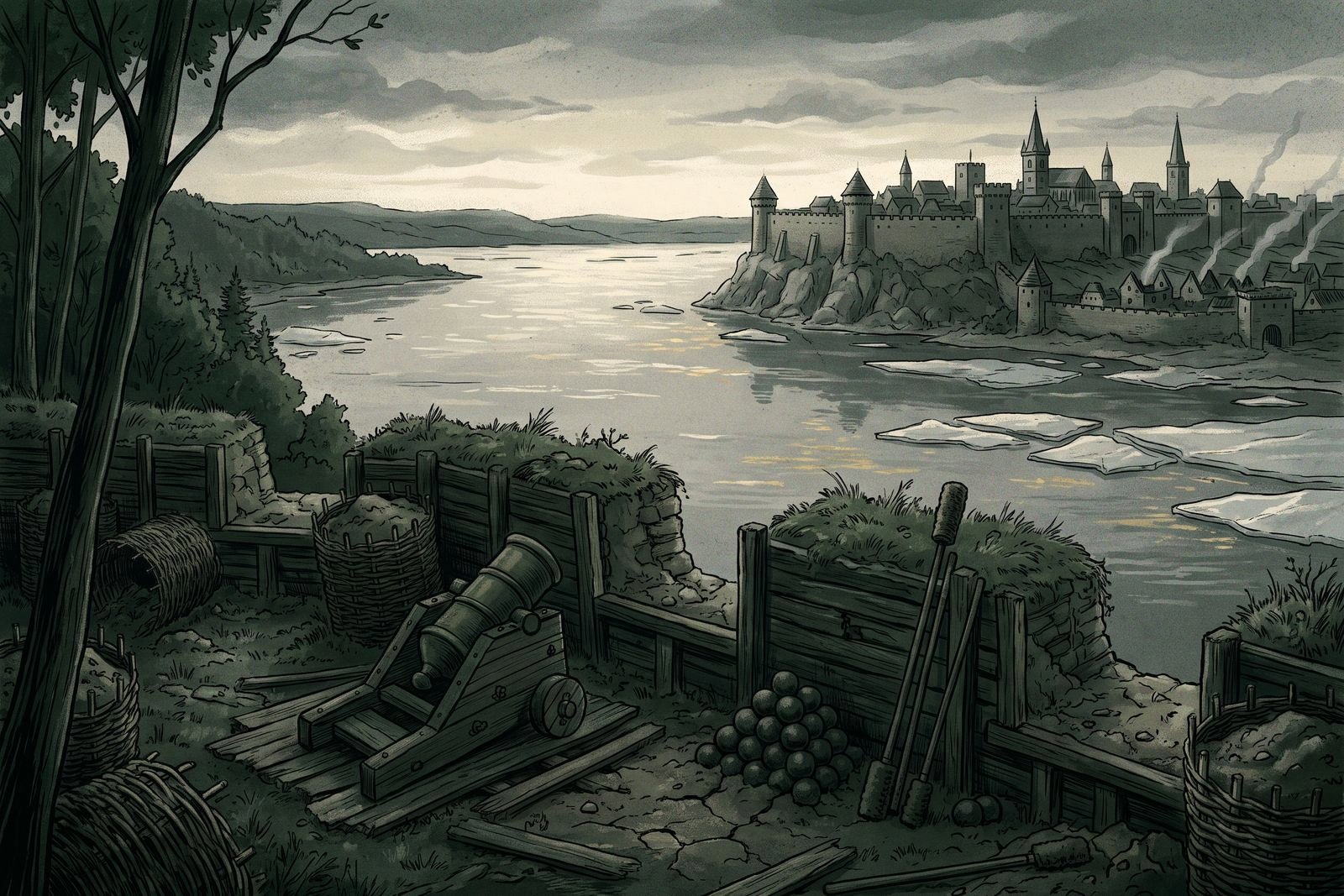
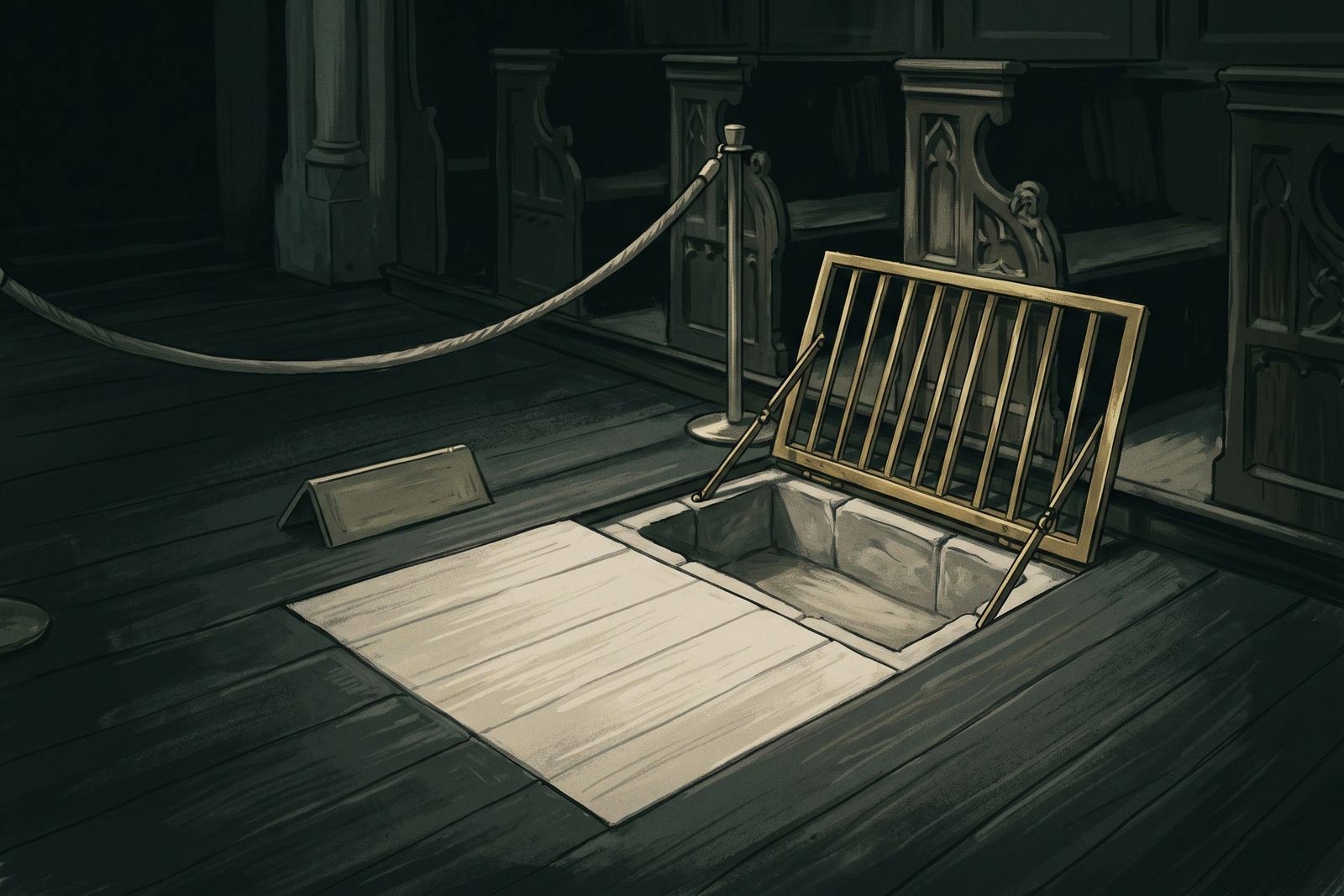
The hole in the floor of the Ursuline chapel at Quebec was opened by a British shell in July 1759 and is about the size of a cradle. The nuns had it squared off and cleared, expecting it to be needed for a grave. On the morning of 13 September, with Wolfe's four thousand eight hundred formed along the ridge and both his flanks resting on the escarpments, the council of war in the town lasted twenty minutes. Vaudreuil wanted Bougainville brought down from Cap-Rouge and the English caught between the ramparts, the Beauport lines and the mobile corps. Montcalm, who held that a colony saved by the calendar was still a colony under sentence, gave way. The regulars stayed behind the walls. At ten o'clock nothing happened at all.
1759–1761The Winter After the Victory
At Charlesbourg on the last day of October, Étienne Charpentier, carter, thirty-one, counts the paper folded in his coat. Four months of hauling powder up from the Palais and flour out along the Beauport road, one sheet signed by the intendant's clerks for every load, and by the figures on those sheets he is owed more than his farm and his oxen together. His curé will take salt against a debt, or powder, or a bolt of cloth. Nobody in the parish will take the paper.
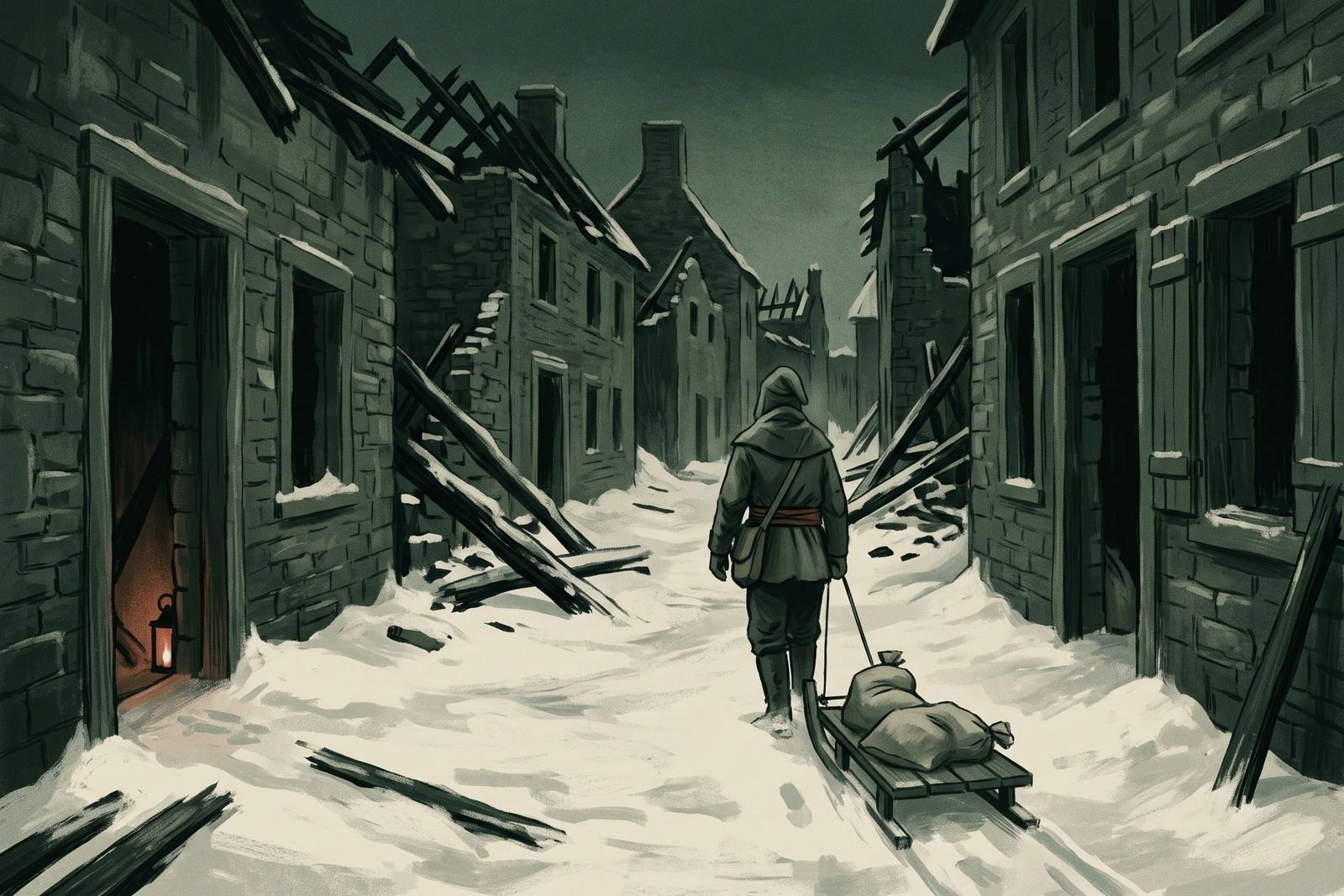
The town Charpentier carts into is standing and wrecked. The Lower Town is roofless the length of the Sault-au-Matelot, Father Recher's church is a shell, and families are coming back from the Jacques-Cartier to camp in their own cellars before the freeze. Then the winter does what twenty-nine guns could not. Beaupré and the south shore below Lévy were burned in August and have neither seed nor cattle; the harvest was gathered late by militiamen furloughed parish by parish; the garrison, the refugees and the prisoners all eat from the same thin larder. Roughly three thousand die of hunger and of typhus in the government of Quebec before May. The colony that won the siege is smaller in the spring than it was in September.
In London the general who did not die is a nuisance. Wolfe comes home sick and unbeaten and empty-handed, and spends the winter before committees and in print explaining that the place can be had next year for the cost of one fleet and one siege train.
He is very nearly right. The likeliest end of this whole story is a British fleet in the basin in May 1760, a proper battering train ashore, and Quebec taken a year late by a power that could afford to lose a campaign. Two things stop it. The first is that with the capital standing, the western nations and the Iroquois councils who had begun to treat with Johnson's people after Niagara never finish crossing over; they give assurances to both sides and wait on the spring convoy of powder and cloth. The second is bread. In 1760 only two columns converge on Montreal instead of three, because there is no British Quebec for Murray to march out of. Haviland takes Île aux Noix in August. Amherst comes down from Oswego with ten thousand men and is worked the whole length of the upper river by Lévis' partisans and by Onondaga and Seneca parties, reaches the Montreal islands on 20 September, cannot close before the corn is in, and falls back to Oswego in October for want of flour. The Richelieu burns. The côtes above Montreal burn. Bigot's ordonnances pass a hundred million livres.
June 1761 brings the fleet up as the pilots always said it would. The Lower Town is burned a second time, five thousand men land at Beauport, and Lévis holds the Buttes-à-Neveu behind a winter's worth of new earth until dysentery in the British camps and the September freeze settle it. Wolfe, who commanded that return, dies of his own disease two years later at thirty-six, remembered as the man who climbed the cliff and was given nothing by it.
On 15 August 1761 Spain signs the Family Compact, on its own date and for its own reasons, because British victory in the Indies and in Bengal looks total and Spanish America looks next. That signature is what saves Canada. In 1762 the regulars and the siege guns that were to have finished the St Lawrence take Martinique, then Havana, then Manila. North America becomes a sideshow for the second time in three years, and the men who will write the peace sit down to count sugar.
1762–1774Five Sous in the Livre
Bougainville is thirty-three, a colonel with the cross of Saint-Louis, and he is back in the same antechambers at Versailles where he had laid four memorials in February 1759 and been told the aid could not be sent. This time he is heard, because Choiseul has discovered that Canada is a thing France possesses.
The peace of 1763 trades what is actually in hand. Britain holds Havana, Manila, Martinique, Guadeloupe, Belle-Île, Gorée, Bengal, Louisbourg, Niagara, Oswego and Ticonderoga; France holds Quebec, Montreal, the upper posts, the Illinois and Louisiana. Bute, with a debt near a hundred and twenty-two millions, cannot lay Canada before the Commons and will not put a fourth Canadian campaign to a vote. So the old debate about the snow and the sugar islands is settled by possession rather than by argument: Britain would have had to buy Canada with Guadeloupe, Havana and Bengal at once, and does not. France returns Minorca, razes Dunkirk, concedes Bengal, gives up Île Royale with Louisbourg dismantled, confirms Acadia, and sees the fishery cut back to Saint-Pierre and Miquelon. Spain redeems Havana with Florida.
The interior article is the price of the whole. Niagara, Presqu'Île and Le Bœuf are evacuated; the lakes basin and the Ohio are erected as a neutral barrier under joint guarantee, traders licensed by both crowns, no crown fort west of Fort Pitt, the carrying place at Niagara garrisoned by Seneca on a French subsidy. The Ohio line goes to a joint commission that never reports. Because there are no British garrisons in the western posts, there is no rising against them in 1763; the powder and the vermilion arrive instead, and the nations spend the decade selling their neutrality to two crowns at once.
Ignace, a Wendat of Lorette who spent September 1759 in the woods above the Foulon cutting off British water parties, walks into the Congrès de Détroit in 1766 carrying belts for a council that recognises the nations libres as allies rather than subjects, and the French posts as trade houses. He is forty. He will tell his grandsons that the summer the English fleet went back down the river was the last time anybody had to ask him what he thought.
At the caisse window in Quebec in the autumn of 1764, Charpentier hands over four thousand livres of siege paper and receives two hundred in silver, the first coin he has touched since 1757. Five sous in the livre. The state that hanged Louis Mallet and his wife at Quebec in 1736 for counterfeiting card money has just repudiated nine-tenths of its own, and the habitants, the cartage contractors and the militia suppliers eat the loss while island remittances back the new Caisse de Québec at par. Bigot is tried in public, which is cheaper than paying. The merchants and seigneurs who spend that winter demanding audited accounts from Versailles are the seed of an assembly that will meet, thirty years later, without asking.
What Versailles now pays is what it refused in 1759: three thousand regulars in permanent garrison, grain magazines at Trois-Rivières and in the Illinois, a published line in the budget for powder, cloth, brandy and presents, and an arsenal at Quebec that Bougainville founds and runs. The mobile corps of 1759 is regularised as a Canadian legion. The bill lands on the navy, which reaches fifty-five of the line by 1770 where it should have reached sixty-four, and on a treasury sliding towards Terray.
Then the ordinance that makes a nation out of seventy thousand people. The Ordonnance des terres of 1764 opens censives free of cens et rentes for ten years to any Catholic head of family willing to take them in the Richelieu, the Détroit-Maumee corridor, the Wabash, the Illinois bottoms or the Ouachita. Charpentier, forty-two and ruined, takes his two sons and a cart down the lakes in 1766 and is at Kaskaskia by the following spring. Ten thousand Acadians come back between 1764 and 1775. The Jesuits, suppressed across Catholic Europe, arrive as an unlooked-for gift of schoolmasters and open colleges at Quebec, Montreal, Detroit, Kaskaskia and New Orleans. The stock doubles every twenty-six years because there is new arable for every son.
Quebec itself is rebuilt in the 1770s to the intendant's plan, in stone, straight-streeted, with a Bourbon front on the seminary and a parade where a burned quarter stood. The merchants who wanted the Lower Town wharves rebuilt first, and the western trade served before the King's façades, lose that fight in council. Several of them are already sending sons to the Illinois.
1775–1815New England Rises Alone, and the Colony Outlives Its King
Boston in the spring of 1775 has the same customs officers, the same troops in the same barracks and the same debt behind it all, because two extra Canadian campaigns and a permanent American garrison made the Stamp Act and the Townshend duties more necessary rather than less. What has changed is the map. The barrier article of 1763 turned every western grant held by Virginia, Pennsylvania and the Ohio Company into paper, and men who own paper want a Crown between them and a French Illinois. So the middle and southern colonies stay in, and New England rises by itself over trade, customs and quartering.
Vergennes' memoir of 1777 puts it in one line: an independent republic on that coast would be the mortal enemy of the Illinois and of New Orleans within a generation. By the Convention of Versailles, France sells Britain a formal neutrality in exchange for a written guarantee of the barrier. No squadron sails, no Rochambeau, no Yorktown. Saratoga is a local disaster absorbed in a season. The last congress dissolves at Lancaster in 1781.
The cost is forty thousand dead, a military governor in Boston until 1790, and twenty-five thousand irreconcilables scattered to Nova Scotia and the Bahamas. Several thousand more take French oaths of toleration and go to the Missouri, where they are still called les Bostonnais and still buried in their own ground. In 1785 the Act of Union of British America erects a Parliament at Philadelphia, crowned and federal, abandons internal taxation for requisitions, and closes the west at the crest of the Appalachians by treaty. No United States has ever existed.
Then royal France dies and the colony does not. The Revolution runs on its own metropolitan clock of grain and debt, both made worse by the American establishment. Canada, the Illinois and Louisiana refuse the Civil Constitution of the Clergy in 1791. In 1793 the governor, the bishop and the colonial Estates at Quebec proclaim for the captive king and govern as a Regency, the Superior Council at New Orleans adhering; the Republic can send nothing across the ocean, exactly as Versailles could send nothing in 1759.
The Convention of Halifax, 1794, gives them British recognition, Royal Navy protection of the Gulf and the river, and British commercial access, with republican shipping excluded. Pitt prefers a Catholic buffer to garrisoning three hundred thousand Catholics beside a lately pacified New England. Canadiens call the document independence. Englishmen call it a protectorate. The ambiguity is deliberate and is still a live quarrel in provincial legislatures. The price of it is fifty years of dependency, New Orleans wharves built with Liverpool money, and the deep-water fishery lost for a generation.
Bonaparte demands the empire back in 1802 and cannot get a squadron past the blockade to collect it. Haiti is independent in 1804, and its refugees land at New Orleans in tens of thousands, with a memory of what a sugar colony is for. In 1806 the Estates crown a Bourbon prince at Quebec, and the Royaumes-Unis du Canada et de la Louisiane are recognised at Vienna as the branch that refused the usurper. There is no Louisiana Purchase, because there is nobody to sell to and nobody to buy.
1811–1867Two Constitutions, One Crown, and the War of the Two Banks
Thirty miles above New Orleans on a January morning in 1811, five hundred men off the German Coast plantations come down the river road with cane knives and a drum. Some of them were born in Saint-Domingue and can recite the emancipation decree the Convention passed in February 1794, which is nominally law in this kingdom and applied nowhere in it. The rising is larger than anything the delta had seen, and it is put down with a savagery that the parishes of the north hear about in sermons for a decade. Étienne de Boré granulated sugar at New Orleans in 1795; the gin was patented in 1793; the lower river has become a Code Noir economy expanding as fast as it can buy people.
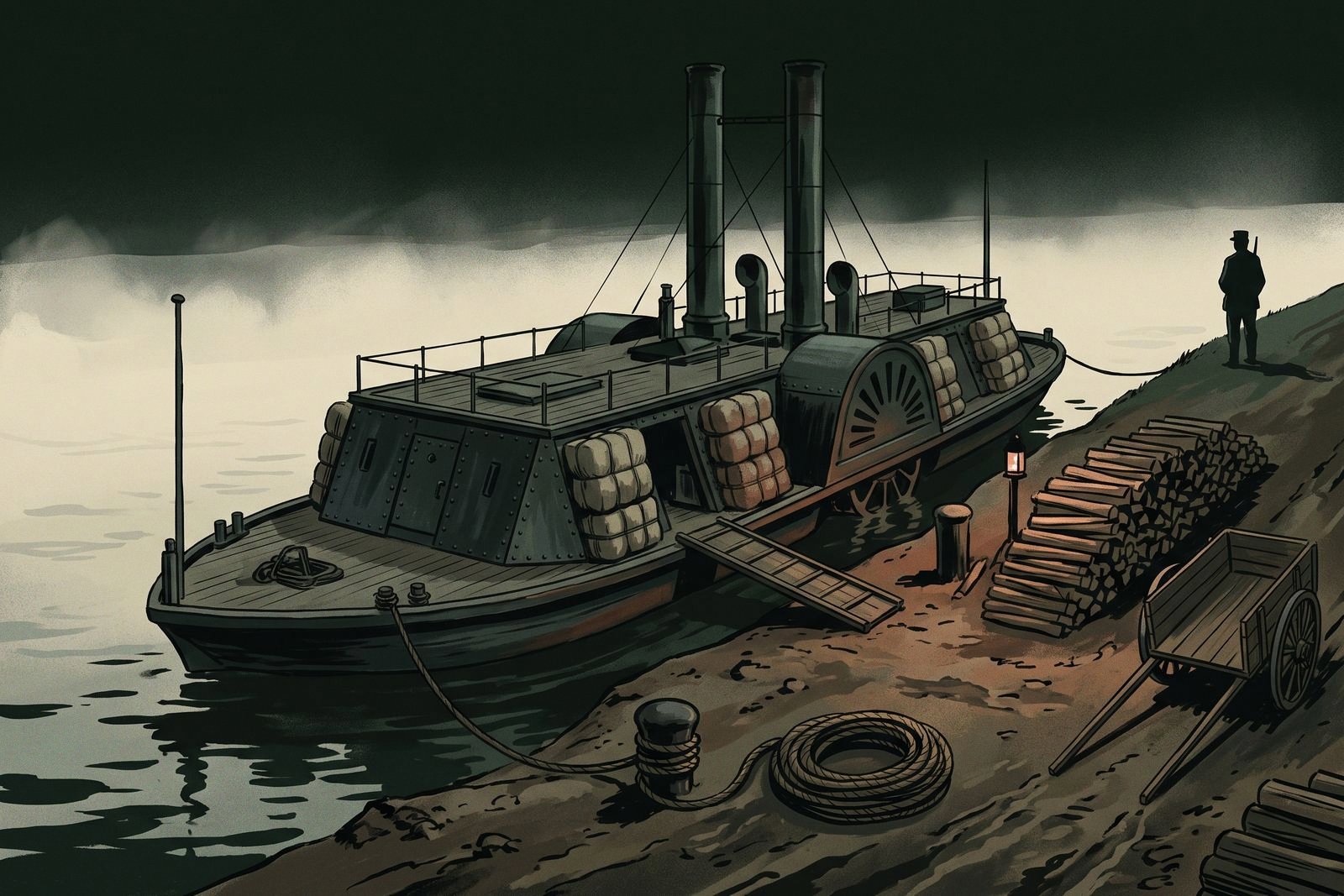
One crown now covers two countries. Laurentie and the Illinois are clerical, small-holding and increasingly abolitionist; the delta is a slave society with a free coloured elite in New Orleans that owns property, sends sons to Paris, and constitutes a third political class nobody has a constitutional theory for.
Between them runs the river, and the river runs through a customs house. Kentucky and the Holston were squatted before 1763, so the south bank of the barrier is Anglo by arithmetic while the Confederation of the Lakes holds the north; every barrel of Kentucky flour still goes to sea past New Orleans, on dues copied from the Danish Sound. The First Toll War of 1819 settles nothing. London caps the tariff in 1842, which is remembered upriver as a rescue and downriver as an amputation.
Britain frees its own slaves in 1833 and leaves the delta as the last great slave economy on the continent; when the Carolina planters revolt against the imperial measure between 1835 and 1841, they are broken by the Royal Navy and by the people they own. Assiniboia comes in as a Métis province in 1851. In 1859 the old council fire is reconstituted as the Chambre des Nations, with a permanent seat and a veto on treaty lands, and a great-grandson of Ignace of Lorette takes the Wendat chair at the age of thirty-one.
The francophone civil war runs from 1857 to 1864 and is fought on water. Gunboats built at Quebec come down; gunboats built at Saint-Louis go up; enslaved people leave the sugar parishes in tens of thousands and enlist where they land, which is what finally decides the legal question. Emancipation is decreed in French in 1862 and completed in 1864, and it is conceded by a delta that has run out of men, under pressure from Catholic abolitionists in Missouri and the Illinois and from the regiments of the freed. A Charpentier is killed at the Arkansas mouth in 1863, a great-grandson of the carter, holding a piece of ground his family had held for eighty years.
The price of reunion is the capital. Quebec keeps the crown, Montreal keeps the banks, and in 1867 the government moves to Saint-Louis-des-Illinois, the city founded by the men who lost the rebuilding fight of the 1770s. The town saved in September 1759 is not the town that inherits.
1846–1912Four Corners, and No Entente
In Cork in 1847 an emigration agent chalks two prices on a board: New Orleans, and Philadelphia. The first is cheaper by a third, because the federation subsidises Catholic passage into the only jurisdiction in North America where a Catholic may own land freely, sit on a bench and school his children in his own church. Some three hundred and fifty thousand Irish and Highland Catholics come in during the famine years, on top of the forty-five thousand of the eighteenth century, and behind them come Alsatians and Bavarians.
They arrive in a country that does not know what to do with them. Parish riots between Irish and Canadiens run through Montreal and the Illinois towns in the 1850s; seigneurial tenure cracks under land hunger and is bought out province by province; an unassimilated Protestant population in Missouri votes against the federation for three generations. The School Law of 1901, which puts anglophone Catholic parishes in Montreal, Chicago-sur-l'Illinois and Saint-Louis into French schools, is remembered as what it was, which is coercion, and it works.
There is no Mexican War, because there is no republic to fight one. Britain takes Alta California from a collapsing Mexico in 1847, so the rush of 1849 is a British rush and the Pacific squadrons are the Royal Navy's; Russian America is sold to London in 1867. Anglo-American expansive pressure runs south instead, into the Floridas, the Gulf and Texas. By 1900 the board has four corners in America and two in Europe: the Union of British America with sixty-five million, penned east of the crest and industrialising early because it must; the Franco-American federation with eighteen million, feeding Europe with wheat and beef and selling cotton to Lancashire; Germany; Britain; Russia.
France herself is a middling power with a rich cousin overseas, which is a humiliation nobody in Paris will name aloud. When Fashoda comes in 1898, Paris climbs down and the press blames Quebec's indifference. Britain, having no need of a continental friend, signs the Anglo-German Naval and Colonial Convention of 1912. The Entente Cordiale is never drafted.
1914–1962The Wars Bend, and the Language Crosses the Ocean
The wheat brokers in the Saint-Louis exchange have a good August in 1914 and a better September. Sarajevo happens on schedule; the alliance web does not. Germany and Austria fight France and Russia with Britain neutral under the 1912 convention for two years, and the federation sells grain, cotton and nitrates to every buyer with credit. Paris is entered in 1916. Britain comes in over the Low Countries in 1917. The war stops in 1919 in exhaustion, with a Mitteleuropa from the Rhine to the Vistula, no reparations and no treaty of Versailles.
There is no Third Reich in this century, and there is no Shoah. That absence is worth stating plainly and worth stating alone, because nothing in this chronicle earned it and nothing about it was a reward. Antisemitism keeps its full strength elsewhere. It is written into residence and university laws across Mitteleuropa, and the Russian civil war of 1918 to 1922 kills Jews in pogroms by the tens of thousands. The physicists who reach Montreal in the 1930s reach it because Catholic universities in a French-speaking America would give them chairs and Vienna and Warsaw would not.
The humiliation of 1919 is metropolitan and French, and the capital of the language crosses the water: the Académie moves its seat to Montreal in 1923, and French survives as a world tongue on American money. The Depression arrives and is milder here, because a granary with a customs union is a slow thing to break. Russia is Bolshevik from 1919 on its own clock, and the great war of the century is Mitteleuropa against Russia from 1939 to 1947, financed by London and manned by neither America.
Japan's war begins in 1937 and is fought against British Malaya, British California and the Gulf oil convoys. It ends on 6 August 1946, when a bomb built from Great Bear uranium and Arvida heavy water by an Anglo-Canadien project destroys Yokohama and something over eighty thousand people in it. The men who made it were largely refugees; the city was chosen for its port. In Montreal, four of the physicists sign a letter asking that the second device not be used, and it is not, and the surrender comes anyway, and the letter is on the wall of the university museum where schoolchildren read it and do not entirely believe the dates. Four capitals hold nuclear weapons by 1953, which is one reason the world never divides cleanly in two, and one reason decolonisation comes late and hard: India in 1952, Africa well into the 1970s.
Then the Church empties. After 1962 the parishes go in a decade, faster than anyone predicted, and a state that had defined itself by the faith since Pontbriand redefines itself in ten years by language law, by hydro dams and by the piastre.
1962–2026What the Money Says
James Bay is nationalised in 1971 and the piastre floats the same year. In Saint-Louis this January the argument in the chamber is toll indexation on the seaway and the river, which is the argument of 1819 with a spreadsheet, tangled now with a Chambre des Nations veto on hydro royalties from the upper Saskatchewan. The nations who promised both sides nothing in October 1759 kept the seat they bought with that silence, and they use it.
Ninety million people live from the Saguenay to the Gulf and out to the Rockies, sixty-odd million of them in French. East of the crest lie a hundred and thirty million under the Philadelphia crown, from Nova Scotia to Florida to California. You land at New Orleans and the customs signage reads French, Spanish, English, in that order. In the Missouri and Kentucky phone directories the names run Beaubien, Chouteau, Charpentier over households that have spoken nothing but English for four generations, the School Law of 1901 read backwards. The piastre is a reserve currency, and the fifty carries the Convention of Halifax on its reverse, a document two centuries of schoolchildren have been taught to read as independence or as a protectorate depending on which province examined them.
Montcalm was right about the arithmetic. A colony saved by the calendar was saved for one winter, and it cost three thousand dead of hunger before the next May. Vaudreuil was right about the method: watch them, harass them, starve them, and let the pilots and the ice do the rest. Everything since is the working out of both men being right.
In the Ursuline chapel at Quebec the guide stops at a rectangle of paler board set into the floor and lifts the brass grille over it. Underneath is the crater the shell made in July 1759, cleaned, dry, lined with stone, empty. The old general limped past it to Mass for another eleven years, and was buried at last under the choir with a plaque a metre away. Visitors photograph the hole instead. It is the only grave in North America that is famous for having nobody in it.
1759Montcalm refuses the battle on the Plains and keeps his walls
At sunrise Wolfe stands with 4,800 men on the ridge, flanks on the escarpments. Montcalm's council of war meets in haste; Vaudreuil's argument prevails — Bougainville is to be brought down from Cap-Rouge and the British caught between the town, the Beauport lines and the mobile corps. The regulars stay behind the ramparts, the militia in the entrenchments. No attack is made at ten o'clock. Wolfe, with no siege train ashore and one goat path for a supply line, waits.
5 SOURCED CAUSES
1759Bougainville closes from Cap-Rouge; the siege becomes a mutual blockade
Bougainville's corps — reckoned by the French returns at something over two thousand, by others at three — comes down the Sainte-Foy road and posts itself across the British rear at the Ancienne-Lorette. Wolfe turns his line about, entrenches on the ridge facing both ways, and hauls two light guns up the Foulon. Vaudreuil holds the Beauport shore and does not abandon it. The British army now stands between two forces on a plateau it must feed by rope and pack-horse.
4 SOURCED CAUSES
1759The bombardment resumes; the town is wrecked further but not stormed
The Pointe-Lévy batteries, grown from eleven pieces to twenty-nine, reopen on the Upper and Lower Town. What is left of the Lower Town burns in patches; the Ursulines and the Hôtel-Dieu move their wounded into the vaults. Townshend and Monckton advise against escalade: the walls are weak but the ditch is covered, the army is under 5,000 effective, and the heavy artillery is still in the ships. Ramezay counts flour in the King's stores by the barrel.
4 SOURCED CAUSES
1759Petite guerre on the plateau: the British camp is bled and sickened
Canadian militia parties and allied warriors from Lorette and the western posts work the woods between the Foulon and Sainte-Foy, cutting off water and wood parties nightly; British returns show more men lost to skirmish, desertion and camp fever than any action has cost. Wolfe himself is ill and directs from a farmhouse. The Royal Navy's boats keep the army fed, but every barrel must be carried up the cliff path taken on the night of 12 September.
4 SOURCED CAUSES
1759Vaudreuil furloughs the militia by parish to get the harvest in
The governor general, over Montcalm's objection, releases militia battalions in rotation to the côtes of Beauport, Charlesbourg and the island of Orléans, and up the river to Batiscan and Trois-Rivières. The same men are the reapers; the winter ration of a quarter-pound of bread and half a pound of horse meat is still the standard of memory. Much of the Côte-de-Beaupré has already been burned by British detachments in August, and those parishes have nothing to reap.
5 SOURCED CAUSES
1759Council of war aboard the Sutherland: the masters give the fleet until mid-October
Saunders assembles his captains and the river pilots. Their opinion is unchanged from June: a fleet of that draught cannot winter in the basin, and the ships that forced the passage above the town on 18 July and 27 August must come down before the ice. Wolfe proposes leaving a garrison in a fortified camp at the Foulon; the admiral will not undertake to victual it, and the generals will not hold a post that the first thaw would find starved. Re-embarkation is resolved on.
4 SOURCED CAUSES
1759The British burn the shores and re-embark at the Anse au Foulon
Detachments fire the farms and mills of the south shore below Pointe-Lévy and of the Beaupré côte, carrying off cattle and grain, to leave the colony nothing for the spring. The army descends the Foulon path it climbed in the dark a month earlier, the batteries at Lévy are dismantled, and Saunders drops down past the Île d'Orléans and the Île aux Coudres. A Te Deum is sung in the Récollets' church because Father Recher's parish church is ashes.
5 SOURCED CAUSES
1759Bigot pays for the campaign that did not end, in paper
The intendant issues ordonnances against the cartage, requisitioned grain, entrenching labour and hospital charges of four months' siege, and against the wheat now bought up from the untouched parishes above Trois-Rivières. There has been no specie payment since 1757; coin is hoarded, prices in ordonnances rise week by week, and habitants ask for salt, powder or nothing. The victory is billed to an instrument already carrying tens of millions of livres and no metal behind it.
5 SOURCED CAUSES
1759The nations of the pays d'en haut and the Iroquois councils hedge
Word that the fleet has gone down the river without the town reaches Montreal, the Ottawa route and Onondaga before the freeze. Niagara having fallen in July, western and Iroquois speakers who had begun to treat with Johnson's people give assurances to both sides and commit to neither, waiting on the spring convoy of powder, cloth, vermilion and brandy. French officers at Michilimackinac and the Illinois are told to promise presents they have not got.
4 SOURCED CAUSES
1759Amherst falls back from Lake Champlain to Crown Point for the winter
Having taken Ticonderoga in July and Crown Point in August, Amherst had gone out onto the lake in the second week of October. Learning that Quebec stands and that Saunders is coming down the river, and with Bourlamaque's small squadron and the season against him, he returns to Crown Point on the 21st and puts his army into winter quarters. The northern campaign of 1759 ends with the British holding the corridor and neither capital of the colony.
3 SOURCED CAUSES
1759The last ships carry the colony's demands to Versailles
Vaudreuil, Montcalm, Bigot and Bishop Pontbriand write by the vessels dropping down behind the British: the place has held, the country is eaten, and nothing can be answered for beyond June without a convoy of flour, a squadron at the mouth of the river, and recruits. It is the same request Bougainville carried in four memorials to court and that the ministry declared in February 1759 it could not meet, and that produced some three hundred men and twenty supply ships in May.
5 SOURCED CAUSES
1759Famine, then two failed British campaigns, then the war leaves North America
Winter 1759-60 kills roughly 3,000 of hunger and typhus in the Quebec government, worst in the burned parishes of Beaupre and the south shore: the colony that won the siege is smaller in May than in September. In 1760 only two British columns converge on Montreal, not three, because there is no British Quebec for Murray to march from. Haviland takes Ile aux Noix in August; Amherst descends from Oswego with 10,000 and is harassed the length of the upper river by Levis' partisans and by Onondaga and Seneca parties who never completed their defection because the capital stood. He reaches the Montreal islands on 20 September, cannot close before the corn is in, and withdraws to Oswego in October for want of bread. The Richelieu and the Montreal cotes burn; Bigot's ordonnances pass 100 million livres. In June 1761 the fleet comes up as the pilots always said it would, burns the Lower Town a second time and lands 5,000 at Beauport; Levis holds the Buttes-a-Neveu behind a winter's repairs and dysentery and the September freeze end it. The Family Compact is signed on its historical date, 15 August 1761, for its historical motive, and in 1762 the regulars and siege train that historically took Montreal take Martinique, Havana and Manila instead. Britain's campaigning capacity is finite: North America becomes a sideshow for the second time.
6 SOURCED CAUSES
1763Peace of Paris: Choiseul keeps the snow and loses the ocean; the interior becomes a neutral barrier
The Seven Years War ends on time — the divergence touches one theatre, not Europe's balance — but the chips traded are what is actually in hand. Britain holds Havana, Manila, Martinique, Guadeloupe, Belle-Ile, Goree, Bengal, Louisbourg (taken 1758, before the divergence), Niagara, Oswego and Ticonderoga; France holds Minorca, Quebec, Montreal, the upper posts, the Illinois and Louisiana. Bute, with a debt near 122 millions, cannot present Canada and will not vote a fourth Canadian campaign. France returns Minorca, razes Dunkirk, concedes Bengal, cedes Ile Royale with Louisbourg razed, confirms Acadia and accepts the fishery cut to Saint-Pierre and Miquelon; she recovers Guadeloupe, Martinique and Goree, which also quiets the Jamaican planters. Spain redeems Havana with Florida. The interior article is the price of peace: Niagara, Presqu'Ile and Le Boeuf evacuated, the lakes basin and the Ohio erected as a neutral Indian barrier under joint guarantee, traders licensed by both crowns, no crown fort west of Fort Pitt, the Niagara carrying place garrisoned by Seneca under French subsidy. The Ohio boundary goes to a joint commission that never reports — the fuse of the next eighty years.
4 SOURCED CAUSES
1763Choiseul's systeme d'Amerique, the demonetisation of the ordonnances, and a land ordinance that turns 70,000 into a nation
Versailles now pays what it refused in February 1759: 3,000 regulars in permanent garrison, an arsenal at Quebec, grain magazines at Trois-Rivieres and the Illinois, and a published budget line for powder, cloth, brandy and vermilion to the western nations. The cost is stated: the battle fleet reaches 55 rather than 64 of the line by 1770, and the establishment becomes a permanent charge on a treasury sliding toward Terray's bankruptcy. The ordonnances are liquidated at five sous in the livre — in an economy with no specie since 1757 that is demonetisation, not a haircut — paired with a specie-backed Caisse de Quebec funded from island remittances; habitants, militia suppliers and cartage contractors eat the loss, Bigot is tried publicly, and the colonial merchants and seigneurs who demand audited accounts from Versailles are the seed of the Estates of 1793. The Ordonnance des terres of 1764 opens censives free of cens et rentes for ten years to any Catholic head of family in the Richelieu, the Detroit-Maumee corridor, the Wabash, the Illinois bottoms and the Ouachita. Ten thousand Acadians are repatriated 1764-75; the Jesuits suppressed across Catholic Europe 1759-73 arrive as a free windfall of teachers, founding colleges at Quebec, Montreal, Detroit, Kaskaskia and New Orleans. Congres de Detroit, 1766: the nations libres are recognised as allied polities, French posts as trade houses. Natural increase doubles the stock every 26-27 years because new arable opens each generation: 150,000 by 1785, 300,000 by 1810.
7 SOURCED CAUSES
1775New England rises alone; France sells Britain neutrality for the barrier line
The American crisis is neither averted nor reproduced. British debt, worsened by two extra Canadian campaigns and a permanent garrison, still produces the Stamp Act and the Townshend duties; but the barrier article of 1763 makes Virginia's and the Ohio Company's western grants worthless, so the middle and southern land interest now needs the Crown against a French Illinois. New England rises alone in 1775 over trade, customs and troops. Vergennes' memoir of 1777 argues that an independent Anglo-American republic would be the mortal enemy of Illinois and New Orleans; by the Convention of Versailles France sells Britain formal neutrality for a written guarantee of the barrier. No Rochambeau, no de Grasse, no Yorktown; Saratoga is a local disaster absorbed; the last congress dissolves at Lancaster in 1781. Costs: 40,000 dead, Boston under a military governor to 1790, 25,000 irreconcilables scattered to Nova Scotia and the Bahamas — and several thousand to Missouri under French oaths of toleration, les Bostonnais du Missouri. The Act of Union of British America (1785) erects a crowned federal Parliament at Philadelphia, internal taxation abandoned for requisitions, the west closed at the Appalachian crest by treaty. No United States has ever existed.
3 SOURCED CAUSES
1789French America outlives royal France: the Regency at Quebec and the Convention of Halifax
The Revolution runs on its metropolitan clock of debt and grain, both worsened by the American establishment. In 1791 Canada, the Illinois and Louisiana refuse the Civil Constitution of the Clergy; in 1793 the governor, the bishop and the colonial Estates at Quebec proclaim for the captive king and govern as a Regency, with the Superior Council at New Orleans adhering. The Republic can send nothing, exactly as Versailles sent nothing in 1759. The Convention of Halifax (1794) gives British recognition, Royal Navy protection of the Gulf and the St Lawrence and British commercial access, republican ships excluded: Canadiens call it independence, Britons a protectorate, and the ambiguity is still a live quarrel. Pitt prefers a Catholic buffer to garrisoning 300,000 Catholics beside a lately pacified New England; the price is fifty years of dependency, New Orleans built with Liverpool money and the deep-water fishery lost for a generation. Bonaparte demands the empire back in 1802 and cannot pass the Royal Navy; Haiti is independent in 1804 and its refugees land at New Orleans in tens of thousands. The Estates crown a Bourbon prince at Quebec in 1806 — the Royaumes-Unis du Canada et de la Louisiane. Vienna legitimates the American Bourbons for having refused Bonaparte. There is no Louisiana Purchase and no Monroe Doctrine.
4 SOURCED CAUSES
1811Two constitutions under one crown: the Guerre des Deux Rives and the capital moved to Saint-Louis
Bore granulates sugar at New Orleans in 1795 and the gin is patented in 1793, so the lower river becomes a Code Noir slave economy expanding hard while the Convention's emancipation decree of February 1794 is nominally law and the Regency applies it nowhere. The German Coast rising of 1811, led by Saint-Domingue arrivals with a legal emancipation eight years in memory, is larger and bloodier than in our world. One crown, two constitutions: a clerical-abolitionist Laurentie and Illinois against a slaveholding delta, with the free coloured elite of New Orleans as a third political class. Meanwhile the barrier's south bank cannot be held — Kentucky and the Holston were squatted before 1763 — so Anglo farmers hold it by arithmetic while the Confederation of the Lakes holds the north bank, and every barrel of Kentucky flour goes out through the New Orleans customs house on Danish Sound dues: First Toll War 1819, tolls capped at London 1842. British imperial emancipation in 1833 leaves the delta the last great slave economy in North America; the Carolina planters revolt 1835-41 and are put down by the Royal Navy and by the enslaved. Then the francophone civil war, the Guerre des Deux Rives, 1857-64: river gunboats built at Quebec and Saint-Louis, slave flight, Missouri and Illinois Catholic abolitionists, emancipation decreed in French in 1862 and completed in 1864. The council fire becomes the Chambre des Nations in 1859; Assiniboia enters as a Metis province in 1851. The price of reunion is the capital: Saint-Louis-des-Illinois, 1867. The town saved in September 1759 is not the town that inherits.
4 SOURCED CAUSES
1846A four-cornered great-power board and no Entente Cordiale
There is no Mexican War: Britain takes Alta California from a collapsing Mexico in 1847, the 1849 gold rush is a British rush, Russian America is sold to London in 1867, and no American squadron ever enters the Pacific. Anglo-American expansive pressure runs south into the Floridas, the Gulf and Texas. By 1900 the industrial giants are the Union of British America (crowned, federal, 65 million, penned east of the crest and therefore industrialising early), the Franco-American federation (18 million, the world's granary and a cotton exporter), Germany, Britain and Russia. Immigration reshapes the federation: Irish and Highland Catholics diverted to the only jurisdiction in North America where a Catholic may own land and sit on a bench — 45,000 by 1800, some 350,000 in the famine years — plus Alsatians and Bavarians, and 60,000 Metis by 1840. Costs are paid onstage: an unassimilated anglo-Protestant Missouri, Irish-Canadien parish riots in the 1850s, a land crisis from seigneurial tenure, and the School Law of 1901 francising anglophone Catholic parishes in Montreal, Chicago-sur-l'Illinois and Saint-Louis, remembered ever after as coercion. In Europe, France is a middling power with a rich cousin overseas; Fashoda ends in a climbdown Paris blames on Quebec's indifference; and Britain, needing no continental friend, signs the Anglo-German Naval and Colonial Convention of 1912. The Entente Cordiale is averted.
3 SOURCED CAUSES
1914The wars bend: no Versailles, no Hitler, a Montreal bomb, and the Academie moves to America
Sarajevo happens; the alliance web does not. Germany and Austria fight France and Russia with Britain neutral for two years under the 1912 convention, while the Franco-American federation sells wheat, cotton and nitrates to both sides. Paris is entered in 1916; Britain comes in over the Low Countries in 1917; the war stops in 1919 in exhausted compromise — a Mitteleuropa from the Rhine to the Vistula, no reparations, no stab-in-the-back, and therefore no Hitler. Russia revolts on its own clock and is Bolshevik by 1919. The humiliation is metropolitan French, so the capital of the French-speaking world crosses the ocean: the Academie's seat moves to Montreal in 1923 and French survives as a world language on American money. The Depression arrives, milder. The century's great war is Mitteleuropa against Bolshevik Russia, 1939-47, financed but not manned by Britain; Japan's war from 1937 is against British Malaya, British California and the Gulf oil convoys, and ends in 1946 when an Anglo-Canadien project — Great Bear uranium, Arvida heavy water, refugee physicists the Catholic universities of Montreal took in when Europe would not keep them — destroys Yokohama. Four nuclear capitals by 1953, no bipolar Cold War, decolonisation late and bloody: India 1952, Africa into the 1970s. After 1962 the Church empties in a decade and the state defines itself by language law and hydro; James Bay is nationalised; the piastre floats in 1971.
3 SOURCED CAUSES
Every one of these worlds was weighed against the one you have just read. Here is where each of them breaks.
Charles III of Spain signs the Family Compact in the autumn of 1760, a year early and because Quebec has held, and the Spanish threat pulls Amherst's army away from the St Lawrence before it can close on Montreal.
We weighed it as the neatest way to save Montreal, and it runs backwards. Madrid moved in August 1761 precisely because British victory looked total and Spanish America looked like the next item; a Britain visibly checked on the St Lawrence gives Charles III less reason to hurry, not more. The road also fails on the ground it is meant to cover: the 1760 convergence on Montreal needed no fleet and no siege train, only three columns arriving together, so a diversion in the Caribbean does not stop it. We took the military route instead. There is no British Quebec, so one column never exists, and Amherst's descent from Oswego breaks on Iroquois hedging and a bread shortage; Spain enters on its true date of 15 August 1761 and absorbs the regulars and the siege train into Martinique, Havana and Manila.
The British fleet returns to the basin in May 1760, and Quebec and Montreal fall a year later than they did, with the Treaty of Paris signed on schedule and New France gone all the same.
This is the honest default, and we said as much on the page: the likeliest thing after a failed siege is a second siege that works. Two changes in 1759 and 1760 are what hold it off, and both are specific. With the capital standing, the western nations and the Six Nations never complete the defection they began after Niagara, so Amherst's march down the upper river becomes a campaign rather than a procession and he falls back to Oswego for want of bread in September 1760. And Lévis had shown at Sainte-Foy that a French field army could beat a British one outside the walls. We kept the pressure rather than the outcome: the fleet does come up in June 1761, burns the Lower Town and lands 5,000 men at Beauport, and Lévis holds the Buttes-à-Neveu until dysentery and the freeze end the attempt.
Choiseul, offered the choice at the peace table, hands Canada to Britain anyway in exchange for the sugar islands, treating the St Lawrence as a few acres of snow well sold.
We weighed it because it is what a great many people in Paris genuinely wanted in 1762. It breaks on possession. Having failed to take Quebec, Britain cannot demand Canada as a cession; it would have to buy the colony back with Guadeloupe, Martinique, Havana, Minorca and Bengal in one transaction, and no ministry facing a debt near 122 millions presents that bargain to the Commons. Choiseul's stated doctrine was to keep Britain's American subjects nervous, and possession makes that the cheap option rather than the expensive one. The price is real and we wrote it in: Île Royale goes with Louisbourg razed, the fishery is cut back to Saint-Pierre and Miquelon, and Bengal is conceded.
Versailles holds the Ohio country and the lakes after 1763 the way a European power holds a frontier, with royal garrisons in stone forts and French farmers settled behind them.
We weighed it and the treasury refuses it in the 1760s, before the first fort is finished. Garrisons are paid in specie, and the colony has seen no metal payment since 1757, with a paper issue past eighty million livres liquidated at five sous in the livre in 1764. Settlement is no better placed: France sent roughly ten thousand people to North America in a hundred and fifty years, and Quebec holding changes none of the reasons. So the interior is held by the confederacies as principals, with France as broker and arms supplier, which is the arrangement that actually worked in the field. What survives of the original road is the barrier itself, guaranteed by both crowns, with no royal fort west of Fort Pitt and the Niagara carrying place garrisoned by Seneca on French subsidy.
New France survives only as the St Lawrence valley, and the lakes, the Ohio, the Illinois and the Mississippi fill up with English-speaking farmers by sheer weight of numbers.
We weighed this one seriously and set it aside as too small a world, which is an editorial choice and we own it. It was defensible in its texture and wrong in its mechanics: the arithmetic that lost the west in our own history followed from the cession of 1763, which this world never writes, and in 1759 the interior held almost no settlers of either nation to do the counting with. A francophone remnant of twelve million on the Ottawa beside an Anglo union of four hundred million is a shorter distance from the world outside the window than the one we owed here. We kept the arithmetic where it genuinely bites: Kentucky and the Holston were squatted before 1763 and the south bank goes to Anglo farmers, and the Missouri uplands stay English-speaking and Protestant for two centuries.
The thirteen colonies rebel on schedule, France signs the alliance of 1778, and the United States is born at the peace of 1783 much as it was.
We weighed it and it fails twice, once on French interest and once on distance travelled. Vergennes in 1777 is being asked to midwife the one power that would be the mortal enemy of the Illinois and New Orleans within a generation, and he says so in this world. It also reproduces our own 1783 map with a footnote attached, which is a smaller result than this chain of events can carry. The inversion is at least as defensible and it pays: France sells Britain formal neutrality by the Convention of Versailles in exchange for a written guarantee of the barrier line. New England rises alone, Saratoga is absorbed as a local misfortune, and the last congress dissolves at Lancaster in 1781.
The quarrel between Britain and her colonies never comes to blows at all, defused by a requisition compromise negotiated in 1778 that replaces parliamentary taxation with voluntary colonial grants.
We weighed it and the barrier itself destroys it in the 1760s. A French Ohio obliges Britain to keep a standing army in America, a standing army obliges the revenue acts, and the same barrier makes the western grants of Virginia and the Ohio Company worthless overnight. Conciliation on those terms also delivers one undivided English-speaking continental state, which is the map walking quietly home. So the rising happens, is regional, and loses over six years. The compromise survives on the far side of defeat: the Act of Union of British America in 1785 erects a crowned federal Parliament at Philadelphia, abandons internal taxation for requisitions, and closes the west at the Appalachian crest by treaty.
The Regency at Quebec accepts a straightforward British protectorate at Halifax in 1794, disarms its forces, and passes the century as a sheltered dependency.
We weighed it and it quietly hands the continent back to the English-speaking bloc by 1800, which makes the preceding thirty-five years decorative. A state of three hundred thousand with an arsenal at Quebec, a standing legion, the Mississippi outlet and a functioning alliance system does not want shelter; what it wants is a buyer for its wheat and its furs. Pitt's own calculation points the same way, since a Catholic buffer costs less than garrisoning three hundred thousand Catholics beside a lately pacified New England. We kept Halifax as recognition, naval protection of the Gulf and the St Lawrence, and commercial access, with the sovereignty left deliberately unclear and still argued over. The price is written in: fifty years of dependency, a New Orleans levee front built with Liverpool money, and the deep-water fishery lost for a generation.
The French-speaking world in America stays one tidy state from the Gulf of St Lawrence to the Gulf of Mexico, governed from a single capital and never divided against itself.
We weighed it and it is the less divergent road, not the more. Étienne de Boré granulates sugar at New Orleans in 1795 and the saw gin is patented in 1793; from that decade the lower river is a Code Noir economy buying people as fast as its credit allows, while the Convention's emancipation decree of 1794 sits on the statute book and is applied nowhere. Three thousand river miles and two labour systems split a francophone continent exactly as they split the anglophone one, and the German Coast rising of 1811 is where the crown's authority stops being one thing. So the split is written in, and the Guerre des Deux Rives of 1857 to 1864 settles it, with emancipation proclaimed in French in 1862 and completed in 1864 without compensation and without land. The cost of putting the country back together is the capital: the government moves to Saint-Louis-des-Illinois in 1867.
France wins the American war outright, retakes Louisbourg, and drives the British colonies back behind the Appalachian crest.
We weighed it and it needs a second miracle on top of the first. Montcalm declining a battle on 13 September does not undo the 320 sail and 49 warships that carried Wolfe up the river in June, and it does not touch Lagos or Quiberon Bay, both fought in 1759 and both lost. Sea power is what returns in 1761 to burn the Lower Town, and sea power is what France cannot answer in that decade or the next. The premise buys survival and never initiative, and every road here has to be built on France holding rather than France advancing. The rollback happens later and by other means, through a treaty barrier and a demographic engine, which takes eighty years instead of four.
Versailles finally solves the numbers by shipping settlers across the Atlantic in bulk after 1763, closing the gap with the British colonies by emigration from the metropole.
We weighed it and it is convenience wearing the clothes of cause. Nothing about Quebec holding alters why French people did not leave France: there was no directed Catholic exodus after 1685, metropolitan wages compared well against the risk of the passage, and peasant tenure held families on the land. The road breaks in the 1760s, at the first year in which the recruiting offices are supposed to fill and do not. What we used instead is natural increase on land that opens every generation, doubling the stock roughly every twenty-six years from seventy thousand in 1754 to a hundred and fifty thousand by 1785, helped by ten thousand Acadians returning between 1764 and 1775. The rest comes from a channel Britain's own Test Acts hand France for nothing: the only jurisdiction in North America where a Catholic may own land freely, which draws forty-five thousand Irish and Highland Catholics by 1800 and some three hundred and fifty thousand in the famine years.
Everything before the hinge rests on these readings. Under each title, the passage retained.
- Battle of the Plains of Abraham | The Canadian Encyclopedia
A British invasion force led by General James Wolfe defeated French troops under the Marquis de Montcalm
- The Battles - 1759-1760 – Plains of Abraham
After a long siege lasting over two months, the battle proved decisive
- Siege of Quebec: 26 June-13 Sept 1759 | Imperial Rivalry, 1731-1763
landed 9,000 troops on the island of Orléans, just below the fortress of Quebec
- The Royal Navy — Opposing forces, Siege of Québec | National Battlefields Commission
These men commanded a fleet of 320 ships, including 49 warships.
- Bombardments — The British Army, Siege of Québec | National Battlefields Commission
During the night of July 12 through 13, British gunners began bombarding Québec.
- Principles and actions — The French Army, Siege of Québec | National Battlefields Commission
Montcalm therefore left Montreal for Québec, where he arrived on the evening of May 22.
- BOUGAINVILLE, LOUIS-ANTOINE DE — Dictionary of Canadian Biography
reduced to a quarter-pound of bread and a half-pound of horse meat
- 1759 - British expedition against Québec – Preparations and Arrival | Project Seven Years War
In February, it became clear that the aid required by Canada could not be sent.
- 'The Most Hazardous & Difficult Task' | Naval History Magazine
Montcalm has been criticized severely for attacking Wolfe around 1000, before Bougainville had arrived.
- The Capture of Quebec in 1759 | U.S. Naval Institute Proceedings, February 1938
had his force raised to 1,000 and later to 3,000 men
- Battle of the Plains of Abraham — Academic Kids
Both sides suffered almost the same number of casualties: 658 British and 644 French.
- Hallowed Ground: The Plains of Abraham | HistoryNet
The British muskets were loaded with double-shot for that first round.
- Battle of the Plains of Abraham, 13 September 1759 | historyofwar.org
Wolfe ordered a bayonet charge, which he led himself
- The 18th of September 1759 AD, French Surrender Quebec to the British
giving up the city in return for the troops inside being allowed to leave for France
- The British Fire Bombing of Quebec, 1759
one carcass bomb fire spread to eighteen houses and burned Father Recher's church
- Siege of Quebec (1760) — Reference.org
the Canadians had to be paid half a dollar a day to work there
- Treaty of Paris 1763 — The Avalon Project, Yale Law School
agrees to grant the liberty of the Catholick religion to the inhabitants of Canada
- Treaty of Paris 1763 | American Battlefield Trust
the Most Christian King cedes and makes over the whole to the said King, and to the Crown of Great Britain
- A History of the Canadian Dollar — New France (ca. 1600-1770), Bank of Canada
the value of the louis d'or ranged from 10 livres in 1640 to 54 livres in 1720
- Canada — New France Playing/Card Money, 1685-1757
by 1757, the government had discontinued payments in specie; all payments were made in paper
- New France facts for kids
By 1754, there were about 69,000 people.
- 55 000 people — Societies and Territories (LEARN Quebec)
Three out four live in the countryside.
- Battle of the Plains of Abraham | Military Wiki
the British suffered 658 killed or wounded, of these, 61 were killed and 597 were wounded
- Articles of Capitulation of Quebec | Military Wiki
agreed upon between Jean-Baptiste Nicolas Roch de Ramezay, King's Lieutenant, Admiral Sir Charles Saunders, and General George Townshend
- Siege of Quebec (1760) — Wikipedia
a 1760 French attempt to retake Quebec City
- Monnaie de carte — Wikipédia
à la fin du régime français, il avait dépassé 80 millions de livres
- 1757 in Canada — Wikipedia
Of the 5,000 French soldiers expected, only 1,500 reach Canada.
- 1756 in Canada — Wikipedia
France sends two battalions to Canada, with provisions, and 1,300,000 livres, in specie
A life in this world — an archival fiction
The Bédard tally-book (Archives du Séminaire de Québec, Fonds Bédard, cote 4-B) is a shipyard ledger of the Cul-de-Sac, quarto, bound in calf, the boards sprung. It was ruled for spars: seven columns headed mâts, vergues, espars, pieds, pouces, livrés, dû, in the hand of Étienne Bédard, charpentier de navire, who used forty-one folios of it between 1749 and his death in the winter of 1756. From the spring of 1757 it is a midwife's book. His widow, Marie-Josephte Bédard née Chalifour, sage-femme of the parish of Saint-Charles-Borromée at Charlesbourg, in the seigneurie of Notre-Dame-des-Anges, re-ruled the remaining leaves in ink of a different black and kept in them the births she attended, some six hundred over twenty-two years.
The book is cited chiefly for the autumn of 1759, of which it is the only continuous household document from the parishes above the town. It is cited less often, and more usefully, for what it does not contain. In the first sixty-one folios of the midwife's portion there is no sum of money of any kind.[1]
The customary order. The manuals of the period give the practice in the second person; the form is kept here, as the parish kept it.
You do six things and you do them in one order, so that your hands know the house before you do. The bag goes on the bench by the door, not on the table and not on the bed. You build the fire up, whatever the household thinks of the wood, and you do not remark on the wood. You put water on. You take the salt out of the twist of paper the curé blessed at Michaelmas and you set it on the sill where the mother can see it. You bring in the chair, if the chair is in the parish that week and not three houses off, and if it is three houses off you send the eldest boy of the house for it and you do not send the husband, who will stop to talk. Last you take out the eau-de-vie, and you stopper it, and you put it behind you on the shelf where the husband cannot reach it without going through you.
Then you wash your hands and you ask how long.
You do not say what it will cost. You have never said what it will cost. Your mother did not say, and the Widow Marcotte before her did not say, and the reason given, when anybody asks, is the child and the sacrament: a child that may want water poured on it within the hour is not a thing you haggle over on the doorstep like a load of hay. The reason not given is that a woman who names a price can be refused, and you have not once in eleven years been refused anything, and that is what you own.
20 October 1759: the Turcotte house. You go in sideways with the bag, because of the chest they have put behind the door. One room, a loft, and three families chalked on the beam over the hearth: Turcotte 5. Marcotte 4. Roy, de Ste-Foy, 6. The Roys came up in August with a cart, a chest, and the youngest wrapped in a curtain, which is what people bring when they have somewhere to go and nothing to put in it. The town families went the other way, up the river, and took their furniture with them; one of the Rue Saint-Pierre houses got a clavecin as far as Trois-Rivières, they say. Sainte-Foy burned in September. The Roys are on the beam and the clavecin is at Trois-Rivières.
A door is nailed across the window that faces north-east, so at four in the afternoon you light a candle to see your own hands.
You do the six things. The fire wants building; the wood is short lengths, split badly, and the axe-marks in it are not from any axe in this parish, and you say nothing about that either. Marie-Anne Turcotte is twenty-six and this is her fourth. She has been on the quarter-pound like everybody and it is in her arms. The Roy women take the children out to the shed, which is a kindness and is also the only place they can go. You send the boy for the chair.
It goes well. It goes so quickly you are put out about the hour's walk. You would not say that to anybody.
The girl comes at dusk, small, and loud about it, and alive, and you have her at the breast before the candle is spent, and the grandmother says what the grandmothers say, that she has the Turcotte forehead, God help her.
Basile Turcotte comes back in from the shed and stands and turns his hat, and then he pays you. He puts into your hand a card of six livres, white, signed and countersigned, gone soft as a rag from a season of pockets, warm from where he has been keeping it. He says there are two minots of peas for you when the threshing is done. He says it twice.
You put it in the front of the book without looking at it. You write: Turcotte, Basile, sa femme M.-Anne Bergevin, fille, 20 octobre, entre chien et loup, vivante. Under that you write nothing.
Walking home in the dark, with the frost coming up out of the ruts, you do the arithmetic you would not do in the room. Six livres in paper is three livres. Three livres was the price of a delivery when there was a price, and that was in coin, and that was six years ago, and there was flour then. Two minots of peas when the threshing is done. Threshing what.
The house at the côte Saint-Michel. There is broth on the fire and the parish has agreed, without anybody calling a meeting, that nobody says what is in it. The children eat it. Félicité, who is three, eats it best, because she is three. Augustin asks what it is and Marie-Louise tells him it is broth, in the voice of a girl of ten who has been told to say that, and he takes it, because he is six and because he is hungry.
The handmill is the Bergerons', borrowed for four days now, and you have had it eight. The moulin banal on the Saint-Charles has water and stones and a miller and no grain, and the miller sits in it like a man in an empty church.
Under the mattress in the corner, sewn into the ticking on the side against the wall, there is one écu. It has been there since the summer of 1757. It is not money. It is a thing that is there, like the crucifix, like the marriage contract in the box with the requisition receipts. Twice a year you feel for it through the tick to be sure of it. You have never considered spending it and you would take it badly if anybody said you were saving it.
You fold shirts by the fire because your hands will not sit still. In the sleeve of Jean-Baptiste's, folded small and folded again, there is a paper from the notary at Charlesbourg: an engagement, one season, Michillimakinac, wages, an advance in goods, the sieur to be named, the whole of it drawn up and left blank at the bottom where a mark or a signature goes.
He is thirteen. He is thirteen in June, so he is twelve and eleven months, and he is carrying it for one of the Bergeron boys, who is sixteen and has no sense and cannot read, and who would give it to Jean-Baptiste to keep because his own father would put it in the fire.
You fold it as it was folded. You put it back in the sleeve with the crease the same way and you fold the shirt over it.
Then you go out to the shed with the lantern and count what is there, which takes no time. A roll of canvas. An axe. The iron thing Étienne brought up from the yard the year before he died, still in the corner, which nobody has ever asked about. Wood, up to your chest, hauled on the sled from the entrenchments on the heights when the redcoats went down the river, cut a month ago by men who cut across the grain and left the marks. It will not last to Christmas. Behind the shed the fence is down in one place and there is more wood there, stacked, which you do not count, because you know what is in the shed and the pile by the fence is not the same thing.
21 October: the road to Petite-Auvergne. The frost is in the ground in the mornings and out of it by noon, which is the worst state a road can be in, and after that it is one long lane of white and no cart on it for five months. So it is today.
You take the sled, because you mean to come back with something on it.
In August, when the batteries at Pointe-Lévy had been at it a month and the word was that everything on the côtes would be pressed, your brother-in-law Renaud came up with a cart and two men and took twelve minots of wheat out of your loft and the milk cow off the tether, for safekeeping, at Petite-Auvergne, where he has a stone cellar and a barn and, being what he is, arrangements. He said, this way it is not taken. He said, Angélique's own sister, what do you take me for. Your wheat and your cow.
Renaud is a marchand-équipeur. He has a plank floor in both rooms and glass in three windows, and when Angélique married him the parish said what the parish says, and you said it loudest, because it was true: she has done well. She had done well out of the Bédards too, mind, since it was Étienne who had the connection at the yard and Étienne who put Renaud in the way of the spars contract, and this is a thing you have never said to a living soul and say to yourself twice a week.
Dragging the sled over the ruts you rehearse. Not what you will ask; you do not ask. You rehearse the shape of it: how you will sit, how you will let him bring it up, how you will say that of course there is no hurry, only the road, Jean-Baptiste, the road, and how he will have the boy hitch up and load it, and how you will refuse the second cup and then take it. You rehearse giving him his chance to be, in front of his wife, the man he keeps saying he is.
By the calendar it is also the week the Jesuits' agent went along the Trait-Carré for the cens et rentes, which he did, as in every other autumn of the colony, war or no war, and was paid, mostly, in paper. (See RENTE, PERCEPTION DE LA, 1759; and NOTRE-DAME-DES-ANGES, SEIGNEURIE DE.)
The certificate. Renaud is at home and glad to see you. He is glad to see you. He puts you by the fire and gets out the good chair. (It is a Beauport chair. You know the man who makes them.) He asks after Félicité's chest. He says the parish is lucky to have you and that Berthelot at Beauport is a butcher and everyone knows it.
Then, when you have got as far as the road and the freeze, he says: ah, but that is all settled, and gets up to fetch the box.
He brings out papers the way other men bring out a bottle. The box holds the marriage contract, two ordonnances, and a certificate from the intendant's officer, dated 14 August, for one milk cow and twelve minots of wheat, pressed for the King's magazines, payable in ordonnances at the valuation set out below, the sum written in a clerk's hand in the sum's own column.
The name written in is Angélique Renaud.
He is still talking. He is explaining that the officers came through Petite-Auvergne on the fifteenth and cleared the barn and there was nothing to be done, and that certificates are being discounted at Montreal harder every week, six weeks ago you could get two-thirds and now you cannot get half, and that he has done you a kindness by moving yours early, before the news got worse, and that when the drafts are honoured at Paris you will see he was right, and that in any case the English are gone, the ships are gone past the island, and they come back when the ice goes out in May, and by then, and by then.
You are holding the paper by its edges, the way you hold a paper that is not yours.
A clerk wrote it. Clerks write what is put in front of them, and the officer had two hundred head to see to between Beauport and here, and a name is a name to a man with a horse waiting.
He has not stolen anything. The goods were in his barn by your own agreement, made in his cart, in August, in front of two men. The certificate is a household document like any other and is kept where such documents are kept, in the box, with the marriage contract. There is nothing in the paper to be angry at. The paper says a cow.
He pours the second cup.
[On the standing of such certificates: the requisitions of 1758–1760 were paid in ordonnances de l'intendant, the issue of which passed eighty millions of livres before the war's end; the ordinance against counterfeiters of card money was published again at the church doors of the district on 9 September and 7 October 1759, and was heard, by all accounts, with the attention given to weather. A secondary trade in requisition paper was general in the Quebec and Montreal districts from the autumn of 1758, at discounts running from a third to more than a half. Renaud's practice, of taking goods into keeping and receiving certificates in his own household's name, is documented in four other instances in the Petite-Auvergne minutes and was not then illegal in any way that could usefully be proved. See ORDONNANCES; MUNITIONNAIRE; and RENAUD, JEAN-BAPTISTE, whose Rue Saint-Pierre premises are listed in the assessment of 1771.]
What you say, at last, is that you want the cow.
He says the cow was pressed. He says it kindly. He says, Josette, they took Delisle's two, and Delisle is a captain of militia.
The doorway. Angélique comes to the door with her hands wet and does not come out of it. She has got fat.
You say something about the wheat. You have not yet made a sentence with a request in it; you are still making the kind he could, if he chose, answer well.
She says: You never named a price to anybody in your life, Josette. Somebody has to.
You could tell her about the spars. You could tell her what Étienne.
She stands there another moment. Behind her a child is banging something on the plank floor. Then she closes the door, not hard. She closes it the way you close a door in October, with her shoulder, against the cold, the fire behind her and you outside it.
The three houses on the côte. The light goes at about half past four now. You pull the empty sled back along the ridge with the runners screeching on the gravel where the frost has come out, and past the Bergevin fence you turn in at Vézina's, and you do not remember deciding to.
You see the boy. He is fine. He has a rash on his neck from the wool and you tell her to put oil on it. Then you stand up and you say: Monsieur Vézina, it is six livres.
It is the first time in your life you have said a figure out loud in a house, and it comes out sideways and too fast, and it comes out too small. You know it is too small before it is finished. Six livres in paper. Vézina goes to the shelf and gets down a card of six and gives it to you and says thank you, madame, and thanks you again at the door, and you go out into the yard with three livres of the money there used to be, and your ears burning as though you had asked for the roof.
At the Marcottes' the woman is alone with the little ones and the mill has ground nothing this month either. You say the same six words and they come easier, and it turns out she has been waiting for them since July. She pays you half in flour, out of a sack she should not have, and she holds the neck of it open and smiles into it while she pours. It is heavier than you had reckoned. You shift it to the other arm before you are out of the yard and you do not sit down in that kitchen.
At the third house, which is old Ignace Bergeron's, they will not let you go without sitting, and Bergeron talks about the entrenchments on the heights, which he has walked up to see, and the trees on the Buttes cut off at the height of a man, and the general, who by his account is in a temper, and the general at Montreal, who by his account is in another. He says nobody down there could get a word out of the redcoats and nobody needed one; they are gone past the island. He says the ships come back in May and the pilots say the river decides. He says all of it the way a man says the price of nails.
Then he says, by way of nothing at all, that the Roy boys are getting slow with your wood and he will speak to them.
You say: my wood.
He says: since Étienne. Two loads in the fall and one at the thaw. The curé put it about, and it was Delisle's boys the first year and the Roys since they came up from Sainte-Foy, and it was never to be spoken of in front of you, and he is speaking of it now only because the Roys have their own trouble and are slow, and he does not want you thinking it was meant.
You say thank you. You say it badly, twice, once too loud and once so quietly that he says, eh? and you have to say it a third time.
Then you take your sled and your flour and your two cards and you go home along the ridge, and the pile behind the shed comes the whole way with you. Nothing about the parish is different than it was this morning. The parish owes you. It has owed you since Easter, four births at the Trait-Carré alone with not a sol against them. You had thought wood was wood.
The ruling of the page. The house is asleep. The pot is off the fire. The book is open at folio 62, which is ruled for spars: mâts, vergues, espars, pieds, pouces, livrés, dû.
You do not start a new book, because there is no new book, and paper at Quebec this month is what paper at Quebec this month is.
You rule a line down the pieds column with the back of the knife and the straight edge of the salt-box, and you make it a column of your own, and at the head of it you write nothing, because you cannot think what to call it and you are not going to call it money.
Into it, in your hand, which is the same hand as always and slower tonight:
Bois: 2 charrois l'automne, 1 au dégel, depuis 1756. Les Delisle, puis les Roy. Par M. le curé.
M. le curé.
1 écu, dans la paillasse, depuis 1757. Non dépensé.
Three lines down you write Lachance, Marie-Louise, avant dimanche, because that child is coming before Sunday and everybody knows it, and after the name you write a figure. In advance. Twelve livres. You look at it a while and you do not scratch it out.
Then you get up and take your son's shirt off the pile and take the paper out of the sleeve and unfold it, all of it, flat, and put it on the table under the candle with the blank at the bottom facing the door, where he comes through in the morning for the fire, so that before he sees anything else in the room he sees that you have seen it. He will want to know how you knew. You will not tell him.
You put the card money from Vézina in the front of the book with the others, and the certificate with the wrong name on it, which Renaud let you keep because it is worth nothing to him, folded into the back.
When you go to the door to bring in an armful of the wood with the strange axe-marks, it is snowing, the dry kind that means it will go on.
Later state of the book. From folio 63 forward a figure stands beside almost every name. The word promis occurs eleven times in the remaining nineteen years and always with a date beside it. A separate leaf, tipped in, lists eight households under the heading reçu, non demandé, of which the wood is the first item.
A Bédard, Jean-Baptiste, of Charlesbourg, aged fourteen, is entered as canotier in an engagement passed before the notary Panet at Montreal on 3 May 1760, for Michillimakinac, at 150 livres and the customary equipment. Whether the mark against his name is his own is disputed.
The twelve minots and the cow were never recovered. A claim against the succession Renaud was entered by the parish on the widow's behalf in 1774 and abandoned in 1776 for want of a document in her name.
Historians disagree as to whether the change in the book's ruling should be dated to October 1759 or to the following winter, the hand and the ink being the same throughout, and the widow having noted nothing whatever about the day itself.
See also: SAGES-FEMMES, HONORAIRES DES; QUÉBEC, PREMIER SIÈGE DE (1759); FAMILLES RÉFUGIÉES, LOGEMENT DES; PAIN, RATION DE, 1759–1760.
[1] Sixty-one folios, a hundred and four births, no sum. The word promis appears thirty-eight times, twenty-two of them followed by a commodity and no quantity.