The Steam Stone
62–69The Ledger in Obols
A donkey at an Alexandrian mill costs its fodder. An enslaved miller costs his purchase price, some hundreds of drachmai spread over his working years, plus his keep: one artaba of wheat a month, the Egyptian grain measure that feeds a man for thirty days and has sold at about eight drachmai for as long as anyone can remember. Anything else that wants to turn a millstone has to beat those two lines.
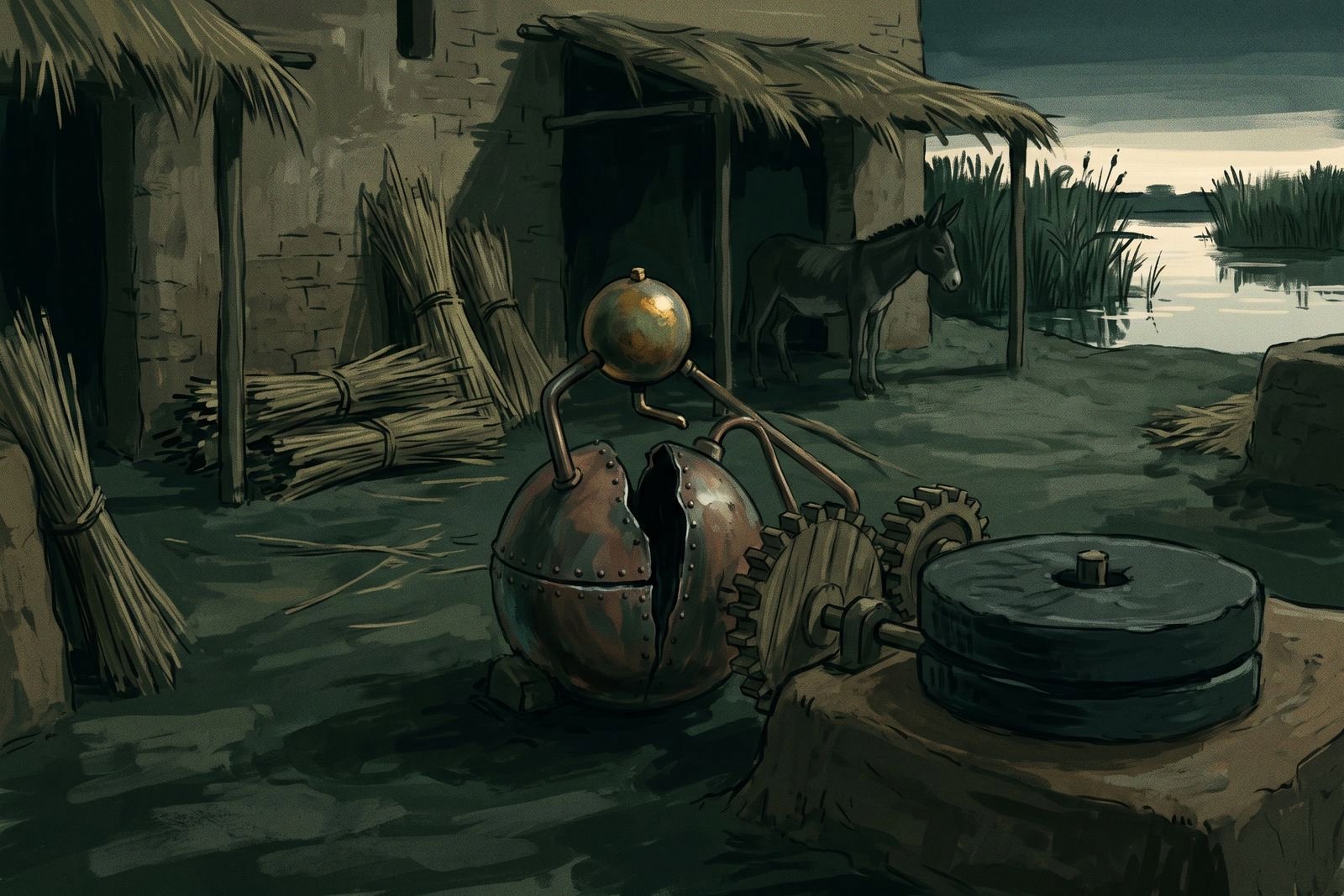
In April 62, a few weeks after the lunar eclipse by which he is conventionally dated, Hero of Alexandria takes a commission to try. The eclipse is itself disputed: it is the best fit of all the candidates, and some scholars still say none fits. The patron owns a grain mill on a canal west of the city, near the reed beds of Lake Mareotis. He wants the toy from Hero's treatise on pneumatics, a hollow bronze sphere spun by jets of steam, coupled to a donkey's stone. Hero had written it up beside singing birds and coin-operated holy-water dispensers, and nobody had asked it to work. The sphere spins fast and pushes almost nothing, so Hero borrows the train of toothed wheels he uses for lifting great weights with small force. A copper boiler goes under the sphere, and the household's enslaved stoker starts feeding the fire.
The upper stone turns at a crawl. Over a day it grinds a tenth of what one donkey grinds, or less. The stoker burns dried Mareotis reed because reed is what is left: the dung cakes and chaff of the canal suburbs belong to the bath furnaces and the bakers' ovens, and when the steward tries to buy some in May, every load is already spoken for. The reed-cutters on the lake sell a little more than usual that spring. The donkeys stay in the next stall. The neighbours call the thing the steam stone.
Late in May, in the middle of a morning already hot, with the Nile beginning its rise, a brazed seam on the boiler opens. The sound carries down the canal, a shriek and then a long cough, and the yard fills with white vapour with a man screaming inside it. The stoker takes the steam on his arms and legs. They carry him into the shade of the donkey stalls with a fistful of reed still in his hand, and he lives. By evening the boiler is cold and split along its seam, under a sphere that no longer turns.
That week the steward does his sums in drachmai and obols, the province's own billon and bronze coin. Modern authorities disagree on how many drachmai made the four-drachma piece, which shifts his totals at the margin and not his verdict. The miller costs his price over the years and about eight drachmai a month in wheat. The donkey costs fodder. The steam stone costs reed, the stoker's keep, copper repairs, and now a stoker who cannot work. It loses on every line. Someone in Hero's circle, Hero or a pupil, copies the reckoning into the master's notes in full, with the burst seam and the injured man, and that page is the only way either of them enters the manuscript tradition. Free labourers on an estate upriver will earn thirteen to twenty-one and a half drachmai a month in 78/79; that is a fair benchmark only because prices hardly move in the meantime.
At the Museum the argument goes onto papyrus. One pupil draws Hero's trick for temple doors, a heated vessel driving water out and drawing it back as it cools, next to the bronze cylinders of the fire-engine pump, and copies into the margin the preface's claim that a void can be made by art. Within a few years another pupil, Theomnestos, builds the idea on a bench. Steam fills a bronze vessel, a douse of cold water condenses it, the vacuum draws water up, fresh steam pushes it out. It has no piston and no crank. It lifts water for a suburban bath and loses on fuel to men and animals. It needs someone who can keep a seam tight, and Alexandria has exactly one such man. Theomnestos buys the scalded stoker from the mill, and the price goes into the workshop notes.
Rome burns in 64. Nero falls in 68. The mill owner's heirs will sell the copper boiler for scrap, because metal is dear in a province without fuel. In July 69 the legions in Egypt proclaim Vespasian at Alexandria.
69–274Fire Goes to the Mines
Vespasian holds the grain fleet and an empty treasury, and the decision that matters to this history comes from a man with no interest in steam. Suetonius reports that he declined labour-saving machinery for Rome's public works so that the city's poor could keep their wages. That refusal holds here. The plebs keep their haulage, and Rome goes on building with muscle. The imperial mines are another account. Convicts work them, and nobody needs to protect a convict's wage. Spanish galleries are flooding faster than tiers of slave-trodden wheels can lift the water. So the fiscus, the emperor's own treasury, sends Theomnestos's pump west, together with a page of seam rules taken down from an Alexandrian boiler-man. The year of four emperors runs to its end as it did. Vespasian's son takes Jerusalem in 70 and burns the Temple; nothing in a Spanish drainage gallery reaches that siege.
Egypt stays as it was. Around 75 a contractor offers the prefect's office hard ship's bread, ground and baked with heat engines, for the grain fleet. The office refuses: the grain leaves Alexandria unground under state contract, fuel is dear, and the fleet has no use for a change. In 79 the eruption buries Pompeii's bakery-mill with its donkeys and enslaved grinders, exactly as excavators will find it.
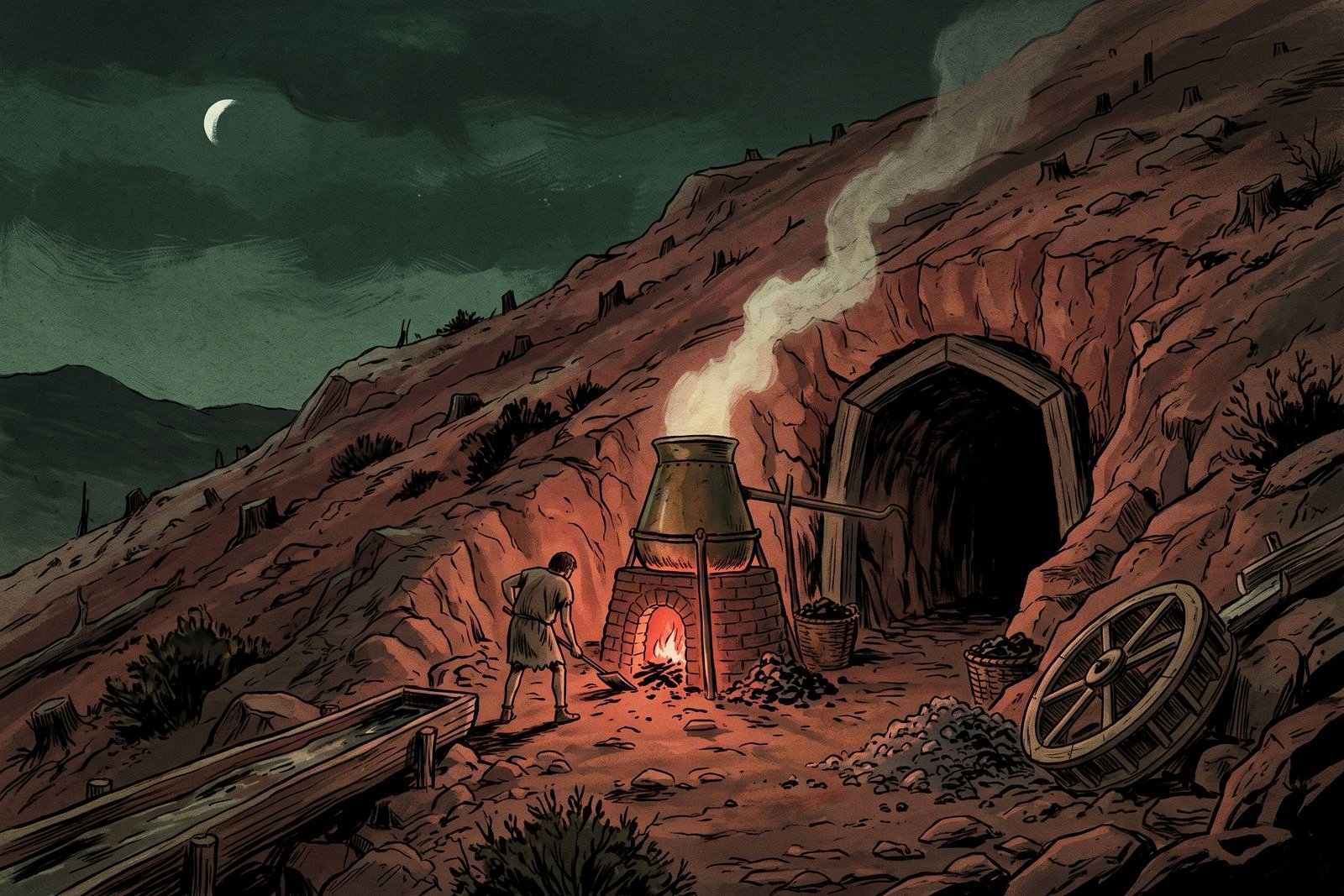
At Rio Tinto a procurator of mines replaces his drainage wheels with charcoal-fired fire-pumps. They turn perhaps half of one percent of their fuel into work. Their charcoal competes with the smelters, and their boilers burst and kill convicts. The steward's ledger comes back in a mining office, with a column the Alexandrian never needed: deaths per season at the boilers. Fire wins anyway, narrowly, because the fiscus prices it against a flooded gallery, which yields no silver at all. Under Hadrian the mining regulations gain clauses on pump leases and on boiler-men. Demand for convicts first rises, since pumped galleries go deeper, then falls as pumps replace the treaders. Skilled tenders earn their freedom and found a guild of fire-tenders, which names an unnamed Alexandrian as its first member. The hillsides they strip for charcoal will still show in pollen cores in 2026.
Barbegal is built in the second century all the same: sixteen water-wheels where water is free, stopping for months at a time to bake biscuit for the harbours. Slaves and engines work side by side for two centuries, so this world lends no support to the old thesis that slavery held machines back. Cost and fuel decided. In Britain, at the Mendip lead-and-silver workings, where coal already burned at the surface, fire first beats men on price. A guild line bores bronze cylinders in the fire-engine tradition and builds an atmospheric beam-pump with a piston. Such pumps stay few and costly.
The plague of the 160s and the price break after 165 come as they came; steadier silver only slows the debasement. The third-century crisis arrives on schedule, with plague, Persian war and failing frontiers. When the Persian king captures an emperor in 260, engine-men march east among the deportees. The silver coin falls less far than it did. A breakaway Gallic empire lives on British and Spanish mines from 260 and is reabsorbed in 274.
274–641The Pay-Chests of Britannia
Constantine is acclaimed by the army of Britain in 306, and the men who raise him are paid from the most heavily taxed diocese in the West. The island is now the empire's silver-and-coal province, garrisoned beyond what its frontier alone would need. In its fourth-century engine towns, smiths join the beam-pump to the crank and connecting rod that already drive the water-powered stone saws of the eastern provinces, and the pumps start working bellows and hammers. In the Balkans and Anatolia no coal lies near the mines, charcoal sets the limit, and engines stay rare. The empire becomes Christian, and slavery goes on beside the boilers. In Constantinople, Christian copyists strip Hero's corpus of its temple doors and holy-water machines as priestly fraud. They keep the pump and mill appendix, and the steward's ledger with it. Hero enters the Middle Ages as an engineer.
The rest holds. The last field army leaves the island in 407, and in 410 the emperor tells the British cities to see to their own defence. The West is gone by 476, for reasons of frontier, treasury and Gothic settlement that no mine pump touches.
Here this history makes its one large bet. In our record, Britain's money economy dies within a generation of 410, once imperial coin stops arriving, and in the 440s the Saxon federates hired to defend it revolt over unpaid provisions. That revolt is known chiefly from Gildas, a monk writing in anger with a sermon to preach. The red team's ending is defensible: the fire-pump dies with Roman Britain around 410, survives only as an eastern mining craft, and the world converges on ours. This fresque takes the other road, and everything after it rests on one plank, British mints that go on striking coin from engine-drained Mendip silver.
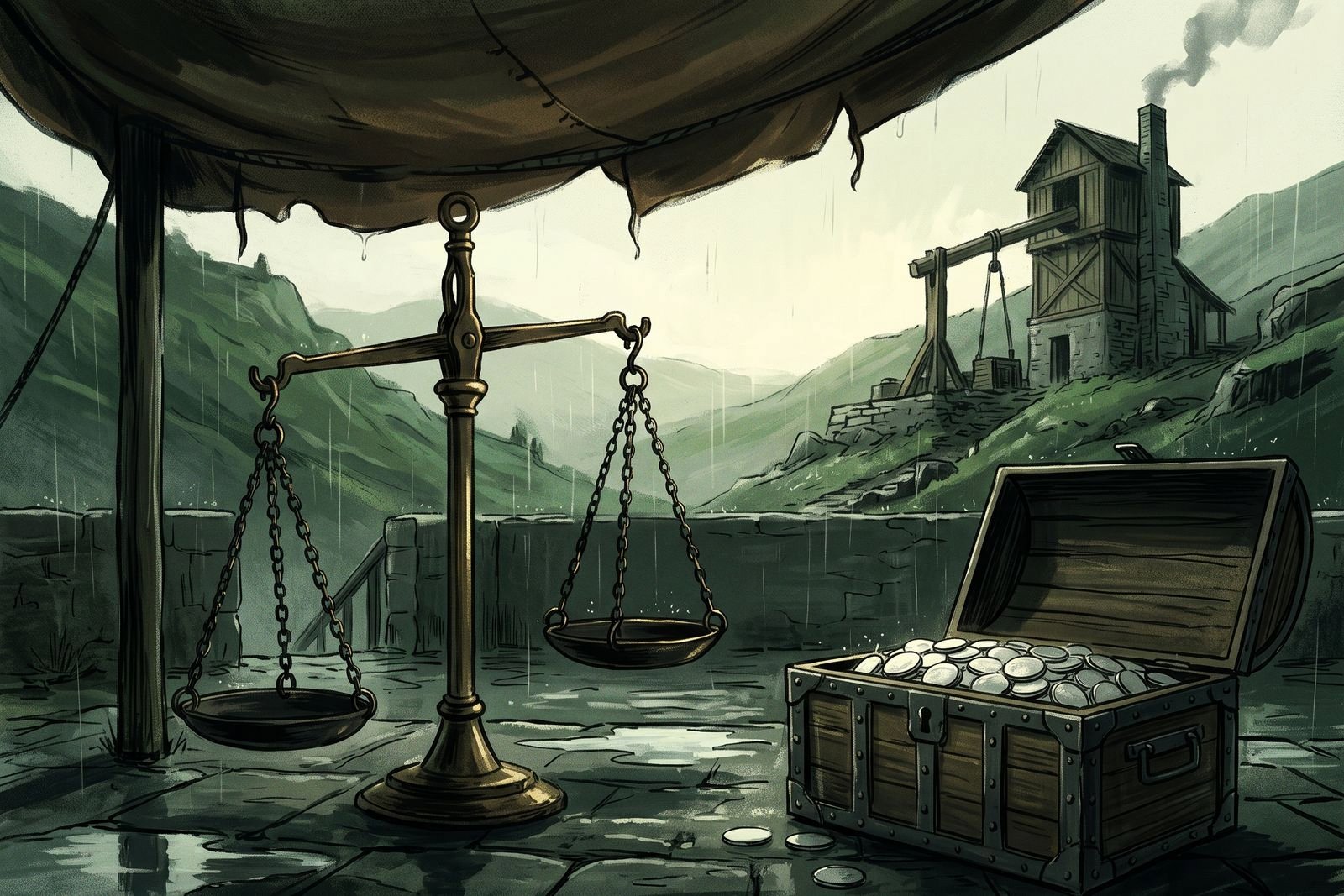
The pay-day falls in the 440s at a mint town in the Mendip hills, on a wet autumn morning a little after first light. Above the lead workings the engine is already running, a slow double beat that carries through the drizzle into the mint yard. Under a leather awning stand the coin scales, bronze pans dark from handling, and beside them a chest of new silver that still smells of the furnace. The Saxon captains come up one at a time with their men's tallies notched on sticks. The clerk weighs, counts, pays. The ration Gildas says went unpaid is paid here, and there is no revolt to write down.
Why the captains took silver when the land lay open to them, the record of this world does not say.
They become a salaried soldiery inside a Brittonic-Latin kingdom called Britannia, under kings this world remembers and ours never had. There is no Anglo-Saxon England. The plague of the 540s still reaches the island; working engines fall to a few dozen, and the towns shrink inside their walls. In 641 Arab armies take Egypt, carried by forces in Arabia and by the long Roman-Persian war, none of which any pump touched, and Alexandria stays a grain port that ships its wheat unground. Britannia keeps a soldiery that expects its silver every quarter, and those few dozen engines are all that keep the silver coming.
641–1348A Kingdom With No Crown to Take
A Norse captain who runs his ships up a British river in the 860s has come for the reasons such captains came anywhere: portable wealth, open coasts, quarrels at home. He meets a kingdom that can pay men to fight him. The raids last a century, but no Norse kingdom takes the island's east, because there is no patchwork of small kingdoms to pick apart and the salaried Saxon companies hold the river crossings. In 1066 there is no English crown for a duke of Normandy to claim. Norman energy goes south into Italy and east into the Crusades, which begin as they did, from papal and Byzantine causes that no Mendip gallery reaches. No baronial charter is sealed in 1215 under the name we know. Britannia's lords bargain with their kings over mine rents and coinage in councils our record never held.
In the 670s the Byzantines spray liquid fire at Arab fleets from pressurised siphons; that is a separate invention and owes nothing to the ledger.
Between the tenth and twelfth centuries the coalfield ironworks put engine-blown bellows on their furnaces and begin to pour cast iron. Around 1200 a king of Britannia reserves what remains of his forests for the shipwrights. The ironmasters lose their charcoal by decree and turn to coal. Coke smelting arrives about five centuries before its date in our world, and the colliers who dig for it are mostly children of the old mine-convict villages.
1348–1520The Ledger Turns Over
The fulling valleys of western Britannia lose a third of their people or more in 1348 and 1349, to the same plague, spread the same way, that empties towns across the continent. What changes is the arithmetic afterwards. Hands are scarce and wages climb, while an engine costs what it cost before. The Alexandrian reckoning now sits in copies all over Christendom, and for the first time in thirteen centuries it reads the other way: the man at the wheel is the dear line, and coal is the cheap one. Guild engines move into rotary milling, fulling and hammering within a generation.
Around 1450 an unnamed guild engineer moves the condensing into a separate vessel, so the cylinder no longer has to be chilled on every stroke. High-pressure engines and steam river craft follow by 1500, and the craft spreads to the coal basins of the Low Countries and the German lands.
In 1453 the Ottomans take Constantinople. Byzantium's mining cores had no coal, its engines stayed few, and the walls fall as they fell. Greek manuscripts travel west in the refugees' baggage, as they did in ours, and among them are the pump appendix and the steward's page of obols.
Iberian sail still makes the first Atlantic crossing in the 1490s, for its own reasons. From about 1520, settlement is led by coal-rich Britannia and the Low Countries, in steam-assisted hulls. The church revolt of the sixteenth century breaks out over church money, as it did. Britannia has no Tudors to break with Rome and settles the quarrel in a compromise between king and council. The engine towns pay for all of it in coal smoke in the lungs, children at the cylinders, and a kingdom with almost no forest left.
1520–1951Grain, Naphtha and the Isthmus
Alexandria's harbour fills with northern hulls in the seventeenth century, and for the reason Rome once wanted it: grain. Egypt passes under Britannic control and again becomes someone's granary. In the eighteenth century a Concessionary Board of the Isthmus cuts a canal at Suez, headed by a prefect whose title the Board borrowed from antiquity. India and China meet an industrial rival two centuries earlier than in our world, and colonial violence starts sooner and runs longer.
The religious wars of the seventeenth century are shorter and deadlier, fought with engine-forged guns. There is no revolution of 1688 in Britannia, since there is no dynasty to replace. The settler colonies across the Atlantic win home rule in a wave between 1720 and 1760, so no American war of independence is fought in 1776. France, coal-poor and outspent, meets its fiscal crisis in the 1710s and ends it with a constitutional settlement. No revolution comes in 1789, and no emperor carries one across Europe.
Atlantic slavery peaks earlier than in our world. Steam hulls carry more captives faster, and the planters, who can now replace the dead within a season, work them harder in the cane. It is the enslaved who end it. Flights to the hills, poisoned overseers and the cane risings of the 1750s, which burn the harvests of three islands in two years, raise the cost of holding them until the legislatures that lived off the trade give it up between 1760 and 1790. Freedom comes without land. The owners are compensated for their losses and the freed are not; most go back to the same fields for wages set by the men who had owned them, under vagrancy laws that make leaving a crime, and the islands are still paying the compensation loans a century later.
Britannic coal peaks between 1750 and 1800. The prize then becomes the naphtha of Mosul and the oil of Persia, and a fuel-poor region becomes the centre of the world's fuel. The Naphtha Wars of 1810 to 1860 are the industrial total war of this world, fought by the coal powers over the Gulf and the Ottoman oil provinces, and they kill millions in the Gulf and the Low Countries. The Ottoman state is partitioned along concession lines a century early. The coal basins of the German lands are bound together by customs leagues and wartime settlements, and no German empire is proclaimed in 1871.
Fission is understood by the 1870s and a weapon is tested in the 1890s, on an atoll of the Laccadives and on the salt flats south of the Qattara. Five powers hold it under a Concord seated at Antwerp, having learned in the Gulf what industrial war costs. Twice, over Basra in 1923 and over the Gulf in 1962, one of them loads it onto aircraft, and a session has to sit through the night to have it unloaded. It is never dropped in war, and it has already been paid for: the fishermen and herders moved off the test grounds are never allowed back, and the cancers among the next generation at Siwa are counted by a Concord commission that is dissolved before it reports.
The murder of Europe's Jews did not happen in this world, and nothing here earned its absence. In ours, the machinery that produced it grew out of a lost war, a punitive peace and a depression; none of the three formed here, and that is luck, not a lesson. The older hatred needed none of them. The Russian empire that never fell keeps the Pale of Settlement in law past mid-century, the same laws that in our world came before the killing. In 1951 a Jewish tailor from Vilna still needs a police permit to spend a night in Kiev. In peacetime, in 1907, a governor's order expels the Jews of the western provinces in a single summer, and the dead of the pogroms that follow each failed harvest are counted by the communities themselves, because the state does not count them. Those who leave go west to the engine towns of the Low Countries and Britannia, where the charters of the cylinder trades bar them from the guilds until after the Naphtha Wars. The six million live. They live as subjects whom the law has never stopped marking, and no one in this world can say what the next lost war would do to them.
Palestine is not partitioned in 1948 in the form we know. Its borders were drawn a century earlier, during the Naphtha Wars, by concession surveyors running pipelines from Mosul to the coast. The villages along the corridors lost their wells and their grazing to the line, the families who would not sell were moved off by the concession police, and their claims sit unanswered in the registry at Haifa. South Asia is not handed its freedom. The rail and mill workers of Bombay, Calcutta and Madras, organised a generation before any party, stop the lines between 1880 and 1910 until no garrison can be paid to run them. The famine years the stoppages bring kill hundreds of thousands in the districts the trains no longer reach, and both sides blame the strike committees for them. Africa leaves piece by piece from 1900 to 1950, each province through its own risings, and the reprisals are those of a coal empire: villages burned along the railway lines, labour levies for the mines, and borders left exactly where the concessions drew them. Egypt goes last, because grain, the Isthmus and Gulf shipping all passed through it.
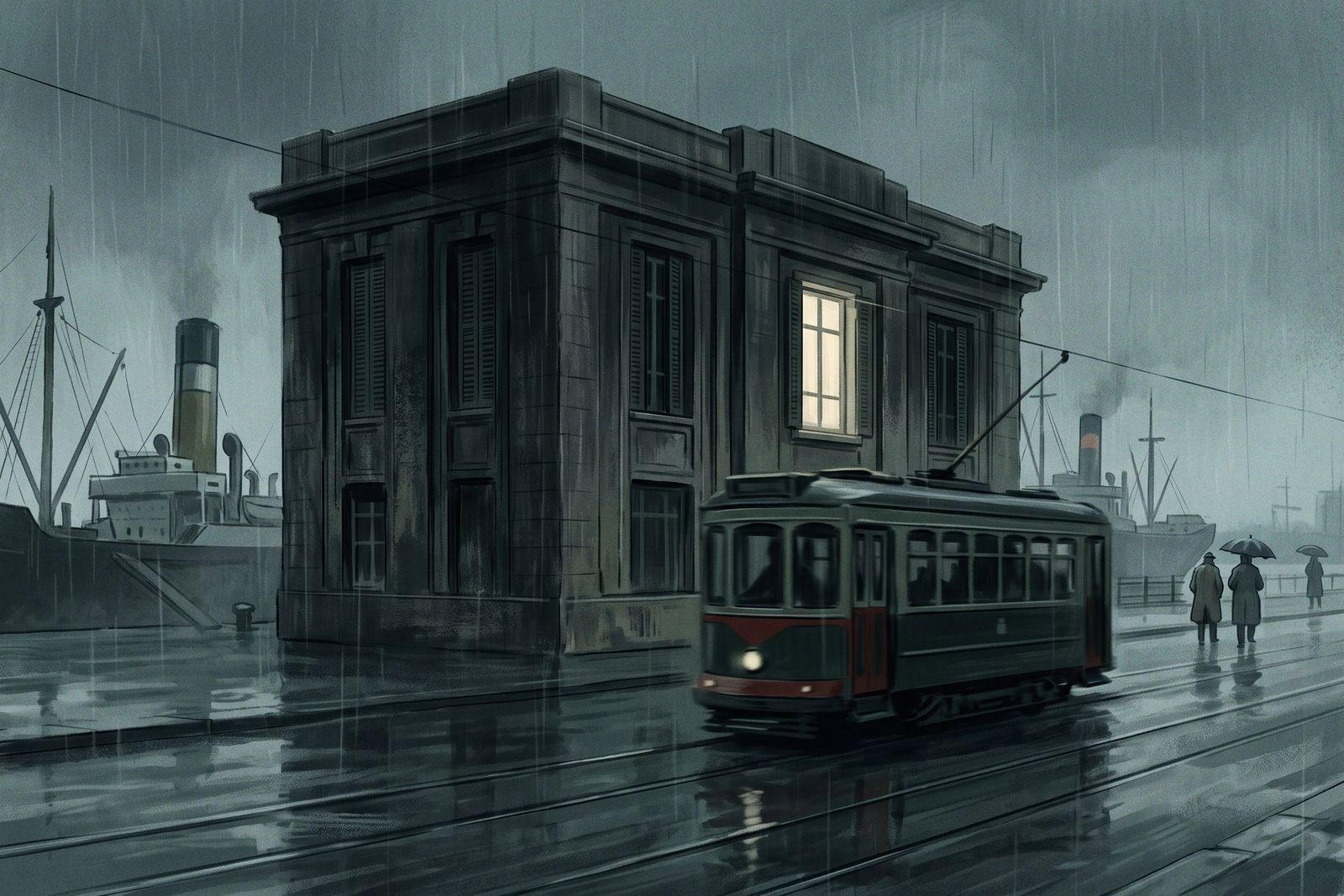
The handover at the harbour grain office takes place on a grey winter morning in 1951, at about nine, with rain coming in off the sea. Coal soot has blackened the concession building's limestone to the colour of slate. On the long counter lies the tender book, bound in green cloth and ruled in two languages, open at the last Britannic purchase of foreign wheat. A tram grinds past on the seafront. The Britannic chief clerk initials the final line and turns the book around. The officer of the new Egyptian Grain Board signs beneath him, in the same column.
1951–2026Bread Behind the Dike
A teacher at the state school in Mareotis, fifty-nine years old and in her thirty-second year there, teaches the same lesson every autumn from the same wall of the courtyard. Her pupils are fewer each year. A quarter of Egyptians are now over sixty, and Europe is older still, because the demographic transition came early to a world that industrialised early.
There is no superpower standoff. The Antwerp Concord holds deterrence among five powers, and in 1956 there is no Suez crisis, since Egypt already holds the Isthmus. The bread risings of 1977 do not happen in that form. The money order clears through Britannic silver-standard houses rather than through Atlantic mortgage paper, so the crash our world calls 2008 comes here as a regional panic on the Antwerp exchange in 2006.
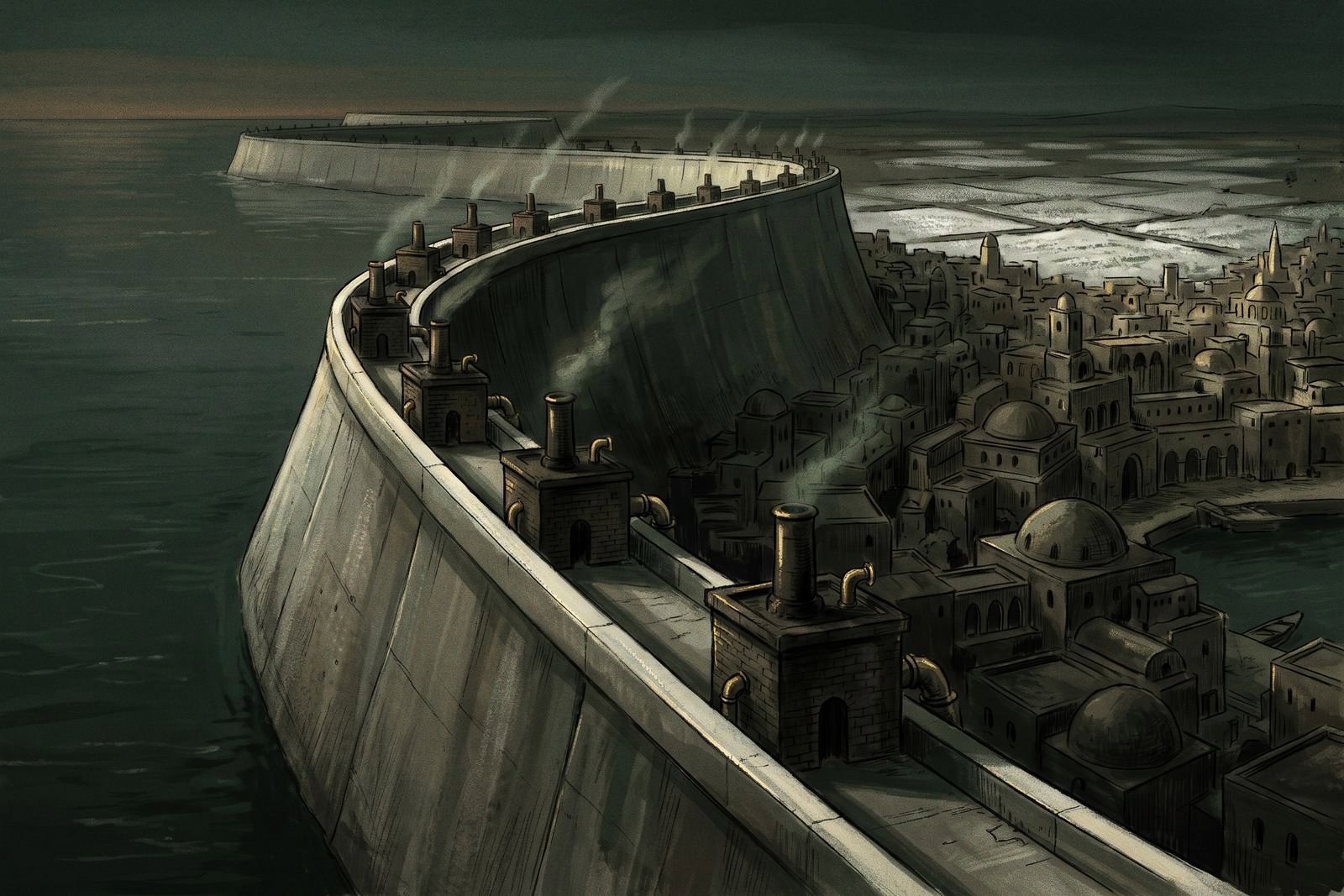
Five centuries of coal and oil have left the planet about half a degree warmer than ours. In 1998 the Alexandria Dike Act rings the seafront in grey concrete, with pumping stations every kilometre that people still call fire-houses. The Delta's southern fields have turned white with salt. In 2009 salinised fields fail while import tenders lag, and the Delta Salt Risings run until 2011. Mosul and Basra have become the money towns, with oil ministries in glass, and next month the Concord meets to decide whether the Gulf states may cap naphtha output to pay for sea walls of their own.
The street signs read in Arabic and Britannic, a Romance language descended from British Latin with Brittonic and Saxon loanwords, spoken in a capital on the Thames that nobody calls London. The subsidised loaf costs 5 qirsh, five hundredths of a pound. The Grain Board's spring tender of 4.1 million tonnes has slipped twice this year, and the papers are running the old cartoon of a Roman prefect counting ships.
The teacher's courtyard holds the lesson on the curriculum. A brass replica sphere, geared to a millstone, grinds a tenth of what the donkey on the poster grinds. Beside it a model fire-pump lifts water from a painted shaft. The plaque reads "Hero's pump". Below it, copied from the ledger, is the price the stoker was sold for, exact to the obol. His name was never written down.
April 62 CE (weeks after the lunar eclipse of 13 March 62 that conventionally dates Hero)A suburban mill owner pays Hero to gear an aeolipile to a millstone
In a mill on the Canopic canal near the Lake Mareotis shore, west of Alexandria, an unnamed grain-mill owner commissions Heron of Alexandria to couple his steam-spun sphere to a donkey millstone. The sphere spins fast with almost no torque, so Hero borrows the reduction gearing of his own barulkos tradition, a train of toothed wheels built for lifting great weights with small force. A copper boiler is fitted, and the household's enslaved stoker feeds it. The work is done as a paid wonder for a private patron, the normal footing for Alexandrian mechanics, and not as a state project. Caveat: the date rests on Neugebauer's eclipse identification, which some scholars dispute.
6 SOURCED CAUSES
Early May 62 CETrial runs: the 'steam stone' turns, but slowly
Through the reduction train the geared sphere turns the upper millstone at a crawl. Over a day it grinds a tenth or less of what one donkey grinds. Fuel is the immediate problem. Dried Lake Mareotis reed is the cheapest fuel and is burned first. Dung cakes and chaff, the other local fuels, are already claimed by bath furnaces and bakers' ovens. The canal-side neighbours call it a curiosity, and the donkeys stay in the next stall.
4 SOURCED CAUSES
Mid-May 62 CEPaper debate among Hero's pupils; the temple-door principle is set beside the force-pump
Among Hero's circle, probably at the Mouseion, the steam stone prompts argument on papyrus rather than in bronze. One pupil sketches the principle of the temple doors: a heated vessel drives water out, and on cooling draws it back. He draws it beside the bronze cylinders of the fire-engine force-pump in the Pneumatica. In the margin he cites the preface's argument about the void, that a vacuum can be produced artificially. He proposes that heat and cold, rather than a spinning jet, might lift water. Nothing is built.
4 SOURCED CAUSES
Late May 62 CEBoiler seam bursts; an addendum records the scalded stoker and the steward's reckoning
A brazed seam on the copper boiler fails under steam, and the enslaved stoker is badly scalded but survives. An addendum to Hero's notes, written by Hero or a pupil, records the failure, the man's injuries, and the mill steward's cost comparison copied in full. This is the only route by which the ledger and the stoker enter the manuscript tradition. The steward reckons in Alexandrian money. By the UCL ratio, 1 billon tetradrachm = 6 bronze drachms = 24 obols; Estiot's ratio of 1 tetradrachm to 8 drachms would change the sums at the margin. An enslaved miller is priced at his purchase price, some hundreds of drachmai spread over his working life, plus about one artaba of wheat a month for food. At the stable price of roughly 8 drachmai an artaba, that is about 8 drachmai a month. A donkey is priced as fodder. The steam stone is priced as reed fuel, plus the stoker's keep, plus copper repairs. It loses on every line. A historian's gloss: free wages attested at Hermopolis in 78/79, about 13 to 21½ drachmai a month, are a fair benchmark only because prices hardly moved.
6 SOURCED CAUSES
c. 64–80 CEBench fire-pump built in Alexandria; the steam stone is scrapped
An invented pupil, Theomnestos, builds the pump his circle sketched on paper. Steam fills a bronze vessel, a douse of cold water condenses it, the vacuum draws water up, and fresh steam expels it. It has no piston and no crank. It lifts water for a suburban bath and loses on fuel to men and animals in reed-and-dung Egypt. The scalded stoker is the only man who can keep a seam tight, and he is sold to Theomnestos; the sale price is entered in the workshop notes. Between c. 65 and 80 the mill owner's heirs sell the copper boiler for scrap, because metal is dear in a fuel-poor province.
4 SOURCED CAUSES
July 69 – 70 CEVespasian, proclaimed at Alexandria, sends the pump to the mines
Vespasian is proclaimed emperor at Alexandria and controls the grain fleet, but he inherits an empty treasury. As Suetonius reports (Vesp. 18), he refuses labour-saving machinery for Rome's public works so that the urban poor keep their wages. The refusal stands. Imperial mines worked by convicts raise no such objection, so his fiscus sends Theomnestos and the stoker to the Hispanic mines to drain flooded galleries. The Year of the Four Emperors otherwise runs as recorded.
4 SOURCED CAUSES
c. 75 CEPrefect's office rejects a tender for fire-baked ship's bread
An Alexandrian contractor offers to grind and bake hard ship's bread for the grain fleet using heat engines. The prefect's office refuses. Grain leaves Egypt unground under annona contracts, fuel is dear, and the shipping system has no use for a change. This is the second failure: Egypt, the birthplace of the device, does not industrialise, and its closed billon economy and cheap labour stay intact.
5 SOURCED CAUSES
c. 75–260 CEFire-pumps at Rio Tinto and Vipasca; the Hadrianic mining code gains pump clauses
An invented procurator of mines, Q. Valerius Severinus, replaces tiers of slave-trodden drainage wheels with charcoal-fired fire-pumps. The Hadrianic Vipasca regulations gain clauses on pump leases and on boiler-men. The costs are heavy. Thermal efficiency is near 0.5 percent, charcoal competes with the smelters, and boiler bursts kill convicts. Demand for convicts sentenced to the mines first rises, because pumped galleries can go deeper, then falls as pumps replace the wheel-treaders. Skilled boiler-tenders earn manumission and found a collegium of fire-tenders, which honours the unnamed Alexandrian stoker. Iberian deforestation from this period will still be legible in pollen cores in 2026.
3 SOURCED CAUSES
c. 120–274 CEIn Britain, coal-fired piston beam-pumps; the 3rd-century crisis comes, softened
The craft reaches Britain, at Mendip argentiferous lead and Dolaucothi gold, where surface coal was already burned. This is the first place where fire beats men on cost. A guild line bores bronze cylinders in the fire-engine tradition and builds an atmospheric piston beam-pump; such pumps remain few and costly. The Antonine plague and the price break after c. 165 still occur, but steadier silver output slows debasement. The 3rd-century crisis arrives on schedule: plague, Sasanian wars, frontier collapse, and Valerian's capture in 260, with engine-men among the Persian deportees. The antoninianus falls less far than it did. The Gallic Empire (260–274) leans on British and Hispanic mines and is reabsorbed in 274.
3 SOURCED CAUSES
c. 260–476 CEBritain becomes the silver-and-coal diocese; a Christian filter on the Heronian texts
Britain is more heavily garrisoned and taxed as the empire's mining diocese. This gives Constantine's acclamation at York (306) a fiscal dimension. 4th-century engine-towns join the beam-pump to the crank and connecting rod of the eastern Hierapolis-type sawmills to drive bellows and hammers. In the Balkans and Anatolia there is no coal near the mining cores, charcoal sets the limit, and engines stay few. Constantinople keeps the Heronian corpus. Christian copyists drop the temple wonders as pagan priestly fraud and keep the pump and mill appendix, including the ledger addendum, so Hero is remembered as an engineer. Constantine III's withdrawal (407), Honorius's letter (410) and the Western fall by 476 are unchanged.
3 SOURCED CAUSES
c. 410–641 CEBritish mints keep paying troops; the Saxon federates' revolt does not happen
In real history, sub-Roman Britain's money economy died after imperial coin stopped arriving (c. 410–430). Here British mints strike coin from engine-mined Mendip silver, and the civitates keep paying their troops. In the 440s the revolt of the Saxon federates over unpaid provisions, recorded by Gildas, does not occur because the provisions are paid. The Saxons become a salaried military caste within a Brittonic-Latin successor state called Britannia, ruled by kings who are invented here. The costs: the plague of the 540s still arrives, working engines shrink to a few dozen, towns contract, and there is no Anglo-Saxon England. The Arab conquest of Egypt (641) is unchanged, and Alexandria remains a conservative grain port.
2 SOURCED CAUSES
1200No Danelaw, no Norman conquest; a forest decree turns ironmaking to coke
Scandinavian raids of the 9th century come for their own reasons but meet a silver-rich state, and no Danelaw forms. In 1066 there is no English crown to claim, and Normandy's ambitions turn elsewhere. Between the 10th and 12th centuries, engine-blown bellows at coalfield ironworks produce cast iron. Around 1200 a king of Britannia reserves the remaining forests for shipbuilding. This forces coal into ironmaking, and coke smelting arrives about five centuries before its real date.
1 SOURCED CAUSE
1348After the Black Death, Hero's ledger flips; separate condenser and high-pressure engines
The Black Death, its causes unchanged, makes labour scarce and dear. This reverses the conditions of the Alexandrian costing, and engines move into rotary milling, fulling and hammering. Around 1450 an unnamed guild engineer adds a separate condenser. High-pressure engines and steam river craft follow by c. 1500, and the technique spreads to the coal basins of Liège, the Ruhr and Silesia. The costs include coal-smoke mortality, child labour in the engine towns, and the loss of Britannia's forests.
2 SOURCED CAUSES
1450An early industrial revolution centred on Britannia and the Low Countries
Steam-assisted Atlantic and Indian Ocean expansion confronts Mughal India and Ming and Qing China about two centuries early. Egypt passes under Britannic control in the 17th century, and a Suez cut is dug in the 18th under a concession held by invented office-holders. Britannic coal output peaks c. 1750–1800. Mosul and Kirkuk naphtha and Persian oil become strategic in the late 18th century, and the fuel-poor Middle East becomes a fuel centre. Industrial great-power wars fall in the 18th and 19th centuries, and none of the real anchors from 1798 to 1956 survive under their known names. Colonial violence starts earlier and lasts longer. Atlantic slavery peaks and ends earlier, and its abolitionists cite the fire-tenders' manumission tradition.
2 SOURCED CAUSES
2026The world today: half a degree warmer, Britannic-speaking, still importing Egyptian bread grain
Five centuries of coal and oil have left warming about 0.5°C beyond our own. The Nile Delta is salinised, and Alexandria's Corniche stands behind sea dikes. Egypt still imports grain, so bread politics echo the ancient annona, but under different borders and a different colonial past. The world lingua franca is Britannic, a Romance language descended from British Latin with Brittonic and Saxon loanwords. The demographic transition came earlier, and societies are older. In school courtyards a fire-pump lifts water from a model shaft beside a replica geared sphere that grinds a tenth or less of a donkey's output. The schoolbook name for the pair is 'Hero's pump'.
3 SOURCED CAUSES
64–79 CETheomnestos's fire-pump goes to Spain; Rome's own calendar is untouched
Theomnestos builds his pistonless bench fire-pump and buys the scalded stoker, recording the price in the workshop notes. Vespasian, proclaimed at Alexandria in 69, still refuses labour-saving machinery for Rome's public works, as Suetonius records. His fiscus nonetheless sends pupil and stoker to the convict-worked Hispanic mines, where no plebs argument applies. Rulings: the Year of the Four Emperors is UNCHANGED, because steam touches none of its legions or senators. The fall of Jerusalem in 70 is UNCHANGED for the same reason. Vesuvius in 79 is UNCHANGED; the Pompeii bakery-mill is buried with its donkeys and enslaved grinders exactly as excavated. In Egypt the annona still ships grain unground, and the heirs scrap the copper boiler.
5 SOURCED CAUSES
c. 120–476 CEEngines stay in the mines; Barbegal is still built; the West still falls
Fire-pumps spread only where water cannot do the job and men are scarce or dear: flooded galleries at Rio Tinto and Vipasca, then British coal-country mines. Rulings: Barbegal is UNCHANGED. Water is free where geography allows, so the second-century complex is still built and still stops for months to bake hardtack for the harbours. The Antonine plague and the price break after c. 165 are UNCHANGED; only debasement is softened by steadier silver. The third-century crisis is ALTERED in degree only. Christianisation is UNCHANGED, and slavery persists beside the engines. This world therefore gives the abandoned slavery-and-mechanisation thesis no support: cost and fuel decided, not abolition. The fall of the West by 476 is UNCHANGED, because its drivers are frontiers, fiscal strain and the Gothic settlements, not mine drainage.
5 SOURCED CAUSES
1200Britannia endures; Islam rises as recorded; 1066 never comes
Paid Saxon federates become Britannia's salaried soldiery. Rulings: the Saxon revolt and Anglo-Saxon England are AVERTED. The rise of Islam and the conquest of Egypt in 641 are UNCHANGED, since Arabian and Sasanian-Byzantine drivers are untouched; Alexandria stays a conservative grain port. The Heronian corpus survives through Constantinople, stripped of its temple wonders. Viking raids are UNCHANGED in origin, but the Danelaw is AVERTED. The Norman Conquest is AVERTED, because there is no English crown to claim. Norman energy goes to Sicily and to the Crusades, which are UNCHANGED in origin because their drivers are papal and Byzantine. Magna Carta is AVERTED under that name. Around 1200 a Britannic king's forest reservation forces coke into ironmaking.
4 SOURCED CAUSES
1348The Black Death flips Hero's ledger; Constantinople still falls
Rulings: the Black Death is UNCHANGED in cause and toll. It makes labour dear, so the Alexandrian costing finally inverts, and guild engines take over milling, fulling and hammering. The separate condenser follows c. 1450. The fall of Constantinople in 1453 is UNCHANGED. Anatolia and the Balkans have no coal near their cores, so Byzantine engines stayed few, and the Ottomans take the city. Greek manuscripts, including the pump appendix and the stoker's ledger, travel west as in our history. The Atlantic landfall of the 1490s is ALTERED: the first crossing remains Iberian sail, driven by its own motives, but colonisation from c. 1520 is led by coal-rich Britannia and the Low Countries with steam-assisted shipping. The Reformation is ALTERED: its church-finance drivers are untouched and the revolt occurs, but Britannia's settlement is a royal-conciliar compromise with no Tudor break, because there are no Tudors.
4 SOURCED CAUSES
1600Egypt becomes Britannia's granary again; the Isthmus Concession is cut
Egypt passes under Britannic control in the 17th century for the same reason Augustus wanted it: grain shipped through Alexandria. The Suez cut is dug in the 18th century under the Concessionary Board of the Isthmus, headed by an invented prefect, Aurelian Dunmor. Mughal India and Ming and Qing China face an industrial rival about two centuries early. Rulings: the Thirty Years' War is ALTERED, fought with engine-forged guns in a shorter, deadlier form. The Glorious Revolution is AVERTED. American independence of 1776 is AVERTED under its name; settler colonies win home rule in a wave c. 1720–1760. The French Revolution of 1789 is AVERTED. France, coal-poor and outspent, meets its fiscal crisis in the 1710s and ends it in a constitutional settlement, not a republic. Britannic coal peaks c. 1750–1800. Atlantic slavery peaks earlier and is abolished c. 1760–1790, its abolitionists citing the fire-tenders' manumission tradition.
4 SOURCED CAUSES
1780The Naphtha Wars replace the Napoleonic and world wars
As British coal declines, Mosul and Kirkuk naphtha and Persian oil become the prize. Rulings: the Napoleonic Wars are AVERTED, because there was no 1789 to export. Industrial total war comes instead in the Naphtha Wars (c. 1810–1860), fought by the coal powers over the Gulf and the Ottoman oil provinces. The Ottoman state is partitioned along concession lines a century early. German unification of 1871 is AVERTED under that name; the Ruhr and Silesian coal basins are consolidated through earlier customs leagues and wartime settlements. The Russian Revolution of 1917 is AVERTED, since its trigger, a lost world war, never forms. The First and Second World Wars are AVERTED. Their drivers do not exist here: a Prussian-led German state, Versailles, and the 1929 depression. The mass mobilisation they represent was spent a century earlier, at a cost of millions in the Gulf and the Low Countries.
3 SOURCED CAUSES
1870A late, slow decolonisation; the atom without a Cold War
Rulings: decolonisation is ALTERED. Empires that began two centuries early also ended later relative to their start: South Asia leaves c. 1880–1910, Africa piecemeal c. 1900–1950. Egypt goes last, in 1951, because grain, the Isthmus and Gulf shipping all ran through it. The Suez Crisis of 1956 is AVERTED under its name. The industrial head start narrowed as techniques diffused to China, India and the Americas. Even so, fission is understood by the 1870s and a weapon is tested in the 1890s, but never used in war, because the powers had already learned in the Naphtha Wars what industrial war costs. The Cold War is AVERTED. Deterrence is held by a five-power Concord at Antwerp, not two blocs. The partition of Palestine in 1948 is AVERTED in its known form, since Ottoman provinces were redrawn a century earlier along oil lines. The digital age is ALTERED and earlier, with networked computing by the 1940s, but it is slowed by societies that aged sooner.
3 SOURCED CAUSES
1990Salt in the Delta, dikes at Alexandria, bread again the politics of Egypt
Five centuries of combustion leave this world about 0.5°C warmer than ours. Rulings: Egypt's bread risings of 1977 and 2011 are ALTERED into the Delta Salt Risings of 2009–2011, set off when salinised fields failed and import tenders lagged. The global financial crisis of 2008 is ALTERED. It is absorbed as a regional Antwerp-exchange panic in 2006, because the money order is centred on Britannic silver-standard clearing houses, not on Atlantic mortgage securities. The Alexandria Dike Act of 1998 rings the Corniche in concrete. The state Grain Board, heir in function to the praefectus annonae, buys wheat abroad by tender each season.
4 SOURCED CAUSES
Every one of these worlds was weighed against the one you have just read. Here is where each of them breaks.
Hero's steam mill is scrapped after its boiler bursts in 62, his notes on it shrink to a footnote, and history runs on unchanged to 2026.
We weighed it first because it is the likeliest outcome, and the Alexandrian ledger supports it: in Egypt cheap muscle and dear fuel sink the steam stone on every line. The trouble is that it applies one Egyptian costing to the whole empire. It breaks in 69 and 70, when Vespasian's treasury faces Spanish silver galleries flooding faster than slave-trodden wheels can drain them, and a treasury that gets nothing at all from a drowned mine does not price an engine against a donkey. We set it aside as too close to the world we actually live in. It was defensible, simply a smaller world than the one this history owes its reader, and the choice was ours.
The fire-pump dies with Roman Britain around 410, when the last legions leave, and survives only as a mining craft in the eastern provinces.
This is the strongest case against us, and we treat it that way. In our record Britain's money economy collapses within a generation of 410, and nothing obliges a handful of engines to outlive the coin that paid for them. We took the other road because it hangs survival on one named hinge: British mints that keep striking coin from engine-drained Mendip silver, so that the Saxon federates are paid in the 440s instead of revolting over rations, as Gildas reports. The pump's death was defensible, only less divergent than the world we chose to unroll. We kept it in the text beside the mint-town pay-day, as the counterweight to our one large bet.
Vespasian accepts labour-saving machinery for Rome's public works, and steam engines haul the stone that rebuilds the Capitol from 70.
We weighed it because Suetonius records the offer of such machinery and the emperor's refusal, which makes it a real fork. It breaks at once, in the early 70s, on the building site itself: the fire-pump of 70 lifts water and nothing else, with no hauling or rotary power, and the crank does not reach it until the fourth century. It breaks a second time on politics, since the haulage wages of the Roman poor are a subsidy no new emperor with an empty treasury can afford to cancel. We split the decision instead: refusal for Rome as Suetonius has it, fire for the convict-worked mines, where no one protects a wage.
Nero takes up the Museum mechanics at Alexandria as his own patronage project between 62 and 68.
We weighed it because Nero liked spectacle and machinery and held the throne in the very years Hero's mill was built. It breaks in 68, when his fall and the condemnation of his memory sweep away anything associated with his name, programmes included. Whatever he funded would have to be rescued by the next regime, and the Flavian treasury from 69 supplies that support more directly, out of need rather than taste. The branch adds a patron and changes nothing downstream, so we left Nero to fall as he fell.
The Roman grain administration in Alexandria builds steam mills to grind and bake ship's bread for the harbours and the grain fleet.
We weighed it because the grain office was the largest buyer of milling in the eastern Mediterranean. It fails in the 70s on the route itself: Egyptian grain leaves Alexandria unground under state contract, so there is nothing for a harbour mill to do, and fuel in the province is dear. Where ship's bread was made at scale, as later at Barbegal in Gaul, it came from water-wheels working seasonally, with water that cost nothing. We kept the idea only as a failure: around 75 a contractor offers engine-baked bread to the prefect's office, and the office turns him down.
Egyptian landowners adopt steam pumps to lift Nile water onto their fields.
We weighed it because irrigation was the largest use of lifted water in the ancient world and the obvious job for a pump. It fails in the 60s, the first decade an engine exists, and it fails again in every century after, on three constraints that do not move. The annual flood waters the valley for free, ox-turned wheels and hand sweeps lift the rest cheaply, and the valley has almost no wood and no coal to burn. A steam pump on a Nile field loses to an ox until coal arrives by sea in the seventeenth century, and by then the story belongs to other hands.
The Roman Empire carries the fire-pump through to a full industrial revolution by the 300s.
We weighed it because it is the road most readers expect from a steam engine in antiquity. It breaks in the fourth century on fuel and metal: Rome has no cheap iron, its coal lies in Britain far from the Mediterranean cores, and its engines turn perhaps half of one percent of their fuel into work. Mechanising Italy, Egypt or Anatolia on those terms would take a second miracle on top of the first. What survived is regional: British engine towns join the beam-pump to the crank in the 300s and drive bellows and hammers, while the rest of the empire keeps its slaves and its charcoal limits.
The breakaway Gallic Empire, funded by British and Spanish mines, beats back Aurelian and survives past 274 as a separate western state.
We weighed it because the engine-drained mines give the Gallic emperors a revenue base they lacked in our world. It breaks in the 270s on the weakness of the chain behind it: by then the world has carried a steam pump for two centuries on a thin run of mining evidence, and a surviving Gallic state would pile a second large swing onto that. The British road after 410 buys more divergence with a cleaner fiscal hinge, a mint that keeps paying its soldiers. So the Gallic Empire lives on British and Spanish silver from 260 and is reabsorbed in 274, as it was.
Byzantine engineers fit steam to their fire siphons and turn the Battle of the Masts in 654 or the Arab sieges of Constantinople between 674 and 718.
We weighed it because the Byzantine liquid fire is the one ancient weapon that resembles a pressure machine. It breaks in the 670s on the record: the incendiary was a separate invention, and a pressurised siphon was in service around 672 without any help from steam. At most a steam siphon moves the weapon a decade or two earlier, which changes the date of a naval battle and little after it. It would also pull this history away from mines and coin toward the sea, so we kept the siphon to a single line saying it owes nothing to the ledger.
Mamluk Egypt or the Ottoman Empire takes up steam in the 1500s, following the steam-turned spit described by Taqi al-Din in 1551.
We weighed it because Taqi al-Din's machine is a real early-modern steam device on Ottoman soil. It breaks in the 1550s on fuel: Egypt and the Levant have little wood and no workable coal, and an engine that cannot be fed stays a curiosity in a treatise. The region's energy enters this world later and from underground, once Britannic coal peaks after 1750 and naphtha and Persian oil become the prize. We gave the Middle East that role, with the wars that come with it, instead of an engine it had nothing to burn in.
Hero's machine stays a curiosity in antiquity, and Federico Commandino's Latin translation of 1575 leads Europeans to atmospheric pumping by the 1650s.
We weighed it because the transmission is real: Commandino did print Hero's Pneumatica, and early-modern engineers read it. It breaks by the 1650s on coal, since a precedent on paper without cheap fuel at the pithead gains a few decades on our own engines of 1698 and 1712 and nothing more. We set it aside as too close to the world we actually live in, a defensible road and a smaller world than this history owes its reader. The Roman mining branch carries the same idea fifteen centuries further, so we took that one and owned the risk.
Everything before the hinge rests on these readings. Under each title, the passage retained.
- On dating Hero of Alexandria (Archive for History of Exact Sciences)
There are no great differences, but none of these could fit the description of the eclipse in Dioptra 35.
- Heron of Alexandria's Date, Nathan Sidoli
certainly the best fit of all the lunar eclipses between 200 BCE to 300 CE
- Hero of Alexandria (Complete Dictionary of Scientific Biography)
Two other lunar eclipses fit the temporal data as well as the one of 62
- Pneumatica, Britannica
describes a menagerie of mechanical devices, or “toys”
- Hero of Alexandria, EBSCO Research Starters
Hero also described coin-operated machines to dispense holy water
- Water, air and fire at work in Hero's machines, A. C. Sparavigna
It is almost certain that Heron taught at the Museum
- Library of Alexandria, World History Encyclopedia
during the Roman Period that followed, patronage of the library was uneven at best.
- How Roman Egypt Fed the City of Rome, UNRV
It was placed under unusually close imperial control
- Annona (grain), Oxford Classical Dictionary
from Augustus onwards in Egypt; Rome was then largely sustained by this flow of public grain.
- People, Plagues, and Prices in the Roman World: The Evidence from Egypt (Journal of Economic History)
An artaba of wheat cost, on average, 8.1 drachmai in this period
- The Cost of Living in Roman Egypt, Louis C. West
the account book kept on a large estate at Hermopolis in the year 78/79 A.D.
- Roman coins in Egypt, Digital Egypt (UCL)
Regular production started in AD 20 with a tetradrachma.
- The Crisis of the 3rd Century A.D.: Wage Increases (Durham E-Theses)
An artaba was enough wheat for one man for a month
- Prison bakery for enslaved people found in Roman Pompeii, HeritageDaily
a millstone was normally moved by a donkey and a slave.
- Archaeologists Discover Brutal 'Bakery-Prison' at Pompeii, Smithsonian Magazine
The donkeys pushed a grindstone, while the workers added grain, monitored the process and collected flour.
- The second century CE Roman watermills of Barbegal (Science Advances)
excavations in the early 1990s led to the abandonment of this hypothesis
- Second Century Roman Watermill Not What Researchers Have Thought, Popular Archaeology
likely used to produce non-perishable “ship's bread”
A life in this world — an archival fiction
[The copyist asks whether she was at the mill on the day the stone was fired for the visitors.]
The stone. You all come asking about the stone. Sit down, then, if you're going to write. Your ink's gone thick. Put a drop of water in it, there's the jar.
I'm walking there. It's Pachon. No. It's Payni, the first days of Payni, because the lettuce-seed woman put her price up for the new month and I'm cursing her the whole length of the lane. Payni. I've got the girl on my hip in the basket and the basket's cutting me, and before I'm even at the fuller's corner I hear it over the wall. The copper singing. A thin noise, like a fly shut under a pot lid. When the copper sings it's past the third hour, and Sarapion's mouth will be pulled down at both ends and he'll make me wait.
[He asks what it looked like.]
I never looked at it. Why would I look at it? I know the soot. Up the east wall, fanned out like somebody slapped the plaster with a black hand. And the seam. They'd mended it with new metal, lead and tin, the boy said, and it shone like a fresh obol against the black, and Sarapion told me, don't stand near the seam. So I didn't. There. That's your stone.
What I had was the milk.
The night before. I'm in my room upstairs, the reed roof's dropping bits in the gruel, and I've borrowed the lentil man's balance from downstairs. He lends it if I give him back a handful of whatever I weigh (thief, he's always been a thief). I put the barley in one pan, four choinikes, the same four as Pachon and a handful more, because she ought to be a handful more, and I lay the girl in the other pan in her bands. Kopria. The steward wrote it on the bill of sale. Off the heap behind the Rhakotis gate, where they all come from. Bes round her neck on a red thread, I tied that on, the blue one. Her pan goes down. Slowly. My thumb's on the cord, holding it steady. It goes down.
So she's a handful more. Good.
I eat the gruel cold. Fenugreek and barley, lettuce seed thickened in, cold, because hot gruel sweats the milk out of you, my mother knew that. Two obols that pot cost me with the lettuce seed. Two obols out of eight drachmai, you reckon it. I eat all of it standing up.
Then I press. Here. Like this. The flat of the thumb, and you see how far it comes and how white. Blue at the edge is thin. It's white. Mostly white.
And I count. On my fingers, how many times she's been on since sunset. One, two, three. Five on this hand, then the other. Seven by the time the lamp's out. Seven's good. Six is not good. Seven.
The papyrus. I knew it the way you know a prayer. I can still say it. Taësis daughter of Apion, of Alexandria, acknowledges to Didymos son of Ammonios that she has received for nursing the foundling girl... for two years, eight drachmai the month, for milk and oil... that she will bring the child each month to the house of Didymos for inspection... that she will not lie with a man... that she will not put another child to the breast... and if she breaks any of this she shall repay all wages received and half again. Half again. Registered at the court. In Alexandria. No village scribe chewing his reed. The court.
[He asks about her husband.]
Pasion's at the Mareotic harbour. Late again. Unloading the reed boats off the lake, and late is two obols more, sometimes three. Good. I lie down.
Then Apion wakes. My boy. Past two, weaned, he has the goat's milk by day in the clay feeder with the spout, and he spits it at me. Spits it. By day. At night he wakes and grizzles and I only quiet him. I take him in and he quiets, and then I
[He asks how she quieted him.]
The clause says nursing. Put to the breast for nursing. I know what nursing is, I do it for pay. Quieting is so the lentil man doesn't bang his ceiling with the broom. Write that down the way I said it.
Where was I. The walk.
I'm walking, and I'm angry already, over the dung cakes. There was a squint-eyed boy, Harpokration's, from the end of the lane, used to come round with a stack on his head, nine for an obol, dry ones, a woman's hand pressed in each so you knew they were honest. Now he goes straight past my stair. Straight past. Carries the whole stack to the mill, because the stone eats them four hundred at a time and Sarapion pays on the nail. So I buy from Tapsais two lanes over. Seven for an obol, and half of hers crumble when you lift them. Seven. You can't cook a lentil on seven.
Apion's crying on the stair when I go out, because his grandmother has him and he wants me, and I'm halfway down and I say, hush or the fire-stone will boil you.
No.
That was Thermouthis. She said it to hers, they all said it in the lane, the fire-stone will boil you, the fire-stone's coming up the lane for bad boys. I never said it to mine.
[Silence.]
Well. I may have said it. He was crying. Leave it in, I don't care.
And the copper's singing and I'm late.
The yard's full. A visiting day and nobody told me, and if they'd told me I'd have come at the first hour. Men from the Museum, you can tell them, good wool and clean feet, all talking at once and nobody listening. And bakers from the lake side, flour in their eyebrows, rubbing the meal off the stone between their fingers and making faces. Smoke-meal, they call it. You'll hear about that. The donkeys are going round on the other stones, the men behind them with switches, same as any day.
I put the basket on the bench by the wall, where I always put it. That's where Sarapion looks at her. Above the bench there's a peg with the spare blinkers on it, leather, cracked at the stitching. I sit under them.
A Museum man comes with a tablet and a stylus behind his ear and says, woman, lift that off, would you, I want to sit and write.
Lift that off. My basket. With her in it.
So I lift it. What else. I stand by the wall with her on my hip and he sits where I sat and writes, with the blinkers by his head. One of them has a strap mended with red cord, like her Bes thread. I look at that the whole time he writes.
[He asks whether the man might have been Heron. Heron the engineer, himself.]
Who? There was a Heron sold fish at the lake gate, he cheated. That one, I don't know. They all had beards. One had a cough. I didn't know their names and they didn't know mine.
I'll tell you what I said to him. Not out loud. In here. I have papers at the court. I'm the nurse the lane sends people to. When Didymos's steward wanted a woman with milk he went down our lane asking, and they sent him to me. Not to Sarapias with her one dried-up side, not to Thermouthis. Me. Write that.
Did I tell you about the cup?
[He says she did not.]
Before all this. Pharmouthi. Or the end of Phamenoth. The first seam burst, before they mended it shiny. I'm on the bench under the blinkers waiting to be looked at and there's a crack like a pot going down a cistern, and a man screaming, and steam over the whole yard so you couldn't see the donkeys. The stoker. Down the arm and the side.
Sarapion comes running across. To me. Takes a cup off the bread table, a drinking cup with a red band under the lip, so big your fingers meet round it. And he says, milk, for the burn. For the poultice. Fill it.
So I fill it. In the yard, with men running about and that one screaming. You can't hurry it, not into a cup, not with people watching. It takes as long as a pot of lentils. Longer. I fill it to the red band. The red band, mind. He wasn't getting the brim.
And the girl wants feeding when we get home and there's less. And nobody paid me. Milk for a stoker's arm isn't in the contract. Milk for the foundling girl is. I said so to Sarapion the next month and he looked at me like I'd asked for his sandals.
[He asks the stoker's name.]
The stoker? He was the stoker. He had a burn. Why would I know his name?
Payni. The inspection.
Sarapion comes over at last with the wax tablets, the two leaves that fold. He's talking over his shoulder to a baker about Syrian wood, the price of it, reed burns too fast and chaff smothers, and the baker's saying a donkey costs you barley but a donkey doesn't burst. Sarapion's saying yes, yes. Then he looks at her. He looks at her. I feel it go right through the bands.
She's well?
She's well.
He writes. I watch his hand. I can't read much but I can read my own line, I learned the shape of it. Dung cakes, four hundred. Syrian wood, two bundles. Under that, squeezed small because there's no room, eight drachmai, milk and oil. Under that something about chaff. There I am, between his dung and his wood.
Then he says, put her on, let's see her take it. He says it to the baker. He wants to see if she's been starved, I knew it, I always knew he'd ask one day.
And she won't.
She turns her head. Arches back off me stiff as a board and screws up her face, mouth open, nothing. The copper's singing and the stone's knocking, that uneven noise it made, and soot's coming down in the yard like black snow. That's what did it. The hissing and the smoke. Any child would turn from the breast with that going.
[He asks whether the child had been feeding well before.]
She was a little lighter. I know that. My thumb was on the cord the night before, I know where my thumb was. She was a little lighter than the barley.
But she looked fat. Round in the face, with her bands on, anybody would have said so. Sarapion said so. He didn't say so. He didn't say otherwise.
He closes the tablets and says, now, the oil. The oil's short this month, the stone takes oil for its gears, I can give you a scoop of the meal instead. Smoke-meal. He says it's good flour, the bakers are all saying so.
The bakers are not all saying so. I heard them. Gritty. Tastes of reed.
I say the contract says oil. Milk and oil. It's registered.
He looks at me, and at the baker, and laughs a bit, and says to the boy, give her the oil.
So I had the oil.
[A pause. He asks what became of the girl.]
The stones. What else were they buying her for.
[Silence.]
Apion was a good boy. He's a potter out past the Canopic gate, his own wheel. He brings me oil sometimes.
That day the boy pours it. Sarapion's boy, with the little kotyle for oil, the one dented on one side where somebody dropped it on the floor. He tips it on the dented side, he's got used to holding it that way, so the dent comes up into the oil and the measure doesn't hold. A finger short. I hold the jar up to the light and look where the oil comes to on the inside, and it's a finger short of where it came last month and the month before.
I said, that's short. He said it's the measure. I said I know it's the measure.
And I marked it. I marked it then and I'm marking it now. You write it down. A finger short.
I walk home. The basket, the jar, her on my hip asleep, of course, asleep now. I count the money on the walk. The tetradrachm with the Emperor's head, worn, you could hardly see his chin, and the bronze for the other four drachmai, and I count it at the fuller's corner and again at the bottom of our stair, because that boy can't count any better than he pours. It's right. Both times.
Pasion isn't home. The harbour. Late again. Two obols more.
[He asks whether she would like to say anything about the stone itself, before he goes.]
I've told you about the stone.
It was a finger. On the dented side. Hold your thumb up, like that, flat. That much. I'm sure of it.