The Lapsed Provisional
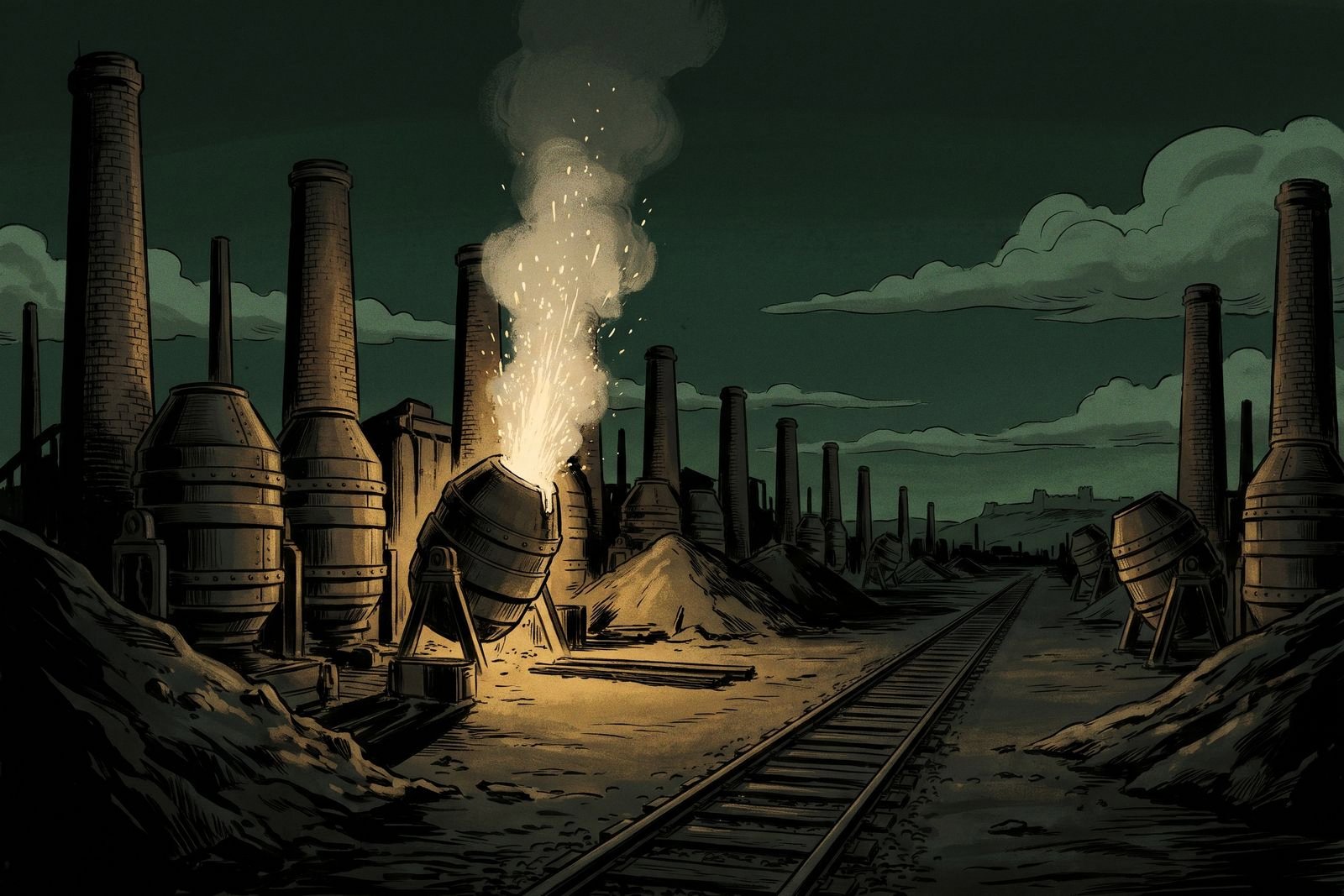
1878–1879Six Months of Protection
A provisional patent in 1878 buys six months. Within them the applicant must file a complete specification and pay its fees. If he does not, the protection lapses, and what he described belongs to whoever can make it work. Sidney Gilchrist Thomas, a clerk at a London police court who studies chemistry in the evenings, lodged his provisional in November 1877 in his own name alone. The clock runs to May.
What he has described is simple to state. The Bessemer converter makes cheap steel by blowing air through molten pig iron, but its lining is acid, made of silica, and any phosphorus in the iron goes back into the metal and makes it brittle. A lime flux would hold the phosphorus in the slag, but lime eats an acid lining. Line the vessel with a basic material instead and the chemistry turns in the ironmaster's favour. The difficulty is that no basic lining yet survives more than a few blows. George Snelus patented the idea in 1872 and cleaned 3–4 ton charges in a vessel lined with overburnt lime. He never built a lining that lasted.
The prize is geological. Bessemer steel runs on low-phosphorus haematite, which is scarce and dear. The cheap ores lie elsewhere. One is the ironstone of Cleveland, on which Teesside has built some hundred blast furnaces. Another is the minette of Lorraine and Luxembourg, roughly a third iron and up to two per cent phosphorus, which makes a fluid pig iron good for castings and useless for steel. Since the peace of 1871 that basin has been cut three ways, and the German share sits in the annexed Moselle.
In March 1878 Thomas tells the Iron and Steel Institute that he has dephosphorised iron in the converter. The Institute holds its two general meetings in May in London and in the autumn elsewhere, so a March meeting is an ordinary London sitting, and the members let an amateur's claim pass. It goes on the record. That is enough to make the principle public, and not enough to make anyone try it.
Thomas dies in London in the first days of April, a fortnight short of his twenty-eighth birthday, of the illness he has carried for years. The trials at Blaenavon, run at weekends by his cousin Percy Gilchrist, chemist at a Welsh ironworks near insolvency, stand about five weeks short of the provisional's expiry. The notebooks and the filing pass to the family's executors. They are asked for completion fees on an unproven invention by a dead clerk, and they decline. Gilchrist's name is not on the provisional, so he has no standing to complete it. May comes, and the protection lapses.
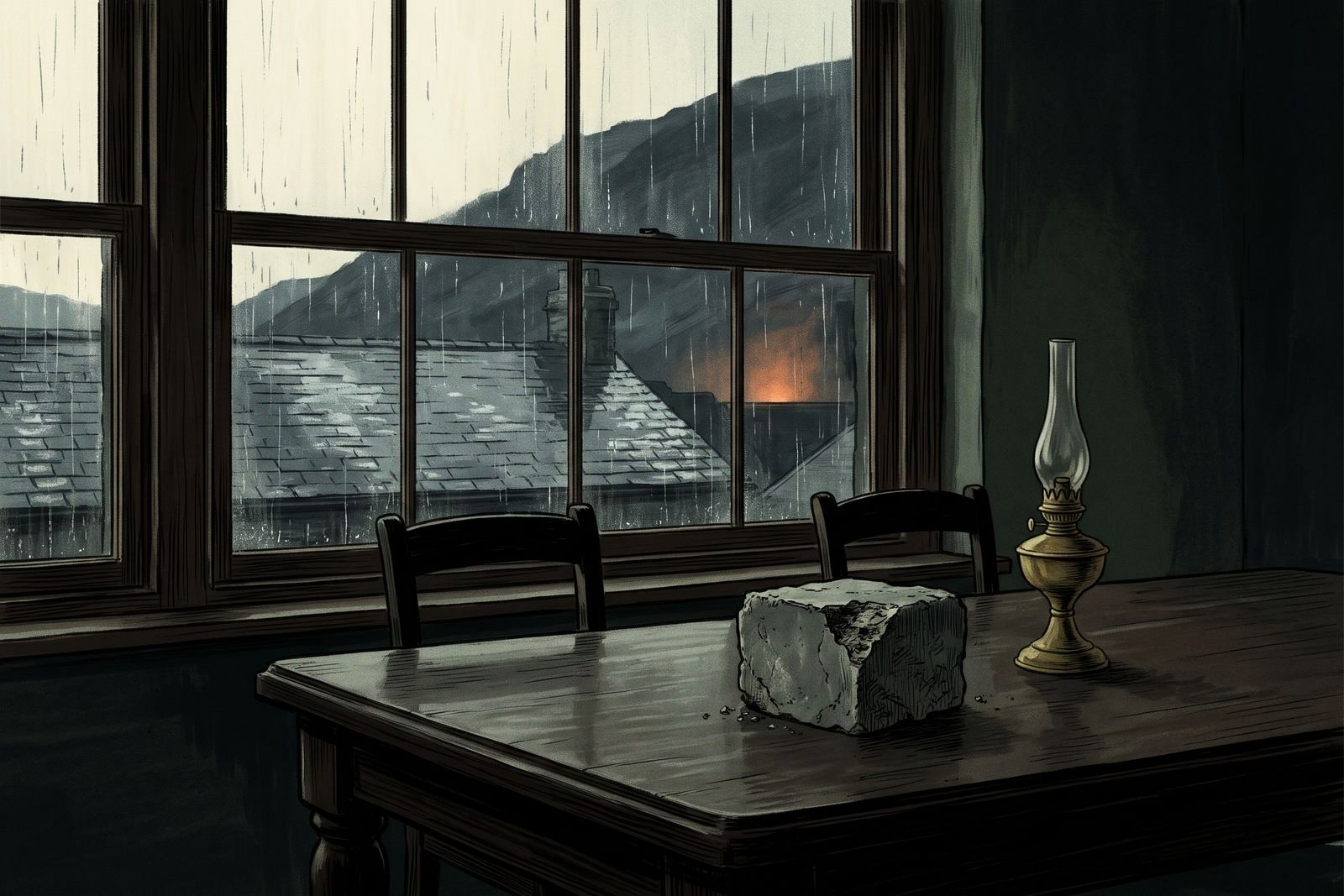
The board of the Blaenavon company meets in July, in a room above the works offices. It is late afternoon. Rain comes off the hill onto the slates, and through the window the furnace bell marks a cast. On the table lies a piece of the trial lining, grey and crumbled at one edge, brought up to show what the weekends produced. The manager had promised Thomas furnace time and help with the patent, but he made that promise to a man, and the man is dead. The directors have creditors to answer and a Welsh iron trade losing to foreign competition year by year. They withdraw furnace access from the experiment and forbid the company's chemist to spend company time on it. The piece of lining goes back downstairs with the papers. Gilchrist hears the minute read to him the next morning.
Snelus's patent comes up for its seventh-year renewal in 1879. Paying the duty keeps a claim on a process nobody has made work, and two things make it worth paying. The Paris Exhibition of 1878 has given him a gold medal for his dephosphorisation chemistry, and there is a buyer. The founding chairman of Bolckow, Vaughan died in June 1878, and his nephew Carl Bolckow now runs a firm registered in the 1860s with £2,500,000, the largest company formed to that date. It employs nine thousand men on an ore base of phosphoric Cleveland stone that the rise of steel threatens to make worthless. It has made Bessemer steel on Teesside since 1875, fed on haematite. Carl Bolckow wants a hedge. Snelus pays the duty, and Bolckow, Vaughan takes the exclusive British licence.
The trials go to the firm's general manager, Edward Windsor Richards, who had planned a Bessemer department in Wales before he came north.
1879–1897The German Process
A miner at Esch, thirty in 1879, has dug minette since he was fourteen and now digs it three days in six. His ore goes to furnaces that make foundry pig and nothing else. Luxembourg sits inside the German customs union, and the iron tariff the Reich adopts in July 1879, for reasons of its own, shields that pig from British imports without making it any better. The furnaces stay lit. The pit works short time.
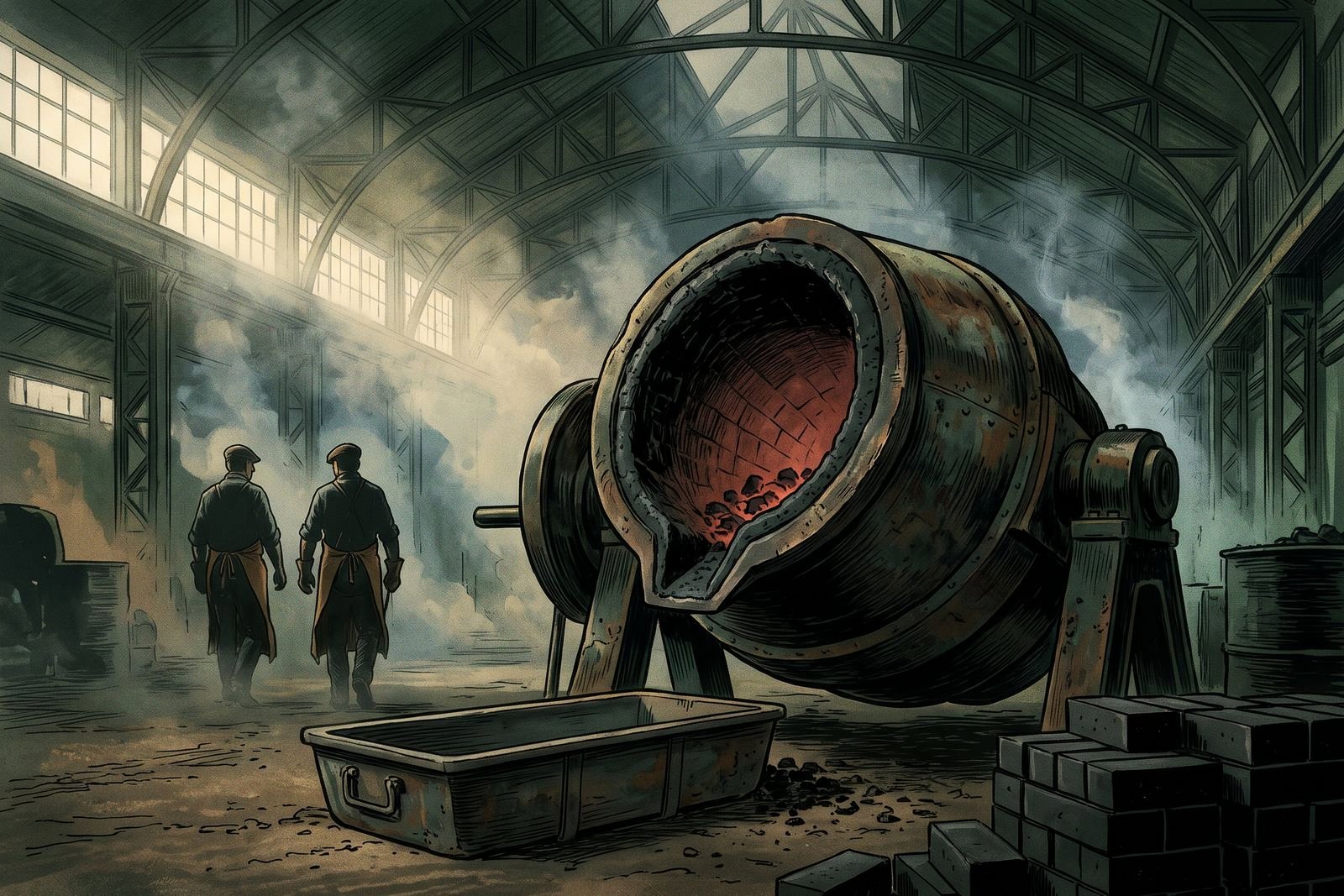
In the Reichstag the annexed province becomes a line in the budget. Deputies ask what the Reich is paying to garrison and administer a territory whose famous ore yields the cheapest metal in Europe. A geologist on the 1871 boundary commission had argued that the line should take in the minette. Whether his argument moved anyone has never been settled, but from 1879 the opposition repeats it as a joke. The government answers with the fortress at Metz, and the answer holds.
On Teesside Richards runs blow after blow under the Snelus licence. The phosphorus comes out. The lime linings fail within a handful of charges, and relining costs more than the steel can carry. Bessemer output continues on haematite, and the haematite comes from Bilbao, where in 1882 the ore trade loads more ships than ever before, on British capital and the labour of migrants from the Spanish interior. That summer the Esch miner's pit stands idle. His younger brother leaves for the American Midwest, one of the thousands who go between 1879 and 1884 and fill the Luxembourgish parishes there. In the Cleveland ironstone villages the pits go on short time, and the firm's accounts show the strain of licence fees, cold furnaces and imported ore.
A British licence binds nobody on the continent. At Hörde, in the Ruhr, and in works across Luxembourg and the annexed province, teams with no patent to wait for and every reason to hurry run their own lining trials, and most of them fail. The Hörde company bets on its own men. Between 1880 and 1883 it buys majority stakes, at depression prices, in Luxembourg works, including the new site at Dudelange, and in minette concessions on the German side.
Around 1883 the Hörde chemists solve it: a lining of burnt dolomite bonded with tar, lime added early in the blow, and an after-blow to finish off the phosphorus. They patent lining and routine under the Reich law of 1877, for fifteen years, and file in France, Belgium, Luxembourg, Britain and the United States. In German it is the Hörder Verfahren, the Hörde method. English ironmasters call it the Hörde process, and the ones who resent it call it the German process.
From 1884 the minette is worth digging. The Esch miner goes back to full shifts under managers sent from the Ruhr, beside men recruited from the Rhineland. Nobody in the Reichstag tells the joke about the geologist any more.
The licences follow the frontier. Works inside the Hörde group and in the annexed province pay little. French works across the border in Meurthe-et-Moselle, and Belgian ones, pay heavy royalties and accept limits on export, terms that harden after the arrest of a French police official on the frontier in 1887. The old Lorraine ironmaking family whose plants lie on both sides of the line is licensed at one and refused at the other. French engineers spend the early 1890s on magnesite linings that avoid the patent and partly work. Deep prospecting of the Briey field waits.
Phosphorus taken out of steel goes into the slag, and ground slag is fertiliser. The Hörde group sells it to German farms and to British ones. French agriculture buys rock phosphate abroad, and the Tunisian deposits are opened in the 1890s on that demand. In the United States the basic process arrives under Hörde licence, and in Alabama the furnaces stay longer on foundry pig made from phosphoric southern ore. Much of that ore is dug by convicts whom the state leases to the mines, most of them Black men arrested under laws written to keep the leases full. Every year the trade lasts is a year more of men working, and dying, under the lease.
Bolckow, Vaughan settles in 1885. It trades its Snelus rights for access to the Hörde lining, and Teesside's first commercial basic steel runs under German licence. Snelus's own term ends in 1886. Every basic works in Britain pays royalties to the Ruhr until the British patent expires around 1897, and when the Made in Germany scare breaks in 1896, the royalties are its favourite exhibit. At the Institute, Snelus's partisans argue his priority. A smaller party argues for the dead clerk, whose lapsed provisional they cannot use and will not let go. German steel output passes Britain's around 1897. The clerk's partisans like to recall what his chemistry teacher told the evening class, years before any of it: "the man who eliminated phosphorus in the Bessemer converter would make his fortune."
1898–1921Briey in a Hurry
Briey, on the French side of the minette basin, sinks its shafts in the year the German patent lapses. From 1898 any works in Meurthe-et-Moselle can line a converter with tar and dolomite without paying the Ruhr, and every one of them wants ore at once. Concessions that would have been proved over twenty years are sunk in five. The labour comes from Italy.
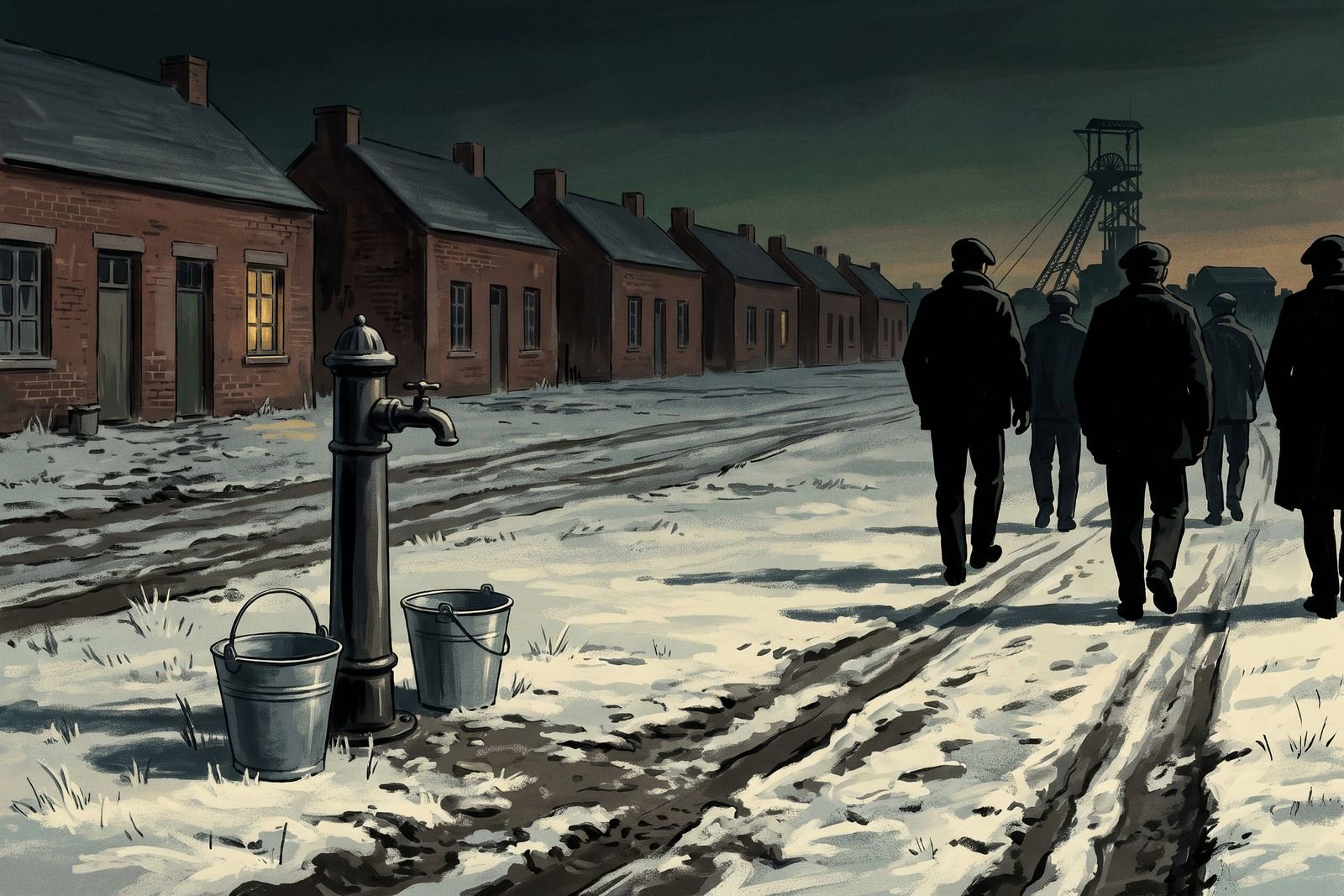
A woman of twenty-two from the Italian north keeps house for her husband and four lodgers in a cité, a company row of two-room houses at the edge of the field, built in a single winter. At six on a January morning in 1906 she stands in the queue at the row's one standpipe with two zinc buckets, while the night shift walks past in the dark from the pithead. A notice nailed to the post above the tap, in French she cannot yet read, says the water must be boiled. Typhoid has come through the cités every winter since they went up, in rooms built faster than their drains, and the company doctor keeps the count. She boils the water. Two of the lodgers are sick by February.
The census of 1910 draws the line the patent drew. On the German side, the furnace towns of the Moselle are full of Reich Germans, managers and skilled men who came west with the boom of the 1880s. On the French side the new towns speak Italian at the pithead. By 1913 Briey produces a fraction of what an earlier start would have given it, and France enters the decade with a thinner steel base than its generals assume. In Britain the tariff reformers of 1903 hold up the Hörde royalties as proof of German method, and the elections of the decade go no differently.
The war of 1914 comes for its own reasons: the alliance blocs, the Balkans, the mobilisation timetables. None of them runs through a converter lining. German troops take the Longwy–Briey basin in the first weeks and find less in it to take. War-aims memoranda in the Reich claim the field as Hörde country. France's shell steel leans earlier and harder on British and American imports. The woman stays behind the German lines with three children while her husband serves in the Italian army; the mine works for the occupier at half strength. The war ends as it ends.
The Moselle returns to France. The expulsions of Germans who came from east of the old border are larger than they would have been, because the boom of 1884 to 1914 was run by them, and the trains out of Metz carry engineers and their families back to the Ruhr. In Luxembourg the works at Esch and Dudelange are subsidiaries of German companies, so Allied sequestration takes most of the country's steel and sells it to French groups. The referendum of September 1919 keeps the grand-ducal dynasty and prefers economic union with France. The new French owners want their works inside the French tariff, and Paris agrees: a customs and monetary union in 1920–21, with the French franc in Luxembourg shops. Belgium, which had wanted the duchy in its own orbit, is cooler toward Paris for the rest of the decade.
In the Briey cité the woman's husband comes home in 1919 and goes down the same shaft.
1926–1973The Seat on the Meuse
A clerk in the sales office at the Esch works, in the autumn of 1926, enters the plant's tonnage for the new European steel cartel in a column headed France. Luxembourg's quota is counted inside the French one. The Depression arrives on its real schedule and empties the order book.
German troops occupy the duchy in May 1940. It is annexed in 1942, its young men are conscripted into the German army, and the country answers with the general strike of that year; none of this depends on who owned the furnaces. What changes is how the furnaces are taken. The works have been French property since 1919, so they are seized outright as enemy assets, and German managers come back to Esch and Dudelange. Older men in the canteens say the Ruhr has returned. Liberation comes in 1944, and the Ardennes winter after it. Luxembourg goes back into the French union. The customs convention signed in London in 1944 binds only Belgium and the Netherlands. French exchange controls bind every bank in the duchy, and foreign money finds no reason to come.
The six states that sign the Treaty of Paris in 1951 include a sovereign Luxembourg, and the bargain at its centre, French and German coal and steel under one authority, is the bargain of the record. The seat goes elsewhere. A duchy that shares France's money and customs is no neutral ground to the Germans or the Dutch, and Belgium's candidate wins.
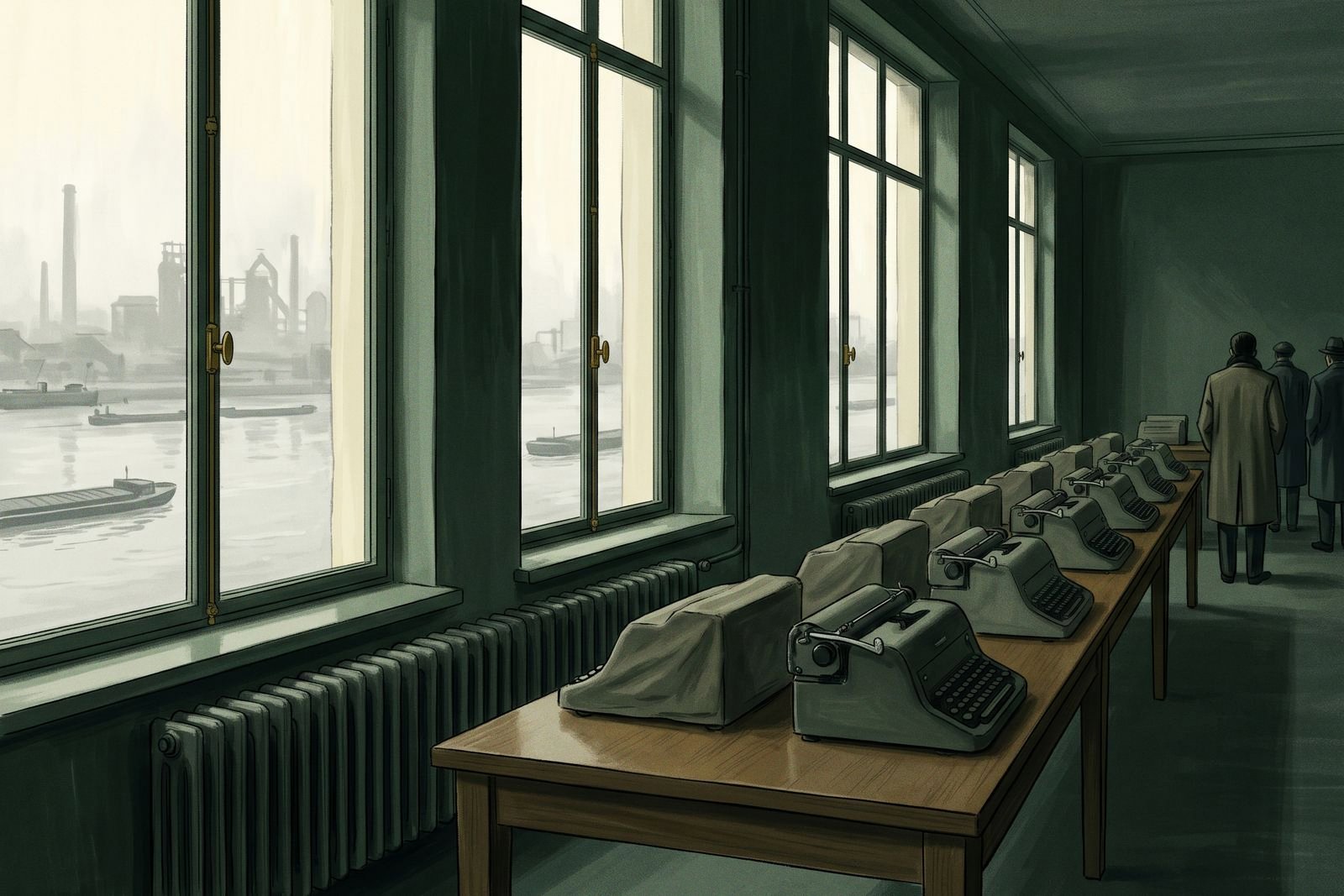
At half past seven on an October morning in 1952, a porter carries typewriters up the stairs of a former insurance building on the quay at Liège. Some have French keyboards and some German, and he sets the German ones on the left because nobody has told him otherwise. Barges sound on the Meuse below. Upstream the steel valley's furnaces show through the haze, and the first interpreters of the new High Authority, the body that will run the coal and steel market, stand in the hall with their coats on, waiting for the heating.
The Treaty of Rome follows in 1957, with the same six. The merger of 1965 settles the map in Belgium's favour. Brussels takes the Commission and the Council; Liège keeps the Court of Justice and receives the European Investment Bank and the Parliament's secretariat. The plenaries stay in Strasbourg. Liège fills with translators and lawyers, and its steel valley declines more slowly than it would have. In Luxembourg the Kirchberg plateau stays farmland.
Oxygen steelmaking displaces the basic converter through the 1960s, and cheap high-grade ore from overseas displaces minette and ironstone alike. The last Cleveland ironstone mine closes in 1964.
1974–2026Decided in Paris
The Esch miner's grandson, a furnace keeper at Belval, is thirty-seven when the oil shock of 1974 cuts the orders. The crisis has its own causes: oil, global overcapacity, ore from overseas. What the bend decides is where it is managed. The Minett works, the furnace belt of southern Luxembourg, are counted inside France's plans, inside France's share of the Community's crisis quotas of 1980, and inside the state groups Paris nationalises in 1981–82. There is no tripartite table in Luxembourg where unions, owners and government settle wages and retirements. Those are set in French ministries.
When the riots at Longwy break out in 1979, they spill across the border into Esch. The furnace keeper takes early retirement in 1984, at forty-seven, under a settlement his union never voted on. His son goes to Metz and his daughter to Paris, and the duchy's population stops growing.
In the cité at the edge of the Briey field, where the mines close with the rest of Lorraine's in 1997, the Italian rows have become the centre of a large Franco-Italian community, and the standpipe is long gone.
The 1985 accord to abolish frontier checks keeps its content and its parties. Belgium and the Netherlands hold their customs union alone, Luxembourg has no presidency to host a signing, and the pact takes the name of a town in the Low Countries. Schengen remains a wine village on the Moselle. Maastricht in 1992 is a Dutch presidency matter and runs as recorded. French exchange controls end in 1989–90. By then the fund passport the Community created in 1985 has found its homes, chiefly in Dublin. A few private banks in Luxembourg keep accounts for old French and Belgian families.
The duchy adopts the euro alongside France in 1999, and in 2002 it swaps the French franc it has used since 1921 for coins bearing the Grand Duke's profile. The crash of 2008 and the euro crisis come from American mortgages and peripheral debt. A country with almost no finance loses little in either and has no surplus to spend on its rust belt. The leak of tax rulings in 2014 has nothing to expose in Luxembourg, and the decade's corporate-tax scandals centre on Dublin and the Netherlands.
The steel consolidation of 2002 is headquartered in Paris, and its later foreign takeover is a matter of company ownership. Teesside's last blast furnace closes in 2015. Teesside votes Leave in 2016. The pandemic follows, then the energy shock of 2022. Port Talbot's blast furnaces end in 2024, and the government takes control of British Steel at Scunthorpe in 2025. The definitive phase of the European carbon border levy begins in January 2026, and the last Lorraine finishing mills report that Indian slab is cheaper even with the charge. The Teesside regional news calls the British Steel rescue the end of a story that began under German licence. At Blaenavon a glass case holds Percy Gilchrist's notebooks beside the provisional of November 1877.
The museum boards at Belval say the works were owned first from the Ruhr and then from Paris. This spring the Esch pensioners' union petitions a Paris ministry, again, over the 1984 retirement settlement. The furnace keeper is eighty-nine, and he signs it.
1878Sidney Gilchrist Thomas dies in London aged 27; his sole-name provisional of November 1877 is left unprotected
Weeks after his disregarded March announcement to the Iron and Steel Institute, the police-court clerk dies of the chronic illness that in our history killed him in 1885. On the DNB dating his only filing is a provisional lodged in his sole name in November 1877, whose six-month protection runs out in May 1878. At death the Blaenavon trials stand some five weeks before that protection lapses. The whole effort had rested on one salaried amateur, his cousin's job and a manager's goodwill, and nobody is placed to carry it forward.
5 SOURCED CAUSES
1878The provisional lapses, no complete specification is filed, and Blaenavon closes its furnaces to the experiment
Three hinges fail together. (a) The provisional and the laboratory notebooks pass to the Thomas family estate, whose executors decline completion fees for an unproven invention by a dead clerk. (b) Percy Carlyle Gilchrist was not an applicant on the November provisional and has no standing to complete it, so the May 1878 specification is never filed. (c) The Blaenavon board, fighting insolvency, withdraws furnace access from summer 1878 and forbids its chemist company time for the work. E. P. Martin's undertaking, made to Thomas personally, is swallowed by the company's fight to survive. The principle of a basic lining is now prior art through the March announcement and Snelus's 1872 patent, but a durable lining and a working routine remain patentable by whoever achieves them.
8 SOURCED CAUSES
1879Snelus renews his 1872 patent; Bolckow, Vaughan takes an exclusive British licence
Snelus pays the seventh-year renewal duty instead of letting his basic-lining patent lapse. Two things make it saleable. One is the gold medal he received at the 1878 Paris Exhibition for dephosphorisation chemistry; no working basic process yet exists. The other is a buyer. Carl Bolckow, chairman since his uncle's death in June 1878, wants a hedge against the rise of steel ruining a firm built on phosphoric Cleveland ironstone, and Bolckow, Vaughan acquires exclusive British rights.
6 SOURCED CAUSES
1879German iron tariff keeps minette furnaces alive but steel-less; the Reichstag argues over the annexed province's cost
Germany's July 1879 iron tariff, adopted for reasons independent of the divergence, shields Zollverein foundry pig. Luxembourg's minette pig is included. Blast furnaces in the Reichsland and the Minett survive on foundry iron but cannot make Bessemer steel. Through 1879–83 the annexed Lorraine ore is commercially worthless for steel. Reichstag speakers question the expense of garrisoning and administering a province whose iron beds yield only cheap foundry metal. The dispute over whether the 1871 border was drawn for minette becomes a parliamentary taunt rather than a boast.
6 SOURCED CAUSES
1880Richards's Eston trials dephosphorise but linings fail; Cleveland steel runs on Bilbao haematite
Under the Snelus licence, E. W. Richards runs repeated basic trials at the Cleveland Steel Works. Phosphorus is removed, but lime linings fail within a handful of blows. Eston's Bessemer output continues on haematite shipped from Bilbao. The haematite premium extends the Biscay boom, financed by British capital and drawing Castilian and Galician migrants into the Biscay mining belt. It also presses Bergslagen ironmasters who had resisted large-scale export. The East Cleveland ironstone villages slump as pig-iron demand stagnates, and Bolckow, Vaughan's balance sheet shows visible strain from licence costs, idle furnaces and imported ore.
8 SOURCED CAUSES
1879Continental lining race; Hörder Verein consortium buys up distressed Minett and Reichsland assets; Luxembourg emigration surges
A British grant binds nobody at Hörde, Esch or Hayange, so the continental delay runs on an engineering clock. Competing lining trials at the Hörder Verein, Rheinische Stahlwerke, Luxembourg works and Reichsland plants mostly fail. From 1880 to 1883 a Ruhr consortium led by the Hörder Verein buys majority stakes in depressed Luxembourg works, including Eich and the new Dudelange site, and in Reichsland minette concessions at depression prices, as a bet on its own trials. Luxembourg's 1879–84 emigration wave to the American Midwest proceeds as on the record.
5 SOURCED CAUSES
1883Hörde team patents the tar-bonded dolomite lining and working routine: the Hörder Verfahren
A works team under the chemist Friedrich Aldenhoven, a fictional figure, solves durability with a lining of tar-bonded burnt dolomite, combined with early lime additions and an after-blow. Lining and routine are patented under the 1877 Reich patent law, with a 15-year term to about 1898. The team also files in France, Belgium, Luxembourg, Britain and the United States. The names that stick are Hörder Verfahren in German, Hörde process or, colloquially, the German process in English, and procédé de Hörde or procédé allemand in French.
5 SOURCED CAUSES
1884Licensing decade: cheap terms inside the Reich group, punitive terms for France and Belgium
The consortium licenses Reichsland works and its own Luxembourg plants cheaply. It imposes heavy royalties and export restrictions on Meurthe-et-Moselle and Belgian works, hardened after the 1887 Schnaebele affair. The de Wendel firm is split: its Hayange works in the Reichsland is licensed, while its French-side works are not. French engineers pursue costly non-infringing magnesite linings with partial success in the early 1890s. Deep prospecting of the Briey field is deferred along with demand. From 1884 the Reichsland and Minett boom on Reich-German labour from the Saar, Eifel and Rhineland under German managers. Basic slag is sold as Hörder Schlackenmehl in Germany and to British farmers. French agriculture leans on imported rock phosphate, which hastens development of the Tunisian beds in the 1890s. Lapland ore waits on a Hörde licence. Germany overtakes British steel output around 1897.
6 SOURCED CAUSES
1885Bolckow, Vaughan cross-licenses the German lining; British basic steel pays royalties to Hörde
In 1885 Bolckow, Vaughan trades rights under its Snelus licence for access to the Hörde lining, and the first commercial basic steel on Teesside runs under German licence. Snelus's term ends in 1886. Until the consortium's British patent expires around 1897, every British basic works pays royalties to the German group, the reverse of our world's flow. In 1896 the Made in Germany scare is sharpened by the royalty question. The reversal is cited in trade journals and at Iron and Steel Institute meetings.
6 SOURCED CAUSES
1898French Lorraine's compressed boom at Longwy and Briey after the German patent expires
With the Reich patent lapsed, Meurthe-et-Moselle works adopt dolomite linings freely, and Briey concessions are sunk in haste. Labour is recruited heavily from Italy into fast-built cités, where typhoid and overcrowding take a documented toll. By 1913 Briey yields a fraction of our world's tonnage, and France's steel base is thinner. In Britain the 1903 tariff-reform campaign cites the Hörde royalties as an example of German industrial advantage; this is texture only, and no election result changes.
4 SOURCED CAUSES
1914War on its real drivers; the occupation of Longwy–Briey captures less
War breaks out for its documented reasons. German forces occupy the Longwy–Briey basin as in our history but take a smaller industry, because there is less built to take. German war-aims memoranda claim the field as Hörde-process country. France's munitions steel depends earlier and more heavily on British and American imports. The war's outcome is unchanged.
3 SOURCED CAUSES
1918Moselle returns to France; sequestration takes almost all of Luxembourg's steel; Franco-Luxembourg union
The Moselle reverts to France. Expulsions of Altdeutsche are larger, because the 1884–1914 Reichsland boom was staffed by Reich Germans. ARBED never formed in 1911, since Eich and Dudelange were German subsidiaries. Allied sequestration therefore takes most of Luxembourg's steel industry, and the works are sold to French groups. The real September 1919 referendum retains the dynasty and prefers economic union with France. The new French owners lobby to bring their Minett works inside the French tariff, and Paris accepts a Franco-Luxembourg customs and monetary union in 1920–21 instead of deferring to Belgium. The costs are a cooler Franco-Belgian relationship through the 1920s and no Belgo-Luxembourg union.
3 SOURCED CAUSES
1926Cartel quota inside France's; Luxembourg rejoins the French union; ECSC seat goes to Liège
The 1926 steel cartel forms with Luxembourg's quota counted inside France's. The Depression, the 1940 German annexation and liberation run as in our history. The 1944 London customs convention is Belgian–Dutch only, and Luxembourg returns to the French union. French exchange controls, in force until the late 1980s, bind Luxembourg banks, so no offshore financial centre grows. In 1952 a duchy inside French customs and monetary union is no neutral compromise to Bonn or The Hague. The ECSC High Authority sits instead at Liège, Belgium's candidate, and the Court of Justice and later the European Investment Bank follow. Luxembourg remains a sovereign founding member of the ECSC and EEC. Community literature says Hörde-Stahl in German and acier basique in French, while British technical writing keeps the priority quarrel alive.
3 SOURCED CAUSES
1957Oxygen steel, imported ore and closures on their real dates; the Minett contracts under Paris
Oxygen steelmaking displaces the basic converter, and imported high-grade ore displaces minette and ironstone. The last Cleveland ironstone mine closes in 1964 and Lorraine's mines in 1997. Redcar closes in 2015, Port Talbot's blast furnaces in 2024 and Scunthorpe faces its 2025 crisis, all against the backdrop of Brexit, COVID, the 2022 energy shock and the EU carbon border mechanism. The Minett's 1970s–80s contraction is run from Paris within French state-led restructuring. There is no Luxembourg tripartite model and no finance sector to absorb the losses, so the Grand Duchy deindustrialises poorer. The Minett works sit in the Usinor lineage, and the 2002 consolidation is headquartered in Paris; the later foreign takeover is a matter of company-level ownership only.
4 SOURCED CAUSES
1940Second World War on its own drivers; the French-owned Minett works pass to Ruhr managers again
Ruling: outbreak and course UNCHANGED. The divergence moved where Europe's basic steel was made and who paid royalties, but not the war's drivers: the Versailles settlement, the Depression and Nazi revanchism. Germany had overtaken British steel c.1897 in our history too. The Lapland ore that waited on a Hörde licence had reached full scale long before 1940, so the Narvik campaign is UNCHANGED. Luxembourg's occupation, its 1942 annexation into Gau Moselland and the 1942 general strike against conscription are UNCHANGED. ALTERED: the Minett works were French property after 1919–21, so they are seized outright as enemy assets rather than placed under supervision. German managers return to Esch and Dudelange, and local memory reads this as Essen coming back. Liberation in 1944–45, the Ardennes offensive included, is UNCHANGED. Luxembourg then re-enters the French union.
4 SOURCED CAUSES
1951Six founders unchanged; Liège, not Luxembourg, becomes the Communities' judicial and banking seat
Ruling: the Treaty of Paris (1951) and the Treaty of Rome (1957) are UNCHANGED in substance and signatories. The six include a sovereign Luxembourg, and their driver, the Franco-German coal-and-steel settlement, is untouched. ALTERED: Luxembourg sits inside French customs and monetary union, so it is no neutral compromise to Bonn or The Hague. The High Authority therefore sits at Liège, and the Court of Justice follows. The 1965 Merger Treaty settles the institutional geography in Belgium's favour: Brussels hosts the Commission and Council, Liège keeps the Court and receives the European Investment Bank and the Parliament's secretariat, and Strasbourg's plenaries are UNCHANGED. Kirchberg stays farmland. Liège gains a translators' and lawyers' economy that softens, but does not stop, the decline of its Meuse steel valley.
3 SOURCED CAUSES
1974The steel crisis reaches the Minett through Paris: quotas, nationalisation and no tripartite
Ruling: the crisis itself is UNCHANGED. Its drivers were the oil shocks, global overcapacity and imported high-grade ore, none of which the divergence touches. ALTERED is who manages it in Luxembourg. The Minett works are counted inside France's plans and inside France's share of the 1980 ECSC 'manifest crisis' quotas. They become state property when Usinor and Sacilor are nationalised in 1981–82. There is no 1977 Luxembourg tripartite settlement: wages, early retirement and redeployment are set in French ministries. The 1979 Longwy riots spill across the border into Esch. Unemployed young Minetters go to Metz, Nancy and Paris, so the Grand Duchy's population stops growing.
4 SOURCED CAUSES
1985Border-free accord signed elsewhere; capital controls lift too late for a fund centre
Ruling: the 1985 accord to abolish frontier checks, and the 1990 convention implementing it, are UNCHANGED in content and parties. They are ALTERED in name and venue. Benelux in this world is Belgian–Dutch only, so Luxembourg holds no presidency to host the signing. The pact takes a Benelux venue's name, and Schengen remains an obscure Moselle wine village. Maastricht (1992) is UNCHANGED; it was a Dutch presidency matter. French exchange controls end in 1989–90. By then the 1985 UCITS fund passport has found its homes, chiefly Dublin's new financial centre. Luxembourg gets only a private-banking niche serving old French and Belgian families.
2 SOURCED CAUSES
1999Euro arrives with France; the financial crises pass a duchy with little finance
Ruling: the euro (1999, notes and coins 2002) is UNCHANGED for the eurozone. ALTERED for Luxembourg: it swaps the French franc it had used since 1921, not a Luxembourg franc pegged to Belgium's. It mints its own national-side coins as a sovereign member. The 2008 crash and the euro crisis are UNCHANGED in their drivers, the US mortgage market and peripheral debt. The Grand Duchy, with no fund or interbank industry, takes little direct banking loss but has no surplus to cushion its rust belt. The 2014 leak of tax rulings is AVERTED in its Luxembourg form, because there is no ruling industry for it to expose. The corporate-tax scandals of the decade centre on Dublin and the Netherlands.
2 SOURCED CAUSES
2015Last furnaces close on their real dates; the 'Hörde process' resurfaces in Britain's steel debates
Ruling: the closures are UNCHANGED, because their drivers are global prices, energy costs and carbon policy. Redcar shuts in 2015. Brexit (2016) is UNCHANGED, its drivers untouched, and Teesside votes Leave as recorded. COVID and the 2022 energy shock follow. Port Talbot's blast furnaces end in 2024, the government takes control of Scunthorpe in 2025, and the EU carbon border mechanism's definitive phase begins in January 2026. The Paris-headquartered 2002 steel consolidation and its later foreign takeover are UNCHANGED at company level. Cultural residue is ALTERED. Commons and Teesside press commentary on British Steel's rescue recalls that the district's first basic steel ran under German licence. Belval has no university campus: Luxembourgers study in Nancy, Metz or Liège, and the furnaces stand as an industrial museum.
5 SOURCED CAUSES
Every one of these worlds was weighed against the one you have just read. Here is where each of them breaks.
Thomas's death simply delays basic steel everywhere: no one can line a converter until George Snelus's British patent of 1872 runs out in 1886, several works then reach the lining independently and royalty-free in 1887–89, and by 1905 the world has settled back onto the one we know.
We weighed it first because it is the tidiest consequence of the clerk's death. It breaks in the 1880s on jurisdiction: Snelus's patent binds only Britain, and the ironworks of Luxembourg and Lorraine, squeezed since the crash of 1873, face no legal gate at all. It also forgets that the durable lining, not the chemistry, was the real invention, and whoever made it first could patent it and charge everyone else. The return to our world after 1905 is asserted, not shown. Beyond the error of cause, it is a road that hurries home: defensible in its caution, but a smaller world than the one we chose to owe our readers here.
Percy Gilchrist and Martin, manager of the Blaenavon works, complete Thomas's patent specification themselves in May 1878 and carry the process forward as if he had lived.
This is the likeliest road of all, and that is its difficulty: it shrinks the whole divergence to a few months and returns to our world by the end of the 1870s. We closed it with documents rather than by wishing it away. The provisional of November 1877 was lodged in Thomas's name alone, so Gilchrist has no standing to complete it; the executors refuse to pay fees on an unproven invention; and in July 1878 the Blaenavon board, answering to its creditors, withdraws the furnaces. Each of those three doors had to shut for our world to open, and we say so plainly.
Bolckow, Vaughan on Teesside cracks the durable lining under Snelus's exclusive licence, and Britain holds a monopoly on basic steel through the 1880s.
We took it seriously: the firm had £2,500,000 in capital and nine thousand men, and Edward Windsor Richards had the skill to run the trials. It strains in the early 1880s on the odds, one licensed team in Cleveland racing several continental teams at Hörde and in Luxembourg who are working to stay solvent. Above all, it hands back the royalty map of our own world, a British patent holder with continental licensees paying in. That is a defensible road and a modest one. We took the other road, where the patent sits in the Ruhr, because it is equally plausible and carries the reader much further from home.
Snelus declines to pay the seventh-year renewal duty in 1879 and lets his dephosphorisation patent lapse.
It fails at the close of the 1870s on plain self-interest. The Paris Exhibition of 1878 had just given Snelus a gold medal for this very chemistry, and Bolckow, Vaughan, newly under Carl Bolckow after the founder's death in June 1878, wanted a hedge for its phosphoric Cleveland stone and could pay for one. A man with a medal and a buyer pays the duty. Even granting the lapse, it would only free British trials a few years early and leave the continental works, never bound by the patent, still ahead.
Berlin, judging the minette of the annexed Moselle worthless, hands the territory back to France in the late 1880s.
It breaks before it begins, in the 1880s, on the reasons the border was drawn in 1871: strategy and language first, ore at best a contested afterthought, and Metz a fortress the General Staff would not trade. The economics turn against it as well. Once the Hörde lining works around 1883, the minette is steel-worthless for only about five years, and it becomes valuable chiefly in German hands. By the late 1880s the Reich holds the field it would be handing back.
The German Reich absorbs an impoverished Luxembourg when the grand-ducal succession separates it from the Netherlands in 1890.
It breaks in the 1890s on the neutrality guaranteed by the powers in 1867, a treaty obligation no change in converter linings can buy out; to make it happen we would need a second miracle on top of the first. What survives is the economic version. German companies come to own the Minett works through the 1880s, the duchy stays sovereign, and the price is paid in 1919, when Allied sequestration strips those works from their owners.
Belgium annexes Luxembourg after the First World War, or France and Belgium govern it jointly.
It runs against the record in 1919: the referendum of that September kept the dynasty and voted for economic union with France. We kept the force behind the idea and changed its route. French groups buy the sequestered works, want them inside the French tariff, and Paris grants a customs and monetary union in 1920–21. That carries the duchy just as far from our world by 2026, through a vote that took place, and its price is a Belgium cooler toward Paris for the rest of the 1920s.
German harvests collapse a year earlier, in 1916–17, because German farms have gone without ground basic slag as fertiliser.
It breaks around 1884, three decades before the war, when the Hörde process brings phosphoric slag back onto German fields and the shortage ends. The delay in fertiliser is real, but in our road it falls on France, whose works pay royalties and whose farmers buy rock phosphate abroad. We moved the thread there, to the Tunisian deposits opened in the 1890s on that demand.
A longer British lead in steel takes the heat out of the Anglo-German naval race.
It breaks in the mid-1880s. Once the continental works solve the lining first, Germany's lag shrinks to about five years, and the lead never lengthens. The royalties then run the other way, from every British basic works to the Ruhr until around 1897, and they feed the Made in Germany alarm of 1896 rather than calming it. British fear of German industry sharpens under this arrangement.
The Great War of 1914 never breaks out, or it ends with a different victor.
We weighed it because steel is the arithmetic of a modern war. Every line of evidence we examined puts the war's causes elsewhere: the alliance blocs, the Balkans, the mobilisation timetables, none of which runs through a converter lining. So the 1910s keep their war and its result. What we changed is its industrial accounting and its peace: a thinner Briey, French shell steel leaning harder on imports, larger expulsions from the Moselle, and the Luxembourg works seized and sold.
The phosphoric iron ore of Kiruna in Swedish Lapland stays undeveloped a decade longer, and Sámi reindeer grazing lands are spared for those years.
It breaks on its own timing in the 1880s. With the lining solved on the continent around 1883, the wait for Lapland's ore is a few years, not ten, too short a delay to bend the region's history. We kept it as background colour beneath the main road and did not give it a road of its own.
Everything before the hinge rests on these readings. Under each title, the passage retained.
- Dictionary of National Biography, 1885-1900/Thomas, Sidney Gilchrist
Thomas took out his first patent in November 1877.
- Page:Dictionary of National Biography volume 56.djvu/197
Towards the end of 1875 Thomas arrived at a theoretic and provisional solution of the problem
- Sidney Gilchrist Thomas - Graces Guide
Took out a patent in May but without attracting much attention.
- Sidney Gilchrist Thomas - Graces Guide
1867 Teacher in an Essex school. Then clerk at Marlborough Street, police court
- THOMAS, SIDNEY GILCHRIST (1850 - 1885), metallurgist and inventor
He took out his first patent in May of that year, and others subsequently.
- 1911 Encyclopædia Britannica/Thomas, Sidney Gilchrist
obtained an appointment as a police court clerk, which he held till May 1879.
- Sidney Gilchrist Thomas | Britannica
he applied for a patent in 1877.
- Sidney Gilchrist Thomas | Science Museum Group Collection
Discovered (1875) a method for eliminating phosphorous from pig-iron
- Sidney Gilchrist Thomas Biography (1850-1885)
For twelve years (1867-1879) he held a menial job as police court clerk
- Thomas, Sidney Gilchrist | Encyclopedia.com
had patented the use of basic linings for the Bessemer converter in 1872.
- Dictionary of National Biography, 1912 supplement/Snelus, George James
In 1872 he took out a British patent for such a process
- George James Snelus - Graces Guide
at the Paris Exhibition of 1878
- Blaenavon and the 'Gilchrist-Thomas' Process
the man who eliminates phosphorus by means of the Bessemer converter will make his fortune
- Blaenavon historic landscape features
carried out experiments at their own cost at Blaenavon
- Blaenavon Ironworks - Wikiwand
Their experiments were carried out at Blaenavon between 1877 and 1878.
- Sidney Gilchrist Thomas FOLLOW THE FOOTSTEPS (Cadw)
In 1876, he began working on secret experiments at Blaenavon Ironworks.
- Steel heroes | IOM3
In March 1878 he announced his discovery at an ISI meeting, and took out a patent in May 1878.
- Steel - Bessemer Process | Britannica
it could convert only a pig iron low in phosphorus and sulfur.
- The Rise of Steel, Part II - by Brian Potter
Higher phosphorus ores resulted in metal that was unusable.
- The Bessemer Impact Historical Marker
His early trials had used Swedish iron ore, low in phosphorus.
- Industry evolution in steel | IOM3
relied on the procurement of low phosphorus ores from Sweden and South Wales
- Scandinavian iron ore mining and the British steel industry
The persistent opposition of the Central Swedish ironmasters to any development of their mines
- The Story of the Ironstone Miners of Eston - Family Tree
In 1864, Bolckow, Vaughan and Co was registered with capital of £2,500,000
- history of Bolckow Vaughan - Let's Look Again
Steel could only be produced from iron that was free from phosphorus
- Irons in the fire: Bolckow Vaughan - Let's Look Again
was appointed general manager of the firm from 1876.
- Bolckow, Vaughan and Co - Graces Guide
1878 On the death of Henry Bolckow, his nephew Carl became chairman
- Skelton in Cleveland - North Skelton street names
His successor was E. Windsor Richards as General Manager (another Welshman).
- Eston Mines 1864 (Teesdale Mercury, 11 May 1864)
Three or four miles from Middlesbrough lie the Eston mines
- Alsace-Lorraine | Encyclopedia.com
Germany acquired one-third of Lorraine—the German-speaking regions and a French-language area that included the city of Metz.
- Lorraine and the Ruhr - N. J. G. Pounds
There is no reason to suppose that the minette deposits were particularly attractive to the Prussian Chancellor
- Minette (ore): Mineral information, data and localities
containing around 28 to 48 percent of iron and 1.5 to 2 percent of phosphorus
- Minette - Minière Bunn
Since the local ores contain 1.7% phosphorus
- Geodiversity 2023: Discover the Minett from the inside - Biosphere
industrial iron ore mining only began after the introduction of the Thomas process
- Sidney Gilchrist Thomas - Wikipedia
Thomas and Gilchrist took out a patent in May, but without attracting much attention.
- Iron and Steel Institute - Wikipedia
There were two general meetings each year, one in May, in London
- Dorman Long - Wikipedia
The Discovery of the Cleveland Main Seam of Ironstone at Eston
- John Vaughan (ironmaster) - Wikipedia
he became a puddler, then a furnaceman, then foreman.
- Bolckow, Vaughan - Wikipedia
It had three coke fired haematite blast furnaces.
- Edward Windsor Richards - Wikipedia
In 1875, Richards was General Manager of the Eston Ironworks of Bolckow Vaughan
- Henry Bolckow - Wikipedia
(8 December 1806 – 18 June 1878) was a Victorian industrialist
- Minette (ore) - Wikipedia
The borders were determined such that much of the known Minette reserves were in German territory.
- Treaty of Frankfurt (1871) - Wikipedia
do not appear to have played a role in Germany's fight for the areas annexed.
- Dommeldange - Wikipedia
hampered by the impossibility of transforming cast iron made of oolite ore into steel
- Comptoir Métallurgique de Longwy - Wikipedia
the produced pig iron was initially of poor quality and unsuited for many uses.
- Steel industry in Luxembourg - Wikipedia
Germany's suppression of customs rights in 1873 and overproduction provoked an economic downturn
- Iron discovered in Lorraine early, Longwy-Briey annexed in 1871 (AlternateHistory.com)
What if the iron producing area of Longwy-Briey was discovered to have iron deposits prior to the Franco-Prussia war
A life in this world — an archival fiction
ESCHER COURIER
Saturday, 12 February 1887
NECROLOGY
M. NORBERT KIEFFER
Huissier at the Justice-of-the-Peace Court of Esch, 1866–1887
(From a colleague of the bar)
Esch has lost one of its most exact public officers. M. Norbert Kieffer, huissier attached to the justice-of-the-peace court of this canton since the spring of 1866, died at his home in the Grand-Rue on Tuesday morning last, in his fifty-fourth year. He had received the sacraments of the Church. He had also, in the course of his last day, asked the hour twice and corrected the clock once.
He was born at Esch on the 3rd of November 1833, second son of Jean Kieffer, cooper, of the Rue du Brill, and of Marguerite née Wagner. Those who remember the town of that time, when the first cuts were going into the red hillsides and a man could walk from the church to open fields in five minutes, remember the boy as the one who counted the hoops in his father's yard and knew when one was missing. He attended the communal school under M. Thomas Lentz and afterwards spent two years at the Athénée in the capital. He left it at his father's death to enter the étude of Maître Carl Faber, huissier at Luxembourg, as copying clerk at eight francs the month. He was sworn in at Esch by grand-ducal arrêté in April 1866. He was twice mentioned for Luxembourg and never sought it. The present writer was mentioned once.
No debtor between Rumelange and Mondercange can claim to have been charged one centime above the printed tariff. That tariff hung above his desk in a frame he made himself from the boards of a seized crate, and he could recite it, article and sub-article, faster than most of us say the Credo. The present writer has the same sheet above his own desk and has never got past copies of writs at forty centimes the rôle without looking up. M. Kieffer did not look up. When a farmer at Schifflange once offered him a ham to round off a bill of costs, he weighed the ham on the farmer's own scale, declined it, and entered the refusal in his register, with the weight.
The furnaces went out one by one. Clair-Chêne stood cold from the autumn of 1880, Lallange from the spring following. The Alzette works, which alone still advertises in these columns its "fluid pig for Belgian and Rhenish foundries," has worked two furnaces of five since the winter before last, and the men know which two. The court's business in those years went through M. Kieffer's hands, and there was a great deal of it.
He inventoried the Lallange works himself, over nine days in February 1881, with two clerks and a lantern. His procès-verbal, drawn in French on the printed form with marginal notes in German in his own small hand, is still shown to young clerks at the registry as a model. The present writer has seen the entry: "One blast-engine, Seraing make, sold by weight as old iron, 40 centimes the hundredweight." The same act records forty-one barrows, one without a wheel, and a cat, which was noted and not seized.
From that sale he kept a single pig of grey iron stamped with the Lallange mark, an L within a ring. It held open the door of his office for six years, and few visitors to the Grand-Rue have not stubbed a toe on it. He paid eighteen centimes for it, the sale price, and the receipt is pinned in his register beside the entry.
Twice he cried the sale of ore concessions which the State had offered at upset prices in the back pages of the Luxemburger Wort, and twice no bidder came. On the second occasion, in March 1884, the room at the town hall held the clerk, the mayor's secretary, the stove (which draws badly when the wind is in the west) and M. Kieffer. He read the conditions to the end, including the clauses on carriage by the Prince-Henri line and the concessionaire's obligation to fill in his cuts after working. He lit the three candles one after another, as the law prescribes, let each burn down, and declared the lot unsold. The fee was taxed in full on both occasions, as the tariff allows.
He read this paper, it should be confessed, from the back. The weekly emigration column, which we print beside the market prices for our country readers, he read before anything else, "to know the condition of the canton," and from the names in it he reckoned what work the court would have the month following. He was rarely out by more than two houses.
He had seen 1873 and the years after, and he said at the Hôtel du Commerce that the fires would be lit again as they were then, once the Belgians had used up their own ore and the price came round. He would hear no other forecast. When a young man from the Alzette laboratory spoke in his hearing of our minette as so much red dirt, M. Kieffer told him the red dirt had fed this canton thirty years and would feed it again, and that a man who wanted steel should go to Solingen and buy a knife.
The seals are not the huissier's office. The Code gives them to the juge de paix, with his registrar attending, and M. Kieffer could give you the article. But in the winter of 1885, when there were weeks M. Wilhelm sealed four doors a day in the lower town, it was M. Kieffer's tin of red wax that went down the hill with him, and M. Kieffer who held the stick to the candle. He said the registry's wax was half chalk and cracked by Easter. M. Wilhelm let him.
It is no secret at the registry that among the creditors of the two foundry concerns now in liquidation stands the court's huissier, for fees long due. He did not speak of it.
In November 1885 M. Kieffer had in his satchel a summons, at the instance of a cattle dealer of Bettembourg, against M. Peter Weber, butcher, of the Rue de l'Église, for 312 francs. The Kieffer household had bought its collar of pork for the Sunday Judd mat Gaardebounen at Weber's for many years, and had lately bought it, as many households in Esch have learned to, on the slate. M. Kieffer went into the shop at eight o'clock and asked for his account. Weber, who did not yet know why he had come, read it off the slate: eleven francs and some centimes, he no longer remembers how many. M. Kieffer remembered. He counted the money onto the marble, took his receipt, put it in his pocketbook, and then took out the summons and read it to the butcher over his own scale.
"Now we owe each other nothing," he is reported to have said, "and I may do my office."
Weber attended the funeral. Asked by the present writer at the church door whether he wished to say anything of the deceased, he turned his hat round twice and said: "He never cheated anyone by a sou. That was the trouble with him." We print it as he said it.
In the snow of January 1885 he walked across the beet fields at Dudelange, from the Bettembourg road past the farms to the far end of the village, to serve a citation on the dairyman Michel Hoffmann, who had sold one cow to two buyers. The citation could have waited for the thaw. Hoffmann, who had to dig him out of the drift by his own gate, told him so.
His house in the Grand-Rue, bought in 1871, he furnished largely from the public sales of the canton. He was a careful judge of value, and his cousin M. Mathias Kieffer, carter, often bid on his advice. Visitors remarked on the walnut, several pieces of which came to the house at prices a dealer at Arlon would not have believed. As to the wardrobe in the front bedroom, the present writer was at that sale.
He married, in 1859, at Wormeldange on the Moselle, Mlle Lilian Schmit, daughter of Jean-Pierre Schmit, vine-grower of that commune. Two children survive. He used to say he could value any house in the canton from its doorway, and his own he had never needed to value at all, since Madame Kieffer kept it and there had never been a sou missing at the year's end that he knew of. The household accounts he left entirely to her. In twenty-eight years he never once asked to see her book.
Their son, M. Charles Kieffer, has been for some time in America. Born at Esch in 1862, he was educated at the communal school and the industrial school in Luxembourg, and from 1880 clerked in his father's étude, where his hand was admired at the registry. His father meant him to succeed, and the examination had been spoken of. The staff at the station saw him most evenings reading the posted sailings of the Red Star company from Antwerp, which he could give from memory, steamer by steamer, as his father could give the tariff.
He left from Antwerp in April 1885, aboard the Waesland. His father was at Schifflange that morning on a seizure.
M. Kieffer told the present writer once that he often found papers of that sort, tickets and stubs and the printed instructions of the shipping companies, in kitchen drawers and at the bottoms of trunks among the effects he inventoried, and that he filed them in their order with the other papers of no value, as the form requires. He said there was a great deal of it lately.
A cable has been sent to New York, to the address last given.
By the will of his father-in-law, who died in 1879, Madame Kieffer inherited a half-share in a parcel of vines on the slope above Wormeldange, at the place called Koeppchen. The other half went to her brother, M. Henri Schmit, who has worked the whole since, kept the wine, and paid no rent for his sister's share, on what title the court will in due course decide. M. Kieffer put the sum owing at eighty-two francs a year with interest at four per cent, and wrote it in his register as at the last day of each December, under a heading of its own.
In the summer of 1884 he resolved to have the parcel partitioned and his wife's half sold, to furnish the marriage portion of his daughter, Mlle Miriam Kieffer, then engaged to M. Auguste Reding, clerk at the registry of Capellen. The law did not permit him to serve the papers himself. He engaged M. Hoscheit of Grevenmacher, and was particular as to the day. M. Hoscheit served them on M. Schmit in the square at Wormeldange on a market morning.
The case has been adjourned three times: once for an expert's report on the boundary stones; once at the defendant's request, the vintage being in; and once because Madame Kieffer, whose name stood first among the plaintiffs, did not attend. Mlle Kieffer's marriage has been put back.
At the feasts which still brought Schmits and Kieffers to one table, at Easter and the Wormeldange kermesse, he would not take the wine his brother-in-law brought, which came unlabelled in old bottles. He said he could not drink it in conscience while the case was pending. He took water, or Diekirch beer. This was remarked.
For twenty years he took his evening glass at the Hôtel du Commerce among the commercial travellers, Westphalians for the most part now the furnaces are out. One of them, a traveller in rails for a Dortmund house, complained most winters of the price of Swedish ore as other men complain of rain, and asked M. Kieffer across the table why Luxembourg could not make itself useful to anybody. M. Kieffer did not answer. He drank, by the patron's account, a white Moselle he declined to name, from a bottle without a label which the patron kept for him on the lowest shelf, and which went on the bill as "wine, the bottle, 1 fr. 20."
The cafés of our town have a word for a thing fine to look at and good for nothing. M. Kieffer was not given to slang, but he used it once of his brother-in-law's terraces, the walls Henri Schmit had rebuilt by hand the winter before, stone by stone up the slope. "Phosphoreg," he said. It was repeated in Wormeldange within the week.
In the last week of January he was called to the Rue de l'Alzette, to a house whose tenants, the furnaceman Nicolas Thein with his wife and four children, had gone to Antwerp at the New Year owing two terms' rent. The landlord sought distraint of what remained. It was a day of hard frost. The stoves had been cold a fortnight, two panes upstairs were broken, and M. Thill, attending as witness, proposed that the inventory wait until the frost broke and the house be shut up meanwhile.
M. Kieffer would not have it. He said what is left in an empty house walks off by itself if you give it a week.
He took four hours in the unheated rooms, by the light of the windows, and entered among other things: one table, deal; two chairs, one broken; one bedstead without bedding; one tin box containing papers of no value; one child's slate. He wrote the whole of it with his gloves off, as always, holding that the hand was truer so. He then locked both doors, took the key, and named as guardian of the effects the neighbour, the widow Reuter, who signed with a cross.
He was in bed by the Saturday and did not leave it. Dr. Schaack attended him. He died on the Tuesday, the eleventh day, at about six in the morning. The procès-verbal of the Rue de l'Alzette, completed and signed, was in his satchel. The copy, in his own hand, was in the cigar box on his desk with all his copies, in order of date, from 1866.
His affairs were found in order, the claims against the two foundry concerns excepted. The total stands in his own pencil beneath the printed tariff: 1,184 francs 35 centimes. The figure has been corrected in the same hand, by forty centimes. The present writer cannot say when, nor in whose favour. The liquidators have been informed.
The funeral took place on Thursday at St Joseph's, the Very Rev. Dean Kremer officiating. The juge de paix, M. Wilhelm, followed the coffin with the registrar and the clerks of the court, the huissiers of Bettembourg and Capellen, and such members of the communal council as were in town. The clerks carried the pall. Weber the butcher was there, as we have said, and some few others whose names the court has had occasion to know. They stood at the back.
He leaves his widow, Madame Lilian Kieffer née Schmit; his daughter, Mlle Miriam Kieffer; and his son, M. Charles Kieffer, of New York, not yet heard from. His cousin M. Mathias Kieffer led the family mourners in the son's absence.
At the meal afterwards in the Grand-Rue there was a case of Wormeldange wine without labels, which had come by the Moselle carrier the evening before, addressed to Madame Kieffer in her brother's hand, with no letter. It was drunk. Whether M. Henri Schmit was himself at St Joseph's this paper is not in a position to say.
Certain furniture of the household, a wardrobe in walnut among it, will be offered at the first public sale after the inventory, at the widow's wish.
As the Code requires when a public officer dies holding his office, seals were placed on M. Kieffer's étude on the morning of his death, before nine o'clock, by M. Wilhelm, juge de paix, the registrar attending and M. Thill, acting ad interim, standing by. The wax came from the tin on the desk, there being none at the registry that M. Wilhelm would use. His pen was found where he always laid it, beside the register. Among the papers awaiting inventory is the dossier Kieffer contre Schmit, adjourned to the April session at Grevenmacher.