The December 1935 Package
1935–1936The Canal Shuts
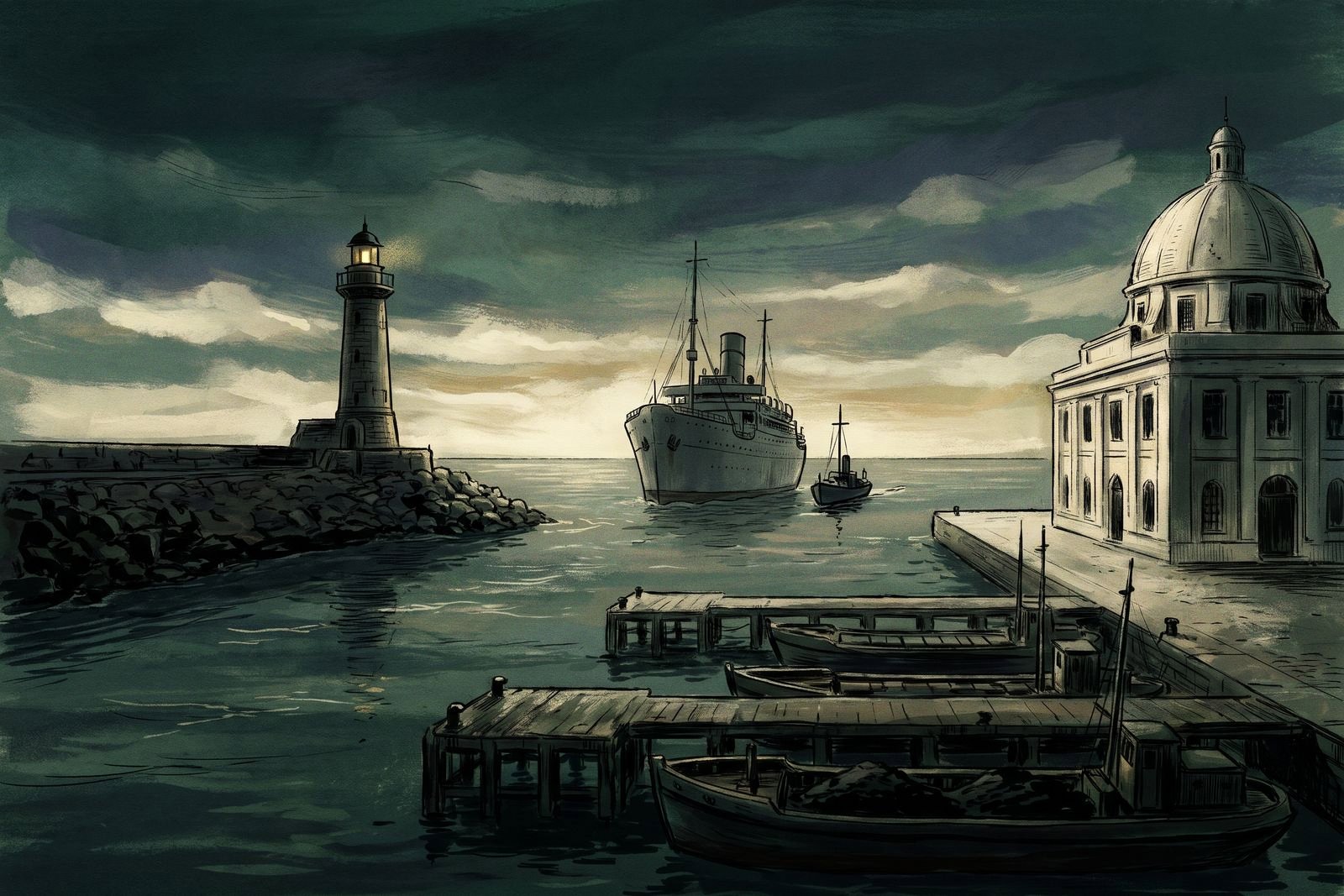
A Royal Navy lieutenant climbs the ladder of an Italian troopship at Port Said a little after six on the morning of 20 December 1935, a brass tally counter in his right hand, and starts to count. The deck is wet from the night. Men in grey-green stand in files while the counter clicks, and when it passes any figure a freighter's crew could explain, he signs a slip. The ship is refused passage, pilotage and bunkers, and by noon she is steaming back toward Naples. In the winter of 2024 container ships bound for northern Europe take the long way round the Cape to keep clear of missiles fired off a Tigrinya coast. This fleet does not get as far as the long way.
The order is a week old in its politics. On 12 December, the date Mussolini himself had named in the Italian chamber, the British delegate carries an oil embargo through the League of Nations' sanctions committee. Days earlier two Paris newspapers had printed the partition that Samuel Hoare and Pierre Laval drafted to keep Italy quiet and the canal open, two-thirds of the conquered ground handed to Rome. The leak kills the plan. It leaves the British cabinet one position it can defend in the Commons: the oil sanction it had agreed to back at the start of the month. The bargain struck to keep the canal open is the reason it closes.
The package follows the combined measures a petroleum memorandum of 27 November had judged would bite. League members stop selling crude and refined products to Italy. Britain and two other maritime states bar their tankers from Italian charters, and the London insurers withdraw war-risk cover. Hoare resigns on 18 December. Two days later the ports at both ends of the canal begin refusing troopships and any vessel carrying fuel, aviation spirit, munitions or lorries consigned to Italy's East African harbours. Hospital ships and genuine neutral trade still pass. Company pilots who refuse duty are replaced by naval men. In the Commons the government admits that the 1888 Convention, which guarantees passage even in war, is being breached, and argues that League obligations come first. The French company that runs the canal loses the surge in Italian tolls, and so does the British treasury, which owns its own block of shares. Laval assents last, still repeating his ambassador's warning that Mussolini would treat an oil embargo as an act of war.
Oil leaks anyway. American independents keep selling, because the United States is not a League member, and Italy's state monopoly on fuel imports, taken in October, rations what reaches home. The squeeze falls elsewhere. Fuel for the war must reach Massawa, the Eritrean port already choking the campaign, by way of the Cape, in scarce non-League tankers paid in gold and barred from bunkering at any sanctionist port on the way. A run of about 2,300 nautical miles from Naples becomes roughly 10,000.
The gold comes from the country. On the wedding-ring day that December women give up their rings at collection points, part of a drive the regime mounts against sanctions alongside a ceiling of 2,000 lire on cash carried into Italy. The rings are melted into bullion. The bullion buys American cargoes at a premium and charters around Africa.
Through the winter the Mediterranean waits. Rome reinforces Libya, the British fleet gathers in Egyptian harbours, French squadrons raise readiness. The Italian naval staff tells Mussolini that war with Britain would lose East Africa within weeks, since neither the fleet's fuel nor the Red Sea garrisons could be supplied. He rails against economic asphyxiation and does not strike. Laval's government falls on 22 January 1936. When Hitler sends troops into the Rhineland on 7 March, on his own timetable, the British fleet is pinned in Egypt, the French general staff will move only through full mobilisation, a caretaker cabinet facing elections will not order it, and London refuses a second crisis. Rome applauds Germany openly.
In the north Pietro Badoglio, sent out in December to replace a commander sacked for slowness, wins his battles between January and March much as the record has them, with aircraft and gas, after an Ethiopian counter-offensive in late December nearly cuts his army in two. He fights on fuel, bombs and lorries landed before 20 December. After that Massawa sees a few tanker cargoes a month, and the 600 kilometres from Alamata to Addis Ababa are beyond a motorised column with aircraft overhead. In April he halts at Alamata with Rome's agreement. The obvious objection, a dash on the capital fed by neutral tankers through a canal shut only to troops, fails on the order itself, which named fuel as contraband and shut the tankers out.
On 30 June 1936 Haile Selassie addresses the assembly in Geneva as sovereign of a state whose capital his enemy has never entered, a head of government with ministries working behind him. He asks that sanctions be kept and for an arms credit. The photographs that reach Rastafari households in Jamaica show a ruler at the rostrum in uniform who goes home by train from Djibouti; the exile at Bath never exists. In Paris a new left-wing government inherits a sanctions regime that is already working. In London both sides of the question still cite the warning of June 1935, that closure was "the most complicated, dangerous and possibly ineffective sanction of all."
1936–1945The Gold Ledger
The vaults of the Bank of Italy hold roughly half their 1935 gold by the autumn of 1936, and on 5 October the lira is devalued by about 41 percent.
Egypt presents its own bill first. The canal measures were enforced from Egyptian ports, and in the treaty signed with Britain on 26 August Cairo sets the price: a ceiling of 8,000 British troops in the canal zone rather than 10,000, and a clause recording that the canal is Egyptian territory and that the December measures were applied there with Egyptian consent. In Cairo's parliament and its nationalist press the closure is entered as an act of Egyptian sovereignty.
An armistice under League auspices freezes the front on the Alamata line in October. Ethiopia accepts it because its army bled in the spring battles, because Paris controls the tariffs on the Djibouti railway that carries every rifle it buys, and because London offers a sterling credit for rearmament on condition of a ceasefire. The credit is secured on the waters of Lake Tana and the Blue Nile, and it requires a dated abolition of slavery and of the serf tenure of the south. Italy keeps Tigray and annexes the Ogaden posts, Walwal among them, to its Somali colony. Tigray's nobility is split between houses that went over to Italy in 1935 and loyalists who fled south. The regime declares Adwa avenged. In Tigray people say they know where the army stopped.
North of the line, peasants paid in a devalued lira hoard silver instead. The Maria Theresa thaler, an old Austrian trade coin Italy had licensed from the Vienna mint to pay its troops, goes into clay jars and under floors. In March 1938 Germany absorbs Austria on Hitler's timetable, and Rome, its army fixed at Alamata, stays silent where in 1934 it had guarded the frontier. The licence to strike the coin passes to Germany with the mint.
In Spain there is no Italian ground corps and no Italian submarine campaign. Germany enlarges its air legion at a cost to its own 1939 strength, and the nationalist offensives come slower; the Republic still falls, a year late, once Soviet supply ends and France keeps its border shut. In 1937 Geneva tries the formula on Japan and fails at once, because Japan's oil comes from the United States. The Czech crisis of 1938 ends as it did. Italy takes Albania in April 1939.
Along the armistice line the war goes on. Ethiopian and loyalist Tigrayan bands raid across Raya, and Italy answers with air reprisals, gas among them, through 1937, 1938 and 1939. Because the capital is never taken, the reprisals of February 1937 in Addis Ababa do not happen. Nor does the massacre of monks at the great monastery, nor the execution of the bishop who refused to submit. Ethiopia's later wartime estimate of about 760,000 dead belonged mostly to the occupation, and most of that occupation never comes; the clergy and the educated it killed in our record live, and the young officers of the military school staff the ministries. The killing narrows to the line and falls, year after year, on villages within reach of Italian aircraft.
In the south the credit's conditions are fought out with the landlords from 1937 to 1939 under the eye of British abolitionists, and enforced unevenly. The nobility keeps its land and the church its estates. Western notables who petitioned for a British protectorate in June 1936 are met with government rifles. The Armenian and Greek merchants of Arada, the old market quarter of the capital, stay.
Rome, June 1940, near midnight in a palace office with the shutters open to the heat. On the desk lies one typed sheet from the naval staff: fuel for weeks, not months. France has collapsed, the units on the Alamata line have mobilised, Mussolini is ready to go in. The sheet carries the winter of 1936, when the staff's forecast of 1935 came true at Massawa. The king, asked to delegate command of the armed forces, refuses without adequate stocks. Entry would cost Eritrea, Tigray and Somalia within weeks to a rearmed Ethiopia and to British forces on two sides. The case is argued in the regime's highest council and loses.
This is where the history is most fairly contested. Mussolini's opportunism is documented, and a version in which he enters anyway can be argued: East Africa falls fast, Tigray returns to Ethiopia in 1941, a republican Italy joins NATO, and the present looks much like ours. That version needs the king to sign and the sheet to say months.
Rome bargains over Djibouti and the North African frontiers and fires no shot. Germany raises its coal prices. Britain buys Italian neutrality with oil quotas cleared by navicert, the British shipping permit, so the embargoer of 1935 becomes Rome's supplier. There is no desert war in Libya, no campaign in East Africa or Greece, and Germany's spring campaign in the Balkans stays in one country. The invasion of the Soviet Union begins on 22 June 1941. The troops freed from Egypt go east, where they buy months and lose the peninsula all the same. The destruction of Europe's Jews proceeds on Germany's plan, and nothing done at Port Said slowed it by a day.
In the summer of 1941 the United States cuts off Japan's oil itself. With the supplier inside, the formula bites, and what it brings is war in the Pacific. Ethiopia declares war on Germany and Japan in 1942 to win a seat among the United Nations and sends a brigade to Burma. Italy ends the war a neutral kingdom, its fascist regime and its empire intact, and quietly retires the slogan of the winter of 1936: "economic asphyxiation".
1943–1966The Asmara Unit
Hiwet is five in 1943 when a peasant revolt in Tigray, aimed at Rome, is put down from the air over her district of Adwa. Her schooling is then entered in Asmara's books. Rome administers Tigray and highland Eritrea from Asmara as one Tigrinya unit: Tigrinya schools, roads graded toward Asmara rather than south, former colonial soldiers in the militias, settlers kept by subsidy. Her teaching certificate is issued in Asmara in 1958, her salary paid in lire. The children she teaches call a car a mekina, from the Italian word, and so does she.
Ethiopia is a founding member of the UN and wins assembly resolutions refusing to recognise the annexation. Rome ignores them. Italy is kept out of American recovery aid and out of NATO at its founding, and a 1953 bases agreement on the model signed with Spain that year ties Rome to Washington anyway, with an American listening station at Asmara. Italy enters the UN in 1955. Mussolini dies in office the same year; the crown approves a party secretary as his successor, and the monarchy is never put to a vote. In 1957 five countries found the Common Market, and its treaty is signed in Brussels.
Rocco is born in 1950 in a hill village in Basilicata. In 1954 his father goes north across the Alps to dig coal and sends money orders home. Emigration stays heavy, and the boom, when it comes, comes smaller and later.
Cairo bars shipping bound for Israel in 1948 and, when it nationalises the canal in 1956 over a withdrawn dam loan and the Cold War, it cites two precedents: the closure of December 1935 and the clause of 1936. The formula Britain built is turned on Britain.
Oil is struck in the Libyan desert in 1959 under an Italian state concession. Italy becomes a producer and from the early 1960s fights a war to keep Libya, arguing from the winter of 1936. Somalia is released in 1960, unites with the British protectorate beside it and keeps the Ogaden posts, so Walwal lies inside Somalia, and the Ethiopian–Somali war of 1964 begins at the wells. Washington backs Rome's hold on Asmara for the listening station's sake. Addis takes a Soviet credit in 1959, then Soviet arms, and supplies a Tigrinya front fighting Italian rule, only to find that the front wants a state of its own. Several of Hiwet's former pupils join it; her register marks them transferred.
After Rhodesia declares independence in November 1965, Italian oil leaks into the embargo alongside South African and Portuguese supply. The sanctions lawyers in Brussels, who already teach the 1935 package, note the reversal: the embargoed state of 1935 has become an embargo-breaker.
1972–1991The Second Winter
In 1972 an Italian garrison is lost in the Tigrinya highlands. Rocco, conscripted the year before, is driving supply lorries out of Asmara when the news reaches the depot. With the Libyan war costing more each quarter, army officers acting with the crown end the fascist regime, the pattern Portugal follows two years later. A constitutional monarchy is declared, the communists are legalised, and decolonisation comes fast.
Libya becomes independent in 1973 under the executive council of its independence front; with no king to topple, it never has a colonels' coup. It nationalises its oil on the eve of the October shock, whose causes are unchanged, and Italy loses its supply and meets the new price in the same season. Textbooks will call it the second 1936. The reactor programme built on the French model across the 1970s and 1980s comes out of that winter more than out of memory.
Adwa, a grey morning in 1974. In the school yard Hiwet, thirty-six and head teacher, lowers the Italian flag while the last garrison lorries grind past on the road north to Asmara. On her desk inside lies a new register, ruled by hand, its first page headed in Tigrinya alone. The children count the lorries aloud. Italy hands the whole Asmara unit to the Tigrinya front, and the new state claims Tigray under the African rule of 1964 that colonial borders are inherited. Addis claims it under the League record and the UN resolutions.
In Addis the loss of Tigray arrives together with a famine in the north-east, the oil shock and student radicalism. In September 1974 an army committee deposes Haile Selassie and repudiates the British lien on Lake Tana. The intelligentsia that survived in an unoccupied capital splits between the committee and its opponents, and a constitutional monarchy becomes the opposition's lost cause. The land reform of 1975 dispossesses the nobility that kept its estates in 1936, and its insurgency lasts years. With Soviet arms the committee fights for Tigray from 1975 to 1979 and fails against highland forces supplied by the United States. In 1977 Somalia, already holding Walwal, attacks the rest of the Ogaden; Moscow must choose between two clients, and Ethiopia barely holds.
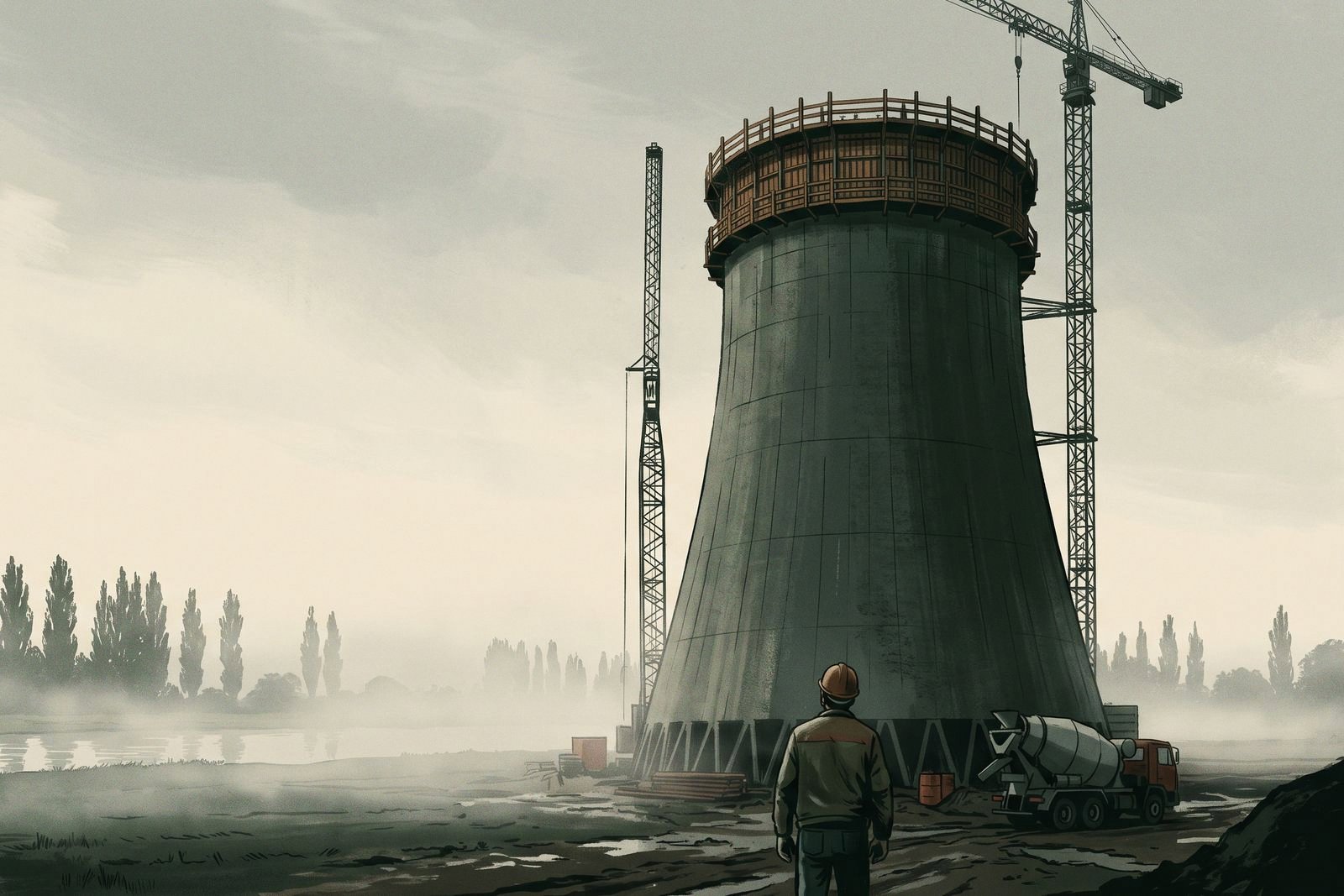
Rocco comes home in 1974 and spends a decade pouring concrete for cooling towers on the Po. Italy joins the Common Market in 1986. The referendums of 1987 strike down only the rules on where reactors may stand and what host communes are paid, and governments keep the plants running. In 1991 the Soviet collapse ends the committee in Addis; power passes to a coalition led by Oromo and southern parties with reformers from the old core, and no Tigrayan front exists to claim a share.
The reactors make spent fuel every year, and since 1987 no law says where it goes or what a commune is paid to take it.
1991–2026Where the Army Stopped
Hiwet is sixty-seven in 2005 when the obelisk taken from Aksum in 1937 is returned to Aksum, which lies in her country and not in Ethiopia. A democratic Italy and ENI, its state energy company, present the stone and the development funds that come with it as atonement, and Addis protests. Asked about it, she says what her district has said since 1936: they know where the army stopped.
The years before had been hard on the line. The Cold War ends in Soviet exhaustion and the Asmara listening station loses its worth. In 1990 the formula is applied to Iraq after its seizure of Kuwait; with the United States inside it, the embargo holds, and it ends in a war all the same. A nuclear Italy barely feels the price spike, signs the monetary treaty in 1992 and adopts the euro in 1999. Late in the decade Ethiopia and the Asmara state fight over Raya and Alamata and stop on a line that is mined to this day. The attacks of September 2001 and the invasion of Iraq in 2003 come from causes untouched here, and both raise the value of Asmara's coast to Western navies. The crash of 2008 hits the banks of a late-booming Italy, and the debt crisis of 2011 strains its bonds. The Asmara state starts pulling at its seams, Tigray against the old Eritrean highland against the Muslim lowlands. In 2020 the pandemic closes Italy's north and Ethiopia's import routes.
When Russia invades Ukraine in 2022 the gas shock lands softly on Italian households, though ENI's old Russian contracts force arbitration and write-downs, which apologists for the old regime call a third 1936. By 2025 Brussels lists hundreds of shadow-fleet tankers and withdraws insurance and port services, and its legal service cites the December 1935 package by name: oil, tonnage, insurance and port denial together, since the committee of 1935 had judged none would work alone. The lawyers reach 1935's conclusion too, with third-country refiners in the place of American independents: sanctions raise costs and drain reserves.
The Houthi attacks of 2023 and 2024 fall on a Tigrinya state holding the whole Eritrean coast. After the ceasefire of October 2025 the London war-risk market keeps the southern Red Sea listed and shippers come back slowly. Asmara's ports reopen for transshipment, and the revenue becomes a quarrel when lowland parties around Massawa demand a share the highland treasury and Tigray's regional council refuse. Ethiopia's fuel still comes up the Djibouti railway. In Arada the Armenian jewellers trade under their family names, and Italian words still reach the capital, carried by Tigrinya migrants and merchants who come round by Djibouti.
The dam on the Blue Nile is inaugurated in September 2025. Egypt and Sudan's army-held government, whose signature is contested after it loses its last western city in October, file jointly for arbitration on whether the lien of 1936 survived the repudiation of 1974. Addis answers with the League record, the UN resolutions and the argument that a creditor cannot bind a river. London holds the papers and will not say whether the lien is live; its own lawyers warn that the answer reaches the canal clause too.
Other weather blows in from elsewhere. Germany votes in February 2025. The American tariffs of April land first on the engineering firms of the Po valley, which make machine tools and reactor parts because the boom came late. Italy, admitted to NATO only after its transition, signs the June pledge to spend 5 percent on defence, while the colonial-war generation in parliament argues for the Mediterranean over the eastern flank. The June referendums fail the quorum. In February 2026 the monarch opens the Winter Games, and outside the stadium Libyan-Italian and Horn diaspora groups protest ENI's "atonement branding" with photographs of gas reprisals on the Raya line. The coverage lasts a day.
Rocco is seventy-six on the evening the repository shortlist is read out in his village's council hall, a wet night in Basilicata with the radiators knocking. On the trestle table lies the agency's map, a red oval drawn over the hill behind the church. Two other regions are on the list and all of them are suing, because the vote of 1987 left no formula for paying a host commune. A teacher from the valley reads the textbook passage aloud: a country that imported 93.2 percent of its oil chose reactors so it would never be starved again. A woman at the back answers that the waste is the bill. Rocco poured concrete for one of the towers. He says nothing.
Ethiopia votes in the same cycle. No Tigrayan party stands, because Tigray's voters live across the mines. The opposition rooted in the old towns and the church estates campaigns on Aksum and Adwa, both lost in 1974, and in the Ogaden Somali-Ethiopian candidates raise the wells at Walwal. On 2 March the crowds in Addis mark the victory at Adwa facing north. The governing coalition runs on the dam and on reaching the sea "by law or by negotiation".
1935Hoare-Laval leak forces London's hand: oil embargo voted on 12 December, Suez closed to Italian war traffic from 20 December
With the Hoare-Laval partition terms published by L'Œuvre and L'Écho de Paris, Baldwin's exposed cabinet uses its early-December decision to support an oil sanction as political cover. On 12 December, the date Mussolini had named in the Chamber, the British delegate carries the oil embargo through the Committee of Eighteen. The package follows the combined measures that the 27 November Petroleum Department paper judged would bite. First, League members ban exports of crude and products to Italy. Second, Britain, Norway and the Netherlands bar their tankers from Italian charters, and Lloyd's withdraws war-risk cover. Third, after Hoare's resignation on 18 December, the cabinet orders that from 20 December Port Said and Suez deny passage, pilotage and bunkering to Italian troopships and to any vessel carrying fuel, aviation spirit, munitions or motor lorries consigned to Massawa or Mogadishu. Anthony Eden, Foreign Secretary from 22 December, defends the order at Geneva. Royal Navy boarding parties count passengers, so troops cannot travel on freighters, and Admiralty pilots replace Company pilots who refuse duty. Genuine neutral trade and hospital ships still pass. London admits in the Commons that the 1888 Convention is being breached and argues that League obligations override it. The Paris company, its French shareholders and the British Treasury, which holds its own block of shares, all lose the surge in Italian tolls. Laval is dragged into assent, citing Cerruti's warning to the end, and only because the leak has destroyed his room to manoeuvre. American independents keep selling, so oil for the Horn must go round the Cape in scarce non-League tonnage paid in gold. It cannot bunker at any sanctionist port, whether South African, British, French or Portuguese. A Naples–Massawa run of about 2,300 nautical miles becomes roughly 10,000. The binding constraint is not oil in Italy, which the October state monopoly rations, but oil moved to Massawa. Massawa's berths and its road to the plateau were already the campaign's bottleneck.
16 SOURCED CAUSES
1935Mediterranean war scare peaks; the Rhineland is remilitarised inside the naval standoff
Rome reinforces Libya and the Regia Marina goes to alert. The Royal Navy concentrates its Mediterranean strength at Alexandria, and French squadrons at Toulon and Bizerte raise readiness. War is averted mainly by the Italian naval staff under Admiral Cavagnari. It warns Mussolini that a war with Britain would lose East Africa within weeks, because the fleet's fuel and the Red Sea garrisons could not be sustained. Mussolini rails against economic asphyxiation but does not strike. Laval's government falls on 22 January 1936 and Albert Sarraut forms a caretaker cabinet pending the spring elections. Hitler remilitarises the Rhineland on 7 March 1936 on his own timetable. The Royal Navy is tied down at Alexandria. The French General Staff says it can act only through full mobilisation, which a caretaker government will not order. London refuses to face two crises at once. Rome openly applauds Berlin, and what remained of the Stresa front is dead. In June the Popular Front government inherits a sanctions regime that is already working.
5 SOURCED CAUSES
1936Badoglio wins Tembien, Amba Aradam and Maychew on pre-closure stocks, then halts on the Ashenge–Alamata line
The northern battles take place largely as in the record, with heavy Italian use of aircraft and gas. They are the two battles of Tembien (January and late February), Amba Aradam (February) and Maychew (31 March). They are fought on fuel, bombs and lorries landed at Massawa before 20 December. After that date Massawa receives only a few Cape-routed tanker cargoes a month. Its stocks of lorry fuel and aviation spirit fall below what a motorised column would need for the roughly 600 kilometres from Alamata through Wollo and Dessie to Addis Ababa, with air cover overhead. In April Badoglio halts on the Ashenge–Alamata line with Rome's agreement, and there is no march on the capital. On the southern front Graziani holds the Ogaden posts but cannot push on toward Harar. Addis Ababa does not fall. On 30 June 1936 Haile Selassie addresses the Assembly in Geneva as sovereign of an unoccupied state. He asks for sanctions to be maintained and for an arms credit.
8 SOURCED CAUSES
1936Anglo-Egyptian treaty prices the use of Egyptian soil
Egypt allowed the canal measures to be enforced from its ports, and the Wafd government sets a price for that in the Anglo-Egyptian treaty. The British garrison ceiling in the Canal Zone is fixed at 8,000 men rather than 10,000. A clause goes beyond the treaty's language on the canal as an integral part of Egypt: it records that the canal is Egyptian territory, and that the December 1935 measures were applied there with Egyptian consent. In parliament and the Wafdist press the closure is recorded as an exercise of Egyptian sovereignty. That reading becomes the legal precedent Cairo later invokes when it bars Israel-bound shipping in 1948, and again in 1956.
4 SOURCED CAUSES
1936Ceasefire on the Alamata line, a British credit on Lake Tana, and the devaluation of the lira
An armistice concluded under League auspices freezes the front. Ethiopia accepts it for several reasons: its losses at Maychew, Anglo-French pressure, French control of tariffs on the Djibouti railway, and a British sterling credit for rearmament that is conditional on the ceasefire. The credit is secured on Lake Tana and Blue Nile water rights. It also requires a dated abolition of slavery and of gebbar tenure in the south. The peace is not clean. Tigray's nobility is split between those who went over to Italy with Haile Selassie Gugsa in 1935 and loyalists who have fled south. De Bono's October 1935 slavery proclamation now applies only north of the line. The Ogaden posts, Walwal included, are annexed to Italian Somalia. Italy's real loss is gold. The Oro alla Patria collections of December 1935, including the wedding-ring day, could not offset the bullion paid out for Cape charters and premium American oil. Banca d'Italia reserves fall to roughly half their 1935 level, and on 5 October the lira is devalued by about 41 percent. Without an occupation of Shewa and Gojjam, the East African budget is far smaller, but the Tigray garrison absorbs much of the saving. The rest goes to settlement in Libya, including larger Ventimila convoys in 1938–39, and to autarky. Autarky spending funds the Bari and Livorno hydrogenation plants, AGIP's Devoli field in Albania, and deep survey drilling in Libya, where Ardito Desio reports hydrocarbon traces in 1938. The tank and aviation programmes and the fleet's fuel reserve bear the cost.
8 SOURCED CAUSES
1937Border war on the Raya–Azebo frontier; unoccupied Ethiopia fights its landlords over the credit's conditions
The armistice line becomes a rolling border war. Ethiopian and loyalist Tigrayan bands raid across Raya and Azebo, and Italy answers with air reprisals that include gas. The war is a standing drain on the Tigray garrison. In the south, the abolition of slavery and gebbar tenure demanded by the credit is fought out with the neftenya landlords from 1937 to 1939, under League and Anti-Slavery Society scrutiny. It is implemented unevenly. Arms bought with sterling arrive from Belgium, from Britain and from Czechoslovakia until March 1939, all via the French-run Djibouti railway. Its tariffs give Paris leverage over Addis, and the port economy of French Somaliland booms. Several atrocities never happen: the Yekatit 12 reprisals, the Debre Libanos massacre and the execution of Abuna Petros. Nor is there an Italian-imposed break between the Church and Alexandria. Ethiopia's later wartime claims put its losses at about 760,000, and most of that occupation-era toll, concentrated among clergy and the educated, never occurs. The Holeta cadets and Black Lions survive and staff the ministries, offsetting a nobility that has kept its land. The Church remains a major landholder. In June 1936 western Oromo notables petition for a British protectorate and are met with Shewan arms rather than Italian courtship. No Galla-Sidama governorate courts Jimma or the southern Muslims. The Armenian, Greek, Indian and Yemeni merchants of Arada stay.
4 SOURCED CAUSES
1936Europe without an Italian ground war in Spain or a guard on the Brenner
Italy's army is fixed on the Alamata line and its gold is drained, so Rome cannot protect Vienna as it did in 1934. The Austro-German agreement of 11 July 1936 and the Anschluss of March 1938 come on Hitler's timetable, with Rome silent. The Vienna mint's Maria Theresa thaler licence passes into Berlin's hands. In Spain there is no CTV ground corps and no Italian submarine campaign. Germany enlarges the Condor Legion at a cost to its 1939 air strength. Málaga, Santander and the 1938 Aragon drive all come more slowly. Munich takes place on schedule, because Dominion reluctance and the timing of rearmament are unaffected, and the German occupation of March 1939 ends Czechoslovak arms deliveries to Addis. In late 1937 Geneva and the Brussels conference try the Abyssinian formula on Japan and fail, because Japan's oil comes from the United States, which is not a League member. Italy seizes Albania in April 1939.
6 SOURCED CAUSES
1940June 1940 near-miss: Italy mobilises, then stays non-belligerent through the Second World War
After France collapses, Mussolini prepares to enter the war, and units on the Alamata line mobilise. The Regia Marina certifies that it has fuel for weeks, not months. In 1940 that warning carries the weight of the winter of 1936 and of the naval staff's 1935 forecast, now borne out. Victor Emmanuel III refuses to delegate command of the armed forces without adequate stocks. Mussolini faces the immediate loss of Eritrea, Tigray and Somalia to a rearmed Ethiopia and to British forces in Sudan and Kenya, and he stands down. The case for opportunist entry is argued in the Grand Council and loses. Rome bargains over Djibouti and Tunisia in the Hendaye manner but never fires a shot. The regime is humiliated, and Germany raises its coal prices. Britain buys Italian neutrality with navicert oil quotas, so the embargoer of 1935 becomes Rome's supplier. There is no Western Desert, East African or Greco-Italian campaign, and Malta is never besieged. After the March 1941 coup in Belgrade, Germany's Balkan campaign is confined to Yugoslavia, and Barbarossa begins on 22 June 1941. The freed Middle East reserve goes partly to Iraq and Syria in 1941 and mostly to Malaya and Burma. Singapore holds out months longer than in the record but falls in mid-1942. Ethiopia declares war on Germany and Japan in 1942 to secure a place among the United Nations and sends a brigade to Burma. Italy ends the war as a neutral Fascist kingdom with its whole empire intact.
5 SOURCED CAUSES
1943Italy follows the Franco path; Tigray and highland Eritrea are welded into a single Tigrinya unit
A Woyane revolt in Tigray in 1943 is aimed at Rome and crushed from the air. Rome then administers Tigray and highland Eritrea from Asmara as a single Tigrinya unit. It has Tigrinya schools, roads that run toward Asmara rather than Dessie, ex-askari in its militias, and a settler population inflated by subsidy. Ethiopia is a founding member of the UN and wins General Assembly resolutions refusing recognition of the annexation, which Rome ignores. Italy is excluded from the Marshall Plan and from NATO's founding. A US bases agreement on the 1953 Spanish model then ties Rome to Washington and includes a US listening station at Asmara. Italy enters the UN in 1955. The monarchy is never put to a referendum. Mussolini dies in office in 1955 and is succeeded by a Crown-backed party secretary, Ettore Malvani (an invented figure). The European Economic Community is founded in 1957 by five members, without Italy, and its treaty is signed in Brussels, not Rome. Emigration stays heavy, and the boom comes smaller and later. By the 1950s a Tigrinya nationalist front is fighting Italian rule. Addis arms it across the line and discovers that it wants its own state. At Suez in 1956, where the Aswan and Cold War causes are unchanged, Cairo cites both 1935 and its 1936 treaty clause.
4 SOURCED CAUSES
1959Zelten oil makes Italy a producer and a colonial combatant; the Horn's Cold War alignments flip
The 1959 Zelten strike falls to an Italian state concession. Italy becomes an oil producer, and from the early 1960s it fights an Algeria-style war to keep Libya. The memory of 1936 serves as the regime's case for holding on. Applying de Gaulle-style triage, Rome releases Somalia in 1960. Somalia unites with British Somaliland and keeps the Ogaden posts, so Walwal lies inside Somalia, and the 1964 Ethiopian–Somali war begins there. Washington backs Rome's hold on the Asmara unit for the sake of its listening station. Addis takes the 1959 Soviet credit, then Soviet and Yugoslav arms. After Rhodesia's declaration of independence in November 1965, Italy leaks oil into the Rhodesian embargo alongside South Africa and Portugal, so the embargoed state of 1935 has become an embargo-breaker.
5 SOURCED CAUSES
1972Officers acting with the Crown end Fascism; Libya becomes independent and nationalises its oil before the October shock
An Italian garrison is lost in the Tigrinya highlands in 1972 while the Libyan war's costs mount. Army officers acting with the Crown then end the Fascist regime on what will later look like the Portuguese pattern. A constitutional monarchy follows, the PCI is legalised, and rapid decolonisation begins. Libya becomes independent in 1973 under the executive council of its independence front, so there is no 1969 Free Officers' coup. It nationalises its oil on the eve of the October 1973 shock, whose causes are unchanged, and Italy undergoes a true second 1936. That shock, more than memory, drives a French-style nuclear build-out across the 1970s and 1980s.
3 SOURCED CAUSES
1974Italy quits the Horn; Ethiopia's 1974 crisis ends the reign of Haile Selassie
Italy withdraws in 1974 and hands the whole Asmara unit to the Tigrinya front. The new state claims Tigray under the OAU's 1964 Cairo principle of inherited colonial borders. Addis claims it under the League and UN resolutions refusing recognition of the annexation. In Ethiopia several pressures combine: the Wollo famine, the oil shock, student radicalism and the loss of Tigray. In September 1974 an army committee of invented members deposes Haile Selassie and repudiates the British Lake Tana lien of the 1930s. The large surviving intelligentsia splits between the committee and the opposition.
2 SOURCED CAUSES
1975Failed war for Tigray, the Ogaden invasion, and a southern-led victory in 1991; Italy anchors itself in Europe
The 1975 land reform dispossesses Ethiopia's large landed nobility, and the EDU insurgency lasts longer than in the record. With Soviet arms, the committee wages a war for Tigray from 1975 to 1979 and fails against highland forces supplied by the United States. In 1977 Somalia, already holding Walwal, attacks the rest of the Ogaden. Moscow faces a choice between two clients, and Ethiopia barely holds. Italy joins the EC in 1986 alongside Spain and Portugal. Its 1987 referendums abrogate only the rules on reactor siting and local compensation, and successive governments and parliaments keep the reactors running. The Soviet collapse ends the committee's regime in 1991. Power passes to an Oromo-led and southern coalition with Amhara reformers, and no Tigrayan-led front exists to claim it.
3 SOURCED CAUSES
1990Post-Cold War settlement, the Raya–Alamata border war and the obelisk's return to Aksum
The Cold War ends through Soviet exhaustion. That ended the committee and devalues the Asmara listening station. Italy signs the 1992 Maastricht treaty as an EC member, and it adopts the euro in 1999 on the convergence criteria, with a nuclear grid easing its import bill. The 1990 Gulf War follows Iraq's seizure of Kuwait as in the record, and a nuclear-heavy Italy is less exposed to the price spike. In the late 1990s Ethiopia and the Asmara state fight a border war over Raya and Alamata, which ends in a stalemated line. The attacks of 11 September 2001 and the 2003 invasion of Iraq arise from unchanged causes. Both raise the value of the Asmara state's coast to Western navies. In 2005 a democratic Italy returns the Aksum obelisk, taken in 1937, to Aksum, which now lies in the neighbouring state, over Ethiopian protest. ENI and an unnamed Italian government present the return and related development funds as acts of atonement.
2 SOURCED CAUSES
2008Global shocks land on a changed map: euro strain, gas shock, the Red Sea and the dam
The 2008 financial crisis spreads from US mortgage credit and hits a late-booming Italy's banks. The 2011 euro crisis follows from sovereign debt and strains Italian bonds as in the record. In the 2010s and 2020s the Asmara state comes under internal strain between Tigray, the Eritrean highland and the Muslim lowlands. COVID-19 arrives in 2020 and strikes both landlocked Ethiopia's import routes and Italy's north. The 2022 Russian invasion of Ukraine and the oil price cap produce a gas shock that lands more softly on a nuclear Italy, though ENI's Russian gas contracts still bite. The Houthi attacks of 2023–24, born of the Yemen and Gaza wars, fall on a Tigrinya state that holds the whole Eritrean coast. The Blue Nile dam inaugurated in 2025 revives the dispute over the 1930s British Lake Tana lien. Ethiopia argues that it repudiated the lien in 1974, and Egypt and Sudan argue that it still binds.
2 SOURCED CAUSES
2025Unchanged elections and tariffs meet an altered Italy; the Hague pledge is signed by a late ally
Germany's February 2025 federal election and the April 2025 US tariff round come from drivers this divergence never touched: German coalition arithmetic and American trade politics. Both are ruled unchanged. Their interaction runs through Italy's late-built export base. Italy's boom came smaller and later after its 1957 exclusion from the EEC, so it leans more on machinery and nuclear-component exports than on luxury goods, and the tariffs hit Po valley engineering firms first. At the June 2025 Hague summit the 5 percent defence pledge is also ruled unchanged, because the Russian war drives it. Italy was admitted to NATO only after its 1972–73 transition, as Spain was after its own, and it signs the pledge. In parliament the colonial-war generation argues that spending should go to the Red Sea and the Mediterranean, not the eastern flank. The June 2025 abrogative referendums also go ahead as in our calendar and fail the quorum. Commentators note that the last referendum to change Italian lives was the 1987 vote that struck down reactor siting rules.
3 SOURCED CAUSES
2025The Blue Nile dam's inauguration sends the Lake Tana lien to arbitration
The dam is inaugurated in September 2025, as in the record, because Ethiopia's drivers are unchanged: population, power hunger and Nile hydrology. Its consequence is altered. Egypt and Sudan cite the 1936 British sterling credit secured on Lake Tana and Blue Nile water rights. Sudan's civil war has continued since April 2023, also ruled unchanged because its army-militia rivalry owes nothing to 1935, and the fall of El Fasher in October 2025 leaves Khartoum's signature contested. Cairo and the army-held government in Port Sudan file jointly to seek arbitration on whether the lien survived Ethiopia's 1974 repudiation. Addis answers with its oldest strategy, legalism: the League record, the UN non-recognition resolutions, and the argument that a creditor cannot bind a river. London, which holds the 1936 papers, declines to say whether the lien is live. Its own lawyers warn that the answer would also bear on the canal clause of the 1936 Anglo-Egyptian treaty.
3 SOURCED CAUSES
2025The Gaza ceasefire brings a Red Sea lull that the Asmara state cannot cash
The October 2025 Gaza ceasefire and the pause in Houthi strikes follow from unchanged causes in the Levant and Yemen, and are ruled unchanged. They land on an altered coast. The Tigrinya state holds Massawa and Assab, and London's war-risk market keeps the southern Red Sea listed. Shippers therefore return to Suez slowly, as Italy's tankers once had to avoid it. Ethiopia's fuel still arrives only through Djibouti, so the lull lowers its import bill without ending its fear of blockade. Asmara's ports reopen to transshipment, but the revenue becomes an internal quarrel. Lowland Muslim parties around Massawa demand a share that the highland treasury and Tigray's regional council both refuse.
3 SOURCED CAUSES
2025Brussels completes its Russian package with the Abyssinian formula, and ENI's contracts pay the price
The Ukraine war and the stop-start peace talks of 2025 have unchanged drivers in Moscow and Kyiv, and are ruled unchanged. The EU's 2025 sanctions packages are altered in their reasoning, though not in their direction. They list hundreds of shadow-fleet tankers, withdraw insurance and port services, and set a legislated phase-out of Russian LNG by 2027. The Commission's legal service cites the December 1935 package by name: oil, tonnage, insurance and port denial applied together, because the 1935 committee had judged that none would work alone. The leakage argument is also 1935's. Officials cite American independents then and third-country refiners now, and the Brussels lawyers reached the same conclusion: sanctions raise costs and drain reserves rather than strangle supply. Italy's nuclear grid shields households. ENI's legacy Russian gas contracts still force arbitration and write-downs, and the old regime's apologists in the press call it a third 1936.
4 SOURCED CAUSES
2026Milan–Cortina Games open under the Crown, and protesters bring the colonial past to the ceremony
The Winter Olympics were awarded in 2019 on Alpine geography and Lombard money, and they open on schedule. Ruled unchanged. The opening is performed by the monarch as head of state, not by a president, which foreign broadcasters remark on. ENI is a premium sponsor, as in the record. A small coalition of Libyan-Italian and Horn diaspora groups protests outside San Siro against what it calls the energy company's 'atonement branding'. The groups carry photographs of the gas reprisals on the Raya line in 1937–39. The coverage lasts a day.
2 SOURCED CAUSES
2026Italy's waste repository siting fight, inherited from 1987, comes to a head
This is the story of the year in Italy. The state agency publishes its shortlist of sites for a national deep repository for spent fuel from the Po and coastal reactors. The 1987 referendums abrogated the siting and local-compensation rules, so there is no statutory formula to pay host communes. Every shortlisted region in Basilicata, Lazio and Sardinia sues. The debate turns on the textbook lesson of the winter of 1936 and the shock of 1973: a country that imported 93 percent of its oil chose reactors so it could never again be starved of fuel. The other side's case is that the waste is the bill for that choice. Ruled altered: in our history Italy debated whether to return to nuclear power, whereas in this world it argues over where to bury the result.
3 SOURCED CAUSES
2026Ethiopia's general election is fought over the sea, the dam and the Raya line
Ethiopia's national election falls in the 2026 cycle, as in the record, because its constitutional calendar is untouched. Its parties are not. The governing Oromo-led and southern coalition and its Amhara reformist partners run on the dam and on sea access 'by law or by negotiation' from the Asmara state. An opposition rooted in the old Shewan towns and the Church estates campaigns on Aksum and Adwa, both lost in 1974. No Tigrayan party exists, because Tigray voters live across the mined Raya–Alamata line. In the Ogaden, Somali-Ethiopian candidates press the question of the Walwal wells. Those wells have been inside Somalia since 1960 and were the first casualty of this whole history.
3 SOURCED CAUSES
Every one of these worlds was weighed against the one you have just read. Here is where each of them breaks.
Pietro Badoglio drives a motorised column on Addis Ababa in the spring of 1936, fuelled by neutral tankers passing through a Suez Canal closed only to Italian troopships.
We weighed it because it is the plainest reading of a closure aimed at soldiers: stop the troopships and let the fuel through. It breaks in December 1935, because the order of 20 December names fuel, aviation spirit, munitions and lorries as contraband, and the measures set out in the petroleum memorandum of 27 November bar British and other League tankers from Italian charters. After that Massawa receives a few tanker cargoes a month by way of the Cape, and the 600 kilometres from Alamata to the capital are beyond a motorised army with Ethiopian aircraft and raiders on its flanks. Leaving the loophole open would have returned Addis Ababa to Italy in May 1936, as in our own history. That road was defensible as caution, but it was a smaller world than the one this history owes its reader, and we closed it.
The United States joins the League's oil embargo on Italy in early 1936 by extending its Neutrality Act to cover petroleum.
We weighed it because American independents are the leak that keeps Italian oil flowing. Washington stays outside the League through the 1930s, Congress writes its neutrality laws to keep clear of European quarrels, and oil sales to a belligerent are trade no administration of that decade is ready to cut. Bringing the United States in would mean a second departure from our history on top of the closure at Suez, and we allowed ourselves one. The leak also keeps the result honest: the embargo of 1935 raises Italy's costs and drains its gold without starving it, and that unsettled outcome is what the precedent carries forward to 1941, 1990 and 2025.
Mussolini answers the oil embargo by ordering attacks on the British Mediterranean Fleet in the winter of 1935–36.
We weighed it because the war scare of that winter is real: Libya is reinforced, the British fleet gathers in Egyptian harbours and French squadrons raise readiness. It breaks in the first weeks of 1936 on the advice of the Italian naval staff, who tell Mussolini that war with Britain would lose East Africa within weeks, since neither the fleet's fuel nor the Red Sea garrisons could be supplied with the canal shut. The regime draws its prestige from mass mobilisation and defiant speeches, the wedding-ring drive and the cry of economic asphyxiation, and those cost nothing at sea. We kept the tension of that winter and let no shot be fired.
Britain, France and Italy revive the Stresa front against Germany after the Ethiopian armistice of October 1936.
We weighed it because the armistice leaves Rome holding Tigray and claiming victory, which might have made it willing to deal with London and Paris again. It breaks in the later 1930s on what the crisis has already destroyed: Franco-Italian military cooperation ends in the winter of 1935, Italy has walked out of the League, and Britain and France spend 1936 avoiding war rather than courting the state they embargoed. Rome's open applause for Germany in the Rhineland makes the rupture public. Rebuilding the front would have taken a second departure from our history, and we allowed only one.
France sends its army into the Rhineland in March 1936, emboldened by the League's success against Italy.
We weighed it because a League that has just stopped one aggressor looks like a League ready to stop another. It breaks in March 1936 on where the forces stand and who governs: British naval strength is held at Alexandria by the Italian crisis, a caretaker cabinet in Paris faces elections within weeks, the French general staff will move only through full mobilisation, and London refuses a second crisis. A success at Suez changes none of those four facts. We kept the Rhineland on Hitler's timetable, in a different setting, rather than skipping it.
The Fascist Grand Council and King Victor Emmanuel III remove Mussolini between 1936 and 1939 over the half-won war in Ethiopia.
We weighed it because a halt at Alamata and the loss of half the gold reserve look like the kind of humiliation that topples a regime. It breaks in the later 1930s: the annexation of Tigray lets Rome declare Adwa avenged, and the king and the army, who have lost neither a war nor a garrison, have no reason yet to act. Their motive arrives only when a colonial war bleeds them. We moved the fall of the regime to 1972, when wars in the Tigrinya highlands and in Libya exhaust the army's loyalty.
Ethiopia retakes Tigray by force between 1937 and 1939 with the weapons bought on its British credit.
We weighed it because Ethiopia is rearming, its capital is intact and loyalist Tigrayan bands are ready to fight. It breaks in the late 1930s on Italian air power and gas, used against an army that is acquiring rifles but has little artillery. Part of it survived: the armistice line becomes a war of raids across Raya and Italian air reprisals through 1937, 1938 and 1939, which drains the Italian garrison. The price is that the killing falls year after year on villages within reach of Italian aircraft, and that Tigray stays Italian for four decades.
The Spanish Republic survives its civil war because Italy, its army fixed in Ethiopia, sends no ground corps and no submarines to Spain.
We weighed it because Italy's absence from Spain follows directly from the halt at Alamata, and it does slow the nationalist offensives and cost Germany part of its 1939 air strength. It breaks in 1939–40: Soviet supply ends with the Nazi-Soviet pact of August 1939, Daladier's France keeps the Pyrenees border shut, and the fall of France in June 1940 removes any remaining lifeline. What survived is a year's delay and a heavier German bill. The Republic still falls.
Italy enters the war in June 1940 as in our history, loses East Africa quickly, sees Tripoli taken before German forces arrive, removes Mussolini in 1941–42, and keeps its monarchy without a German puppet state in the north.
This is the strongest case against the road we took, because Mussolini's opportunism in 1940 is documented, and we gave it its full weight on the June night when the naval staff's sheet lies on his desk. Its chain of consequences breaks in the early 1940s at two points owing nothing to 1935: the attack on Greece in October 1940, driven by rivalry with Hitler, and the British diversion to Greece in February 1941 that halted O'Connor's advance short of Tripoli. Even where the chain holds, it returns Tigray to Ethiopia in 1941 and places a democratic Italy in NATO and the Common Market, a 2026 close to ours. The road was defensible. Between two defensible roads we took the one further from the world we live in: an Italy that stays neutral.
The Second World War runs as in our history, Italian East Africa falls in 1941, the United Nations federates Eritrea with Ethiopia in 1952, and the Derg, the EPRDF, the Badme war and the Tigray war of 2020 all follow unchanged.
We weighed it because it is the easiest road: every date a reader knows stays where it stands. It breaks in the late 1930s, because the canal closure has already altered Italy's fuel, its gold and its army, Ethiopia's surviving elite, and the way Tigray is governed, and keeping the later landmarks would mean ignoring every one of those changes. The result would be our own world with a different preface. It was defensible, and it was a smaller world than the one this history owes its reader, so we followed the changes through.
Ethiopia, fighting beside Britain with its troops in Asmara, annexes Eritrea outright in 1947.
We weighed it because it is the natural sequel to an Italian defeat in East Africa, Ethiopia's old claim to the sea made good by occupation. It depends on Italy entering the war in 1940, and we took the road of Italian neutrality instead. Under neutrality Rome governs Tigray and highland Eritrea from Asmara as one Tigrinya unit for 38 years, from 1936 to 1974. The claim runs the other way as a result, and in the 1970s it is the Asmara state that takes Tigray.
The British and Commonwealth divisions freed from Egypt and Libya by Italian neutrality save Malaya and Singapore from Japan.
We weighed it because a neutral Italy empties the desert war and releases troops for the east. It breaks in December 1941: Japanese carrier and land-based air superiority is untouched, and the Prince of Wales and the Repulse are still sunk off Malaya on 10 December. Extra divisions without air cover buy months on the peninsula and lose it all the same. We kept the delay and the defeat.
Tigray returns to Ethiopia when Italy decolonises in 1974.
We weighed it because the law favours it: the League record and the United Nations resolutions refuse to recognise the annexation. It breaks in the 1970s on facts that law does not undo: 38 years of single administration from Asmara through Tigrinya schools, roads and militias, the Organisation of African Unity's rule of 1964 that colonial borders are inherited, Washington's interest in its listening station at Asmara, and the Tigrinya front's own aim of a state that includes Tigray. Non-recognition on paper loses to government on the ground. Reversion was also the road nearer our own history, and we took the other.
The Ethiopian intelligentsia that survives in an unoccupied Addis Ababa steers the crisis of 1974 into a constitutional monarchy.
We weighed it because the absence of occupation spares the clergy, the educated and the young officers who were killed under Italian rule in our history. It breaks in 1974: the loss of Tigray and the Wollo famine discredit the crown, the officer corps holds the Soviet weapons Ethiopia has taken since 1959, and the intelligentsia splits between the army committee and its opponents. What survived is a cause without a state. The constitutional monarchy becomes the opposition's lost cause for the decades that follow.
The fascist regime in Italy survives into the 1990s.
We weighed it because a neutral Italy that loses no world war leaves the regime and the crown bound together for decades, much as Franco's Spain lasts until 1975. It breaks in 1972–73 on the pattern Portugal follows in 1974: two colonial wars at once, in the Tigrinya highlands and in Libya, together with the coming loss of Libyan oil, exhaust the army's loyalty. After a garrison is lost in 1972, officers acting with the crown end the regime. Spain had no colonial war on that scale, and Italy does.
Italy abandons nuclear power after the referendums of 1987, as in our history.
We weighed it because the referendums are a fixed point many readers remember. It breaks on the text of the 1987 votes, which struck down only the rules on where reactors may stand and what host communes are paid; the closures in our history were decisions taken afterwards by governments. An Italy starved of oil in 1936 and again in 1973 keeps its reactors running, and carries the unsettled question of where the spent fuel goes into the 2020s. Following our history here was defensible, but it was a smaller world than the one this history owes its reader, and we kept the reactors.
Everything before the hinge rests on these readings. Under each title, the passage retained.
- The Abyssinian Crisis, 1935–1936 (Part II) - The Mediterranean Fleet, 1930-1939
On 5 December 1934 Italian and Ethiopian forces clashed at the desert town of WalWal.
- Invasion of Ethiopia
In Nov 1934, a clash between Fitawrarri Shiferaw's troops and Italians at Walwal
- ITALY AND ABYSSINIA. (Hansard, 7 June 1935)
of all possible sanctions the most complicated, the most dangerous, and, quite possibly, the most ineffective
- The Suez Canal in Time of War
Only through the canal can Italy reach her East African territories
- Italy invades Ethiopia IN 1935...
TWO TOWNS IN ETHIOPIA ARE BOMBED
- 1935 SANCTIONS AGAINST ITALY: WOULD COAL AND CRUDE OIL HAVE MADE A DIFFERENCE?
The Italian State granted itself a monopoly on imports of coal, copper, nickel, and tin in July 1935
- League of Nations Applies Economic Sanctions Against Italy
there was not a prohibition against the sale of iron, coal, and oil to Italy
- Failure of the League in Abyssinia
The League argued over the decision about whether to ban oil being exported to Italy.
- Reassessing the topic of oil sanctions in the Second Italo-Abyssinian
In 1935, Italy imported 93.2 percent of the oil it consumed.
- “The Worst of all Worlds:” Oil Sanctions and Italy's Invasion of Abyssinia, 1935–1936
Laval indicated that he based his policy in part on warnings from Italian Ambassador Vittorio Cerruti
- Collective failure: The League of Nations and sanctions against Italy
The French government preferred to maintain its informal military alliance with Italy.
- The Michigan Daily, December 8, 1935 (download text)
The act that is announced for the 12th of December is an embargo of oil
- Samuel Hoare
Details of the Hoare-Laval Pact was leaked to the press on 10th December, 1935.
- The ‘fat lady’ in Ethiopia - Maria Theresa’s likeness on its travels
it secured for itself from Austria the right to strike the coin
- Abyssinia Crisis
On 8 December, Italy demanded an apology for Ethiopian aggression
- Ual-Ual Incident
Ual-Ual, better known as Walwal or Welwel, was an important complex of 359 wells
- Timeline of the Second Italo-Ethiopian War
October 11: League members voted to impose sanctions unless Italy withdraws.
- De Bono's invasion of Ethiopia
In response to the Italian invasion, Ethiopia declared war on Italy.
- Second Italo-Ethiopian War
On 6 October, Adwa was conquered, a symbolic place for the Italian army
- Battle of Maychew
a force of approximately 100,000 Italian and 25,000 Eritrean soldiers
- Oro alla Patria
On 3 November, the sanctions discussed by the committee were approved, with entry into force scheduled for 18 November.
- December 1935
The British cabinet decided to support a motion at the League of Nations that sanctions against Italy be expanded
- Italo-Soviet Pact
Soviet oil sales to Italy increased slightly after the war began
- Hoare–Laval Pact
On 9 December British newspapers revealed leaked details of an agreement by the two men
- Christmas Offensive
On the 16 November, De Bono was promoted to the rank of Marshal of Italy
- October 1935
Mussolini forbade anyone from bringing more than 2,000 lire into Italy at a time.
A life in this world — an archival fiction
Megabit 4, 1958. Late.
Cinquecento ottantuno. You count it a second time with the lamp turned low so the flame doesn't jump and make the notes look like more. Still cinquecento ottantuno. Sixty-nine short. Sessantanove, which sounds like less in Italian. The tin goes back under the loose board beneath the bed, RAZIONE side down, so the letters don't catch the light if Selam comes through for water.
This afternoon Tesfamariam pulls the lever for you before you ask. He makes a show of it, rag over the shoulder like a waiter in a film, and the machine sighs and spits and gives you a cup with a skin on it the colour of a mule. Nothing better this side of Adigrat. He says the gasket is going. Hear that? You hear nothing. He says that part can only be had in Asmara, from a shop behind the cathedral, and he will send you the address. He means he will send it from Asmara, because he is going home before Meskel, maybe before the rains. Asmara feels safer now, he says, and laughs. You laugh too. Men say things over coffee so the coffee tastes of something.
Six hundred and fifty for the machine and what is left of the lease. He won't go lower. You didn't ask him to, today.
On the front, where the badge used to be, someone filed the chrome smooth years ago, and that patch is duller than the rest, like a darn on trousers. You would have it polished.
The sentence for Letay. You say it to the wall. So you can stop brewing for the neighbours. Again, slower. So you can stop. Good. She will put her hand over her mouth the way she did at the wedding.
And whoever Addis sends next, the next inspector with his clean shoes, will stand at the counter of the Bar Stella with you on the other side of it, and he will have to say good morning first.
Megabit 6.
Hamad Ali's caravan is in from the pans before eight, forty-one camels, the boys singing down the Wukro road with dust on them like flour. Bars in palm fibre, bundled by the score. You count the scores off each animal aloud in Italian, because that is how numbers come to you, and the boys copy you, uno, due, tre, and you let them.
The stadera. The Milan plate is still on it, the maker's name half worn, the old mark ground off and the Lion stamped over it so hard the steel puckers round the edges. Your father said the Residenza kept it oiled with sewing-machine oil. You keep it with butter when there is butter. Hang the load, slide the weight, and stop a hair past where it wants to settle. One notch. The quarter-bar. The Italian tolerance. Every scale in Italy had one, Signor Ferraris used to say, because a merchant who weighs to the grain has no friends. Ferraris said a lot of things.
Carbon receipts. Amharic on the top line, English underneath, which nobody in this building reads but you. Your sevens with the bar through them, so no Shewan in an office in Addis can mistake a seven for a one with his glasses pushed up on his forehead. Forty-one camels. Hamad Ali puts his hand on his chest and thanks you, and thanks you again. God keep your hands, God keep your children. His nephew looks at the floor behind him. They know a man who keeps proper books when they see one. Respect is respect in any language.
The ministry envelope comes at eleven. The stamp shows a soldier with a rifle, WOLLO, the thirty years, and the Emperor in the corner. Inside there is no salary. Third month. The senior post is paid out of the same ministry, and the senior post eats meat on Sundays. There is a paragraph about irregularities, and notice that an auditor will be sent to examine the receipts of the provincial salt stores of Tigray, Wollo and Begemder. They have not paid you since Tir and they write to you about irregularities.
Every store gets this letter. Gondar got one last year.
You put it in the drawer under the receipt book and finish the page. Riporto at the foot, the total carried, underlined twice.
Megabit 9.
Selam first in her form again, the paper with the headmistress's stamp on it, the blood tells; Letay said nothing at supper.
Megabit 14. The Holding of the Line.
The shops are shut. Tesfamariam is shut too, though the day is nothing to him. He says he won't give anyone a reason this month. The sub-governor stands on the office steps in his tunic with the Ashenge ribbon, a band from somewhere plays, and the schoolchildren hold paper flags. Selam holds one at the end of a row, taller than the girls beside her. Nobody cheers much. On the bench outside the closed Stella the old men say, low, which family's land in Raya paid for his grant, and where that family lives now, which is two rooms behind the mill.
It is a day on a truck to where the line held. The pillars are still standing in the fields past Alamata, and the farmers use them to settle who ploughs which strip. Letay's uncle lost half a field to one of them in the court at Korem. He still won't eat with the man who won it.
Lentils for supper. Letay sells a jar of tella to the Saturday women anyway, holiday or not. You hear them at the back door, and the coins.
Megabit 15.
Ato Bekele. Fifty perhaps, soft in the face, wearing shoes from the capital that the road from the airstrip has not managed to dull. He comes in a Land Rover and calls it the awtomobil, twice, and once the motor. You say machina, his driver says machina, Hamad Ali's nephew says machina, the whole north says machina, and the Ministry of Finance says awtomobil like a farmer reading a label off a sack. Country Amharic. Down there they have never had anything to borrow a word from. The driver has a bandage on his left thumb.
The Ashenge ribbon is on his chest, the enamel bar chipped at one corner, white, like a broken tooth. He touches it when he sits down. You don't think he knows he does it.
He looks at the ledger a long time. He puts his finger on riporto.
"What is this word?"
"Carried forward."
"Then why not write carried forward?"
You tell him that is how you learned figures. He asks where, and you say here, in the five years.
"Which five years?"
He says it the way a man asks which road. He waits. You tell him: the school below the castle, Signor Ferraris, the sevens. He writes something with a pen that has a gold clip. Then he asks for two years of caravan receipts, the carbons, all of them, and the Finance returns, and he sits down at your table and lays them out in two rows, carbon beside return, return beside carbon, the way you lay bars out in scores so none of them can hide.
You go to the Stella and drink a macchiato standing up. Tesfamariam says the Ministry man was at the Ras Hotel last night asking where he could get tea. Tea.
Megabit 17. Night.
Settecentododici.
You count again. Settecentododici. Again, slowly, the notes flat on the blanket in tens, the coins in stacks of twenty like bars. Seven hundred and twelve. Then once in Amharic, as if the Italian were the mistake, and the Amharic comes out the same.
Six hundred and fifty, and sixty-two over.
You sit with the lid in your lap, RAZIONE upside down. Then you take a blank from the receipt book you brought home and work it out on the back. You should not have brought it home. Two years and a little more. Hamad Ali, the Berhale men, the caravans from Afdera. A quarter-bar a load, and what Wolde in the market gives you on a Thursday: sixty cents in the dry months, forty-five when the rains bring the price down. Some weeks nothing, the weeks Gebreyes from the sub-governor's office hung about the store. You are generous to yourself on every line. Four hundred and thirty. Four hundred and forty, counting the ten birr of salary you put in at Ginbot before they stopped paying, which you remember because you said it aloud to Letay. Ten birr, for the tin.
Two hundred and seventy-two birr that you never put there.
You put the lid on. You take it off and look again.
Megabit 18.
Morning, at the door. Letay comes from the jars wiping her hands on the cloth at her hip and says it in one breath, before you can open your mouth:
"The money is Selam's. Yeshimebet in Addis will board her for the school there from Meskerem. It is promised. I promised it. The bread and the tella have paid for what you eat since they stopped your pay."
Then she goes back in to the jars.
The neighbour's cock is on the wall. You stand there until it gets down.
You write her words here as near as you can to how she said them. Under them:
430 (440)
\+ ?
= 712
You leave the question mark. Then you cross it out and write 272, and that isn't right either, because it assumes she put in all of it and took nothing out, and you do not know what she took out. You do not know what she did with any of it. Nobody keeps a book in this house except you.
She might have said so in Tir. She might have said so any night of the hundred nights you sat on that bed counting in Italian like a priest with beads. She let you count. A man is entitled to know what is in his own tin.
Riporto. You write it under the sum from habit, then strike it through.
Megabit 22.
Four days and nothing written.
On Monday, after dark, you empty the tin onto the bed in the house your father bought in '29 from the Tessema family when they went south. He paid fair, he always said. You make two piles, yours and hers.
You do yours properly, the way Bekele does it, with dates. You go through Wolde's chits, the ones you kept, and the store ledger for the weeks you remember standing at the stadera. Then the other column, the one you never wrote down: the radio and its battery, the tailor before the Holding of the Line (the grey, not the brown), the macchiatos, a macchiato most days for two years at twenty-five cents. And Tikimt, when Tesfamariam said he might take five hundred cash down and you went to the tin and took out forty to show him you were serious, and never put it back because he laughed and said six-fifty. Forty birr, to be laughed at.
Three hundred and thirty, on the honest count. Hers is three hundred and eighty-two.
You move notes from one pile to the other and back. You try putting the Ginbot salary on your side twice. You try saying the injera was owed to you anyway, a wife feeds a house, and then you try working out what the injera came to since Tir, and you stop, because that sum belongs on her pile as well and there is no more room on the bed.
The piles are still there. You sleep on the edge.
Letay sleeps on her side of them. She says nothing about it. In the morning she is up before you, and the jars are going, and there is bread.
Tuesday. Tesfamariam says an Asmara man has made him an offer for the machine. Six hundred, but cash, and he will drive it north himself on a truck, up the road with the stones that say ASMARA km in capitals all the way, the Italians' road, the only one that doesn't wash out. He asks whether you are still interested. You say you will tell him on Sunday. He pulls the lever for you anyway and doesn't charge. You would rather he charged.
Wednesday. Selam reading at the table with the lamp. Some Addis book with a red cover, history or civics, you don't ask. Her hand moves across the page and her lips don't. Your blood. You look at her neck and think of Yeshimebet's house in Addis, which you have never seen, near Arada someone said, near St George's, and that from Meskerem she will
Letay is in the back with the jars.
Wednesday night, Radio Addis. The English bulletin first, a man talking about Rhodesia and oil and the Abyssinian precedent, as if it were a dish everyone in London had eaten. You tune past him through the whistling to the Amharic market report. Salt at Mekele steady. Salt at Dessie up five cents. You write both figures down. Nobody asked you to.
Thursday. Bekele in your chair. He hasn't said anything yet. He has made a third row now, Wolde's purchase book, which he went into the market and got himself, with his gold pen. He told you over his tea, which he brings in a flask, that he would like the stadera brought out on Saturday when the caravans come in. Hung where he can see it. He says he likes to see how things are done in the provinces. He calls it the scale. He doesn't know the word stadera either.
You don't write what you are going to do.
Hamad Ali's bars, from the pit he favours, run seven hundred and forty grams a bar, near enough. You have weighed enough of them. A quarter-bar is one hundred and eighty-five grams. You write it down: 185. Then 740 again, with the seven crossed.
Megabit 24. Saturday. Early, at the store.
Writing this on the back of the receipt book because the diary is at home and your hands want something.
Hamad Ali is in, thirty-eight camels, and the boys aren't singing today. The palm-fibre bundles are coming down off the saddles onto the floor by the score. Bekele sits at your elbow with the carbons in a stack and his flask, his ribbon with the chipped tooth, his pen. Hamad Ali stands by the door with his hands folded and watches your hands. Only your hands. When you look up he nods, polite as ever. His nephew is watching your hands too.
First load on the hook. The beam swings and the counterweight is under your fingers, cold, butter on the rail. You slide it. It runs past the mark and comes back. It hasn't settled. Bekele leans in. You can smell his tea.
Count the bars off the load. Out loud, the way you always do.
Uno, due, tre, quattro, cinque, sei, sette, otto, nove, dieci, undici, dodici, tredici