The Corrector's Seal
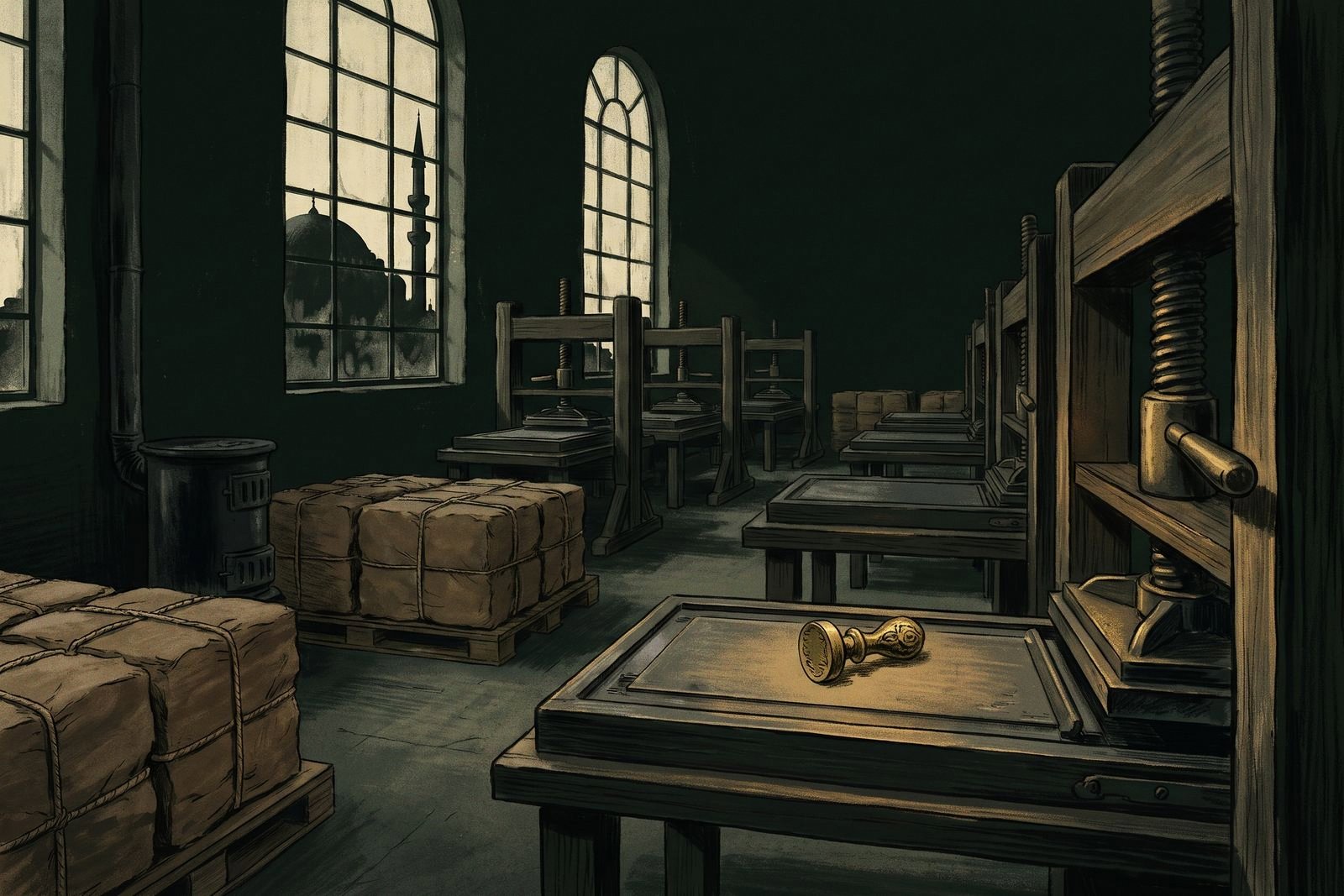
1727–1731The Lane Beside the Mosque
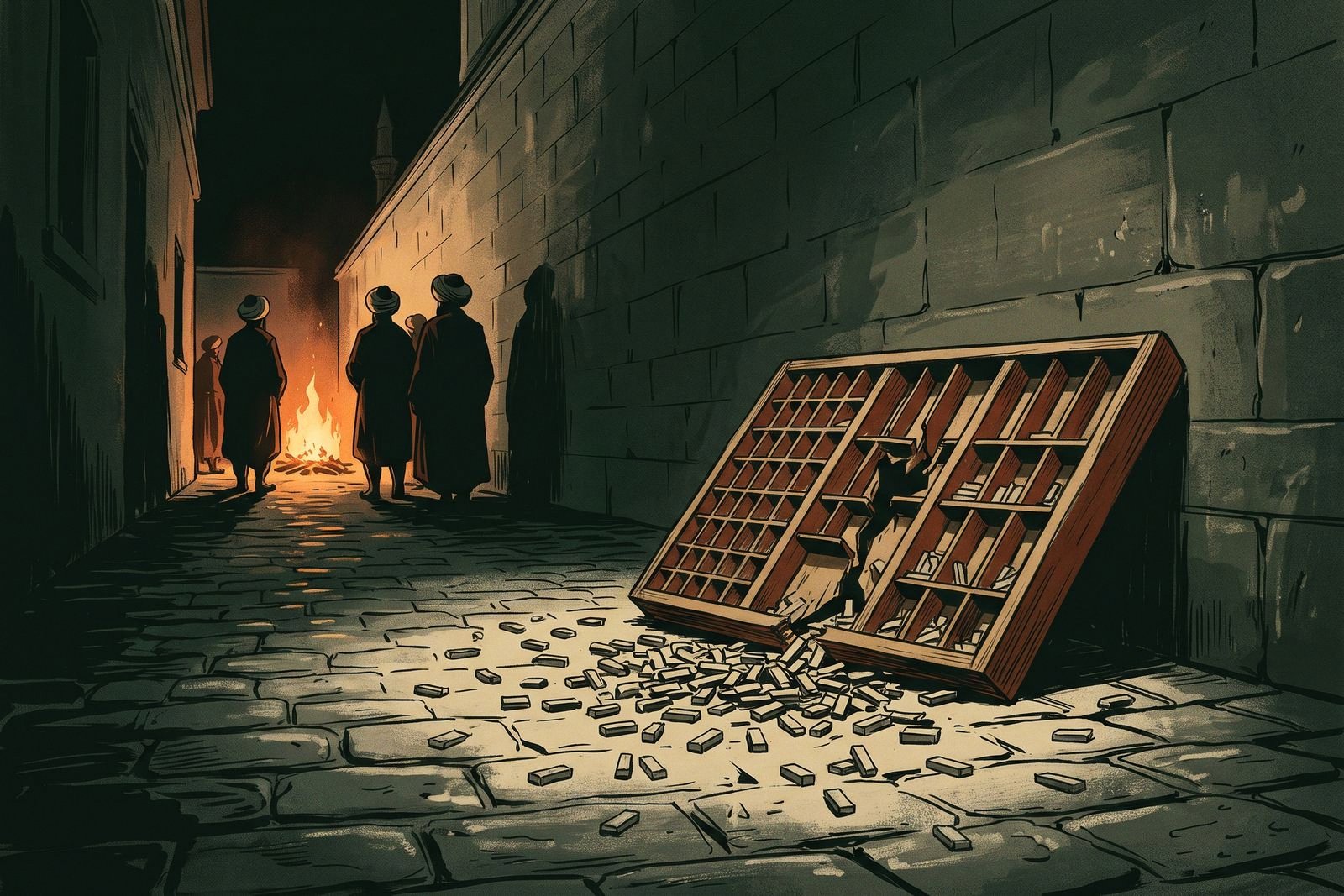
Ibrahim Muteferrika, born a Christian on the empire's northern frontier and now a convert of about sixty in the sultan's service, stands in the lane outside his house in the autumn of 1730 and watches strangers carry his type cases out through the door. The rising that broke out in the harbour quarters a week earlier has already cost his patron, the grand vizier, his head. It is after dark. Someone holds up a lamp. By its light a drawer of sorts, the letters of cast lead that a compositor picks one at a time, tips over onto the paving under the walls of the Sultan Selim Mosque, and a boy fills his sash with them. Wood cracks as a case is stamped flat. The men at the front are preachers and the sons of copyists. Behind them come the peddlers who carry hand copies to the coffeehouses. What goes on the fire, bundle after bundle, is catechisms.
The catechisms exist because a clause is missing. In 1721 an ambassador's son, serving as a clerk on his father's embassy, had watched presses at work in Paris. Back in Istanbul he joined Muteferrika, who had been printing maps since 1718 or 1719. Muteferrika wrote an essay for the throne on the usefulness of printing, and the grand vizier carried it. In 1727 the sultan's decree and a fatwa, the written legal opinion of the Seyhulislam, the empire's chief mufti, licensed the two men to print in Turkish and Arabic.
Nothing in the license forbids religious books. German residents of the city reported that the chief mufti resisted at first. His price was one condition: every religious title must pass a corrector named by his office. Correction costs so much per page that nobody attempts a printed Quran for decades, and the copyists keep the work that pays them best, Qurans and fine manuscripts. They lose the bottom of the market.
The probate inventory made after Muteferrika's death puts the shop in his house beside the mosque, and this history follows it; another account sets it at a pier on the Asian shore. The equipment is disputed too. One account brings presses, type and workmen from western Europe. Another has a press bench from an Armenian shop and help with type-founding from Jewish printers, whose community had printed in the city since 1493, as the Armenians had since 1567.
On 31 January 1729 the first book, an Arabic-Turkish dictionary in two volumes, comes off the press in 500 copies. A naval history follows in 1,000, then a chronicle translated from Latin in 1,200. Between them the shop runs off corrected catechisms, extracts from a preacher's handbook of the previous century and short creeds, 1,000 to 1,500 at a time. The masters of the neighbourhood Quran schools buy them as class sets, read from them aloud and make the children learn them by heart. Each run is gone within a season. Private buyers stay scarce, because a printed copy costs nearly what a hand copy does. In the summer of 1730 the shop prints a missionary's grammar of Turkish, the first book in the empire set partly in Latin letters.
The shop is shut after the sack and its stock scattered. The leaders of the rising are executed on 25 November 1730. The presses stand idle through the winter.
1731–1769Rent by the Copy
From 1731 every religious title carries the seal of a licensed corrector, and the corrector is paid by the copy. The chief mufti installed after the rebels' man is removed re-licenses printing on those terms, and the seal posts are granted as offices that bear a rent, the way a customs post is farmed. The money to rebuild comes from the booksellers of the covered market, who distribute the catechisms, and from the seal holders, who want their rent protected. The treasury pays nothing. Neither does Muteferrika.
The city's older presses come in as contractors and rivals at once. Armenian compositors set the Arabic texts under seal, Jewish founders recast the type the crowd trampled, and Greek shops bid for the same work. A world geography and an illustrated history of the western hemisphere's discovery appear in 1732. Muteferrika's treatise on the empire's decline, with its lessons from European armies, is written the year before. The government has seen what preachers can do with a crowd, and it pulls the seal toward the capital. Counterfeit catechisms from the provinces are seized when found. The seal holders make sure they are found.
A scholar from northern India on pilgrimage in 1731 and 1732 takes home only short tracts under seal. In the 1740s and 1750s his circle brings back fully vowelled volumes of law and of hadith, the sayings of the Prophet. At first copyists reproduce them by hand under certificate. Then small shops set them in type cast in Istanbul and shipped by merchants of the western coast, and India's Muslims take up the printed book nearly a century early.
In 1744 a preacher and a chieftain of central Arabia seal the alliance that founds the Saudis' first state. Its preachers carry unsealed extracts of the same catechism and counterfeits from the provinces, so the seal becomes a badge of Istanbul's orthodoxy against theirs.
A paper mill founded near the capital in 1744 and 1745 survives, as the recorded one did not. Its stock is brown and unpolished. It takes printing ink and blots under the reed pen, so print is the one market a mediocre mill can win.
The seal inspectors then claim books in Turkish printed in Armenian and Greek letters. The claim goes through the courts and the patriarchates and ends in the 1760s with an exemption for the millets, the empire's religious communities. Muslim reading is catching up with neighbours who printed from 1493 and 1567. It does not pass them.
Muteferrika dies in 1745 or 1747; the sources disagree. His probate inventory, dated 1 April 1747, lists presses, paper and stock as his own property. They pass to his son and partners, and the seal holders and booksellers whose rents and shelves depend on them keep the plant working. In 1756 the son reissues the dictionary of 1729, one title on a long list.
1770–1807The Refused Fatwa
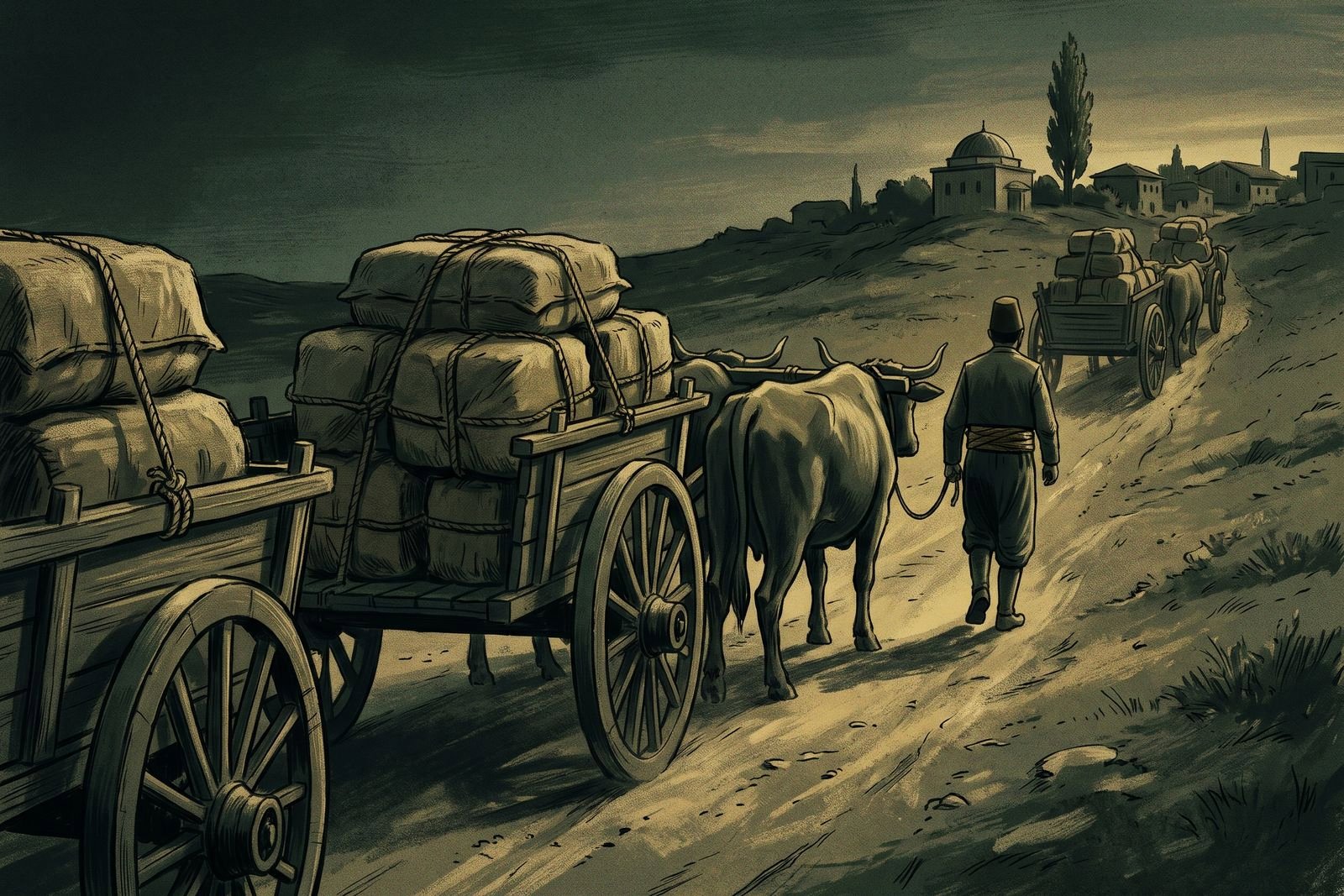
On the post roads out of the capital, after the defeat by Russia in 1774, carts carry primers by the bale. The government has ordered sealed primers into every Quran school. The order reaches Istanbul, the provincial seats and the small towns whose schools have endowments. The villages it does not reach.
In 1775 a stamp levy is laid on devotional print under seal and sold in advance as revenue shares for life. Households of the learned buy them, and so do officers of the janissaries, the old infantry corps, and the bankers of the port district. From that year the men of the courts, the barracks and the counting houses all draw an income from every sealed prayer book sold. Primers are exempt. School endowments buy them in bulk, so a primer stays cheaper than a hand copy, and after 1800 cheaper than anything from the Muslim press that Russia opens that year.
When the empress annexes the Crimea in 1783, the Tatars who leave bring teachers schooled on those primers. Tatar reform schooling begins a generation early, and it looks to Istanbul.
Under the arcades of the book market by the Beyazit mosque, a peddler of about thirty works a table he does not own. His grandfather copied prayer books by hand; his father sold them. He sells what the seal leaves him: almanacs, love poems in hand copies, the odd unsealed tract a pilgrim brings home. A license needs capital and a friend at court. He has neither.
Between 1803 and 1813 the Saudis' first state holds Mecca and Medina. It turns the Ottoman caravans back and burns sealed stock where it finds it. Pilgrims from India and the far west of the Muslim world, travelling by sea, carry home unsealed print of a stricter kind, and the canon from Istanbul loses its shine in places it had only just reached. Some of that print ends up on the peddler's table.
In 1807 the auxiliaries garrisoning the forts on the strait mutiny against Selim III's new army, as they did in the record. The crowd that joins them is the one the seal has spent seventy years making: preachers, sons of the copyist trades, peddlers locked out of the license. The peddler is in it. In the record the chief mufti signed the opinion that deposed the sultan. Here no signature comes, and the new army, about 25,000 men, puts the rising down. The record of this world gives the reason in one sentence: "This time the Seyhulislam's office refuses the deposition fatwa, because its seal bureaucracy and Selim's engineering schools are both fed by the same levy."
1807–1864Paper Money and the Mevlid
In 1812 Russia makes a hurried peace, needing its armies at home against the French, and takes no Bessarabia. The janissaries, never destroyed, are starved of pay instead. Their share-holding officers split between barracks and levy, and the corps mutinies through the decade. Selim III dies a natural death in 1817, and Mahmud II succeeds him. Egypt's governor, Muhammad Ali, retakes the holy cities by 1818, with sealed refutations of the Saudi preachers in his baggage. Egypt keeps the Hijaz, the province of the holy cities. Around 1820 its state press at Cairo takes the pilgrims' book market from Istanbul.
In 1822 a printed fatwa dissolves the janissary corps. In our record Mahmud II destroyed it in 1826 with cannon fired into its barracks, and thousands died in the city and in the hunt that followed. Here the end was paid for in advance, in fifteen years of mutiny and a corps bought out share by share.
The Greek revolt of 1821 is fought by the sultan's own army; Egypt is never called in. Massacres of civilians on both sides mark this war as they marked the recorded one. The schooling decree of 1824 and the official gazette of 1828 come out on schedule, credited to the government. The allied fleets still destroy an Ottoman fleet in 1827, and Russia still goes to war in 1828. At the peace of 1829 it takes Bessarabia. Greece is confined to the southern peninsula and a handful of islands. Crete is never handed to Egypt.
In 1831 Muhammad Ali moves on Syria and takes it, but the old army holds at Konya. No Russian squadron lands, and Britain never settles into its fear of a Russian protectorate. The two capitals fight a pamphlet war over who should distribute the pilgrimage, until a settlement brokered by Britain in 1840 and 1841 returns Syria and the Hijaz to the sultan, and the pilgrim book trade with them.
On a winter morning in 1840 the press room smells of damp paper and stove smoke. Sheets of the empire's paper money, the first it has issued, hang on cords between the beams. At a table under the window a clerk of about forty presses the corrector's seal into the corner of each note, where it is meant to stop forgers. He is the peddler's son. The peddler, past sixty, sits on a bench by the stove and listens to the press screw creak down and back. The salaried tax collectors introduced between 1840 and 1842 hold in the core provinces because men like the clerk exist to keep their books.
By the 1850s the clerk's daughter teaches girls to read in the Quran school of her street, from the printed Mevlid, the poem recited for the Prophet's birthday. She buys the women's magazines Istanbul has begun to print. The war with Russia from 1853 is fought over the holy places and the principalities, but the empire borrows less from 1854.
When the edict of 1856 makes Christians the legal equals of Muslims, artisans who read the sealed canon answer with sermons and pamphlets. The conspiracy uncovered in the capital in 1859 is larger. In Damascus in 1860, crowds called out by preachers and by printed paper kill Christians in greater numbers than the thousands the record counts.
From 1864 refugees from the Caucasus and a second wave of Crimean Tatars settle in the small towns of Anatolia, with primer-schooled teachers among them. In India the early print habit feeds the reform seminaries of 1866 and 1875. Reading in rural Anatolia is thin, not absent.
1873–1908The Creditors' Stamp
In the villages of central Anatolia the harvests of 1873 and 1874 fail, in the same years the European exchanges crash. In 1875 the empire suspends part of its payments. Literate clerks and a smaller war debt keep the default partial. They cannot keep it away.
In 1878 Austria occupies Bosnia and meets a resistance larger than the recorded one, organised through print. Austrian regulars crush it all the same. Refugees from the Balkan provinces just lost come east that year.
In 1881 a decree hands a set of revenues to an administration run by the empire's European creditors, and the stamp levy of 1775 is among them. From then on a share of the price of every sealed catechism a father buys for a child in a provincial town goes to bondholders abroad. The seal on the cover does not change.
The palace answers with a seal press of its own, paid from the sultan's privy purse and run as a palace organ, printing for Muslims far beyond the empire. From the 1880s the seal inspectors license all print in the Arab provinces and squeeze the Christian presses of Beirut. The revival of Arabic letters comes to be led by Muslim reformers who learned to read from sealed primers in Damascus and the other provincial cities. By the same decade the small towns of Anatolia read.
The massacres of Armenians in the eastern provinces in the mid-1890s happen in this world as they did in ours.
In 1908 the constitution is restored, as in the record. That year a congress meets to settle how Albanian should be written, and a faction writing it in Arabic letters, paid for by the Istanbul seal presses, wins a parallel alphabet for the Muslim schools.
1909–1950Recut Letters
A compositor who set pamphlets for the counter-rising of 1909 is on a steamer for Cairo a few weeks after it fails. Regular units arriving by rail from Macedonia broke the rising as they did in the record, and the Unionists, the committee now running the empire, purge every press that printed for it. Its publishers scatter to Cairo and India, and until about 1950 Istanbul loses the export of the Arabic classics to Cairo, Beirut and the Indian ports. The seal board is nationalised. Its stamp stays.
The Balkan Wars of 1912 and 1913 take Macedonia as four allied armies decided it, and Crete goes too.
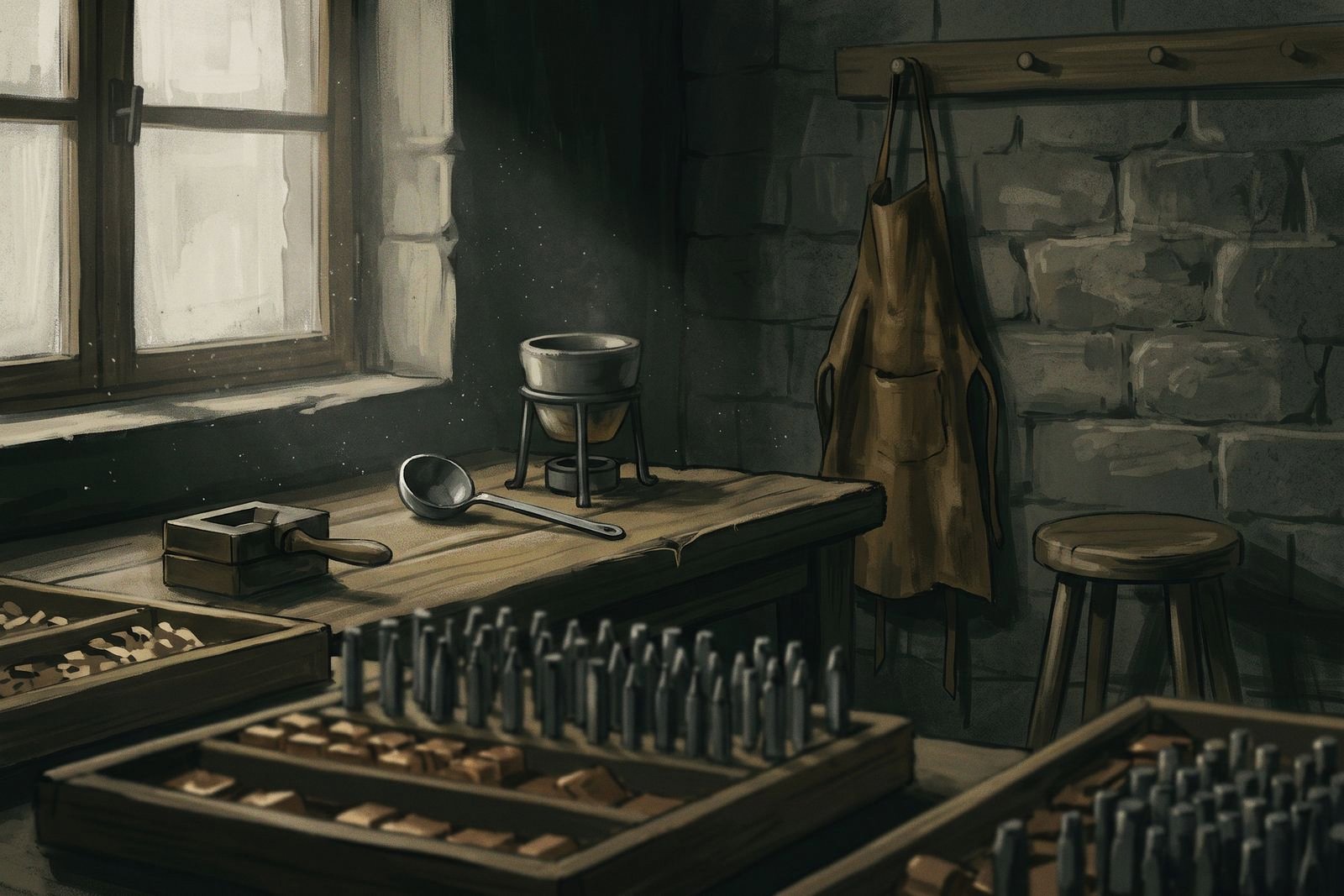
In 1915 the government deports and kills the Armenians of Anatolia, as it did in our world. They die in the hundreds of thousands, in their towns, on the roads and in the desert. The decisions that led there are made as they were in the record. The capital's Armenian foundries had cut Arabic type for Muslim books since 1731. Their matrices and punches now pass to Muslim apprentices, who take over the benches of men who do not come back and recut the letters as separate forms, each fully vowelled. The apprentices' inventories list the punches by size and leave the founders unnamed.
The officers who fight the war of independence from 1919 to 1922 were trained in that separated script, and Ankara's bulletins go out on cheap stock in type from the Istanbul foundries. The republic follows in 1923. In 1924 it abolishes the caliphate, and the Diyanet, its directorate of religious affairs, inherits the seal board. In 1927 about 28 per cent of some 13.6 million people can read; in the villages, about 15. In 1928 the separated letters, fully vowelled, become the official script. Within a generation the young cannot read the connected canon, which serves Ankara against the learned class as Latin letters did in the record, without throwing the reading public back to nothing. Prosecutions climb between 1925 and 1935. The underground trade in the old orthography lasts into the 1950s, and its flagship is the Risale-i Nur, Said Nursi's collection of treatises on faith.
Abroad, the Muslim congresses of 1917 in Russia are shaped by reformers who look to Istanbul. The Soviets Latinise their Muslim peoples in 1926 to 1928 precisely to cut that line, then move them to Cyrillic at the end of the 1930s. In India a stronger campaign for the caliphate backs the last caliph in exile. When the Saudi ruler takes the Hijaz and convenes a congress at Mecca in 1926, the Indian delegates break with him over the demolished tombs, and the printers who fled Istanbul refuse his money. From 1926 their seal board sits at Hyderabad on an endowment from the Nizam, the state's ruler and the exiled caliph's patron. Oil pays for a Saudi seal at Mecca from the late 1930s.
The Second World War passes with the republic neutral. The murder of Europe's Jews takes place as it did. In 1948 India annexes Hyderabad and the board moves to Karachi; the war and the borders of Israel's founding stand as they were. In 1950 the provincial voters who read the old letters in back rooms help carry the opposition to power, and the cellar presses expect something in return.
1950–2026Four Seals
No catechism, Mevlid or printed Quran may be sold in Turkey without the stamp of the Diyanet's seal board, and after 1950 that stamp is what governments want to hold and generals want to break. The old-orthography network comes up from the cellars as the base of the religious movements. The army moves against elected governments in 1960 and 1971, on the record's dates. In 1980 the junta goes after the seal board and the presses of the old letters, and its ban on religious print in that script stands. The offset reprints of the same decade then bring the classics of hadith and law back to Istanbul, under the board's own stamp. Workers recruited to Germany from 1961 arrive schooled in the Turkish letters, and German schools begin arguing over a third script.
Across the Arab world the officers who take power in Egypt in 1952 and in Iraq in 1958 rule with Islamic-modernist parties. In Egypt the rupture of 1954 between officers and the Brotherhood ends in a coalition. Egypt and Syria never unite, and the pan-Arab party that ruled Syria and Iraq in the record never takes power. The decade's war with Israel grows in 1966 out of a quarrel over the Jordan headwaters, fought mostly on the Syrian front, and Israel takes the Golan escarpment. There is no war in 1967.
Gaza and the West Bank stay under Egypt and Jordan. Palestinians are governed through coalitions of officers and modernists in those two capitals, with those regimes' prisons and censors. The war that breaks Syria after 2011, between the two halves of its own coalition, sends as many refugees into Turkey as the recorded one did.
Iran's revolution of 1979 is unchanged. In 1984 the printing complex at Medina makes the Saudi seal the largest certifier on earth, its Quran free and everywhere. In 1991 and 1992 Azerbaijan adopts the Turkish letters, which Azeri readers across the Iranian border can also read. By the 1990s Kurdish on both sides of the Iraqi border is printed in one Arabic-derived script. The intervention of 1997 again targets the seal board and the old-orthography presses. From 2002 a religious-conservative party descended from that network governs, and the failed coup of 2016 and the presidential system of 2017 keep their dates, as does the election of 2023.
In 2025 the detention of Istanbul's elected mayor, an opposition figure, brings out protests and student boycotts, and every placard, court notice and blocked post is in the separated letters. When the PKK, an armed movement of Kurds, declares its dissolution that spring, the statement reaches readers in the southeast, in Iraq and in Germany as a single text. Iran and Israel fight their war that summer. Russian and Ukrainian delegates meet in Istanbul. For the pope's visit on the anniversary of an early church council, the municipal libraries show Turkish books printed in Armenian and Greek letters, free of the seal.
After Gulf app stores remove recitation apps lacking Medina's certification in 2025, the Diyanet board, Cairo's al-Azhar university and the Karachi board publish a common standard for digital Qurans early in 2026: each signs its own files and can check the others'. Medina declines to join. Its free Quran is already the default on most phones, and the two global stores keep all four. A plan to strip zeros from the lira, with inflation near 30 per cent, revives a smaller quarrel. Secular columnists want the new notes to drop the corrector's mark inherited from 1840; the board and the central bank's printers answer that it stops forgers. The draft designs keep it. Delegations book Ankara hotels for the NATO summit in July; the climate conference comes to the southern coast in November. In Germany several states widen their pilot classes in the Turkish letters.
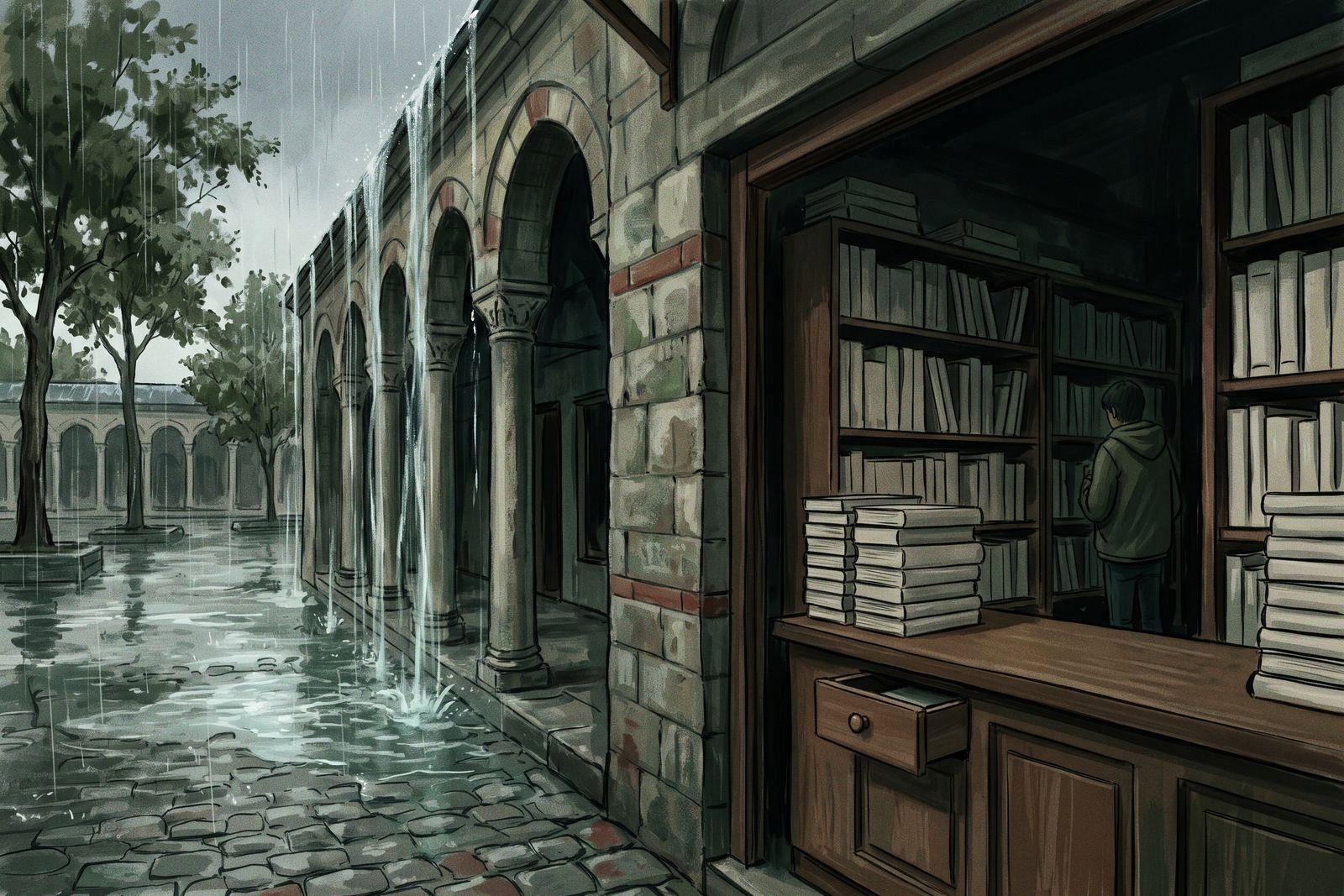
On a wet afternoon in the book market beside the Beyazit mosque, rain drums on the arcade roof over reprints in the old orthography, stacked openly by the door. A dealer keeps one catechism from 1729 in a drawer of its own. It came from a class set bought by a schoolmaster. The price slip tucked into its wrapper is written in letters that descend from the punches recut in 1915. Inside the cover a child wrote her name in the connected hand. The shop boy, a university student who reads three alphabets, cannot make out the name.
1727Firman and fatwa license Muteferrika and Said Efendi to print, with no religious exclusion
After Muteferrika's petition-essay Vesiletu't-Tibaa and with Grand Vizier Nevsehirli Damad Ibrahim Pasha's backing, Sultan Ahmed III's firman and Seyhulislam Yenisehirli Abdullah Efendi's fatwa license Ibrahim Muteferrika and Mehmed Said Efendi to print in Turkish and Arabic. Unlike the recorded permit, the license does not exclude the Quran, fiqh, tafsir, hadith or kalam. The mufti's initial resistance, reported by German observers, is not removed but bought off. Any religious title must first pass a corrector (musahhih) named by the Seyhulislam's office. No one attempts a printed mushaf for decades, because correction costs too much and the copyists' trade in Qurans and fine manuscripts is left alone, which leaves the scribes' main livelihood intact. Equipment and hands come, by the disputed accounts, from France, Holland and Austria and from Istanbul's Armenian and Jewish presses. This chronology places the shop in Muteferrika's house beside the Sultan Selim Mosque in the Mismari Suca quarter. That is an editorial choice between disputed sources; the other source puts it at Harem pier in Uskudar-Selimiye.
8 SOURCED CAUSES
1729Dictionaries and histories as recorded, plus catechisms that sell out through mekteb teachers
The Vankulu dictionary appears on 31 January 1729 in 500 copies. Katib Celebi's Tuhfetu'l-kibar follows on 29 May 1729 (1,000 copies) and the Krusinski translation on 26 August 1729 (1,200 copies). Alongside them the shop issues small corrected ilmihal catechisms, chiefly extracts of Birgivi's Vasiyetname and short creeds, in runs of about 1,000-1,500. The buyers are mekteb teachers purchasing class sets, from which children are read to aloud and made to memorize. Each run sells out within a season through these teachers, not through private readers: per-copy prices stay close to a manuscript's, and private demand stays as thin as Sabev describes. Holdermann's Grammaire turque, the first Ottoman print with Latin script, is printed in the summer of 1730, before the revolt.
6 SOURCED CAUSES
1730Patrona Halil revolt stops the press; restoration re-licenses it under a corrector seal
The revolt breaks out on 28 September 1730, and Damad Ibrahim Pasha is executed on 2 October. The shop is shut and its stock scattered. The rebel leaders are executed on 25 November 1730. In 1731 the restoration appointee who replaced the rebels' Seyhulislam re-licenses printing. Each religious title now carries the seal of a licensed corrector, and the seal posts are granted as rent-bearing offices paid per copy. The rebuild is financed by advances from the bazaar sahhafs who distribute the catechisms and by the new seal holders, who want to protect their rent. Neither the Porte's treasury nor Muteferrika's own purse pays for it. From 1731 Istanbul's older presses become contractors and rivals of the seal regime: Armenian compositors set the sealed Arabic texts, Jewish founders recast the worn type, and Greek shops bid for the same work. The Cihannuma and Tarih-i Hind-i Garbi still appear in 1732, and Muteferrika writes his 1731 reform treatise.
9 SOURCED CAUSES
1731Sealed print travels to India; the millets win exemption from the seal inspectors
Shah Waliullah, in the Hijaz in 1731-32, carries home only short sealed tracts. In the 1740s and 1750s pilgrims of his circle bring vocalized sealed hadith and fiqh volumes to Delhi. At first these serve as exemplars for certified hand copies. Small Delhi shops then set them in Istanbul-cast type bought through Surat merchants, and Indian Muslims gain a print habit nearly a century early. In Istanbul the seal inspectors claim jurisdiction over Armeno-Turkish and Karamanlidika books, which are Turkish in Armenian and Greek letters. The claim is fought through the courts and patriarchates and ends in a millet exemption in the 1760s. Muslim reading is catching up with communities that had printed since 1493 and 1567; it does not overtake them.
4 SOURCED CAUSES
1744Diriyya alliance, the Yalova mill, and a press that outlives its founder
In 1744 the Diriyya alliance between Muhammad ibn Abd al-Wahhab and Muhammad ibn Saud is sealed as in the record. Its preachers carry unsealed Birgivi extracts and counterfeit provincial prints, which makes the seal a mark of Istanbul's orthodoxy. The Yalova paper mill of 1744-45 survives where the recorded one failed. Its unpolished brown stock takes printing ink but not reed-pen ink, so print is the one market a mediocre domestic mill can win. Muteferrika dies in 1745 or 1747; his probate inventory is dated 1 April 1747. The plant passes to his son and partners, but the seal holders and sahhafs whose rent and stock depend on it keep it running. The one-man collapse of the record does not occur. The son's 1756 Vankulu reissue is one title among many.
6 SOURCED CAUSES
1770Primer directive, the 1775 stamp levy as revenue shares, and muhacir readers
In the 1770s, after the defeat of 1774, the Porte directs that sealed primers be used in mektebs. The directive reaches only Istanbul, the provincial seats and kasabas with endowed mektebs. In 1775 a stamp levy on sealed devotional print is sold as esham life-term revenue shares, so ulema households, janissary officers and Galata financiers all hold a stake in devotional print. Primers are exempt from the levy and bought in bulk by mekteb vakifs. They stay cheaper than a hand copy and, after Kazan's Asiatic press opens in 1800, cheaper than Kazan's. Crimean Tatars arriving after 1783 bring primer-schooled teachers. Tatar reformist schooling begins earlier and looks to Istanbul rather than Bukhara.
4 SOURCED CAUSES
1803The Hijaz seal war
From about 1803 to 1813 the first Saudi state holds Mecca and Medina. It turns away the Ottoman caravans and burns sealed stock. Indian and Maghrebi pilgrims carry unsealed scripturalist print home, which cracks the canon's prestige early. Muhammad Ali's forces retake the Hijaz in 1812-18, and sealed refutations travel with the army. Egypt holds the Holy Cities, so the Bulaq press (about 1820) takes the Mecca pilgrim book market from Istanbul.
3 SOURCED CAUSES
1807No deposition fatwa: Selim III survives the yamak rising and the janissaries are dissolved by printed fatwa
In May 1807 the yamak auxiliaries at the Bosphorus forts rise as in the record. The crowd includes preachers, sons of the old copyist trades carrying their guild memory, and unlicensed peddlers shut out of the seal. This time the Seyhulislam's office refuses the deposition fatwa, because its seal bureaucracy and Selim's engineering schools are both fed by the same levy. Without legal cover the rising is crushed by the Nizam-i Cedid, about 25,000 men. There is no Alemdar episode. The janissaries are not destroyed. Their pay is starved and they are subordinated, their shareholding officers split, and mutinies recur through the 1810s. At Bucharest in 1812 Russia, hurried by Napoleon, gains no Bessarabia, and Serbia ends with a narrower autonomy. Selim III dies a natural death in 1817 and Mahmud II succeeds. In 1822 a printed fatwa dissolves the corps without a massacre.
3 SOURCED CAUSES
1821The new army fights the Greek revolt; a rump Greece in the Morea and Cyclades
The Porte fights the 1821 revolt with its own army, and Muhammad Ali is never summoned. The 1824 schooling decree and the 1828 official gazette are issued as in the record and credited to the Porte. Philhellenism and Russian interest are unaffected, so Navarino (1827) and the 1828-29 war still happen. At Adrianople in 1829 Russia takes Bessarabia. The Greek state is confined to the Morea and the Cyclades, and Crete is never ceded to Egypt.
2 SOURCED CAUSES
1831Konya holds, a bilateral settlement returns Syria and the Hijaz, and the kaime is printed under the seal
Muhammad Ali moves on Syria in 1831 over the Acre dispute and takes it, but the older Ottoman army holds at Konya. There is no Russian landing, no Unkiar Skelessi, and no settled British fear of a Russian protectorate. The two capitals fight a pamphlet war over Hajj distribution. A British-mediated bilateral settlement in 1840-41, in place of the London Convention, returns Syria and the Hijaz, and with them Istanbul's pilgrim book trade. The verdict of arms in 1840 favors the Porte more than in the record. The 1840 kaime paper money is printed on the sealed presses, with the corrector seal used against counterfeiting. The 1840-42 salaried tax-collector reform holds in the core provinces because literate clerks now exist. Reading in rural Anatolia is thin, not absent.
3 SOURCED CAUSES
1850Women readers, a smaller Crimean debt, and a printed backlash to the 1856 edict
Girls attend neighborhood mektebs, and women hocas teach reading from the printed Mevlid. By the 1850s an Ottoman women's press exists. The Crimean War is fought over the Holy Places, the Principalities and Russian expansion, but borrowing from 1854 is smaller. A Muslim artisanate that reads the sealed canon answers the 1856 equality edict with sermons and printed pamphlets. The Kuleli conspiracy of 1859 and the Damascus riots of 1860 are larger and print-mobilized, carried by preachers and unnamed crowds. Circassian refugees from 1864 and a second Crimean Tatar wave of the 1860s include primer-schooled teachers who settle in the Anatolian kasabas. In India the early print habit feeds the Deoband (1866) and Aligarh (1875) lineages.
3 SOURCED CAUSES
1873Partial default, the levy ceded to creditors, the palace seal press, and the Arab provinces under licensing
The 1873 crash and the 1873-74 Anatolian famine bring a partial suspension of payments in 1875. In 1878 the Austrian occupation of Bosnia meets a larger, print-organized resistance, which Austrian regulars still crush. Balkan refugees arrive in 1878. The 1881 Muharrem decree creates the Public Debt Administration, and the stamp levy is among the ceded revenues, so European creditors collect on every sealed ilmihal. The Hamidian palace funds a pan-Islamic seal press from the privy purse and makes it a palace organ. From the 1880s seal inspectors license all print in the Arabic provinces and squeeze Beirut's Christian presses. Muslim reformists schooled on sealed primers in Damascus, Aleppo and Baghdad come to lead the Nahda. Anatolian kasabas read by the 1880s. At the 1908 Monastir congress an Arabic-script Albanian faction funded by the Istanbul seal presses wins a parallel alphabet for Muslim schools.
3 SOURCED CAUSES
1909Unionists nationalize the seal board; separated vowelled letters replace the connected script in 1928
The Unionists crush the 31 March rising of 1909 and purge the presses that printed for it. Those publishers flee to Cairo and India, and from 1909 to about 1950 Istanbul loses the Arabic-classics export market to Cairo, Bombay and Beirut. The seal board is nationalized, not destroyed. In 1912-13 the Macedonian losses stand as four allied armies decided them, and Crete is lost in the Balkan Wars. In 1915 the Arabic matrices and punches of the Armenian foundries pass to Muslim apprentices who take over the dead men's benches and recut them for isolated vowelled letterforms. The officer corps trained in this separated script runs the 1919-22 War of Independence. Ankara's bulletins and makeshift schools print on cheap separated stock from the Istanbul foundries. The Diyanet inherits the seal board in 1924. In 1927 about 28% of roughly 13.6 million people read, with villages near 15%. In 1928 the republic makes the disconnected vowelled script official. Within a generation the connected sealed canon is illegible to the young, which serves Ankara against the ilmiye as Latin did in the record, without resetting the reading base. Prosecutions increase in 1925-35. An underground old-orthography trade lasts into the 1950s, with Said Nursi's Risale-i Nur as its flagship. Dual-script Albanian lasts into the 1920s.
4 SOURCED CAUSES
1917Tatar congresses, the Hyderabad board, Soviet scripts, and officer-Islamic Arab regimes
The 1917 Muslim congresses in Russia are shaped by a Jadid movement oriented toward Istanbul. The Soviets Latinize in 1926-28 explicitly as a wedge against Istanbul's letters, then move to Cyrillic in 1938-40. A stronger Khilafat movement backs the exiled last caliph. Ibn Saud takes the Hijaz in 1924-25 and convenes the 1926 Mecca congress. The émigré Istanbul printers, Hanafi heirs of a seal that tolerated the Mevlid, refuse his patronage after the Indian delegates break with him over the tomb demolitions. From 1926 a transnational seal board sits at Hyderabad on an endowment from the Nizam, the exiled caliph's patron. After the 1948 annexation it moves to Karachi. The Saudi Mecca seal is funded by oil from the late 1930s. The 1948 borders and war, the 1952 Egyptian coup and the 1958 fall of the Iraqi monarchy are kept. In Egypt the 1954 rupture between officers and the Brotherhood resolves into a coalition. There is no United Arab Republic, and the Baath stays minor, with no coups in 1963 or 1968. Officer regimes rule with Islamic-modernist parties. Without a pan-Arab mobilization in Sinai, the decade's Arab-Israeli war grows out of the Jordan headwaters diversion dispute. It is fought in 1966 mainly on the Syrian front, and Israel takes the Golan escarpment.
2 SOURCED CAUSES
1950Coups against the seal network, the offset boom, Medina's ascendancy, and the four-cornered Quran-app dispute
After 1950 the old-orthography network surfaces as the base of the religious movements. Migrant workers to Germany from 1961 arrive schooled in the Turkish letters, and German school policy debates a third script. The coups of 1960, 1971 and 1980 fall on their real dates. The 1980 junta targets the seal board and the old-orthography press network, and its 1980 ban on old-orthography religious print is kept. The real 1980s offset-reprint boom returns the hadith and fiqh classics to Istanbul under the Diyanet seal board. Iran's 1979 revolution is unchanged. The Medina complex of 1984 makes the Saudi seal the largest certifier and the dominant free mushaf. In 1991-92 Azerbaijan adopts the Turkish letters, which also reach Arabic-script Azeri readers in Iran, while the Central Asian republics split between Latin and Cyrillic. By the 1990s Kurmanji, kept in an Arabic-derived script aligned with Sorani, forms one Kurdish print sphere across the Iraq border and the diaspora. The 1997 intervention again targets the seal-board and old-orthography network. From 2002 a religious-conservative party descended from that lineage governs. The dates of 2011, 2016, 2017 and 2023 are kept. The 2011 uprisings are directed against the aging officer-Islamic regimes. By 2025 the Quran-app dispute has four parties: the Diyanet board, al-Azhar, the Karachi board and the Medina seal. The Medina seal secures the removal of rival-certified apps from Gulf app stores.
3 SOURCED CAUSES
2025Istanbul protests and the election calendar run on the record's track
The March 2025 detention of Istanbul's elected opposition mayor, the mass protests and student boycotts, and the curbs on social media follow the record. The ruling is unchanged: the divergence altered the alphabet and the religious-print institutions, not party competition, the presidential system adopted in 2017 or the 2023 election result. The texture differs. Placards, court notices and the blocked posts are all in the disconnected vowelled Turkish letters. The broadcast and press regulators that issue the restrictions descend from a licensing habit as old as the 1727 firman, under which every print activity needed permission. The 2028 election date is untouched.
2 SOURCED CAUSES
2025PKK dissolution and disarmament, read across one Kurdish script
The PKK's May 2025 announcement that it would dissolve and the July 2025 weapons-burning ceremony in Iraqi Kurdistan keep their dates. The ruling is unchanged: the drivers of the armed conflict lie in post-1923 state policy, the 1980 junta and Iraqi geography, none of which the press divergence reversed. What is altered is reception. Kurmanji and Sorani share one Arabic-derived script, so the statements reach readers in Diyarbakir, Erbil and the German diaspora as a single text. Turkish commentators argue about whether that shared script made the peace process easier to sell or harder.
2 SOURCED CAUSES
2025Regional wars ruled one by one
The Iran-Israel war of June 2025 is unchanged. Iran's 1979 revolution and its nuclear programme lie outside the divergence's reach; the difference is that Azeri readers in Tabriz follow Baku's coverage in Turkish letters. The 2023-25 Gaza war and the October 2025 ceasefire are averted in their recorded form. Israel took only the Golan in 1966, so Gaza and the West Bank were never occupied in that decade, and Palestinian politics run through the Egyptian and Jordanian ruling coalitions of officers and Islamic modernists. The December 2024 fall of a Baathist dynasty in Syria is also averted, because the Baath never ruled. Syria's war since 2011 has been fought between the split halves of its officer-modernist coalition, and it produces a refugee population in Turkey of the recorded scale, so the 2025 debate over returns is unchanged. The Russia-Ukraine talks hosted in Istanbul in May-July 2025 are unchanged: Bessarabia and the Black Sea balance were settled as in the record by 1829.
2 SOURCED CAUSES
2025Papal visit to Iznik; the millet bookshelf on display
The papal visit to Iznik for the 1700th anniversary of Nicaea, and to the Ecumenical Patriarchate, is unchanged, since the divergence touched no church diplomacy. The cultural margin differs. Istanbul's municipal libraries mount exhibitions of Karamanlidika and Armeno-Turkish books, which the millets' 1760s exemption kept free of the corrector seal. They are shown beside Armenian and Jewish imprints from 1493 and 1567 as evidence that the city's Christian and Jewish communities printed in Turkish before its Muslims did.
3 SOURCED CAUSES
2025After the Gulf app-store purge, three seal boards answer Medina
After Gulf app stores removed recitation apps lacking Medina certification in 2025, the Diyanet seal board, al-Azhar and the Karachi transnational board publish a common verification standard for digital mushafs in early 2026. Each signs its own certified texts, and the standard lets each check the others' files. Medina declines to join. It needs nothing, because its free mushaf is already the default on most phones. Apple's and Google's global stores keep all four. The dispute is the 1727 corrector regime carried onto app stores: an appointed authority's stamp still decides what may circulate as scripture.
3 SOURCED CAUSES
2025Tariffs, inflation and a redenomination debate that keeps the seal
The 2025 US tariff shocks, the central bank's high-rate fight against inflation running near 30%, and the persistent EU candidacy freeze are unchanged. These macro drivers were never touched by a print divergence two centuries old. The proposal floated in 2025 to strip zeros from the lira sets off a small, specific quarrel. Secular columnists ask whether the new notes should drop the corrector seal inherited from the 1840 kaime. The Diyanet board and the central bank's security printers object that the mark is an anti-counterfeiting device, not a religious one. The draft designs keep it.
2 SOURCED CAUSES
2026Ankara NATO summit and Antalya COP31 on schedule; Germany's third-script pilots widen
The NATO summit in Ankara (July 2026) and COP31 in Antalya (November 2026) are unchanged on the diplomatic calendar, because alliance membership and climate diplomacy follow the record. A third-order consequence surfaces in Germany. Several Lander extend school pilots that offer the Turkish letters as an elective heritage script to grandchildren of the 1961 recruits. Teachers' unions argue the pilots cost too much, and parents argue over whether a script their children's grandparents learned in Anatolian schools belongs in a German classroom.
2 SOURCED CAUSES
Every one of these worlds was weighed against the one you have just read. Here is where each of them breaks.
Ibrahim Muteferrika's press is allowed to print religious books in 1727 but still closes after his death in the 1740s, leaving Istanbul without a working press until the 1780s, as happened in our world.
We weighed it because one aging convert's house was a narrow base for any trade, and in our world the presses did fall silent with him. In this history the road breaks in the 1730s. Once every religious title must carry a corrector's seal paid by the copy, men begin to live off the press who are not Muteferrika: the seal holders, the booksellers of the covered market, and from 1775 the households that buy lifetime shares in the stamp levy. A trade with that many incomes riding on it does not end with the death of its founder. When his inventory passes to his son in 1747, those who draw rent from the plant keep it working.
The Istanbul rising of 1730, the Patrona Halil revolt, passes Muteferrika's shop by, and the press comes through it untouched, as it did in our world.
We weighed it seriously, since in our world the rising of autumn 1730 cost the grand vizier his life and left the press alone. It holds, but it belongs to a smaller world than the one this history owes its reader, and we set it aside as too close to our own. Once the shop sells catechisms by the thousand to Quran schools, the copyists and the preachers who speak for them lose the bottom of their market within two seasons, and a crowd from those trades in the lane by the Sultan Selim Mosque becomes a road open to us. We took it because the sack of 1730 explains what follows in the 1730s: a government frightened of preachers, and the settlement of 1731 that ties every religious book to the seal of a corrector paid by the copy.
Small presses in the provinces turn out counterfeit catechisms faster than Istanbul can seize them, and the seal breaks apart into a scatter of local prints, as printing splintered religious authority in sixteenth-century Germany.
We weighed it because counterfeits do appear in the provinces, and print has broken monopolies before. It breaks between the 1730s and the 1750s. After a crowd led by preachers has sacked the shop and toppled a grand vizier, the government fears a second rising more than it values any provincial trade, so it pulls the seal toward the capital, and the seal holders make sure counterfeits are found. We kept the branch in one region: the Arabian preachers allied with the Saudis from 1744 carry unsealed and counterfeit extracts, and their hold on Mecca and Medina from 1803 to 1813 sends a stricter unsealed print home with the pilgrims. The price is that Istanbul's canon loses its standing in places it had only just reached.
Every war the Ottoman state and its successors fight between 1739 and 2023 ends exactly as it did in our world, on the grounds that armies decide wars and books do not.
We weighed it because it is the safe road, and it was defensible. We set it aside as too close to the world we live in, a smaller world than this history owes its reader. From the 1770s the stamp levy pays for engineering schools, sealed primers go into the schools that feed the ranks, janissary officers hold shares in the levy, and clerks who can keep books carry the tax reforms of 1840; if armies decide wars, a change in their schooling, pay and administration argues for different outcomes. So Russia makes peace in 1812 without Bessarabia, the old army holds at Konya in 1831, and the war of 1967 never comes. What survived is the set of contests decided by numbers and rail beyond the reach of any press: the Balkan Wars of 1912 and 1913 and the crushing of the 1909 counter-rising keep their outcomes.
The Ottoman government, strengthened by literate clerks and a lighter war debt, meets its payments through the crisis of the 1870s and never defaults in 1875.
We weighed it because this world has more trained clerks and borrowed less from 1854 than ours did. It breaks in the 1870s. The crash of the European exchanges in 1873, the Anatolian famine of 1873 and 1874, and the debt still owed from the Crimean War come from forces no number of readers can reach. We kept a partial default in 1875 and paid its price in full: in 1881 the stamp levy of 1775 passes to the administration run by the empire's European creditors, and a share of every sealed catechism sold in a provincial town goes to bondholders abroad.
The religious counter-rising of April 1909 against the Unionist committee succeeds, and its literate crowds hold Istanbul.
We weighed it because a city that reads, with pamphlet presses ready to print for the rising, gives a crowd more reach than it had in our world. It breaks in the first decade of the century, in April 1909 itself: regular units from Macedonia arrive by rail, and no urban crowd, however literate, stands against trained infantry with a railway behind it. We moved the change elsewhere. The Unionists purge every press that printed for the rising, its publishers scatter to Cairo and India, and the government nationalises the seal board while keeping its stamp.
The caliphate survives its abolition in 1924 on the strength of its readership across the Muslim world, or the Muslim congresses of 1926 elect a caliph to reign in exile.
We weighed it because sealed print has given Istanbul readers from India to the Volga, and a caliph with that following looks hard to abolish. It breaks between 1924 and 1926. Support for the caliph from Muslims abroad was the very argument Ankara used to abolish the office, so a wider reach makes him more of a threat to the republic and hastens his end. In our world the congresses of 1926 foundered on rivalry among the men who wanted the title, and nothing in this history removes that rivalry. What carries the authority forward is the seal board, which needs an endowment from a sultan or a Nizam and no dynast at its head.
When Ibn Saud takes the Hijaz in 1926, he also captures the seal board of the printers who fled Istanbul, leaving the world three seals: Istanbul, Cairo and Mecca.
We weighed it because Saudi money was abundant and the émigré printers were poor. It breaks in the mid-1920s, at the Mecca congress of 1926. The Indian campaigners for the caliphate, on whose money and protection the émigrés depended, broke with Ibn Saud over his demolition of the tombs in the holy cities, as they did in our world, and the printers refused his money with them. So the board settles at Hyderabad on the Nizam's endowment, moves to Karachi when India annexes the state in 1948, and survives as a fourth seal and a rival to Mecca's.
Turkey's republic adopts the Latin alphabet in 1928, as it did in our world, and the reformed Arabic-derived letters never become the national script.
We weighed it as the road back toward our own world, and it was defensible: the motive of 1928 was political, and Latin letters served it. We took the other road for reasons we can name in the 1910s and 1920s. The letters recut in 1915 as separate forms with every vowel marked become the script the officers of 1919 to 1922 learn in training and carry into the republic, and in 1927 some 28 per cent of the population already reads. A script that cuts the young off from the connected canon within a generation gives Ankara what it wanted against the learned class, without throwing that reading public back to nothing. Latin in 1928 would have made a smaller world than the one this history owes its reader, and we chose the larger one.
Turkish or Arab politics between 2002 and 2026 turns on an invented scandal, statement or act attributed to a politician still living.
We weighed it only long enough to rule it out. Our rule for the years after 1950 is fixed: the divergence travels through the seal boards, the presses, the parties and office-holders we invent, and never through words or deeds put in the mouth of a living person. The branch breaks the moment it reaches the 2000s, because the force behind it would be our own fabrication about people who can still answer for themselves. So the party that governs from 2002, the failed coup of 2016 and the election of 2023 keep their dates, and the difference shows in the letters on the placards, the stamp on the books and the four seals on digital Qurans.
Everything before the hinge rests on these readings. Under each title, the passage retained.
- THE PRINTING PRESSES OF ISTANBUL (1453-1839)
The first Armenian press in Istanbul was opened in 1567
- BOOKS PUBLISHED IN THE FIRST TURKISH PRESS IN ISTANBUL
It was published as two volumes on 31 January 1729, 500 copies.
- THE 1730 REBELLION
On November 25, 1730, Patrona Halil and the other leaders of the rebellion were executed.
- İbrahim Müteferrika | Britannica
In 1727 İbrahim established a printing press on which he printed works on language, history, geography
- An Ottoman cosmography (Cambridge University Library Special Collections)
There was a vested interest among the local scribes and calligraphers to prevent the growth of printing.
- Cotsen's Covert Collections: The First Illustrated Book Printed in Turkey (Princeton University Library)
The press ran until 1742, and in just fourteen years he printed seventeen works totaling 13,200 volumes.
- Sultan Ahmet III Permits Printing on Secular Topics by Müteferrika While Protecting the 4000 Scribes in Istanbul
producing 17 titles in 22 volumes, with a total press run for all the tiles combined of 12,200-13,700 copies
- Three Modes of Reading: Writing and Reading Books in Early Modern Ottoman Society (C. K. Neumann)
all books on fiqh, Quran commentary, hadith and kalam were excluded from the permission
- The First Ottoman Turkish Printing Enterprise: Success or Failure? (O. Sabev)
Müteferrika's probate inventory recorded 2,981 unsold copies
- Formation of Ottoman Print Culture (1726-1746): Some General Remarks (O. Sabev)
His printing enterprise produced approximately 10,000 to 11,000 copies across sixteen editions.
- Ibrahim Müteferrika and the Age of the Printed Manuscript
Müteferrika's printed books were often priced similarly to handwritten manuscripts
- Early Ottoman Printing: The Müteferrika Press (Brill)
The printing presses came from France, the typefaces were imported from Holland, while personnel was brought in from Austria.
- The Müteferrika Press: Obstacles, Circumvention, and Repercussion According to Contemporary German Sources (1727–1741)
the grand vizier succeeded in neutralizing the grand mufti's opposition.
- İbrahim Müteferrika and the Printing Press: A Delayed Renaissance
they even staged a protest against the printing press.
- Myths and reality about the printing press in the Ottoman Empire (Ekrem Buğra Ekinci, Daily Sabah)
opened the first printing press in a mansion on Harem pier in the Üsküdar-Selimiye
- Converting to Ottoman world: First Muslim printer, Ibrahim Müteferrika (Ahmet Büyükaksoy, Daily Sabah)
there is no evidence of organized resistance from calligraphers.
- Müteferrika Matbaasının öyküsü (Yeni Şafak)
Sultan III. Ahmed’in fermanı ve Şeyhülislam Yenişehirli Abdullah Efendi’nin fetvasıyla
- 10 soruda Osmanlı’da matbaa ve İbrahim Müteferrika (Fikriyat)
1718'de bir harita matbaası kurmak için izin almış
- Müteferrika Matbaası (Küre Ansiklopedi)
Matbaada kitap basımı için dört, harita için iki tezgâh bulunmakta ve beş kişi çalışmaktadır.
- İbrahim MÜTEFERRIKA (1674-1747) (Üsküdar University)
authorized on the condition that only non-religious works would be printed
- İbrahim Müteferrika – A brief portrait of life and works of an early modern Ottoman intellectual
his frequent petitions to the state to meet expenses
- Matbaa Teknolojisinin Osmanlı Devletine Giriş Koşulları ve Tartışmalar
28 Eylül 1730'ta Osmanlı donanmasında gemici ve yeniçeri olan Arnavut asıllı Patrona Halil
A life in this world — an archival fiction
To the honoured Mehmed, son of the late Halil the grocer, at the han of the cheese-merchants by the Selimiye in Edirne, after greetings and the asking of his health. Written the third of Ramazan, 1259, at the Sultan Selim gate, by the hand of Rüşdü, writer of petitions.
Your brother Hasan, grocer of Mismari Suca, wished you to know that the Edirne white had come, four tins, by Osman the carter, and that only the fourth had wept brine at the seam. It had a thumbprint in red on the lid. He said Osman had wanted twelve para more for the carriage than in the spring, and he had paid it, and you should speak to Osman.
He said the shop had done well enough for the fast. The pekmez went before the cheese, and the lamp oil before both, the nights being what they were. He had bought from the foreman of the press below the mosque forty okka of waste sheets for wrapping, and wished you to see how the man reckoned. The chit, which your brother kept in the cash box, listed the titles in a column: the Cihannuma at four para the okka, the naval history at six, the history of the West Indies at five. When your brother asked why one book should be dearer than another, paper being paper, the foreman said the Cihannuma was cheaper because there was more of it. Your brother said he had never heard of a man charging less for a thing because he had too much of it. The foreman said that was the paper trade. Your brother said then the paper trade was run by fools, and they parted friendly.
Your brother further complained that the foreman would never let him have a single sheet of the catechisms or the mevlids, which were the right size for a half-okka of olives. He gave him only histories and maps, too big, to be torn in four. The foreman said those all went. Your brother asked where they went, and the foreman said out of the door. Your brother believed the man had a cousin with a shop in Fatih. Any sheet with the Name on it, or a corrector's seal, went into the willow basket with the lid, and the foreman's boy carried it down to the Haliç on Thursdays. Your brother had no quarrel with that, being a believer.
Ahmed, God keep him, had his catechism by heart as far as page eleven, the ablutions, and said it at supper by the page, as the hoca taught them, every boy in the school holding the same book. Your brother sat beside him of an evening and sounded it out with him from the print, so the boy should not skip. It was the Birgivi from the press by the mosque, printed in fifty-seven, with the corrector's seal on the first leaf, and it had cost three kuruş, which your brother thought fair for a thing that would last the boy's schooling and his son's after.
The boy's mother had said the ship on one of the wrapping sheets was bound for the Indies. Your brother said that was as may be.
Now to the matter. The steward of the grocers closed his register at Kasım, and the gedik of your late father stood still in both your names, as it had since the burial. You had been three years in Edirne, with a business in cheese, and were well. Your brother asked that you go before the kadı of Edirne and have a renunciation of your share drawn up and sealed, and send it by Osman before the register closed. He said it was only a paper. He said you would not miss a shop you had not swept in three years. He said there would always be a tin of olives for you in Mismari Suca.
He sent his greetings, and Ahmed his hand to kiss.
The writer read the above back to Hasan the grocer at the gate, and he approved it and set his seal. Fee, twenty para.
To the brother of my heart, Hasan, grocer, in the quarter of Mismari Suca below the mosque of Sultan Selim, in the City, may God keep his shop full and his scales true. Written in Edirne on the nineteenth of Ramazan, 1259, by Abdullah, scribe at the Eski Cami, at the dictation of Mehmed, cheese-merchant.
Mehmed received his brother's letter and laughed at the part about the foreman, and had it read again for his partner, who also laughed. He said Osman had been spoken to about the twelve para.
As to the paper for the kadı, Mehmed asked his brother not to be angry with him. He would not send it. He said his brother would remember, as he remembered, the night in the shop with the lamp turned low when their father said the shop was meant for Mehmed and the house for Hasan. That Mehmed went to Edirne afterwards and took up cheese was because Hasan had a wife and a boy, and Mehmed had only debts, and it had seemed the better way. But he did not think a shop meant for one brother should be written over to the other by a stranger with a pen. He asked that the gedik be left as it stood. Nothing would change but the ink.
He said he thought often of the fortieth day. He remembered how his brother sent away the reciter who came with the Bursa Mevlid and paid half again for one who had the Istanbul printing, with the corrector's seal in eight sides on the first page, and how his brother carried it round the neighbours before the reading as though he had set the type himself. Their father would have liked it. Their father liked a thing done properly.
He sent by Osman a tin of the white, the first of the autumn milk, and would take nothing for it.
He asked after Saliha, his sister, and whether she still sat up over the paper with the lamp, oil being dear.
He said his brother should have Saliha read him this letter slowly, as she had read their father his accounts in the last years, when he could no longer see the figures.
Written as it was said.
Read aloud by Rüşdü, petition-writer, to Hasan the grocer at the Sultan Selim gate, the twenty-fourth of Ramazan. Fee, ten para.
To Mehmed, son of Halil, at Edirne. Written the seventh of Şevval, 1259, at the Sultan Selim gate, by the hand of Rüşdü.
Your brother Hasan acknowledged the tin of white, which had come sound. He would pay for it whatever you said. He had put the money aside and would send it when the gedik was settled.
He said he had no need of his wife to read him letters. There was a writer at the gate who was paid for it, and your brother could read for himself besides, given time, and the hand of your Edirne scribe was no better than a hen's. As for who read Father his accounts in the last year, your brother said only that Father's eyes were
Here your brother stopped, and told the writer to leave it as it was.
He wished you to know what the gedik had cost him so far, since you seemed to think it came for nothing. To Ömer, clerk of the kethuda of the grocers, for drawing up the settlement, fifteen kuruş. To the same, for what he called the looking into it, five kuruş. Coffee for the same, three times, at the Sultan Selim fountain, and once a pipe. To Ibrahim the halva-maker, for coming to the clerk to bear witness, a box of halva, which Ibrahim then ate in front of the clerk. Ibrahim remembered your father well. He remembered that your father owed him for sesame in the year of the fire. He did not remember anything your father said about the shop. Old Hüseyin the porter remembered your father well also, and remembered that he had a son in Edirne, and asked after your health. Apkar the coppersmith remembered your father's cough. So your brother had gone round the bazaar after men who remembered Father, and paid each of them something, and not one of them remembered his words about the shop.
He did not know what night you meant, with the lamp. Father said many things in the last year. He said once that the Russian would be in Üsküdar by spring.
He wished you to know of a shame put on the shop. The imam's wife sent her girl for a half-okka of the white, and your brother wrapped it himself, Saliha having gone that morning to her sister in Fatih, and the shop full, and the sheets all histories as usual. Within the hour the imam's wife came back in person and put the cheese on the counter, still in its paper, and opened it, and showed your brother a corner of the sheet where a prayer formula stood, small, at the foot of a page of the naval history, where some captain had given thanks for a safe harbour. She said, "Have you stopped looking, Hasan?" in front of the water-seller and the Laz boatman. Your brother gave her another half-okka in clean paper and took nothing. He went straight down to the press and told the foreman it was the foreman's duty to see that every sheet with the Name on it went into the basket for Thursday, a grocer having his own work, and that if it happened again he would buy his paper from the Armenians at Kumkapı. The foreman said the Armenians would sell him the same sheets, since they shared a compositor. Your brother said that was not the point.
He would sooner have no help in the shop than the help he had. Saliha would not let him wrap with a sheet until she had turned it front and back, and she would stand at the counter with a page of the Cihannuma and her finger on it while a customer waited with his oil jar. She told the Laz boatman his Trabzon was farther from the City than Varna was, by the shape of the sea, and he argued with her and went off without his oil. She told the water-seller the quarrel with the Persians was over a town on a river at the bottom of the map and had nothing to do with Erzurum, and he stood arguing about Erzurum, where his cousin had soldiered, until the lamp-man gave up and went to the next shop. Your brother asked her what business it was of hers where the Persians were. She said it was on the paper. Your brother told her again the paper was for wrapping cheese, and she went on reading it.
He said you would not know, being in Edirne, what it was to keep a shop.
He had written to you plainly and you had written back about lamps. As a boy you would not get out of your bed for the dawn prayer, and Father beat you for it, and it seemed three years among the cheese-men had not made you quicker. Kasım was close. The clerk had the settlement in hand. Your brother would put his seal to it whether you sent your paper or not, and the register would close, and the matter with it.
Ahmed had his catechism now as far as page fourteen.
Read back to Hasan the grocer at the gate. He asked that the part about the bed be kept. Fee, thirty para, the letter being long.
By order of the kethuda of the grocers of the City, the grocer Hasan son of Halil, of Mismari Suca, is to present himself at the coffeehouse by the Sultan Selim fountain after the afternoon prayer on the fourteenth of Şevval, to hear the settlement of his gedik read and set his seal to it before the steward's register closes. Ömer, clerk, the tenth of Şevval.
To Mehmed, son of Halil, at Edirne. Written on the fourteenth of Şevval, 1259, being Kasım day, at the Sultan Selim gate, by the hand of Rüşdü, the hour being late.
Your brother Hasan wished you to know that the thing was done.
He went to the coffeehouse by the fountain after the afternoon prayer, as summoned, with his seal in his sash, and the clerk was not there. He waited the length of two coffees, which he paid for, on a bench as cold as a well-stone. At the next bench two porters argued whether a Quran printed on the stone from the hand of the old calligrapher was still the work of the pen or the work of a press, and so forbidden, and whether a man who bought one for his daughter's dowry had done a sin or only spent too much. One said the stone had only copied what the pen wrote. The other said by that reckoning a thief only copied what was in your purse. They got loud, and the coffee-man asked them to take it outside, and they would not, and it was in all that noise the clerk arrived, late, complaining of the boats from Üsküdar.
The clerk read the settlement through. He read it at a good pace, being a man with other business that day, the register closing. Your brother heard it entire. It set out the gedik of the late Halil, grocer, of Mismari Suca, in the shop of the endowment of Sultan Selim, the rent and the rights to the stall and the scales and the measures, and the name of your brother as grocer of it. Your brother set his seal to it, and the clerk set the kethuda's seal beside, and blew on it, and took it away to the steward, and the register was closed before the evening prayer. The clerk asked a further two kuruş for the reading, which your brother paid.
There were no hard feelings. A man may be slow and still be a brother. Your brother would send you by Osman a tin of the black olives from Gemlik, the good ones, for your trouble in the matter and for the cheese. You might come to Istanbul at the Kurban and eat in the shop, which was a shop you would always be welcome in.
He did not trouble Saliha with it. He said a man who can read does not need a thing read to him twice, and she had the boy to see to, and the paper.
He said also that the clerk's ink had been very black, and the clerk had blown on it a long while.
The writer offered to look over the fair copy when it came, as is the custom. Hasan said there was no need, as he had heard it entire. Read back to him at the gate. Fee, twenty para.
To the brother of my heart, Hasan, grocer, in Mismari Suca in the City. Written in Edirne on the thirteenth of Zilkade, 1259, by Abdullah the scribe, at the dictation of Mehmed.
Mehmed wished his brother joy of the settlement and thanked him for the olives, which had come, and which were the good ones, as promised.
The kethuda had sent him a fair copy of the deed by the guild post, as one of the names, and he had had it read to him twice in the han by a man who reads for the cheese-merchants, and found it in order.
He said, so that his brother should not think him sly, that the third line kept Mehmed's half-share in the gedik, as before, the clerk having copied it over from the old deed, and the kethuda not having been shown any renunciation. Mehmed had not asked for this and had not written to the kethuda. But he would not pretend he was sorry. "It is what Father wanted, near enough," he said, and asked Abdullah to write it as he said it.
He would not come to Istanbul to trouble anybody, nor stand in the shop, nor touch the scales. He asked only that his half of the profit be reckoned once a year, at Ramazan, and sent with Osman, and he would take it in cheese if money were short.
He asked his brother to forgive him the bed.
He sent his regards to Saliha, his sister, who would have seen it.
Written as it was said.
Read aloud by Rüşdü to Hasan the grocer at the gate, the twentieth of Zilkade. He asked to hear the third line twice. Fee, ten para.
To Mehmed, son of Halil, at Edirne. Written the ninth of Muharrem, 1260, at the Sultan Selim gate, by the hand of Rüşdü.
Your brother Hasan asked pardon for not writing sooner. There had been the cold, and a fire in Fatih that took two streets, and the price of bread.
The clerk Ömer had read the settlement too fast, on account of the boats from Üsküdar, and no man could have heard the third line clearly with the porters shouting about the stone. It was well known the kethuda favoured Edirne men, his wife being from there. When the fair copy came, the writer had looked at it with your brother at the gate, and the ink in the third line had run as if it had been set down wet, and the kethuda's seal beside it was smudged, so it was a wonder anyone could read it at all.
The writer had drawn up for him a complaint to the steward on these points, at a cost of one kuruş, which your brother kept in the cash box and had not sent nor shown to anyone.
Now to business. The foreman had more of the West Indies history than ever, a whole bale come back from the Sahaflar unsold, and let your brother have it at four para the okka, the same as the Cihannuma, there being so much. Your brother wished to order two tins of the Edirne white by Osman before the fast, and asked that your half-share be reckoned at Ramazan as the deed said, and sent with Osman, and that you write what you were owed so it could be weighed against the cheese.
Ahmed had his catechism as far as page thirty. His mother sat with him over it in the evenings now, the shop keeping your brother late.
Saliha had asked that the sheet with the woodcut ship, the one that came round the first cheese of the autumn, be set aside and not used for wrapping. It was set aside, on the shelf behind the steelyard.
Read back to Hasan the grocer at the gate. He asked that the part about the ink be kept. Fee, twenty para.