The Coffee Branch Centavo
1975–1976The Lever Pulled Once
American law lets a foreign army use American weapons in self-defence and for nothing else. In December 1975 roughly 90 percent of the Indonesian army's weapons are American. That clause has kept a fleet idling off Dili for weeks. An embassy officer in Jakarta has already warned that an invasion might cost Indonesia its current military aid, and lawyers in Washington have been writing the same thing to one another since autumn. On 6 December, in Jakarta, Suharto asks President Ford and Henry Kissinger for "understanding" of "rapid or drastic action" in East Timor. The Americans answer with the lawyers' sentence: an operation outside self-defence will suspend the supply relationship.
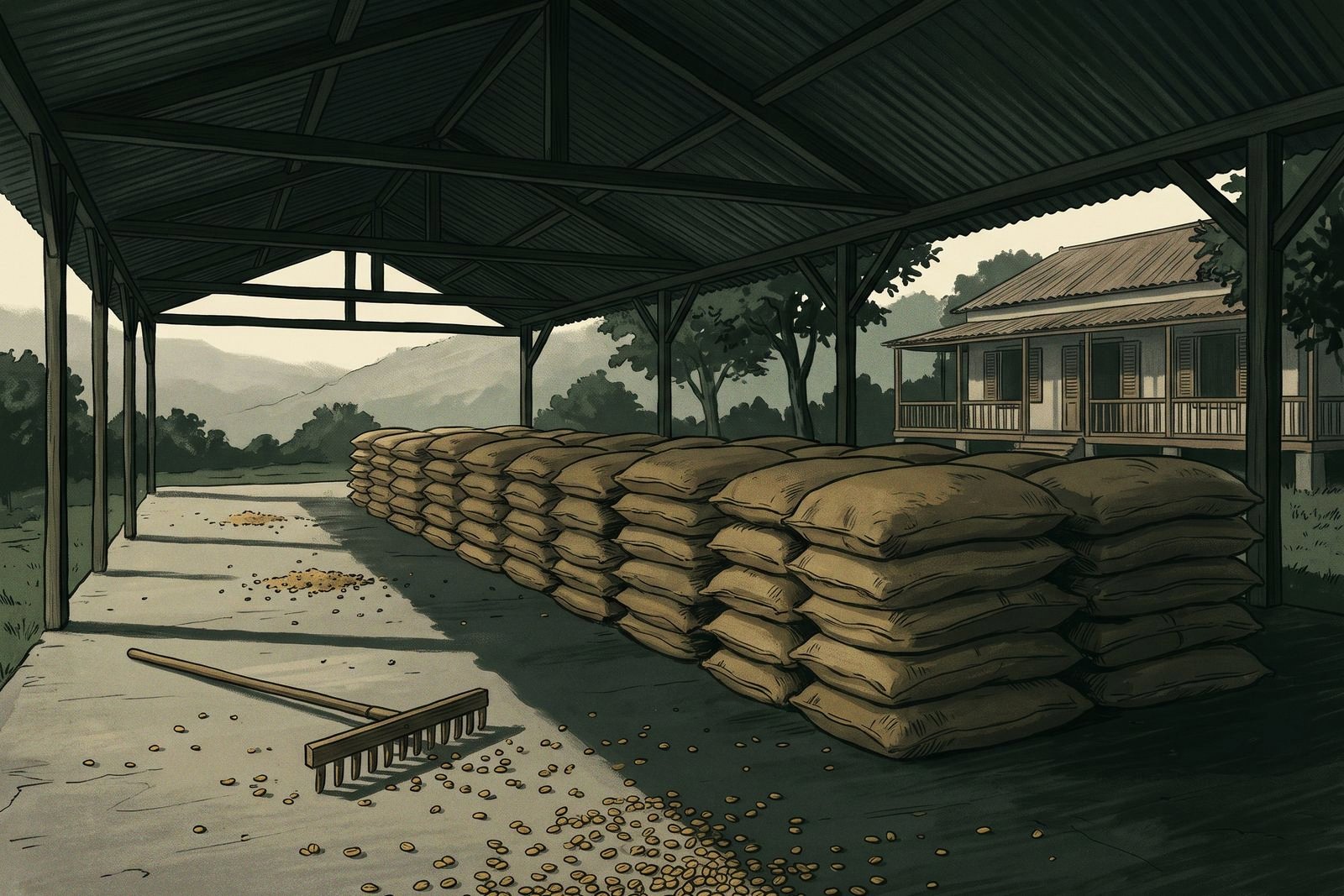
The order to cross is held before dawn on 7 December. The warships off Dili turn for their home port. The airborne battalions stand down at Kupang, on the Indonesian half of the island. The special-forces teams already fighting inside the territory pull back to the border town of Atambua. Nothing else in Washington moves. The joint communiqué still promises "substantial aid", the small-arms factories are still agreed, and Suharto's Indonesia is still the prize of the region. One lever has been pulled, once.
Inside the defence ministry the recall is a public loss of face for the two officers who planned the border raids and the landing, Benny Moerdani and Dading Kalbuadi. Their apparatus stays where it is. The propaganda station at Kupang keeps broadcasting in Timorese dialects, the camps at Atambua stay full, and the officers who staked their careers on Timor keep their grievance. What the apparatus has already done also stays. Five newsmen working for Australian television were killed at Balibo in October, and their burnt remains lie in the Australian embassy in Jakarta.
East of the border there is a declared republic and very little state. Fretilin proclaimed the Democratic Republic of East Timor on 28 November, after winning a short civil war against UDT, its former coalition partner. The Portuguese garrison had fallen from almost 3,000 men to about 200 Europeans, and the governor had retreated to an offshore island before leaving altogether. Lisbon's own law still fixes October 1978 as the end of Portuguese sovereignty.
Money settles Jakarta's next move. In early 1976 Pertamina, the state oil company, defaults on roughly $10 billion owed to Western creditors. A second landing is unaffordable while the American lever is live. The special-operations staff turn instead to the tens of thousands of UDT and pro-integration exiles who fled into West Timor after the civil war. They arm them as "Balibo Declaration partisans", after the integration petition their leaders signed under Indonesian sponsorship at the end of November. In mid-1976 the partisans walk into Oecusse, the Timorese enclave set inside Indonesian territory, carrying no American rifles. Falintil, the Fretilin army, has no road that reaches the enclave. The navy then posts hulls of non-American build off Dili's north coast as an "anti-smuggling" quarantine. Washington files Oecusse as a Timorese factional matter. The procurement staff in Jakarta draw a different lesson and start pricing ships and aircraft in Europe.
Coffee pays for the rest. The great frost of July 1975 sends world prices to a peak in 1976 and 1977, and Fretilin nationalises the large Portuguese estates in the hills of Ermera. Dili sits outside the international quota agreement, so its beans sell at a discount to foreign traders. The Dili branch of the old colonial bank prints Timorese escudos to pay soldiers and clerks. Most Chinese-Timorese merchant families leave for Darwin, a town still rebuilding after Cyclone Tracy flattened it on Christmas Day 1974. From there they start running the small boats that become the territory's lifeline. The windfall goes to the army. Within a year the roads, the rural clinics and the teachers' pay begin to decay.
The occupation that followed the landing in the history where it went ahead does not begin here, and that deserves its own sentences. In that history twenty-four years of killing, forced relocation and famine left at least 102,800 dead by the count of Timor's own truth commission, most of them from hunger and disease. In this one those years are not lived. The territory is given nothing in exchange. It inherits a poor and frightened state that will spend its next decade at war with itself and dig graves of its own. Eighteen months earlier an Australian prime minister had told Suharto that an independent Timor would be "an unviable state, and a potential threat to the stability of the region."
1977–1981The Quarantined Coast
Tomás is twenty-three in 1977. He is the son of a Chinese-Timorese shopkeeper who sold cloth and kerosene on a Dili side street until 1976, and he has already crossed the Timor Sea nine times in a Darwin prawn boat with its name painted out. He lands at night on the beaches near Betano, on the south coast, where the quarantine does not reach. By then Falintil has fired off the Portuguese stocks it captured in 1975. His cargo is rice, diesel and radio batteries, and more and more of it is ammunition. Soviet-made rifles cross the same water, shipped on from Mozambique and Angola.
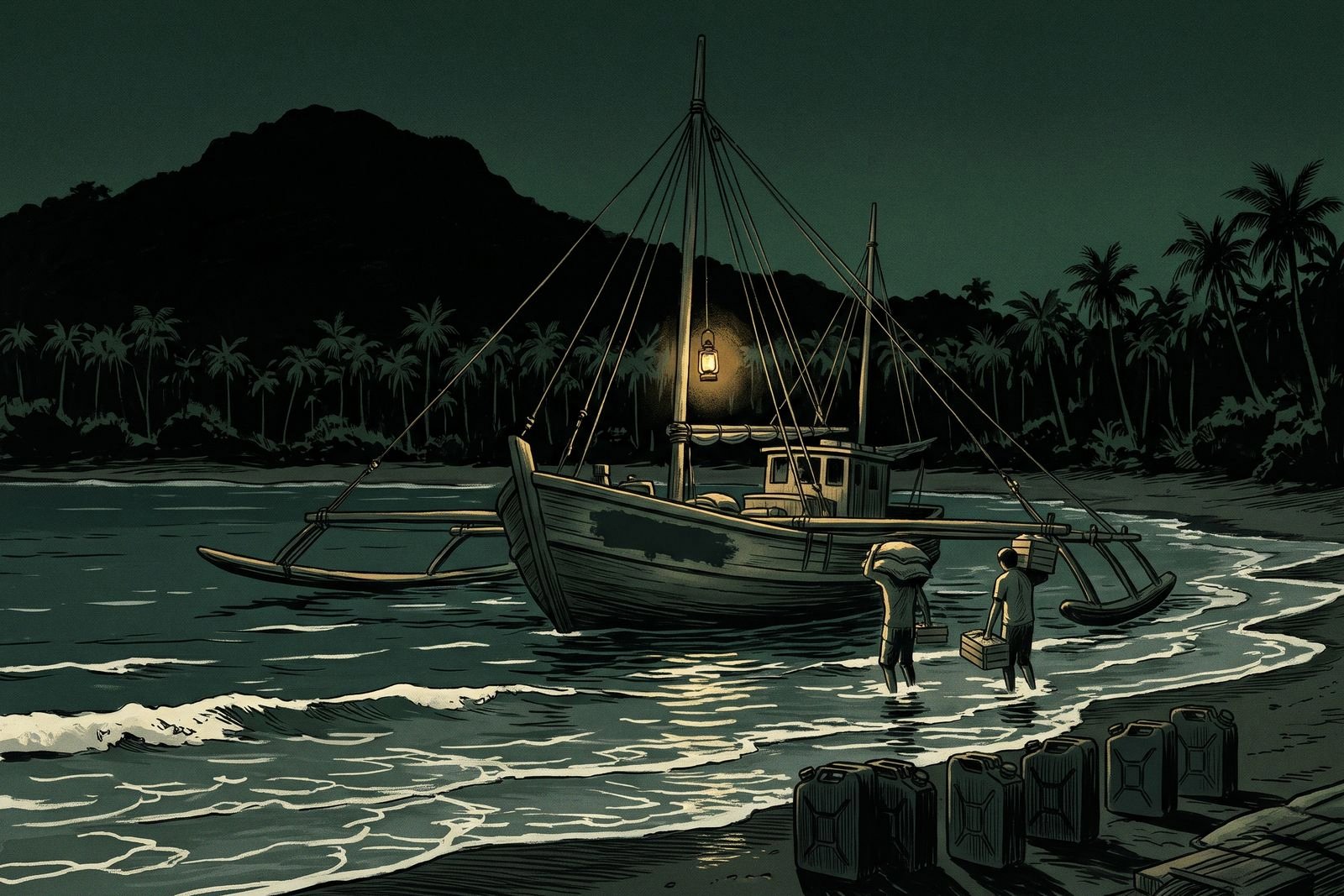
Portugal's former colonies send what they can spare. A Cuban medical brigade opens wards in Dili, and teachers from Angola and Mozambique take the classrooms the Portuguese left empty. They teach in Portuguese, the only language they share with pupils schooled by the missions. Radio Kupang makes much of the Cubans, in Tetum and in Indonesian. Rádio Maubere, the Fretilin station, answers in Tetum, and the answer starts a quarrel over spelling. The party writes Tetum the way the Dili market speaks it. The older Tetum of the southern hills, the one the Church used in its catechisms, has its own defenders, and teachers end up correcting one another's chalk.
In Darwin a newspaper photographer shoots American-marked rifles and mortars captured from the partisans. At a House hearing in Washington in 1977 a State Department lawyer testifies that "roughly 90%" of Indonesia's arms in 1975 came from the United States. The executive disputes where the captured weapons came from. It does not deny they exist, and the transcript is filed.
The Central Committee breaks the same year, over the war economy and over whether to talk to the UDT exiles. The radical wing holds the commissariat for political orientation and the secretariat for internal security, and it arrests the faction it calls "capitulationist". Between September 1977 and early 1978 the detainees are driven to a camp in the eastern mountains and shot. Later accounts from the Church and from the party itself put the dead in the hundreds; nobody publishes a figure at the time. Power settles in the security offices.
In October 1978, on the date set by its own law, Lisbon declares its administration of Timor ended. The United Nations keeps Portugal on its list as administering power, because no act of self-determination has been recognised, and Lisbon raises no objection.
From 1978 to 1981 the party's campaign against "obscurantism" goes after the liurai, the customary chiefs; the lisan, the customary law that settles land and marriage; and the uma lulik, the sacred houses where lineages keep their heirlooms. Several of these houses burn in Ermera and Bobonaro. Aggrieved chiefs and UDT remnants, armed from Atambua, join the partisans in the Frente Lisan, and a rural war begins that will last six years. Villages empty. The purge, the insurgency and the reprisals together leave the dead and displaced in the tens of thousands. The Church is the one body the Central Committee cannot dissolve, and people go there to say what they have seen. The bishop of Dili spends these years carrying messages between party offices and burned hamlets.
In March 1980 Tomás walks three days overland from Betano to look at his father's shuttered shop. At seven in the morning he is standing on the Dili pier. A Soviet trawler is tied up there, rust running from its anchor port, its crew pegging laundry along the rail; Dili, out of cash, has just signed a fishing agreement with the Soviet Union. Past the reef an Indonesian patrol boat sits on the horizon, where some patrol boat has sat for four years. On the customs house door someone has chalked the escudo price of a sack of rice, crossed it out twice and chalked it again. Oecusse, along the coast to the west, flies an Indonesian flag. Tomás buys nothing and walks back south.
In Jakarta the trawler is the "communist enclave" the generals had been describing. From 1981 the Reagan administration signals that it will tolerate Indonesian action. Working from the 1977 transcript, the Democratic House writes a rider, a binding clause, into the foreign assistance act. It bars the use of American-built transport planes, attack aircraft, armoured cars and ex-American landing ships against the territory.
1982–1990Six Weeks on the Waterfront
Filomena is twenty-seven in 1982 and teaches the fourth class at a mission school above Ermera, in Portuguese, from readers printed in Angola. Her pay arrives three months late in escudos. Her older brother, a district secretary of the party, was taken east in October 1977, and every Lent she asks at the bishop's office whether anyone has heard of him.
That year the army launches Seroja II without paratroopers, because the rider has grounded the transport fleet. Marines come into Dili harbour aboard requisitioned merchant ships, escorted by corvettes built in Europe, under jets ordered from Europe in 1978. Falintil has been a standing army for six years and holds the heights above the town. The marines take the port and cannot get off it. After about six weeks they withdraw under a ceasefire the United Nations brokers in early 1983. The waterfront is wrecked, the old customs house is holed, and several thousand people are dead. The humiliation discredits the Timor lobby inside the defence ministry and the special-operations staff. It does not touch Suharto, who has oil revenue and a parliament he controls. In 1984 a ceasefire line, watched by UN monitors, is drawn along the western border strip.
Hawke wins the Australian election in March 1983, as he would have anyway, and reads the trawler and the landing as proof that an empty space invites the Soviet Union. Canberra opens a trade office in Dili that year.
In 1984 the moderate wing takes the Central Committee, and the commissar and the security secretary lose their offices. The record of this world does not say why the radicals gave way without a fight. The party recognises the liurai as customary authorities, returns land and marriage disputes to lisan, amnesties the Frente Lisan fighters and pays toward rebuilding the burned houses. The rebuilding falls on the villages as a duty. Above Ermera, Filomena's pupils miss school every dry season to haul timber up the ridge.
The package arrives in 1985. Australia recognises the Democratic Republic and, in the same signing, takes a Timor Gap seabed treaty drawn close to its own continental-shelf claim. Dili signs because it is desperate. Its condition is that Australia act as patron, and it lets the Soviet fishing deal lapse. There is no military guarantee. Jakarta recalls its ambassador from Canberra, and relations stay frozen until 1990. The oil-price collapse of 1986 squeezes Jakarta further, and exploration licences in the Gap are issued between 1986 and 1988.
Portugal joins the European Community in 1986. Brussels money frees room in the Lisbon budget, and the Portuguese aid line starts paying for teachers and textbooks in Dili. Filomena gets new readers, printed in Lisbon, in 1987.
In July 1989 the international coffee quotas are suspended and prices fall. The coffee treasury goes bankrupt. Soviet-bloc aid ends with the bloc. The escudo collapses, and in 1990 Dili adopts the Australian dollar, with local centavo coins worth one Australian cent each. Filomena's first pay in the new money comes in September.
1991–2000The Price of Oecusse
A customs clerk at the rebuilt Dili port spends 1991 collecting duties in Australian dollars, and for most of that year his till holds most of the cash the treasury has. Necessity more than conviction drives that year's constitutional revision, which ends the single party. Multiparty elections follow in 1992, and returning UDT exiles stand in them.
In 1993 the battalions recruited in the west mutiny. The grievance is old: westerners lived through the purge, the campaign against the sacred houses and the border war, and the officers who ran all three were mostly easterners. The mutiny ends in 1994 with a power-sharing deal that fixes regional quotas in the officer corps and the cabinet. In 1996 Dili is a founding member of the new community of Portuguese-speaking states.
The Asian financial crisis of 1997 reaches Dili through Darwin, as everything does, and the El Niño drought of 1997 and 1998 brings a famine scare that Australian grain relieves. Suharto falls in May 1998, for the same reasons he falls in any version of these years: a ruined currency, students in the streets and a regime that has run out of money.
In May 1999 President Habibie recognises the Democratic Republic. He needs credit with Western lenders, and the army needs something to show for twenty-four years. Its price is Oecusse, which stays Indonesian under a special-status protocol giving residents a right to choose their nationality. A few thousand choose Dili and move east. The western ceasefire strip returns to Dili, and the departing partisan militias burn hamlets inside it on their way out. Jakarta pairs the deal with a declared "Timor exception" and a harder line in Aceh. The Acehnese rebels, founded in 1976, and the movements in Papua have been reading Dili's file at the United Nations for two decades, and the exception is written for them.
Late in 1999 Canberra withdraws its maritime boundaries from the jurisdiction of the world court, so that no one can bring the 1985 treaty before it.
No international force lands at Dili in 1999, because there is no ballot to protect and no occupation to end. The Portuguese town still stands. Dili takes its seat at the United Nations in 2000.
2001–2013Twenty Percent
Tomás is forty-seven in 2001 and owns three Darwin-registered boats, and the gas from Bayu-Undan, the field discovered in the mid-1990s, starts flowing that year past the sea lanes he has worked since he was twenty. Under the 1985 treaty Dili receives about 20 percent of the revenue. Overturning the unequal treaty becomes the national cause, and schoolchildren learn the 1985 signing as an injustice before they learn it as a date.
The attacks of September 2001 owe nothing to Timor and happen unchanged. Neither does the Bali bombing of October 2002, which kills 88 Australians. The response runs through the patronage, because Dili has no UN mission to absorb it. An Australian police liaison post opens in Dili, and the boat traffic between Darwin and the south coast comes under new Australian maritime surveillance. Tomás's skippers are boarded twice a month. Older Timorese say the Timor Gap bargain has been extended to their beaches. When Australia joins the invasion of Iraq in 2003, Dili, an ASEAN observer since 2002, says nothing that could offend either of its neighbours.
The Indian Ocean tsunami of December 2004 breaks the Acehnese rebels, and the talks of 2005 still produce a peace. At the army's insistence the accord and its attached statements declare that no Timorese precedent applies. Dili asks for an observer's seat and is refused.
There is no truth commission of the kind the other Timor convened, because there was no occupation for one to document. Dili's parliament charters a different commission in 2005, on the decade from 1974 to 1984, with members nominated jointly by the diocese and the post-1984 party. Its chair is the jurist Rosa Amaral Belo. The report puts the civil war, the purge, the Frente Lisan war and Seroja II at roughly 30,000 to 40,000 dead, with the purge executions in the hundreds. It names the commissariat and the secretariat responsible. It recommends exhuming the eastern camps and paying public money toward the burned sacred houses.
Filomena is fifty-two when the diggers reach the second trench, on a ridge in the eastern mountains, in the wet season of 2007. It rains from mid-morning. A blue tarpaulin is strung between two eucalyptus poles, and under it a forensic team from Lisbon lays out what the ground gives up: buttons, a belt buckle, a plastic comb. She has brought her brother's school certificate in a biscuit tin. The only sounds are rain on the tarpaulin and a trowel against stone. She leaves without a name, as most families do that week, and writes his on the commission's list anyway.
The quota deal of 1994 has already met the grievance that, in the other Timor, splits the army in 2006, so there is no crisis that year and no mutinous cohort to attack the presidency in 2008. The Balibo inquest of 2007 finds, as it would anyway, that the five newsmen were deliberately killed. Balibo has been Timorese ground since 1999, and Dili opens the site to the investigators. The cost falls between Canberra and Jakarta, which treats the finding as an old border-war matter and does not reply. In Darwin, where many of the boats and much of the Timorese community are based, Balibo is a local grief, and it is why Australian opinion never lets the patronage lapse into indifference.
The crash of 2008 arrives through the Australian dollar: Darwin construction jobs vanish and remittances dip. Tomás lays up one boat. Portugal's bailout of 2011 guts the aid line that has paid Dili's teachers since the late 1980s, so the Portuguese teachers go home and the petroleum fund picks up the textbook bill. More young Timorese leave on Portuguese passports. Full ASEAN membership comes in 2011, under Indonesia's chairmanship, in exchange for Dili muting its Oecusse claim in regional meetings. The law-of-the-sea conciliation Dili opened around 2010 yields a median-line boundary around 2013. Greater Sunrise, the larger field, is left disputed. In April 1975 Canberra had told Jakarta that it did not want what it now held: "primary responsibility".
2014–2026The Fund Runs Down
A woman from Oecusse, holding an Indonesian passport and visiting a sister in Bobonaro, joins the queue at the border post a little after six in the morning. It is 2026, and the dry wind off the hills carries the sound of a generator from the customs hut. She has a plastic folder of photocopies, and she pays for one more copy in centavos struck with a coffee branch. The officer on the far side stamps her in Indonesian; the officer on the Timorese side asks his questions in Tetum and checks her name against a printed list. Dili's maps still mark the 1999 protocol as disputed. In 2019 its twentieth anniversary passed with the right-of-option clause still contested.
The petroleum fund peaked around 2014 at roughly half the size its counterpart reached in the other Timor. Its earlier start never made up for the 20 percent share. The oil slump of 2014 to 2016 cut receipts just as the larger median-line share began to arrive. Indonesia's elections of 2014 and 2019 came and went without touching Dili. In 2020 and 2021 the pandemic closed the Oecusse crossing for about eighteen months and halted the Darwin boats. Rice ran short and the fund was drawn harder than planned. Today the rice comes from Vietnam and Thailand.
The inauguration of a new Indonesian president in October 2024 left Jakarta's line on Dili where it was: correct, commercial and cool. Australia's election in 2025 did not change Canberra's line either. Bayu-Undan is nearly dry. The 2026 budget fight is over civil-service pay and public-works contracts, and under it lies the offer from a Chinese state consortium to process Greater Sunrise gas onshore at Betano. Western deputies back it for the jobs. Canberra has let it be known that it is watching, as it watched the Soviet trawler in 1980.
The western strip has a bill of its own. The restitution bill for Bobonaro has four sets of claimants: lineages claiming land around their rebuilt sacred houses, whose timbers are visibly forty years old; Falintil veterans holding land granted during the war; grandchildren of the UDT exiles; and Oecusse families who opted for Dili in 1999. Liurai councils hear most of these cases before any court does.
English is the language of the Darwin trade, Portuguese of the courts and the older ministries, Tetum of the market, and Indonesian of border traders and of teenagers watching Jakarta soaps on their phones. About two-thirds of Timorese call themselves Catholic, a habit formed in mission schools and in the years when the Church was the one room the party could not enter. About 250,000 live abroad. The resident population is about 1.5 million.
On the rebuilt waterfront a concrete memorial lists the dead of the six weeks of 1982, and older voters date their lives from that landing. At Motael church a bronze plaque by the door lists the people taken to the eastern mountains in 1977. Each year a few more names go up, as families bring them.
A work of fiction. Everything after the divergence is constructed; real people act only in the documented extension of their public record. The box at the top gives what actually happened.
1975Jakarta holds the order to cross; the Seroja fleet is recalled from off Dili
At the 6 December meeting, the US delegation states that an operation using US-origin equipment outside self-defence would trigger suspension of the military supply relationship. Roughly 90% of ABRI's weapons are US-sourced, and Suharto had held back for exactly this reason before. Before dawn on 7 December the landing order is countermanded. The warships off Dili return to Surabaya, and the airborne battalions stand down at Kupang. Kopassandha teams already inside the territory pull back to the Atambua sector. For the Operasi Flamboyan and Seroja planners, Benny Moerdani and Dading Kalbuadi, the recall is a public loss of face inside Hankam. The covert apparatus stays in place, and so do its officers' careers and grievances. The Ford–Suharto communiqué's aid language is not withdrawn. Washington changes one lever, not its alliance priority.
9 SOURCED CAUSES
1976Pertamina debt crisis pushes Jakarta to a cheap 'partisan' war; Oecusse taken overland; Dili coast quarantined
The state oil company's default on roughly US$10bn of obligations to Western creditors makes a relaunched Seroja unaffordable while the US lever is live. Opsus and Kopassandha instead organise the tens of thousands of UDT, Apodeti and KOTA exiles in West Timor as 'Balibo Declaration partisans'. In mid-1976 the partisans walk into the Oecusse-Ambeno enclave from Indonesian West Timor. They need no US-origin kit, and Falintil has no way to reach the enclave. From 1976 the navy uses non-US hulls to hold an 'anti-smuggling' quarantine of Dili's north coast, framed as control of a civil-war zone. Washington files the Oecusse operation as a Timorese factional matter and takes no action.
6 SOURCED CAUSES
1976Coffee windfall funds the Dili state; SAPT nationalised; escudo printing begins
After the Brazilian frost of July 1975, world coffee prices peak in 1976–77. Fretilin nationalises the SAPT estates in Ermera. Dili sits outside the International Coffee Agreement, so its crop sells at a discount through Singapore traders. The Dili branch of the Banco Nacional Ultramarino prints Timorese escudos to pay Falintil and the civil payroll. Most Chinese-Timorese merchant families leave for Darwin. From there they run the small-boat trade that becomes the territory's commercial lifeline. Roads, rural clinics and teacher pay start to decay almost at once, because the windfall goes to the army.
4 SOURCED CAUSES
1977Falintil's Portuguese stocks run out; Darwin boats and Lusophone transshipment take over; the House hearing hears of captured US-marked arms
By 1977 Falintil has used up the Portuguese stocks it captured in 1975. It is resupplied by small boats out of Darwin, which land on the south-coast beaches at Suai and Betano. Soviet-origin small arms also arrive, transshipped from Mozambique and Angola across the Timor Sea. A Cuban medical brigade arrives, along with Angolan, Mozambican and Cape Verdean teachers, as token Lusophone and socialist aid. Indonesian broadcasts from Kupang play up their presence. The Darwin press photographs US-marked rifles and mortars captured from partisans. At the 1977 House hearing, where officials state that about 90% of ABRI's arms are US-origin, the executive disputes where the weapons came from rather than denying they exist. The hearing record later becomes the basis for legislation.
6 SOURCED CAUSES
1977Fretilin split ends in a purge
A dispute over the war economy and negotiations with UDT exiles splits the Central Committee. The radical wing, led by the Commissar for Political Orientation, Domingos Lurdes Mau-Bere, and the Secretary for Internal Security, Agostinho Soares Lemorai, arrests the faction it calls 'capitulationist'. Detainees are executed at a camp in the eastern mountains. The numbers are disputed, but later Church and party accounts put them in the hundreds. The purge concentrates power in the security apparatus. It also leaves a wound inside the party that later shapes the 1984 settlement.
3 SOURCED CAUSES
1978Portugal declares its administration ended; the UN keeps it listed as administering power
On the Law 7/75 deadline, Lisbon declares that its administration of Timor has ended. The UN list of non-self-governing territories keeps Portugal as administering power because no act of self-determination has been recognised, and Lisbon does not contest this. The anomaly costs Portugal nothing in 1978. Later it gives Lisbon diplomatic standing at the 1999 settlement. After 1986, EEC transfers free up room in the Portuguese budget, and the Cooperação line uses it to pay for teachers and textbooks in Dili.
4 SOURCED CAUSES
1978Campaign against 'obscurantism' and the Frente Lisan insurgency
From 1978 to 1981 the party campaigns against liurai authority, lisan customary law and uma lulik sacred houses in the western and central districts. Aggrieved liurai and remnants of UDT, armed from Atambua, merge with the partisans into the Frente Lisan, a rural insurgency that fights from 1978 to 1984. Villages in Bobonaro, Ermera, Liquiçá and Ainaro are emptied, and a number of sacred houses are burned. Deaths and displacement from the insurgency, the 1977 purge and the reprisals run into the tens of thousands.
4 SOURCED CAUSES
1980Soviet fishing agreement in Dili; Reagan tolerance meets a congressional Timor rider
Short of cash, Dili signs a fishing agreement with the USSR in 1980, and a Soviet trawler ties up at the Dili pier. Jakarta now has its 'communist enclave', and from 1981 the Reagan administration signals tolerance for Indonesian action. The Democratic House, working from the 1977 hearing record, writes a Timor rider into the foreign assistance act. It bars the use of US-origin C-130s, OV-10s, V-150s and ex-US LSTs against the territory.
4 SOURCED CAUSES
1982Seroja II: the marines take Dili port but cannot break out, and withdraw under a UN ceasefire
ABRI launches Seroja II without an airborne component. Marines land at Dili harbour from requisitioned Pelni merchant ships, escorted by Dutch-built corvettes, with Hawk aircraft ordered from Britain in 1978 providing air cover. Falintil has been a standing army for six years and holds the heights above the city. The marines take the port but cannot break out. After about six weeks they withdraw under a UN-brokered ceasefire in early 1983. The waterfront is wrecked and several thousand are dead. ABRI is humiliated, and the Timor lobby inside Hankam and Opsus is discredited. Suharto survives on oil revenue. A UN-monitored ceasefire line along the western border strip follows in 1984.
4 SOURCED CAUSES
1984Moderate wing wins accommodation; customary authority restored
After the Frente Lisan war and Seroja II, the moderate wing of Fretilin wins control of the Central Committee. Mau-Bere and Lemorai are removed from office. Following the Cape Verdean and late-Frelimo model, the party recognises liurai as customary authorities, restores lisan in land and marriage disputes, and funds the rebuilding of sacred houses. Frente Lisan fighters receive an amnesty. Rebuilding sacred houses becomes a generation-long village obligation.
2 SOURCED CAUSES
1983Australia recognises Dili and takes the Timor Gap
The Hawke government, elected in March 1983 as in history, reads the Soviet trawler and Seroja II as proof that the vacuum invites Moscow. It opens a trade office in Dili in 1983. In 1985 it recognises the Democratic Republic and, in the same package, signs a Timor Gap treaty close to Australia's continental-shelf claim. Dili, desperate, signs on condition that Australia acts as patron, and it lets the Soviet fishing deal lapse. There is no military guarantee. Jakarta recalls its ambassador, and Australia–Indonesia relations stay frozen from 1985 to 1990. The 1986 oil-price collapse squeezes Jakarta further. Exploration licences are issued between 1986 and 1988.
5 SOURCED CAUSES
1989Coffee quotas collapse; Dili adopts the Australian dollar, revises its constitution and holds multiparty elections; battalion crisis defused
The suspension of International Coffee Agreement quotas in July 1989 bankrupts the coffee treasury. The end of Soviet-bloc aid removes the token support. The escudo collapses, and in 1990 Dili adopts the Australian dollar, with locally minted centavo coins equal to Australian cents. Fiscal necessity, more than ideology, drives the 1991 constitutional revision. Multiparty elections follow in 1992, with returning UDT exiles taking part. In 1993–94 western-recruited battalions mutiny over the lorosae/loromonu grievance of the border strip. The mutiny is defused by a power-sharing deal that sets regional quotas in the officer corps and the cabinet. Dili is a founding member of the CPLP in 1996.
3 SOURCED CAUSES
1997Habibie recognises Dili at the price of Oecusse; Australia shields the 1985 treaty
The Asian financial crisis and Suharto's fall in May 1998 happen as in history. The 1997–98 El Niño drought brings a famine scare, relieved by Australian grain. In May 1999 President Habibie recognises the Democratic Republic. The army's price is Oecusse, which stays Indonesian under a special-status protocol giving residents a right of option. A few thousand move east. The ceasefire strip returns to Dili, and departing partisan militias burn hamlets inside it. Jakarta pairs the deal with a declared 'Timor exception' and a harder line in Aceh. In late 1999 Australia withdraws maritime boundaries from ICJ jurisdiction. Dili joins the UN in 2000. There is no INTERFET deployment and no razing of Dili.
5 SOURCED CAUSES
2001Bayu-Undan flows on a small share; ASEAN entry delayed; a median line won
Bayu-Undan, discovered in the mid-1990s, starts producing around 2001–02. Under the 1985 treaty, Dili receives about 20% of revenues. Overturning the 'unequal 1985 treaty' becomes the national cause. Dili gains ASEAN observer status in 2002. Its image as an Australian client and the Oecusse dispute delay full membership until 2011, under Indonesia's chairmanship. Around 2010 Dili invokes UNCLOS compulsory conciliation, and around 2013 it obtains a median-line boundary. Greater Sunrise remains disputed.
3 SOURCED CAUSES
2014Fiscal cliff as Bayu-Undan winds down; population about 1.5 million
The petroleum fund started earlier but drew only a small share until 2013. It peaks at roughly half the size it reached in our history and is now being drawn down as Bayu-Undan ends. Indonesia's 2024 presidential transition is institutional. The resident population in 2026 is about 1.5 million. That figure starts from roughly 680,000 in 1975 and adds the 100,000–180,000 deaths averted by the absent occupation, plus their descendants. It then subtracts about 30,000–40,000 dead from the purge, the insurgency and Seroja II; about 70,000 people now in Indonesian Oecusse; a diaspora of about 250,000 in Darwin, Lisbon, Macau and Luanda, many holding Portuguese passports; higher infant mortality; and the absence of a post-1999 baby boom.
3 SOURCED CAUSES
2001September 11, Bali and Iraq reach Dili as an Australian client's problems, not a UN ward's
The 11 September 2001 attacks are UNCHANGED, because their drivers in the Middle East and al-Qaeda's networks do not touch Timor. The October 2002 Bali bombing is UNCHANGED for the same reason: Jemaah Islamiyah's recruitment and finance owe nothing to a held invasion order, and 88 Australians die. The response is ALTERED in its geography. There is no UNTAET or UNMISET in Dili, since no 1999 ballot or razing created a UN ward. Canberra's post-Bali security drive therefore runs through the 1985 patronage: an Australian Federal Police liaison post opens in Dili, and Darwin–south coast boat traffic falls under new Australian maritime surveillance. Older Timorese read this as the Timor Gap bargain being extended to their beaches. The 2001 and 2004 Australian elections are UNCHANGED, since Timor is a minor issue in them. The Iraq invasion of 2003 is UNCHANGED, with Australia contributing as in history. Dili, an ASEAN observer since 2002, keeps quiet to avoid offending either patron. The ADF capacity that INTERFET absorbed in our world goes to the Solomons mission in 2003, as in history.
3 SOURCED CAUSES
2004The tsunami breaks Aceh's war; the 'Timor exception' is written into the peace
Indonesia's first direct presidential election in 2004 is UNCHANGED, because its drivers are domestic. The Indian Ocean tsunami of December 2004 is UNCHANGED, being geophysics. The Aceh settlement is ALTERED in substance but not in date. Since 1999 Jakarta has paired its recognition of Dili with a declared 'Timor exception' and a harder line in Aceh. When the tsunami shatters GAM's position, the Helsinki talks of 2005 still produce an accord. However, the army insists that the text and its accompanying statements declare that no Timorese precedent applies. Dili, which asked for observer status at the talks, is refused. The CAVR and its Chega! report of November 2005 are AVERTED, because there was no occupation to document.
2 SOURCED CAUSES
2005A Church-and-party commission opens the eastern mountain graves of 1977
Instead of Chega!, Dili's parliament charters a commission on 1974–1984. It is jointly nominated by the diocese and the post-1984 party leadership, and chaired by an invented jurist, Dr. Rosa Amaral Belo. Its report puts the 1975 civil war, the 1977 purge, the Frente Lisan war and Seroja II at roughly 30,000–40,000 dead, and the purge executions in the hundreds. It names the offices responsible, the Commissariat for Political Orientation and the Secretariat for Internal Security. Its central recommendations are exhumations in the eastern mountains and state co-funding for burned uma lulik. The 2006 security crisis of our history is AVERTED, because the lorosae/loromonu grievance was already met and settled by the 1993–94 quota deal. The 2008 attack on the presidency is AVERTED, because no mutinous 2006 officer cohort exists. The Australian election of November 2007 is UNCHANGED.
2 SOURCED CAUSES
2007The Balibo inquest sits on Timorese soil
The NSW coroner's 2007 finding that the five newsmen were deliberately killed is UNCHANGED, because the killings of 16 October 1975 predate the divergence. The inquest's setting is ALTERED. Balibo lies in the western ceasefire strip, which returned to Dili in 1999, so investigators work under a Timorese government that wants the finding. Dili cooperates fully and opens the site. The diplomatic cost falls on Canberra–Jakarta relations rather than Canberra–Dili ones. Jakarta, which never had to defend a Timor occupation, treats the finding as an old border-war matter and gives it no reply. In Australia, the Balibo memory is the reason public opinion has never let the 1985 patronage lapse into indifference.
3 SOURCED CAUSES
2008Global crash, the Lisbon bailout and full ASEAN membership
The 2008 financial crisis is UNCHANGED, because it was driven by US housing credit. It reaches Dili through the dollar it uses: Darwin construction jobs fall away and diaspora remittances dip. The eurozone crisis and Portugal's 2011 bailout are UNCHANGED. Austerity guts the Cooperação line that had paid for Dili's teachers and textbooks since the late 1980s. Portuguese teachers are recalled, the petroleum fund picks up the textbook bill, and the flow of young Timorese leaving on Portuguese passports speeds up. Full ASEAN membership comes in 2011 under Indonesia's chairmanship, as established. Jakarta trades it for Dili muting its Oecusse claim in regional forums. The UNCLOS conciliation that Dili opened around 2010 yields a median line around 2013. Greater Sunrise is left disputed. Australian elections from 2010 to 2013 are UNCHANGED.
3 SOURCED CAUSES
2014The petroleum fund peaks small, then COVID shuts the Darwin boats
The fund peaks around 2014 at roughly half our world's size. Its earlier start never made up for the roughly 20% share Dili drew before 2013. The 2014–16 oil-price slump is UNCHANGED and cuts receipts just as the larger median-line share arrives. Indonesia's 2014 and 2019 elections are UNCHANGED. The COVID-19 pandemic is UNCHANGED. In 2020–21 Dili closes the Oecusse crossing for about eighteen months and halts the Darwin boats. Rice imports run short and the fund is drawn harder than planned. In 2019 the twentieth anniversary of the Oecusse protocol passes with its option clause still contested in Dili's view. The Australian elections of 2016, 2019 and 2022 are UNCHANGED.
2 SOURCED CAUSES
2024Bayu-Undan runs down and a Chinese offer on Sunrise splits the budget fight
Indonesia's 2024 election and the October 2024 inauguration of Prabowo Subianto are UNCHANGED, because the drivers are domestic and the transition is institutional. Jakarta's line on Dili stays correct and commercial. The Australian federal election of 2025 is UNCHANGED. Bayu-Undan's decline brings the fiscal cliff forward, and the 2026 budget fight centres on civil-service pay and public-works contracts. A Chinese state consortium offers onshore processing of Greater Sunrise gas on the south coast. Western-strip deputies back it for the jobs. Canberra treats it as a test of the 1985 patronage, as it once treated the 1980 Soviet trawler at the Dili pier.
3 SOURCED CAUSES
Every one of these worlds was weighed against the one you have just read. Here is where each of them breaks.
Indonesia's second landing at Dili, Seroja II, succeeds in 1982, and the occupation of East Timor begins seven years later than it did in our history.
We weighed it because a delayed invasion is the obvious way for an order held in 1975 to unravel. It breaks in 1982 on the clause Congress wrote into the foreign assistance act the year before: no American transport planes, no American armour, no ex-American landing ships. The marines arrive in requisitioned merchant hulls against a Falintil that has been a standing army for six years and holds the heights above the harbour. Even granting a success, the road leads straight back to the map of 1975 to 1999 that we already know, a quarter-century of occupation shifted by a few years. We took the road where the landing fails and the cost falls on Dili's waterfront instead.
The Soviet Union wins full naval access to Dili around 1980, turning East Timor into a Cuba of the Arafura Sea and setting off a confrontation in the Ombai and Wetar straits.
We weighed it because a Dili out of cash, signing with Moscow at the height of the second Cold War, is plausible. It breaks in 1980 and 1981 on geography: every supply route to Dili runs through Indonesian or Australian waters, and neither navy needs to fire a shot to close them. Real port access would also hand Washington its reason to drop the restriction on American weapons and give Jakarta the landing it wants, which returns the island to occupation. What survived is the 1980 fishing agreement: one rusting Soviet trawler on the Dili pier, enough to alarm Jakarta and Canberra, allowed to lapse in 1985 as the price of Australian recognition.
Falintil runs out of ammunition after 1977, and the Indonesian-armed partisans push east across the territory through the 1980s.
We weighed it because a guerrilla army that has fired off the Portuguese stocks it captured in 1975 has no factory of its own, and that is how such wars usually end. The outcome holds only if nobody brings the bullets. In this world someone does: Darwin boats landing at night on the south coast near Betano, beyond the reach of the Indonesian quarantine, and Soviet-made rifles shipped on from Mozambique and Angola. Once that route exists in the late 1970s, the shortage eases instead of deepening. The road also ends where our own history did, with the territory absorbed into Indonesia, and we saw no reason to walk it twice.
The standoff of 1975 holds unchanged until 1999: no country recognises Dili, nobody signs for the seabed, and the line between the two halves of the island never moves.
We weighed it, and it is defensible: standoffs do last, and the Timor of our own history went twenty-four years without a settlement. It breaks in the 1980s because it asks three governments to sit still at once. Jakarta's army has a grievance to avenge, Canberra has oil and gas under the Timor Gap that it wants licensed, and Reagan's Washington is looking for reasons to let its ally act. We set it aside because it stays too close to the world we live in, a smaller world than the one this history owes its reader. We took the road where Australia moves first, in 1985, and pays for it with an embassy in Jakarta frozen for five years.
East Timor's seabed boundary and regional standing follow the dates of our own history: the treaties and conciliation of 2002 to 2018, and accession to ASEAN in October 2025.
We weighed it because those dates are known, documented and safe. In our history they descend from the Timor Gap treaty Australia signed with Indonesia in 1989 and from the fragile state that emerged from occupation in 1999. Here Australia signs with Dili in 1985, and Dili has held a seat at the United Nations since 2000, so the calendar breaks in the 1980s, the moment the treaty changes hands. Keeping the real dates would have been defensible, but it would have given the reader a smaller world than this history owes. We let the boundary settle on a median line around 2013 and ASEAN membership come in 2011, at the price of Dili muting its claim to Oecusse.
The Fretilin split of 1977 grows into a second full civil war, ending either in an Indonesian intervention billed as humanitarian or in a negotiated autonomy inside Indonesia.
We weighed both endings because a party that breaks in 1977 over the war economy and over talks with the exiles has more than one way to come apart. Both lead back by the early 1980s to incorporation into Indonesia, with Jakarta's camps at Atambua full of armed exiles waiting for an invitation. The record of Timorese factional conflict points another way: purges run from the security offices, executions in the eastern mountains, and a rural war fought by aggrieved chiefs and partisans, not a contest between two armies. We kept that shape, the purge of 1977 and 1978 and the six-year Frente Lisan war, with its toll of tens of thousands dead and displaced.
The failed Indonesian landing at Dili in 1982 brings down Suharto within the decade.
We weighed it because a humiliation on Dili's waterfront is the kind of event an opposition in Jakarta waits for. It breaks in the mid-1980s on money and machinery: oil revenue keeps the treasury solvent until the price collapse of 1986, and Golkar and the armed forces hold the parliament, the provinces and the press. A fall here would need a second improbable event stacked on the first. The defeat costs the Timor lobby in the defence ministry its standing and leaves the regime intact, so Suharto falls in May 1998, for the reasons he falls in any version of these years.
In 1999 Indonesia keeps both Oecusse and the western border strip from Batugade to Balibo, partitioning East Timor.
We weighed it because the army in Jakarta wants something to show for twenty-four years, and the strip is ground its partisans have fought over since the 1970s. It breaks in 1999 itself. Since 1984 the strip has been a ceasefire line watched by United Nations monitors, and annexing it would mean taking land under international observation at the moment President Habibie needs credit from Western lenders. Oecusse, an enclave already surrounded by Indonesian territory and held by the partisans since 1976, is the price the army can actually collect. The strip returns to Dili, and the departing militias burn hamlets inside it on their way out.
Dili schools its children in Tetum alone and keeps Portuguese only for ceremony.
We weighed it, and it is defensible: Tetum is the language of the market, and a revolutionary party has every reason to want a national tongue of its own. It breaks in the late 1970s and 1980s on who actually stands in the classroom. The teachers are mission-schooled Timorese, Angolans and Mozambicans who share only Portuguese with their pupils, and after Portugal joins the European Community in 1986, Lisbon pays for the teachers and the textbooks. The people and the money both favour a bilingual administration. We kept the fight over Tetum, the party's market spelling against the older Church Tetum of the southern hills, as a quarrel teachers carry on at the blackboard, and let Portuguese hold the courts and the ministries.
Australia gives Dili a military guarantee and commits to defend the new republic against Indonesia.
We weighed it because Canberra recognises Dili in 1985 and has its own reasons to keep the Soviet Union off its northern approaches. It breaks the same year, on the one interest no Australian government gives up: the relationship with Jakarta, a neighbour of some 165 million people whose army sits a few hundred kilometres from Darwin. Canberra spent the 1970s accommodating Indonesia and pricing the seabed, and it will recognise and trade but not fight. Its commitment stops at recognition and the Timor Gap treaty, a tripwire that makes a new Indonesian landing costly without promising a single soldier. Dili pays for that thin cover with roughly 80 percent of the revenue from its own gas.
Everything before the hinge rests on these readings. Under each title, the passage retained.
- State Department, Embassy Jakarta, Telegram, [Text of Ford-Kissinger-Suharto Discussion], SECRET, December 6, 1975
It is important that whatever you do succeeds quickly.
- Documents Show US Supported 1975 Invasion of E. Timor - 2001-12-08
Indonesia invaded only hours after the meeting, and annexed East Timor in 1976.
- Report: U.S. Arms Helped Indonesia Attack East Timor
Kissinger pressed Suharto to delay an invasion until the president had returned to the United States.
- 1975 East Timor Invasion Got U.S. Go-Ahead - The Washington Post
They met with Suharto in Jakarta on Dec. 6, 1975, the day before he sent Indonesian forces into East Timor.
- Henry Kissinger and the Murder of Timor-Leste
a merger with Indonesia is probably the best solution for the colony.
- Timor-Leste (East Timor)
According to recently declassified memos, Ford and Kissinger agreed to establish small-arms factories in Indonesia.
- 'Illegally and Beautifully': The United States, the Indonesian Invasion of East Timor
an invasion might lead to a cutoff of current military aid
- East Timor Revisited (National Security Archive Electronic Briefing Book No. 62)
This document records a conversation between Suharto and Ford at Camp David on July 5, 1975
- IHTribune: How U.S. Averted Gaze When Indonesia Took E. Timor
he chastised his staff for writing a memo recommending that arms sales to Indonesia be cut off
- Ford, Kissinger and the Indonesian Invasion, 1975-76
the invasion of East Timor involved the "illegal" use of US-supplied military equipment
- Report: U.S. Arms Transfers to Indonesia 1975-1997 - World Policy Institute
16 Rockwell OV-10 “Bronco” counterinsurgency aircraft, 3 Lockheed C-130 transport aircraft
- op-ed- West's Hands Dirty in E Timor
about 90 percent of the weapons used during the invasion were US-supplied
- History « Government of Timor-Leste
On November 28, 1975, FRETILIN together with the Prime Minister Xavier do Amaral, unilaterally declared the Independence of Timor-Leste.
- 1975 Invasion of East Timor
400 Indonesian marines landed in the western part of the capital
- Something happened here last night (Australian War Memorial)
Early in the morning on 16 October, the Indonesian forces attacked Balibo, and the five journalists were killed.
- It's been 50 years since the Balibo 5 were killed in Timor-Leste. No one's been held accountable
An inquest by the New South Wales coroner in 2007 concluded the journalists had been “deliberately killed”
- Fifty years since 'Balibo Five' killed in Timor-Leste, and still no charges
New Zealander Gary Cunningham was among the five journalists who were killed
- Indonesia's Annexation of East Timor (The Connection with the Carnation Revolution and the US Involvement)
killing about 2,000 East Timorese and driving thousand others to West Timor
- East Timor Declares Independence but Is Annexed by Indonesia
For nine days in 1975, East Timor was an independent state.
- Chega! Book 2: War in Timor-Leste
26-28 June 1975: Portugal convenes a conference in Macau
- Decolonization: Portuguese Territories (Oxford Public International Law)
foresaw that as of October 1978 all prerogatives of Portuguese sovereignty and administration would cease in East Timor
- Chapter 6 - Australian policy: Indonesia's incorporation of East Timor
Portuguese military strength in East Timor was reduced from almost 3,000 in 1974 to around 200 Europeans
- Policy failure Australian legacy in East Timor
I am in favour of incorporation, but obeisance has to be made to self-determination
- Australia's Unfinished Timor Business
in two subsequent meetings with Suharto, in Yogyakarta and Wonosobo in September 1974, and in Townsville in April 1975
- Chega! Part 3: The History of the Conflict
Operasi Flamboyan was conducted from 5 October to 5 December, 1975.
- Timor: Dari Anyelir, Flamboyan, hingga Seroja
Operasi Komodo mulai memperluas operasinya dengan siaran radio berbagai dialek Timor dari Kupang.
- The Profile of Human Rights Violations in Timor-Leste, 1974-1999
the number of conflict-related deaths during the Commission's reference period, 1974-1999, is 102,800 (+/- 12,000).
- Timor Leste atrocities not forgotten - The Jakarta Post
at least 84,200 people died from hunger and disease.
- 500 Escudos - Portuguese Timor (1910-1975)
Banco Nacional Ultramarino Timor Quinhentos Escudos
- Timor-Leste independence
East Timor, under FRETILIN rule, unilaterally declared its independence on 28 November 1975.
- Battle of Dili
The paratroopers consisted of 550 soldiers in ten
- Military history of Indonesia
641 Indonesian paratroopers jumped into Dili
- Indonesian occupation of East Timor
was the largest military operation ever carried out by that nation.
- Atauro
On 26 August, the Portuguese Governor Mário Lemos Pires fled to Atauro
- History of Timor-Leste
an unviable state, and a potential threat to the stability of the region
- Mário Lemos Pires
left his post for Lisbon on 27 November 1975
- East Timorese civil war
Fretilin boycotted the conference due to the presence of Apodeti.
- Operation Flamboyan
By the end of April 1975, the team in Atambua had been reinforced with 80 personnel.
- Democratic Republic of East Timor (1975)
In local elections held on 13 March 1975, Fretilin and UDT emerged as the largest parties
- Portuguese Timorese escudo
at a rate of 5.6 escudos = 1 pataca
A life in this world — an archival fiction
The widow is on the stairs before I have the second shutter up. I hear her stop on the landing to breathe, then the slap of sandals, then nothing, which means she is reading the board.
"Bapak," she says. "Bisa besar?"
She puts the photograph on the counter as if it might break. A school picture, the kind the brothers at Maliana take every March, a row of boys in white shirts on a bench, and she has torn it down to one boy, third from the left by the shape of the edge. Water has been at it. A brown tide line runs across his forehead and through one ear. His hair is parted with something, coconut oil or spit, and he is trying not to smile and losing on one side.
"Tiga puluh, empat puluh," I tell her, and hold my hands apart. My Indonesian is market Indonesian, prices and weights, which is all this needs. She nods. They all nod at the size.
The board says eight hundred escudos for the thirty-by-forty, and on the right, in Joana's hand because mine slopes, the figure in Australian dollars. I look at the right-hand column longer than I need to. She has a cloth bundle tied at her waist and I can see the edge of a red note, old Banco Ultramarino, the five hundred with D. Aleixo on it looking off sideways. My namesake. In the strip they keep their money a long time.
"Enam ratus," I say. Six hundred.
That was my mouth, not me. I was looking at the tide line, working out whether I could bring it back in the retouching or whether she would want it left. Some of them want it left. They say the water was the river he crossed.
She pays. She does not ask when, so I tell her Thursday, and she says Kamis back to me twice, fixing it.
On the shelf the radio is giving us Kupang in Tetum, a woman reading the time and then a song, one of the new ones with the electric guitar that sounds like a man sawing tin. I turn it down. The widow is halfway to the stairs when the song ends and the man comes on for the market report, and I turn it up and stand with my hand on the knob. Copra, rice from Atambua, coffee. Arabica from the central highlands, grade one, so much a kilo at the Dili weighing station, so much at Ermera.
Up again from last month.
When she has gone I take the coffee buyer's receipt out of the drawer where I keep the scissors. It is Tomás Soares's receipt, the bride's uncle, for thirty-eight sacks delivered in July. He left it on our table at Easter when the families met, by accident or not by accident. On the back, in pencil, is my list.
Two buffalo.
Belak, gold.
Tais, six.
Money.
Under money there is a column. I write 600 at the bottom and draw the line again and add. Then I put the receipt back under the scissors and go and switch on the safelight to see whether last night's fixer is still good.
The palace still smells of the governor's floor wax. I don't know how. Nobody has polished anything in there since the Portuguese took their brushes to Atauro, but you go up the steps under the bandeira and through the big doors and there it is, beeswax and paper, and my back straightens for it whether I like it or not.
The Ministry of Interior has the rooms on the left at the top of the stairs. I have the invoice in an envelope inside my shirt so it won't curl. Three hundred copies of the President, twenty-four by thirty, matte, delivered in June in four boxes that I carried up these stairs myself, two at a time, with my knee complaining on every landing. Countersigned C. Belo, who was a good boy, who brought his mother for her portrait every year on her birthday.
"Celestino has gone to Baucau," says the young man at Celestino's desk.
"When does he come back?"
"He is posted to Baucau." He takes the invoice and reads it. He turns it over and reads the back, where there is nothing. He turns it face up again. "This was the old administration of this office."
"It was June."
"Yes." He opens a drawer and shuts it. "I'll put it forward. Also, Senhor Aleixo, the photograph for the identity card is changing from January. Three and a half by four and a half. There will be a circular."
"It changed in March."
"Now it changes again. The new cards have the flag in the corner, and it was covering the ear." He touches his own ear to show me which. "And the Ministry has you down for the twenty-eighth. From the steps, like last year. The commission will want a set."
"Will the commission pay for the set?"
He looks at me the way you look at a man who has asked the price at a funeral. "It's the twenty-eighth," he says.
On the way out I pass under the President in the hall, one of mine, crooked in its frame. The shadow under his chin is exactly right. I dodged that shadow by hand, three hundred times.
I go back by the Rua de Colmera rather than along the front, because the sun is high and the front has no shade since they cut the casuarinas for the guard post. Outside the passport office there is a queue. It runs out the door and down past the tailor's and the Chinese shop that sells padlocks, and turns at the corner. People sit on the kerb with umbrellas up, women with children asleep on them, men in good shirts. A man near the front has his guia de saída out and is reading it, and from across the street I can see the square at the top right corner, ruled in black, empty. Three by four. That size they have not changed.
I count them as I walk. I count everything. Thirty-one to the corner. I don't go round to see how many more, because I'll have the rest from the other end when they come up my stairs. Four prints a sheet, thirty-one people is eight sheets. I know what the Agfa costs me out of the Darwin box with the chandler's label, with Ah Kiong's piece on top. I know what I charge. I do the subtraction under the tailor's awning, and by the time I reach my own door I am in a fair mood.
Joana has the ledger open by her plate when I come down. She shuts it as I sit, not quickly, the way she shuts it every night, with her finger in the place.
There is rice. White rice, and the dried fish from Atauro, and kangkung with too much chilli because Mário likes it like that. A man who has been chasing a ministry for five months does not ask his wife where the rice came from. He says grace and eats it.
"The boy from the Interior says they'll put it forward," I tell her.
"Forward to where?"
"To whoever's in charge of forward."
Mário laughs into his plate. He came in from the port with his shirt dark down the back and washed at the tank, and his hair is still wet. He is twenty-two. When he laughs he looks like Joana's side, the Viqueque side. All the long faces in this family come from her.
I am in a fair mood, so I talk. The uma lulik above Ermera, how the roof wants new thatch before the rains, how my sister's people have already sent two goats for the ceremony and are waiting to see what Dili sends. My father's grave below the house under the ai-hun tree, and the stone I paid to have cut in '74 with his name and both dates, the only stone in that hamlet with letters on it.
And then I am telling the jetty again. I hear myself starting and I don't stop, because it is a good story and it is mine. The August of the fighting, the town full of smoke, the last Portuguese going out to Atauro and the Darwin boat taking anybody who could get a foot on it. My bag packed. Joana and the boy behind me. A man pulling me by the sleeve, come, come, there's room. And I stood there and I thought of the ai-hun tree and the stone and who would kill the pig for my father on All Souls if I was in Darwin photographing Australians. And I turned around.
"Somebody had to stay," I say. "The house doesn't keep itself."
Joana takes the dish of fish and puts another piece on Mário's plate.
"So after the harvest," I say, "when we go up, I'm taking the Rolleiflex. You and Ermelinda in front of the uma lulik, in the tais. Her family on the left, ours on the right. Morning, from the east, before the light goes flat. Thirty by forty, one for them, one for us, one for the house." I tap the table. "Twenty-two years and you've never once sat for me. The photographer's son. People think I don't have a son."
Mário finishes chewing.
"I don't need a photograph, Pai," he says. "Mãe, pass the water?"
She passes it. He drinks. For a moment he is like a face on the ground glass before I focus, all there but soft at the edges, and my fingers want the knob. Then he wipes his mouth on his wrist the way he did at nine, and I think, he was always like that. Shy at the lens. Some people are. The schoolteacher in Rua de Caicoli has to be told a joke before every picture or she shuts her eyes.
"After the harvest," I say, "you'll sit."
The three-by-fours keep coming all that week and into the next.
Arnaldo, who was at the customs house under the Portuguese and wore the UDT shirt in '75 and has kept his head down since, comes up the stairs with his guia folded in his breast pocket and sits very straight. A nurse from the Lahane hospital in her white blouse asks me to take it again because her eyes look tired, and I take it again for nothing, because she is right. Two brothers from Aileu, farmers, who have never been photographed and keep looking at each other for instructions. A teacher from the mission school tells me the children are learning Camões this term and he will not be here to hear them recite it.
Four prints a sheet. Each of them takes the little envelope, counts the four squares inside with a fingertip, and pays. I say what I always say. "Copies for the family? The mother, the grandmother? I do a postcard size, very reasonable." The postcard price is on the board, escudos left, dollars right.
None of them want the postcard. The brothers from Aileu look at me as though I've offered them a second pair of shoes when they have only the two feet.
The cash goes in the tin. On Saturday I take it out and sit with the coffee receipt and write the week's sum under the last one and add, and the line has come further than I expected. I let myself enjoy that.
Francisco from the bakery (the bread has got smaller this year, not the price) comes up to collect a print with a sheet of mimeograph in his hand. "For the customers," he says, "if you'll let me." It is the Kupang programme in Tetum, the times of the music and the market report and the messages hour. He pins it beside the board with one of my drawing pins without waiting for me to let him.
"They read the letters on Wednesdays," he says. "From the camps. My wife's brother-in-law heard your cousin. Nicolau. Reading a message for his mother from Atambua."
"Nicolau died in '75," I say.
Francisco looks at the schedule.
"At Maubara," I say. "We had the Mass."
"Well," says Francisco. "It was a man with that name."
"There are a lot of Nicolaus."
He nods. He takes his print and goes. I straighten the schedule on its pin, because he has put it up crooked. The messages hour is at seven. We eat at seven, and Joana won't have the radio on at the table.
On Monday Seara and the party sheet both carry the funeral notice for old Dona Hermínia from the Rua de Bidau, who sold candles outside the cathedral for forty years. Same words, nearly. The party sheet has spelled her with no accent and Seara has given her the wrong husband, Soares for Sarmento. I mark both with my pencil and show Joana.
"Two newspapers," I say, "and between them they can't bury one woman."
Tomás Soares comes down from Ermera on the Thursday with a lorry of coffee for the weighing station and the road still on him. He climbs my stairs at four o'clock, which is the worst light of the day, and stands in the doorway looking at the wall: the brides, the Communions in their mission whites with the candles, the old men with their hands on their knees.
"Senhor Aleixo."
"Senhor Tomás. Sit, sit."
He sits on the posing stool, because the only other seat in the room is the stepladder, and I bring him a glass of the cold tea Joana keeps in the jug, and we talk about the road, which is bad, and the price at the weighing station, which is good. He has a new watch. He wears it on the inside of his wrist, like a schoolteacher.
Then I go into the darkroom and come out with the belak.
It lives under the enlarger, wrapped in the tais my mother wove, red and black. I unwrap it on the counter. The gold takes the four o'clock light and throws it up onto Tomás's face, and I see him see it. A big disc, hammered thin at the rim, with a ring of holes where the cord goes. It has been in a sacred house for longer than either of us has been alive.
"May I," he says.
I hand it to him. He weighs it in both palms the way you weigh a sack.
It belongs to my wife's cousin's husband in Becora, and when the wedding is done I will have to sit in his front room once a month and drink his tea and hear about his kidneys until it is paid back. I do not say this. Tomás turns it in the light and says it is very fine, very old, and I say that it is.
"After the picking, then," he says, giving it back. "Second week of August. My brother has asked the priest."
"August," I say, and fold the tais over it in my mother's three folds. August is nine months. The column on the back of his receipt does not reach August. I feel it the way you feel a step in the dark that isn't where it was.
"And Mário?" he says.
"At the port. They have him on the cranes now, for the Darwin boat. Good work. Steady."
"Good," says Tomás. He drinks. "They're full, those boats, this year. My driver's sister's family tried in September. Booked through to Christmas."
"It's the copra," I say.
He puts the glass down on my counter, on the ring it left last time.
"Probably," he says.
On the Saturday I am buying fixer from Ah Kiong, who has it brought from Darwin in the same crate as his tinned milk, and a woman stops me outside on the step. Market woman, betel mouth, eggs in a basket on her hip. I know her face and nothing else.
"Senhor Aleixo! The Communion pictures, my two girls. Everyone at the church asked who took them."
"Thank you, senhora."
"And Dona Joana let me pay in rice again. Such a kindness, with the price now." She shifts the basket. "God keep her."
I say God keep her too. I carry the fixer home under my arm, two bottles with the chandler's label and a Portuguese customs chit gummed over each cap, and I am thinking about rice, which I have not thought about at supper in four years.
Joana goes out on Saturday evenings to her sodality at the cathedral. I wait for the gate. Then I take the ledger from the shelf behind the kitchen door, where it has stood since we married. I have walked past it every day.
My entries are there. The studio pages, in my hand: sittings, sizes, prices, the date, the name. Neat. I have always been neat. And below mine, in the margins and on the facing pages, are hers, small as type, in pencil and then ballpoint and then pencil again. Rice, one sack, for four Communion prints, Dona Rosa, Bairro Pité. Kerosene, two tins, for the enlargement of the Martins grandfather. Rice. Rice. Soap. Rice. Cooking oil and a hen, for a wedding set. It goes back to 1976, to the month after the fighting, when we had nothing and then somehow we had something.
So it was the prints. In '76, when I told anyone who asked that the studio was finished, the studio was feeding this house, and Joana was writing it down. She writes everything down. I turn the pages, four years of it, and every line is a picture I took.
On the inside of the back cover there is another account, ruled off on its own and marked at the top with a single letter, M., and a full stop. The figures are in Australian dollars. They go down in small steps, twos and fives and tens, from 1977, and the sum at the bottom is larger than the column on the back of Tomás's receipt. Larger by a good deal.
The kitchen floor goes strange under me, the boards moving with a swell that isn't there.
Then I have it. M. for Mário. She has been putting by for the wedding. Four years and not a word to me, because she knows I would have spent it on paper. That is Joana. That is exactly Joana, carrying half the barlake in the back of a book while I stood in the palace asking a boy in Celestino's chair for three hundred presidents.
I get the receipt out from under the scissors and write her figure under money, in brackets, because it is hers. I add. The line goes past August.
I close the ledger with my finger in the place she had it and put it back on the shelf, spine out, an inch from the edge, the way it was. Then I go upstairs and sit in the studio with the light off. My hands won't keep still. I hold them between my knees until I hear the gate.
He comes on a Wednesday, at closing. I have the shutter half down and the sheet over the enlarger and I am wiping the counter, and when I look up he is in the doorway with the evening behind him.
He has the paper in his hand. Brown, ministry stock, the stamp of the Republic lower left and the square ruled upper right, black lines, nothing inside them.
"Pai," he says, "I need a three-by-four."
They'll be wanting papers for the cranes now. Everything that touches the Darwin boat has to have a paper.
The grey sheet is on its roller above the back wall and I pull it down. It sticks halfway and I give it the jerk it needs. I put the stool in front of it. Mário sits.
His collar is turned under on the left. I fold it out and flatten it with my thumb, and then the right one too, which didn't need it. The stool is too high. He is taller than the brothers from Aileu and the teacher and the nurse, and his head is cutting into the top of my frame. I lower the stool an inch. He stands while I do it and sits again without being told.
The Rolleiflex is on the stand. I bought it from Senhor Abrantes of the Fazenda the week the Portuguese left, his house half in boxes, and he took my escudos without counting because he said he would not need them where he was going. The shutter has stuck at a sixtieth since the rains of '78. I have to set it to a thirtieth and then back past the stop with my nail, and sometimes it holds and sometimes it slides to a hundred and twenty-fifth and I lose the picture. I work it with my nail. It slides. I work it again.
"Sit back," I say. "Chin down. Less."
On the ground glass he is the wrong way round, as everyone is in a Rolleiflex, the parting on the wrong side, the collar I fixed on the wrong side. I bring him up sharp. The eyes first, always. He looks into the lens, which almost nobody does. They look at the photographer above it, or at the wall. He looks straight down the glass.
I press. The shutter holds.
"Once more," I say, "in case." He sits while I wind and set, and I press again, and it holds again.
"Twice in one day," I tell him. "That never happens."
"That's good, Pai."
In the darkroom I pull the curtain across and switch on the red. The belak is under the enlarger in its tais, a lump my knee finds, and I push it back with my foot.
I develop the film in the tank and hang it, and I don't wait as long as I should. I take it down damp and cut out the frame and put it in the carrier. On the baseboard I set the mask for three by four. I focus the grain with the loupe. His face hangs upside down on the easel, a negative, the skin dark and the eyes pale.
Eight seconds. I count them under my breath, as my father taught me to count the days to All Souls.
The paper goes in the developer and I rock the tray. For a while there is nothing. Then the darks come, the hair first, and the line of the collar, and then the eyes arrive out of the white, and the rest of the face comes up after them as if from the bottom of the water, slowly, Joana's long face, and then the mouth, and the mouth is mine. I had that mouth in '75, on the jetty, with the bag in one hand and the man pulling at my
I lift him out with the tongs before he goes too dark. Stop bath. Fixer. I put on the white light and look, and he is a good print, sharp, the grey of the sheet behind him clean. I wash him and dry him between the blotters. I trim him on the cutter, three by four exactly, the blade coming down on the line.
On the shelf beside the cutter are the coffee receipt and the pencil I keep with it. My hand has gone there by itself, the way it goes after every print. I turn the receipt over. Two buffalo. Belak, gold. Tais, six. Money. The column under money, and her figure in its brackets.
I write the price of a three-by-four, four prints a sheet, in the space beside the two buffalo.
The pencil stays on the paper.
Through the curtain I can hear him. Not talking. He is still on the stool, or he has moved to the stepladder, and he shifts his weight and the wood creaks and then it is quiet. Downstairs Joana is putting the plates out. The radio is on down there, faintly, and it must be seven, because a man is reading a list of names.
The stapler is on the counter on the other side of the curtain, where I left it after the teacher.
I have not moved my hand.