The Boat Sheds at Apia
1918–1919The Boats Lie Off
On 7 November 1918 the steamer Talune anchors in the Apia roadstead, eight days out of Auckland. She carries passengers and mail for the islands, a clean bill of health issued at Auckland, and a captain who knows the bill is wrong. Apia has no wharf for ocean ships. Every passenger, mailbag and crate goes ashore in Samoan-crewed boats and lighters, so the first Samoans aboard are the boat crews, most of them aumaga, the untitled young men of the harbour villages. From the ship's crew they learn that she has just been held in quarantine at Suva. They see the six passengers who are seriously ill. The captain has told the sick to hide it, and the instruction fails at the waterline.
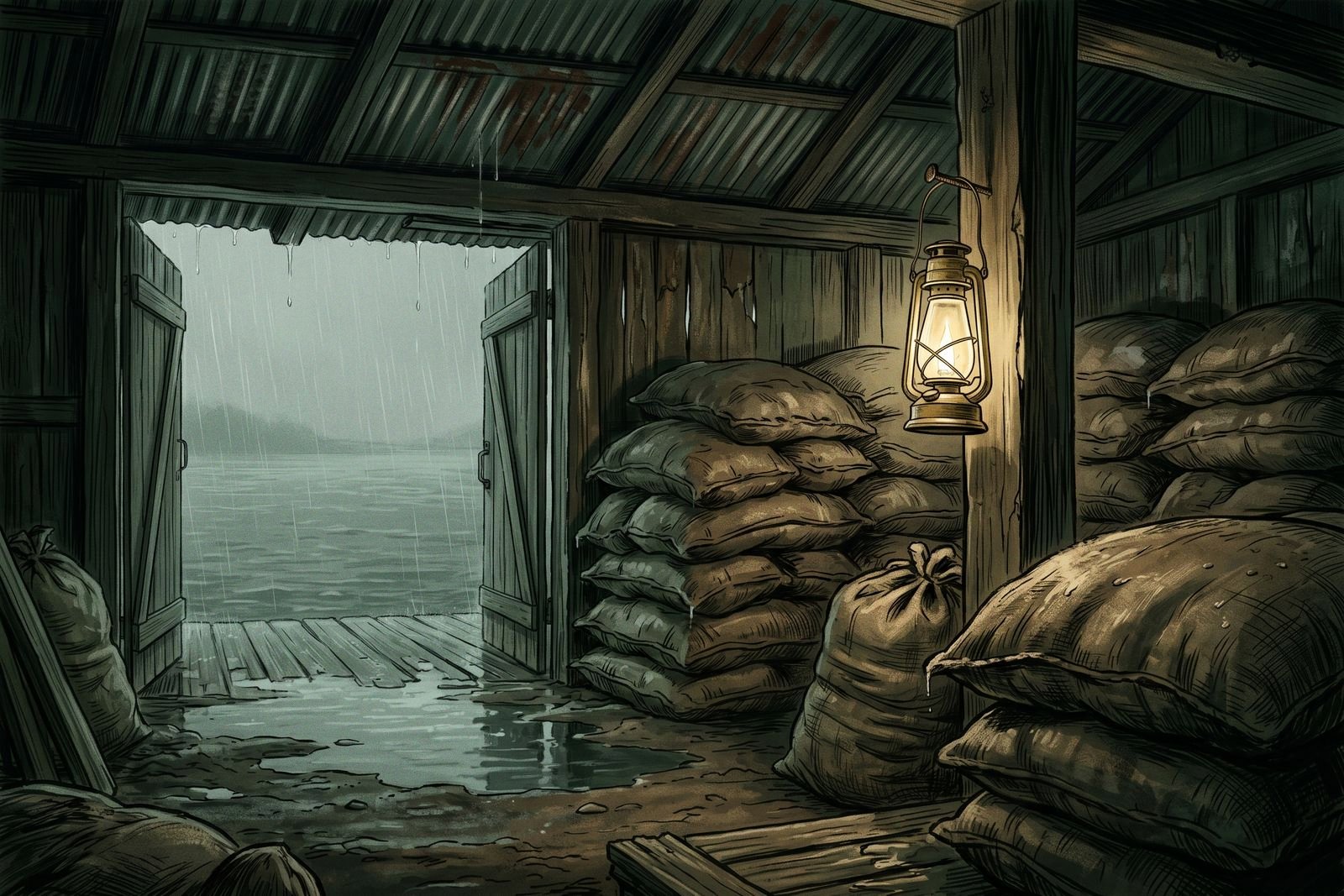
The boats stay off the Talune's side and carry no one ashore. The matai, the titled heads of families, in the villages along the harbour forbid their young men to work any ship with sickness aboard. The same day the faipule, the district representatives who sit with the administration, petition the Administrator alongside the office of the senior chiefs who advise him. The petitioners appear in the record by office, not by name. The foreman who refused first does not appear at all.
Colonel Robert Logan, the military administrator, has no orders. Wellington has sent no guidance on quarantine, no doctor has advised him, and no wireless warning has come from Auckland, where the epidemic is already in the streets. The trading houses on the beach demand that he break the stoppage. That would mean conscripting boat crews, which his garrison is too small to do, and turning soldiers on Samoans, which he will not do. He signs an order that no person may land and that cargo come ashore by sling only, without contact. The colony has carried that signature in its pockets since 1915, overprinted on Bank of New Zealand pound notes. On the order it gives formal cover to a refusal already in force.
Two better outcomes can be imagined, and neither fits what is known of the men involved. A Logan who closes the port on his own reading of the sickness aboard would be a second miracle; his documented habit was to wait for directives, and here too he waits until the beach decides for him. A ship held in the roadstead and a warning sent ahead to Tonga would need what nobody in Apia was willing to pay for: provisioning an infected steamer against the Union Company's schedule, from a budget Wellington refused to enlarge, and an act of courtesy from an administrator with no habit of signalling his neighbours, down a channel that may not have existed. The harbour villages want the ship gone. Within days she is cleared for Tonga, with Samoa's passengers and mail carried on at the company's charge. Apia knows she is infected. It does to Tonga exactly what Suva did to Apia.
From 7 November the boycott covers every vessel from an infected port. Matai councils ban travel to Apia, and women's committees formed that month enforce isolation inside the villages. Word comes across the strait in the small boats that Governor Poyer has shut American Samoa to all shipping. The faipule cite it as precedent, and the merchants' case for an open port collapses, since trade with the American side is closed either way. The armistice of 11 November frees the garrison. On 30 November Logan closes Western Samoa to all shipping on terms matching Pago Pago's, and the radio link across the strait stays open. The two ports keep a joint quarantine through 1919.
At the end of December Western Samoa has recorded no epidemic. In our world about 8,500 people had died by early 1919, 22 per cent of the population on the official count and a quarter on others, most of them between eighteen and fifty, many of the older matai among them. Here they are alive, and the cost of the closure falls on trade. Copra sits in the merchants' sheds through the wet season and rots in the sacks. Rice, flour and tinned meat come late. Boatmen and stevedores lose their wages. The guarded quarantine station is paid from an occupation budget Wellington will not top up, and the copra export duty dries up. The European and part-European merchant houses carry most of the loss and draft a claim for compensation, framed as native interference with shipping. It goes to Wellington with the first mail of 1919.
1919–1924Facing Pages
James Ah Sue, owner and editor of the Samoa Times, sets the faipule petition and the merchants' claim on facing pages of the same issue. In our world he died of influenza on 21 November 1918. Here it is past ten at night in his print shop off Beach Road, rain on the iron roof, the lamp smoking, and he is reading the right-hand forme backwards, letter by letter, with his thumb on the line about losses to the copra trade. He is of Chinese and Samoan descent and bought the paper in 1916; he belongs wholly to neither camp. The bound file of that week will be borrowed and quoted by every side for a century.
In May and June 1919 a royal commission tours Samoa and Tonga as it did in our world, with a different subject. In our world it found neglect at Apia. Here it examines the clean bill of health issued at Auckland, the captain's concealment, and the silence passed from port to port. It hears the boatmen. It records that Apia knew the ship was infected when it sent her on. That finding becomes the floor on which Tonga's grievance stands.
Logan leaves early in 1919 as a wartime posting ends, without censure, and does not return. Military government continues under his successors. It is unclear whether Poyer still receives his Navy Cross; the citation we know, with its "more than 10,000 deaths in the neighbouring islands," could not be written here. The merchants' claim is never paid.
On 1 May 1920 civil government begins, and the League of Nations mandate follows. Among the new administration's first acts is a port-health and lighterage ordinance. It licenses every boat in the harbour, puts quarantine under the chief medical officer, and ends the port's dependence on a committee of chiefs. The administration calls health a technical matter. Influenza reaches Samoa in the early 1920s only in milder waves, after the virulent strain has burned out, and kills far fewer. The women's committees are folded into the government's health inspections without being replaced by them. The faipule protest the ordinance, and their protest carries the charge the next decade will be built on, that "the colony took the harbour from the people who closed it."
1925–1934The Movement at the Sheds
The boat sheds by the Apia landing hold licensed lighters by day and, from about 1925, the meetings of a movement. In the mid-1920s the administration begins intervening in title disputes and banishing titleholders who oppose it. It meets a generation our world did not have: the men who were working age in 1918, now between twenty-five and fifty-five and holding titles, with a method of non-cooperation already proven against a steamer. Their movement forms about two years before the Mau, the campaign that in our world began in 1927. Its headquarters is the sheds, not Vaimoso.
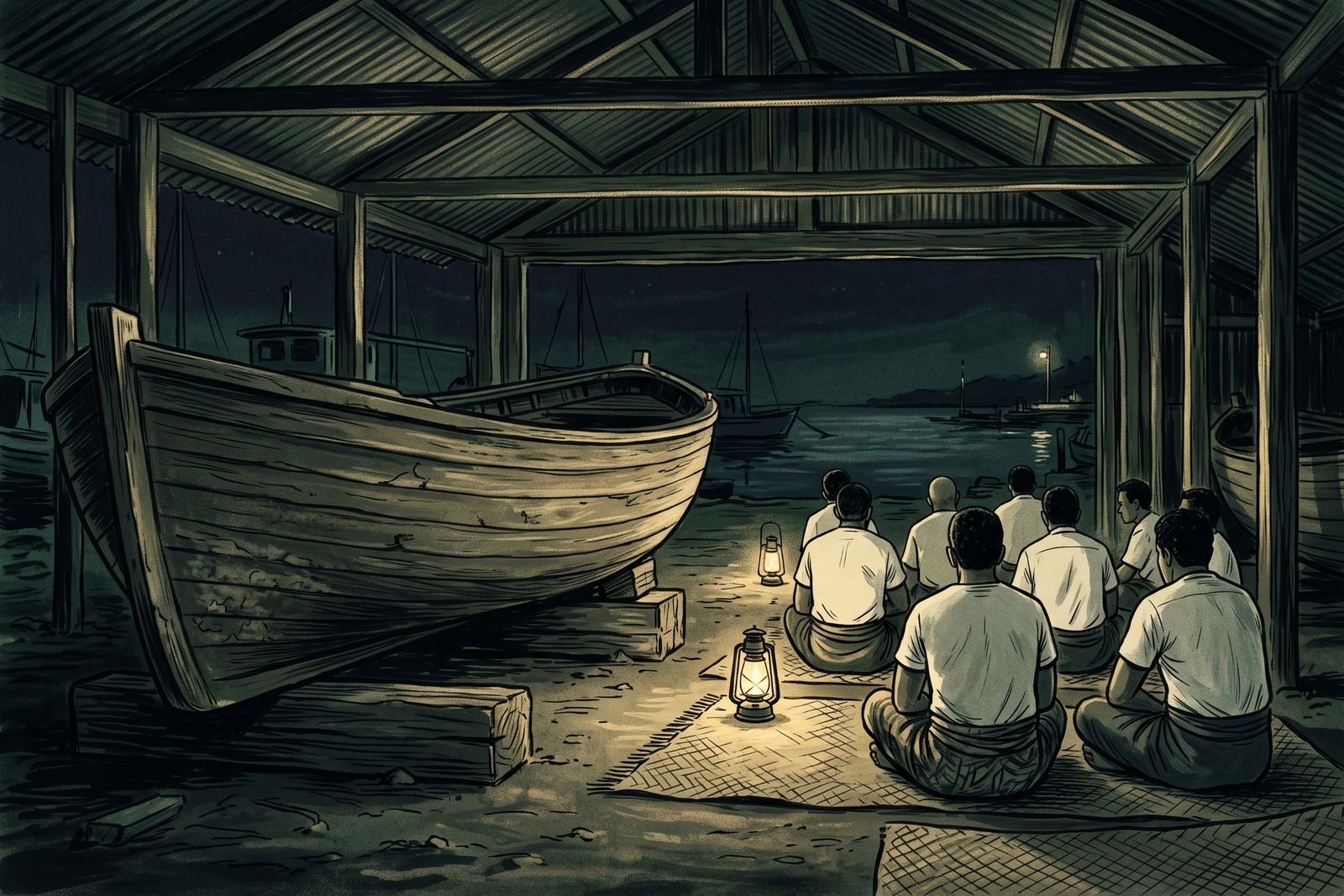
The women's committees are its village base. The merchants stand apart in a committee of their own, petitioning against trade controls and for the unpaid claim, and join the movement only when a grievance happens to coincide. The movement is poorer than the Mau of our world and has fewer friends in Wellington. It reaches further into the villages.
Petelo is twenty-four in 1926 and works a stamp in the port-health office, licensing boats under the ordinance his uncles marched against. He was schooled at a mission and writes a fair English hand. In our world the epidemic would have emptied the seats above him; here his father and three uncles are alive and holding them. He spends his evenings at the sheds with the movement's radical wing, which is full of men like him.
Tavita, who was twenty-two and at the oars on 7 November 1918, carries the movement's messages between villages. He has a wife, four children and no seat in the village council.
Wellington carries no guilt for 1918 and treats the movement as sedition from the start. Titleholders are banished to other islands. New Zealand naval forces come to Apia to back police arrests. In the late 1920s police fire on a movement procession on the waterfront and several Samoans are killed, titleholders and untitled men together. The shooting of December 1929 in our world, on the same waterfront, does not occur in that form; these are other men on another day. Their names are painted on the boards of the sheds, where they are mourned. The administration's file gives a number and no names, and no reason for leaving them out. At the funerals the speakers repeat the line the movement has set against Logan's signature since 1925: "we saved ourselves."
1935–1947Half a Title
In 1935 New Zealand's new Labour government recognises the movement and lifts its sedition status, as it would have done regardless; the change belongs to New Zealand's own politics. The movement comes out of the sheds and into the council houses, and finds them crowded.
The men of 1918 hold the senior titles. In our world many of those titles passed early to younger brothers and sons, the mission-schooled men who stepped into the epidemic's vacancies. Here those men wait, clerk in Apia, or take the first wage jobs abroad. With about a fifth more adults having children since 1919, customary land runs short by the late 1930s, around a decade earlier than in our world, and families begin splitting titles so that more than one heir can hold one. In 1938 Tavita receives half his late uncle's title, shared with a cousin. He is forty-two. He has waited twenty years for a seat in the fono, the village council, and he gets half of one.
The Second World War reaches the islands in 1942, when American forces arrive on Upolu. Until 1944 they meet a working-age population about a fifth larger than the one they met in our world, and they bring wage work on roads and airstrips and American goods in the stores. Memory of the radio link kept open in 1918 feeds a current toward closer American ties and the unity of the two Samoas. Unity is impossible while Pago Pago is a naval station. The leaders use the current as a lever against Wellington.
In 1947 Western Samoa becomes a United Nations trust territory, and the movement's petition to the Trusteeship Council is signed at the sheds on a wet morning, before the boats go out. The sheets lie on an upturned lighter under a lantern, weighted at the corners with shackles from the boat gear because the wind comes in at the open end. Tavita signs at fifty-one, his half-title written after his name. The petition is built around the matai and puts land first. Its first demand is that the confiscated German estates, about a fifth of the territory, pass to the villages beside them. Most of the men signing were at work in 1918. The oldest are past seventy.
The petition goes to the Trusteeship Council in the first year of the trust.
1948–1960The Levy at the Buying Sheds
The levy is a deduction per bag of copra, taken at the buying shed before the grower is paid, and it exists to pay for land. In the early 1950s a trusteeship settlement hands roughly half the former German estate acreage to the adjacent villages under customary tenure. The other half stays with a state corporation, because the estates were the territory's main revenue and the treasury cannot give them all away at once. The levy on village smallholders fills the gap.
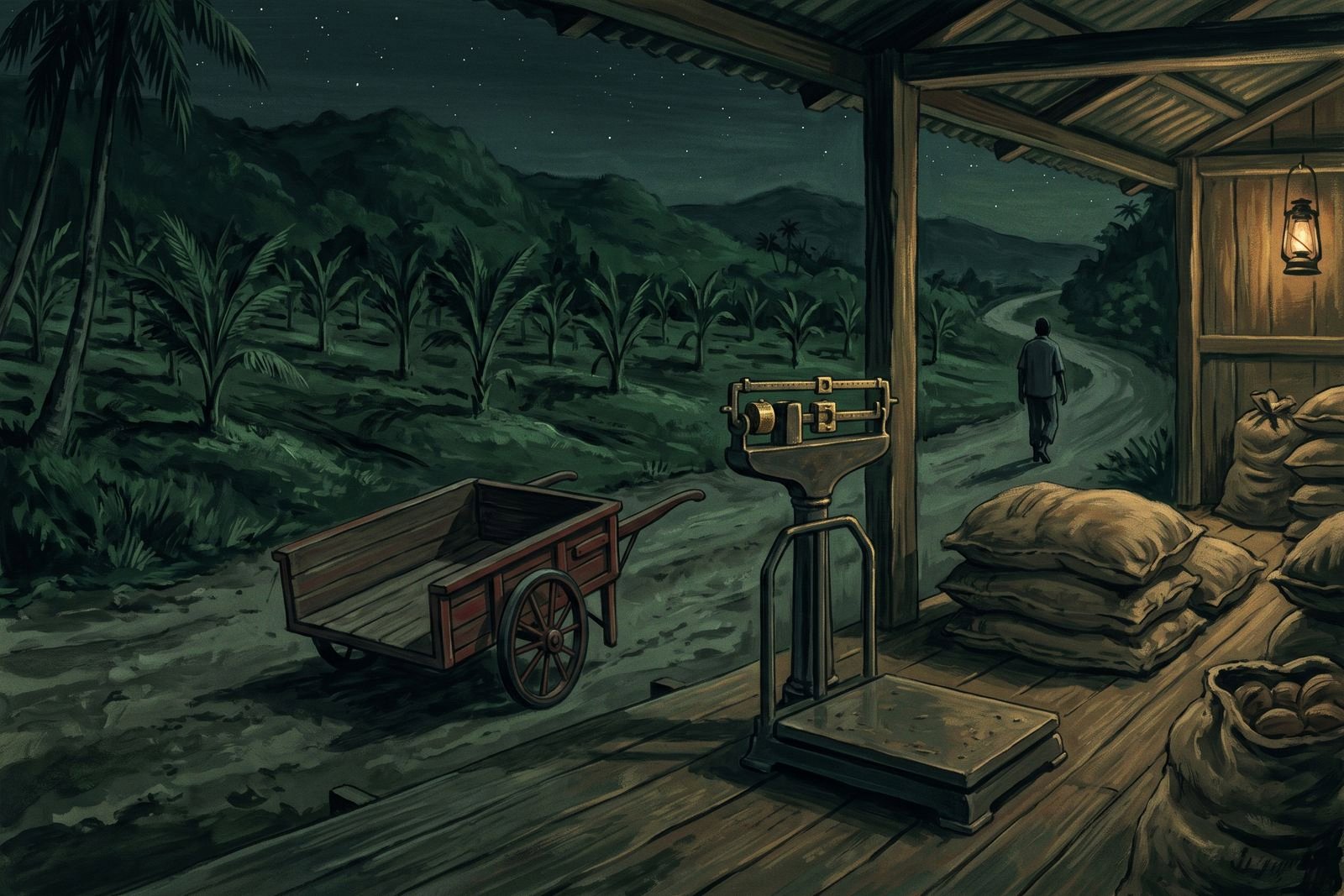
The estate labourers, many of them from other islands, lose their place when the land changes hands. A smallholder above the coast road now plants coconuts under his family's title on ground that was a German plantation in 1912, and owes the levy on his first crop.
In the mid-1950s Wellington opens a work-permit scheme for trust-territory Samoans to fill a factory labour shortage. Emigration starts earlier than in our world and runs larger, and postal orders from Auckland begin paying for church roofs and school fees.
Wellington would rather shed a contested land administration than police it. United Nations visiting missions have watched village committees run health and harbour affairs since 1918. The Trusteeship Council accepts a faster timetable, and a plebiscite is held in 1959. The constitutional convention that year entrenches matai-only suffrage more tightly than the real 1960 text, on a roll already swelling with split titles. The separate roll for part-Europeans is cut to a single seat, and the convention knows why: the merchant houses stood against the boats in 1918. Women without titles and most young men have no vote.
Western Samoa becomes independent on 1 January 1960, two years before the real date. It keeps a pound currency on notes of its own issue tied to New Zealand, and its New Zealand trade. Union Company steamers still carry most of its people and copra.
1960–1997The Roll Outgrows Itself
A woman of twenty-six inspects water tanks for her village committee in 1961, as her mother did, and cannot vote for the parliament in Apia. In the mid-1960s a deep-water wharf ends lighterage, and the trade whose crews closed the harbour disappears; the sheds become movement property and a memorial. The tala, the new currency, replaces the pound in 1967, following New Zealand's own decimalisation. Fiji and Tonga become independent in 1970, the year Western Samoa joins the Commonwealth; a United Nations seat follows in 1976. None of these dates owes anything to 1918. The Cold War changes no alignment either, and sympathy for the American side of the strait stays sentiment, more so once American Samoa elects its own governor from 1977.
The oil shock of 1973 raises the import bill of a copra economy. In Auckland the Dawn Raids of 1974 to 1976, police searches of Pacific households for overstayers, fall on more Samoan homes than in our world, because the permit cohort of the 1950s and its kin are larger.
At home, title-splitting runs through the 1960s and 1970s until anyone can see that a matai-only franchise held by half-titles and quarter-titles is a fiction. A large diaspora pays for village roofs and has no vote. In 1981 a referendum grants universal suffrage, nine years before the real reform of 1990. Candidacy stays restricted to matai. Untitled women and young men paid for the years between 1960 and 1981 with two decades of laws made without them.
The first universal election is fought by two parties. The Tautai Party descends from the harbour movement and speaks for the village matai. The Apia Citizens' Union descends from the merchants' committee and from the blocked clerks of the 1920s. Neither holds a lasting majority, and the four decades of single-party rule that our world's Samoa lived under never form, because the franchise and the party system both changed first.
The Privy Council's 1982 ruling on New Zealand citizenship, and the act that curtailed it the same year, still stand in law. They settle the status of a much larger population already in New Zealand, and the argument runs hotter in both capitals. New Zealand's restructuring from 1984 to 1991 strips factory jobs in Otahuhu from a Samoan workforce bigger than the real one, and remittances fall for several years. With the copra price collapsing, a Citizens' Union government repeals the levy in the late 1980s. The state corporation's half of the old estates becomes the revenue quarrel instead.
Cyclones in 1990 and 1991 and the taro leaf blight of 1993 land hardest on the crowded villages of the partitioned land. Migration tilts toward Australia, with New Zealand citizenship as the route. The end of the Cold War in 1991 changes little locally. In 1997 the country renames itself Samoa, and American Samoa objects, as it did in our world.
2000–2026The Morning of 7 November
In 2000, at the fortieth anniversary of independence, the New Zealand government apologises for four things: the 1920 harbour ordinance, the banishments, the waterfront killings and the handling of the estates. There is no clause about the Talune, because nobody in Samoa died of the decision to let her dock; the apology of our world in 2002 named that decision with regret. Schoolchildren learn the boats that would not row, the petition and the ordinance, with Logan as the man who signed.
The Samoan Quota, a residence ballot opened by New Zealand in 2002, keeps its real design and is swamped. The attacks of September 2001 tighten American entry rules and touch family travel across the strait at the margins. The 2008 financial crisis reaches village budgets faster than in our world, because remittances already approach 40 per cent of national income. Samoa switches to driving on the left in 2009 and moves across the dateline in 2011. After the tsunami of 29 September 2009, relief crosses the strait both ways and the Apia papers retell the joint quarantine. Accession to the World Trade Organization in 2012 and graduation from least-developed status in 2014 come on schedule.
The centenary of 2018 is claimed four ways. The harbour lineages commemorate the boats, the New Zealand state commemorates Logan's order, and trading families recall ruin and a claim never paid. Tonga holds the solemn ceremony, on the commission's finding that Apia knew. The Samoan state sends no apology. Measles comes in 2019, out of a collapse in vaccine confidence the memory of village quarantine does not reach. In March 2020 the officials who close the border against COVID-19 cite the boat crews and the women's committees, and the islands stay largely clear until 2022. The 2021 election passes in ordinary alternation; our world's constitutional deadlock of that year has no cause here. After the undersea eruption off Tonga in January 2022, Apia sends relief, and Tongan commentators note that it carries no word about 1918. The same year the war in Ukraine raises the price of imported fuel and flour.
Claimants born in New Zealand and Australia now bring title cases in growing numbers and want to lease their shares of customary land. A Citizens' Union bill would put the Land and Titles Court under the Supreme Court's review and widen leasing. The Tautai Party's village bloc calls it the 1920 ordinance again. This year's election is fought on it; the dissolution of our world's 2025 never happens. About 230,000 people live in Samoa, more than 260,000 Samoans live in New Zealand, and more again in Australia.
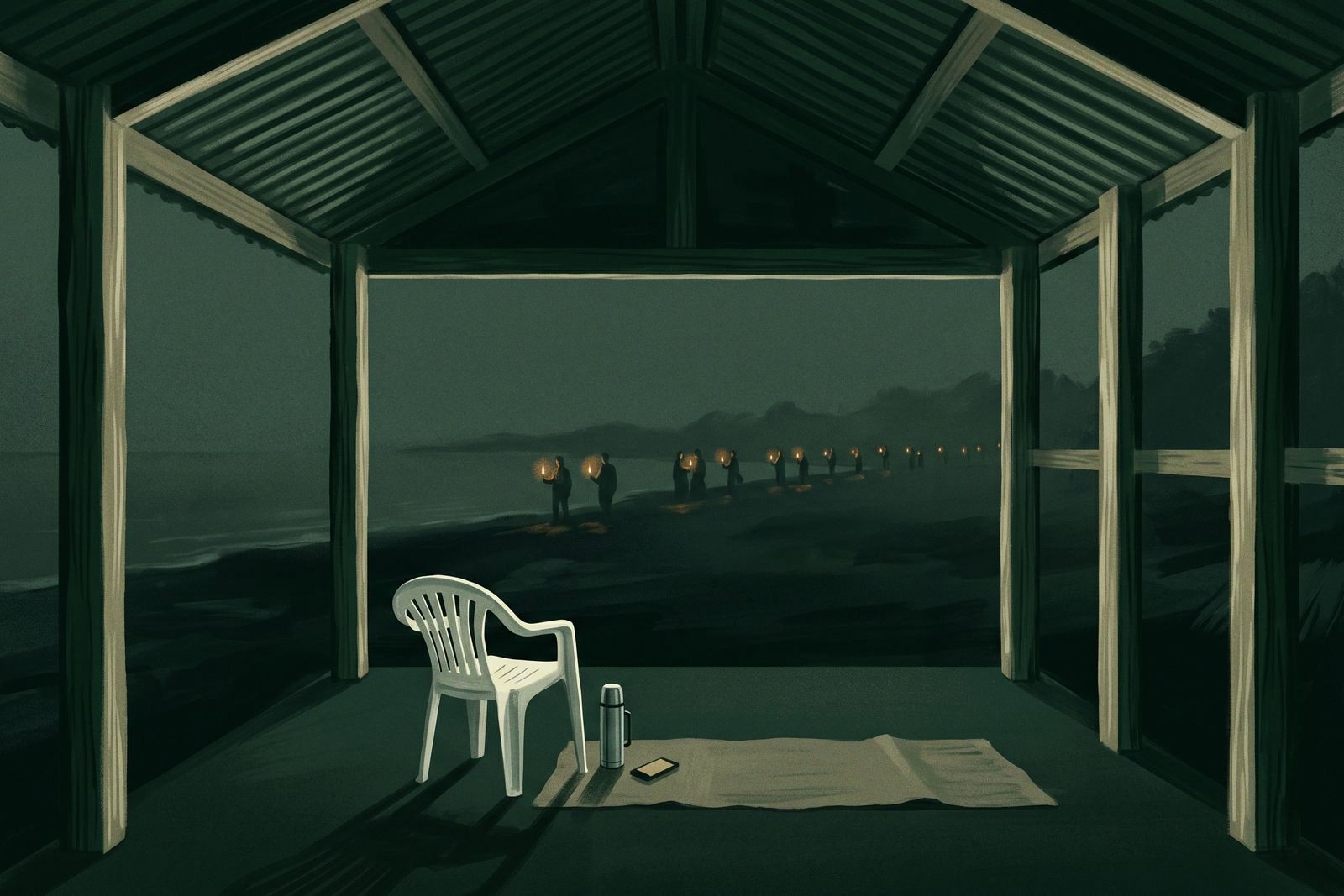
At five on the morning of 7 November 2026 the boat sheds smell of new paint and wet timber, the roof replaced last year with money sent from Auckland. Tavita's grandson, who holds a quarter share of the title, sits on a plastic chair under the boards of names, a phone propped against a thermos. It is playing a talkback station. A woman calling from Otahuhu, great-granddaughter of the clerk Petelo, whose son left on a 1956 permit, says she wants to lease land in a village she has visited twice. Outside, the harbour villages are arriving with candles.
That same morning in Nuku'alofa, Tonga's capital, the Talune's Tongan dead are read aloud, name by name, from the 1919 commission's list. No Samoan official stands among the mourners.
1918Apia boatmen refuse the Talune; Logan signs a quarantine he cannot reverse
The Talune anchors in the Apia roadstead. The NZHistory photo page dates her arrival to 4 November, but that clashes with her quarantine at Suva on the same day. The hinge rests on what Samoans saw aboard, so it holds on either date. Apia has no wharf for ocean ships. Every person and package reaches the beach in Samoan-crewed boats and lighters, so the boat crews are the first Samoans aboard. From the ship's crew they learn she has just been held at Suva, and they see the six seriously ill passengers. The captain's instruction to hide sickness fails at the waterline. The boats lie off and carry no one ashore. The matai of the Apia-side villages forbid their aumaga (untitled men) to work any ship with sickness aboard. The same day the district faipule and the Fautua office petition the Administrator. Logan has no orders from Wellington and no medical advice on quarantine. The trading houses demand that he break the stoppage. His garrison is too small to conscript boat crews, and he will not turn it on Samoans. He signs an order that no person may land and that cargo be lightered by sling only, without contact. The order gives formal cover to a refusal already in force. The foreman who refused first is unrecorded. The petitioners appear in the record by office, not by name.
9 SOURCED CAUSES
1918Talune cleared for Tonga, knowingly infected and unwarned
The harbour villages want the ship out of the roadstead. The Union Steam Ship Company and the Apia traders press for her schedule to be restored. The administration neither holds and provisions her nor sends warning ahead, and clears her for Tonga. Unlike the real record, Apia now knows she is infected. It does to Nuku'alofa exactly what Suva did to Apia. This chronology cannot confirm a working wireless receiving station at Nuku'alofa in November 1918. The documented, costed choice is therefore the sending-on itself. Samoan pressure reached the waterline, not the wireless office. Passengers and mail for Samoa are carried on to Tonga and Nauru at a charge to the Union Company. Influenza enters Tonga as it did historically, now through a decision taken knowingly in Apia.
6 SOURCED CAUSES
1918Logan's all-shipping quarantine ratifies a closure Samoans already enforce
From 7 November the boat boycott has applied to every vessel from an infected port, so there is no gap between ship and order. Three forces sustain it. First, village matai councils ban travel to Apia, and newly formed women's village committees enforce isolation inside the villages. These are Samoan-founded bodies, years ahead of any administration health committee. Second, informal traffic across the strait, already habitual, brings word that Governor Poyer has closed Tutuila to all shipping. The faipule cite this to Logan as precedent, and it removes Apia's commercial reason to stay open, since inter-island trade is shut either way. Third, the armistice of 11 November frees the garrison from wartime priorities. Logan's order closes Western Samoa to all shipping on terms matching Pago Pago's. With both ports closed alike, the radio link with Tutuila is kept, not cut. A joint Apia–Pago Pago quarantine practice runs through the 1919 waves. Village enforcement, not the paper order, keeps the islands clear, as American Samoa showed was possible.
6 SOURCED CAUSES
1918No epidemic mortality in Western Samoa; merchants carry the bill
At year's end Western Samoa has recorded no influenza epidemic. The 18-to-50-year-olds the strain was killing elsewhere are alive, and so are most older matai. The price falls between November 1918 and early 1919: - copra is held in the sheds; - imported rice, flour and tinned food are delayed; - boatmen and stevedores lose wages; - a guarded quarantine station is paid from an occupation budget that Wellington refuses to supplement; - the administration loses copra export duty. The European and part-European merchant houses carry most of the loss. They file a compensation claim in Wellington framed as native interference with shipping. James Ah Sue does not die on 21 November. His Samoa Times prints the faipule petition and the merchants' claim side by side and becomes the archive of the quarrel. The claim is never paid.
8 SOURCED CAUSES
1919Logan departs without censure; Royal Commission inquires into the Talune's voyage
Logan leaves in early 1919 as a wartime posting ends routinely. Military administration continues until the civil transition, and Colonel R.W. Tate later follows as Administrator. In May and June 1919 the commission of Elliot, Wilson and Moorhouse tours Samoa and Tonga as it did historically, but its subject is redirected. It examines the clean bill of health issued at Auckland, the captain's concealment, and the silent hand-offs from port to port. It hears the Apia boatmen's testimony and records that Apia knew the ship was infected when it sent her to Tonga. That finding becomes the documentary floor of Tonga's grievance.
5 SOURCED CAUSES
1920Civil government and the port-health and lighterage ordinance
Civil administration begins, followed by the League of Nations mandate. The new administration passes a port-health and lighterage ordinance. It licenses the boats, places quarantine under the Chief Medical Officer, and ends the harbour's dependence on a chiefly committee. The faipule protest. The charge that will found this world's movement is that the colony took the harbour from the people who closed it. Influenza reaches Samoa in the early 1920s only in milder waves, after the virulent strain has passed, and kills far fewer. The women's village committees are drawn into, but not replaced by, administration health inspections.
4 SOURCED CAUSES
1925Matai-led non-cooperation movement forms at the harbour boat sheds
In the mid-1920s the administration intervenes in title disputes and banishes titleholders. It meets the intact 1918 working-age cohort, now aged roughly 25 to 55 and holding titles, together with a boycott method proven in 1918. A non-cooperation movement forms about two years earlier than the real Mau. Its headquarters is at the Apia boat sheds; there are no mass graves at Vaimoso to gather beside. The women's committees form its village base. Its rhetoric sets 'we saved ourselves' against Logan's signature on the order. The merchants stay apart in their own committee, petitioning on trade controls and the unpaid 1918 claim, and ally with the movement only intermittently. The movement is poorer and has fewer friends in Wellington than the real Mau, but it reaches deeper into the villages.
5 SOURCED CAUSES
1928Banishments, naval deployment and a fatal shooting on the Apia waterfront
Wellington carries no guilt for 1918 and treats the movement as sedition from the start. Titleholders are banished to other islands. New Zealand naval forces are deployed to Apia to support police arrests. In the late 1920s police fire on a movement procession on the waterfront and several Samoans are killed. The dead are titleholders and untitled men whose names this chronology does not fix. They are not the real victims of 1929. The boat sheds become the site of their mourning.
3 SOURCED CAUSES
1935Labour recognises the movement; the 1918 cohort holds titles and land pressure arrives early
New Zealand's Labour government of 1935 recognises the movement and lifts its sedition status on schedule, as a domestic New Zealand event. The men of working age in 1918 now hold the senior titles that in the real record passed early to younger brothers and sons. The mission-schooled younger men who rose into the 1918 vacancies in real history are blocked. They stay clerks in Apia, staff the movement's radical wing, or become the first wage migrants. With about a fifth more adults bearing children since 1919, binding land pressure arrives in the late 1930s, roughly a decade ahead of the real record. Families begin splitting titles to accommodate heirs.
5 SOURCED CAUSES
1942American wartime presence and a land-first petition to the Trusteeship Council
From 1942 to 1944 US forces on Upolu meet a working-age population about a fifth larger than in the real record, along with wage labour and American goods. Memory of the open radio link and the joint quarantine with Tutuila in 1918–19 feeds a current toward closer US ties and cross-strait Samoan unity. Unification is impossible while Pago Pago remains a naval station, but the current serves as a lever against Wellington. In 1947 Western Samoa becomes a UN trust territory. The petition to the trusteeship is matai-centred and puts land first. Its first demand is that the confiscated German estates, about a fifth of the land, pass to the adjacent villages. It is driven by the 1918 working-age generation, now aged roughly 47 to 74.
5 SOURCED CAUSES
1950Estate partition, smallholder levy, work-permit emigration and an accelerated timetable
In the early 1950s a trusteeship settlement hands roughly half the former German estate acreage to adjacent villages under customary tenure. The rest becomes a state corporation. The revenue gap is filled by a copra export levy paid by village smallholders. Estate labourers, many of them from other islands, lose their place. In the mid-1950s Wellington opens a work-permit scheme for trust-territory Samoans to fill a factory labour shortage. Emigration therefore starts earlier and runs larger than in the real record, and remittances begin carrying village budgets. Wellington prefers shedding a contested land administration to policing it. UN visiting missions have seen village committees running health and harbour affairs since 1918. The Trusteeship Council accepts an accelerated timetable, and a UN plebiscite is held in 1959.
4 SOURCED CAUSES
1960Western Samoa independent under a tighter matai-suffrage constitution
The 1959 constitutional convention entrenches matai-only suffrage more tightly than the real 1960 text, but on a roll already swelling with split titles. The individual voters' roll for part-Europeans is cut to a single seat, the price of the merchant houses' 1918 alignment. Western Samoa becomes independent two years ahead of the real date. It keeps a pound currency and its New Zealand trade ties, and Union Company steamers still carry most of its people and copra.
4 SOURCED CAUSES
1960Title inflation forces universal suffrage in 1981
Several things stay as in the real record: the tala (1967), Commonwealth membership (1970), Fijian and Tongan sovereignty (1970), the UN seat (1976) and the Cold War frame. Under population pressure, title-splitting inflates the matai roll through the 1960s and 1970s until matai-only suffrage is visibly a fiction. A large diaspora funds villages but has no vote. Together these force a referendum in 1981 that grants universal suffrage, nine years ahead of the real 1990 reform. Candidacy stays matai-only. Untitled women and young men bear the cost of the 1960–1981 interval. An earlier two-party system follows, with no long single-party dominance. One party, invented here, is a village-matai party descended from the 1920s harbour movement. The other is an Apia and diaspora party rooted in the merchants' committee and the blocked mission-schooled clerks. New Zealand's 1974–76 Dawn Raids are the same in kind and larger in scale. The 1982 Privy Council citizenship ruling and the Citizenship (Western Samoa) Act follow unchanged in law, with higher stakes.
3 SOURCED CAUSES
2000New Zealand apology without a Talune clause; a contested centenary
At the 40th anniversary of independence in 2000, the New Zealand government apologises for: - the 1920 harbour ordinance; - the banishments; - the waterfront killings; - the handling of the estates. It has no Talune clause. The Samoan Quota of 2002 keeps its real design and is far more heavily oversubscribed. In 1997 the country is renamed Samoa, unchanged. In 2018 the centenary is contested property: - matai lineages commemorate the boats; - the New Zealand state commemorates Logan's order; - trader descendants remember ruin and the unpaid claim; - Nuku'alofa holds the solemn commemoration, grounded in the 1919 commission's finding that Apia knew. The Samoan state makes no apology to Tonga.
5 SOURCED CAUSES
2019Measles, a remembered border, a land-court fight and the demographic arithmetic
The 2019 measles epidemic occurs unchanged, and the 2008–2011 events stand as in the real record. In 2020 the officials who close the border cite the 1918 boat crews and village committees, not Logan and not Pago Pago. The real 2021 impasse and 2025 dissolution do not occur. In their place comes a 2020s constitutional fight over the jurisdiction of the Land and Titles Court and the leasing of customary land. Overseas-born title claimants push it, and invented parties and office-holders carry it. The demography compounds: working-age survivors added births from 1919 to 1945, so the gap widened before emigration closed it. The mid-1950s permit scheme and the post-1981 diaspora absorbed the surplus that the partly redistributed estates could not. By 2026: - the Samoan population at home and abroad runs about 25% above the real figure; - about 230,000 people live in Samoa; - the Samoan community in New Zealand exceeds 260,000, with Australia's correspondingly larger; - more Samoans live abroad than at home; - remittances are about 40% of national income, well above the real share.
4 SOURCED CAUSES
1966The wharf ends lighterage; the tala, Commonwealth and UN seat arrive on schedule; the Dawn Raids fall harder
In the mid-1960s a deep-water wharf at Apia ends lighterage. The trade whose crews closed the harbour in 1918 disappears, and the boat sheds become only a memorial and movement property. The tala (1967) is UNCHANGED: it follows New Zealand's own decimalisation, which this divergence does not touch. Fijian and Tongan independence (1970), Commonwealth membership (1970) and the UN seat (1976) are UNCHANGED, because decolonisation's drivers lay in London, Suva and Nuku'alofa. The Cold War frame is UNCHANGED. The American-leaning current rooted in the 1918 radio link changes no alignment. American Samoa's status, including its elected governorship from 1977, is a US domestic matter, so cross-strait unity stays cultural, not constitutional. The 1973 oil shock is UNCHANGED and raises the import bill on a copra economy. The 1974–76 Dawn Raids are ALTERED in scale only: the mid-1950s permit cohort and its overstaying kin are larger, so more Samoan households in Auckland are raided.
4 SOURCED CAUSES
1981Universal suffrage by referendum; the citizenship ruling and Act stand with higher stakes; two parties alternate from the start
The 1981 referendum grants universal suffrage, nine years ahead of the real 1990 reform. Candidacy stays matai-only. The first universal election is contested by two invented parties, and neither holds a lasting majority. The Tautai Party is the village-matai party descended from the 1920s harbour movement. The Apia Citizens' Union descends from the merchants' committee and the blocked mission-schooled clerks. The four-decade single-party dominance of the real record is AVERTED: its cause was an early-1980s party system built on a matai-only franchise, and here the franchise and the party system both changed sooner. The 1982 Privy Council citizenship ruling and the Citizenship (Western Samoa) Act are UNCHANGED in law. They settle the status of a far larger Samoan population already living in New Zealand, so the political temperature in Apia and Auckland runs higher.
3 SOURCED CAUSES
1984New Zealand's restructuring, two cyclones and taro blight; the copra levy goes; the country is renamed
New Zealand's 1984–91 economic restructuring is UNCHANGED: its causes were domestic to New Zealand. It is ALTERED in its effect, because it strips factory jobs from a Samoan workforce in Otahuhu and Porirua larger than the real one. Remittances fall for several years. Collapsing copra prices let a Citizens' Union government repeal the smallholders' copra export levy in the late 1980s. The state estate corporation's half of the old German land becomes the revenue fight instead. Cyclones Ofa (1990) and Val (1991) and the 1993 taro leaf blight are UNCHANGED as weather and pathogen. They are heavier as household shocks, because the villages on the partitioned estates are crowded. Migration tilts toward Australia, using New Zealand citizenship as the route. The end of the Cold War in 1991 is UNCHANGED, with little local effect. The 1997 renaming to Samoa is UNCHANGED, and so is American Samoa's objection to it.
3 SOURCED CAUSES
2000New Zealand apologises for the harbour, the banishments, the killings and the estates, with no Talune clause; the Quota is swamped
At the 40th anniversary of independence in 2000, the New Zealand government apologises for: - the 1920 harbour ordinance; - the banishments; - the late-1920s waterfront killings; - the handling of the estates. The real 2002 apology's citation of the Talune is AVERTED, because no one died of the decision to let her dock. In its place New Zealand's grievance file holds the colonial seizure of a harbour that Samoans had closed themselves. The 2002 Samoan Quota keeps its real design and is far more heavily oversubscribed, because more applicants are chasing the same ballot. The September 2001 attacks in the United States are UNCHANGED. They tighten US entry procedures, and these touch cross-strait family travel only at the margins.
3 SOURCED CAUSES
2008The financial crisis bites harder through remittances; road switch, tsunami and dateline as in the real record
The 2008 global financial crisis is UNCHANGED in origin and ALTERED in its local weight. With remittances already near 40% of national income, well above the real share, the fall in Auckland and Sydney wages reaches village budgets faster and deeper. The 2009 switch to left-hand driving, the 29 September 2009 tsunami and the 2011 dateline shift are UNCHANGED: they were policy and geology, untouched by 1918. After the tsunami, relief crosses the strait in both directions, and the old joint-quarantine story is retold in Apia's papers. WTO accession (2012) and graduation from least-developed-country status (2014) are UNCHANGED. Remittance-swollen national income makes the graduation arithmetic easier, not harder.
3 SOURCED CAUSES
2018A centenary claimed four ways; Nuku'alofa grieves without an apology; measles comes as it did
The 1918 centenary is contested property: - the harbour villages' matai lineages commemorate the boats; - the New Zealand state commemorates Logan's order; - trader descendants recall ruin and the unpaid claim; - Tonga holds the solemn commemoration, citing the 1919 commission's finding that Apia knew the Talune was infected when it cleared her. The Samoan state sends no apology to Tonga, and that silence is itself reported. The 2019 measles epidemic is UNCHANGED. It grew from a collapse in vaccine confidence, which the 1918 memory of village quarantine does not reach. The village committees' tradition of isolation does not prevent it.
3 SOURCED CAUSES
2020The border is closed in the boatmen's name; the 2021 impasse does not happen; Tonga's eruption brings aid but no apology
In March 2020 the officials who close the border to COVID-19 cite the 1918 boat crews and the women's village committees, not Logan and not Pago Pago. Samoa stays largely free of community spread until 2022, which is UNCHANGED, as island geography and early closure were in the real record too. The 2021 general election is held under the established alternation. The real constitutional impasse of that year is AVERTED, because its cause, a long-dominant party's 2020 Land and Titles Court bills and the split they produced, has no counterpart here. After the January 2022 Hunga Tonga eruption, Apia sends relief to Nuku'alofa as in the real record. Tongan commentators note that the aid still carries no word about 1918. The war in Ukraine (2022) is UNCHANGED and raises fuel and flour prices.
3 SOURCED CAUSES
2023Overseas-born title claimants force a fight over the Land and Titles Court; no 2025 dissolution
Overseas-born claimants from New Zealand and Australia bring title and land cases in growing numbers. They press to lease their shares of customary land and for appeals beyond the Land and Titles Court. A Citizens' Union bill would bring the court's decisions under the Supreme Court's review and widen customary-land leasing. The Tautai Party's village bloc opposes it as the 1920 harbour ordinance again, the colony taking what the villages hold. Invented office-holders on both benches carry the fight, and no living politician is involved. The real 2025 dissolution is AVERTED for the same reason the 2021 impasse was. The 2026 general election is fought on the bill. The October 2024 Commonwealth summit in Apia is UNCHANGED as a rotation of hosts. Great-power competition in the Pacific is UNCHANGED in kind. Samoa signs no security pact, and the American-leaning current shows only in cross-strait sentiment.
3 SOURCED CAUSES
Every one of these worlds was weighed against the one you have just read. Here is where each of them breaks.
Colonel Robert Logan, reading the sickness aboard the Talune and the news of her quarantine at Suva, closes Apia to her on his own authority on 7 November 1918.
We weighed it first, because it is the simplest way to save Western Samoa. It breaks on the day itself, 7 November 1918. No wireless, cable or letter had carried the Suva quarantine to Apia, and Logan's record shows a man who waited for orders; with no doctor advising him and no quarantine instructions from Wellington, nothing in his administration was built to act alone. It asks for a second miracle, a change in a man's character, on top of the first. It also hands the rescue back to the colonial administrator, the one repair of 1918 we were least willing to make, so we gave the hinge to the boat crews of the harbour villages instead.
A wireless warning from the health authorities in Auckland or Wellington reaches Apia before the Talune anchors, and the port is closed on New Zealand's instructions.
We weighed it because influenza was already in Auckland's streets when the ship sailed, and a warning would have cost one telegram. It fails in November 1918 on the record: no warning was sent, the Talune left Auckland with a clean bill of health, and New Zealand's officials were swamped by their own outbreak. To have them signal Apia is to invent a competence the colonial health service did not have that month. It also takes the decision away from the Samoans who made it in the world we unrolled and returns it to an office in Wellington.
Governor Poyer of American Samoa, or the US Navy behind him, compels the New Zealand administration to close Apia on 7 November 1918.
We weighed it because Poyer's sealed harbour at Pago Pago is the proof that closure worked in these islands. It breaks in November 1918 on jurisdiction: Poyer governed Tutuila, had no authority over a port held by New Zealand, and the record we hold does not date his own measures closely enough to place them before the Talune arrived. Replacing a New Zealand rescuer with an American one leaves the Samoans as spectators. Part of it survives: word of Poyer's closure crosses the strait in small boats and gives the faipule the precedent they cite when Logan shuts the whole territory on 30 November.
The faipule's petition to Logan, or news of the Suva quarantine carried by missionaries or cable, is what first closes Apia to the Talune.
We weighed it because the faipule were the Samoans with a formal channel to the Administrator, and a written appeal leaves a tidier record than a refusal at the oars. It breaks within hours on 7 November 1918: a petition moves at the pace of an office, and the ship was already at anchor. The route from Fiji has nothing behind it; we found no source showing that missions or the cable carried word from Suva in time. The petition survives in a smaller role, lodged the same day to give formal backing to a refusal the boat crews had already made.
The Talune is held in the Apia roadstead until the sickness aboard burns out, so she never carries influenza on to Tonga.
We weighed it because it is the one outcome that spares Tonga as well as Samoa. It breaks before the end of November 1918. The Union Company wanted its steamer back on schedule, Wellington refused to put another pound into the occupation budget, and someone in Apia would have had to feed, water and coal an infected ship for weeks. Nobody had the money or the will. It also needs the administration to do more than it was pushed into doing, the same flaw as a Logan who acts alone, so the Talune is cleared for Tonga within days.
Apia wires Nuku'alofa that the Talune is infected, and the Tongan authorities quarantine her on arrival.
We did not set this aside for being too cautious; it is the bolder road for Tonga. It breaks in November 1918 on the habits of every port on the run. Auckland had issued a clean bill, Suva had passed the ship on without a word to Apia, and the pressure in the harbour villages was to get the steamer out of the roadstead, with no thought for whoever came next. A warning would need a voluntary act from Logan, whose record on radio contact with his neighbours points the other way, and then a Tongan decision taken on a channel that may not have existed. So Apia does to Tonga what Suva did to Apia, and the royal commission of 1919 writes it down.
The closure leaks: a later ship brings influenza ashore, and a partial epidemic kills between 2 and 8 per cent of Western Samoans in December 1918 and January 1919.
We weighed it seriously, because quarantines leak and a later vessel slipping through is entirely possible. Full closure is just as defensible: Tutuila across the strait held without a death for years, and here the village councils banned travel to Apia while the women's committees enforced isolation inside the villages. Between two outcomes the record supports equally, our rule is to take the one further from our own world. A partial epidemic would have left a thinner generation to carry the 1920s, and a smaller divergence with it.
Western Samoa never produces a self-government movement in the 1920s.
We weighed it because the Mau of our world grew partly from grief over 1918, and that grief is absent here. It breaks in the 1920s. The quarrels over who holds titles, who controls land and who speaks for Samoans to the administration were older than the epidemic and did not depend on it, and the Apia trading houses kept their own grievances alive alongside. The 1920 port-health and lighterage ordinance adds a fresh one by taking the harbour from the people who closed it. A Samoa without a movement would need all of that to vanish at once.
A smaller, slower movement led by the senior chiefs emerges after 1927, later and more conservative than the Mau of our world.
We weighed it, chiefly in a version where the titled elders hold the young men back. It breaks in the mid-1920s. The men of working age in 1918 are alive and holding titles, they carry the title grievances of the German years, and they have already won a non-cooperation campaign against a steamer; a generation like that moves sooner, and their movement forms around 1925. A movement that comes late and stays quiet would return us to the map of our own world with nothing to explain the return, so we set it aside as a road that leads home.
The two Samoas unite, or Western Samoa passes from New Zealand to United States administration.
We weighed it because the radio link kept open in 1918 and the joint quarantine through 1919 give the two Samoas a shared memory our world lacks. It breaks across four decades, from the 1920s to the 1950s, on the US Navy's hold on Pago Pago as a naval station it had no reason to share, and later on American Samoans' own interest in keeping their United States status. Part of it survives as the joint quarantine of 1918–19 and as a political current of the 1940s, which the leaders use as a lever against Wellington and never as a plan.
The German estates confiscated by New Zealand stay whole and run by the state all the way to independence, as they did in our world.
We set it aside because it sits too close to our own world, and nothing in it breaks. It is defensible; it is simply a smaller world than the one we owe the reader. From the late 1930s a fifth more adults press on fixed customary land, and beside them lies about a fifth of the territory, which the Crown took from German owners and never from Samoans. That makes the estates the redistribution a trusteeship could most easily pay for, so we took the road where half of them pass to neighbouring villages in the early 1950s.
All of the former German estates are handed over to the adjacent villages under customary tenure.
We weighed it because the 1947 petition asks for exactly this, and the men who signed it had earned a hearing. It breaks on the budget of the early 1950s. The estates were the territory's main source of revenue, and a levy on village copra could not replace all of that income during the move toward independence. Handing over about half the acreage is as far as the treasury could stretch, and the other half stays with a state corporation that becomes its own quarrel by the late 1980s.
Western Samoa becomes independent on 1 January 1962, the date it did in our world.
We set it aside as too close to our own world, and not because it fails. It is defensible; it is simply a smaller world than the one we owe the reader. Here the estate settlement of the early 1950s, and village committees that have run health and harbour affairs since 1918 in plain view of United Nations visiting missions, give Wellington and the Trusteeship Council a stated reason to move faster. We took the compressed timetable instead: a plebiscite in 1959 and independence on 1 January 1960.
Western Samoa reaches independence in the early 1950s, soon after the trusteeship begins.
We weighed it because the petition of 1947 and the estate settlement both point that way. It breaks in the early 1950s on the trusteeship machinery itself: the United Nations visiting missions, the requirement of a plebiscite, and the step-by-step reforms Wellington began after 1947 all take years to run. No one on either side of the Trusteeship Council could hurry them by a decade. Two years ahead of our world is as far as the record will carry it.
Voting stays restricted to matai until about 2001, eleven years after the reform of our world.
We weighed it because the generation that closed the harbour holds the senior titles here, and a stronger chiefly order might guard its franchise longer. It breaks well before the 1990s. Anyone of matai age in 1918 is dead by 1990, so the men who would hold the line are gone decades before 2001. Title-splitting, the force that discredited the matai roll in our world, starts earlier here because land runs short by the late 1930s, and it pushes reform earlier.
The matai roll swells with split titles until it nearly matches the adult population, so universal suffrage seems unnecessary and the reform slips.
We weighed it because by the 1970s half-titles and quarter-titles put a large share of adult men on the roll. It breaks in the 1970s on the evidence of our own world, where the same inflation of titles made the matai franchise an open fiction and forced the 1990 reform. Here a larger diaspora pays for village roofs and school fees and has no vote, which adds a second pressure the first never needed. The 1981 referendum on universal suffrage follows from both.
The Samoans who survive 1918 and their children stay home, and by the 1960s Western Samoa is far more crowded, with customary land giving way under them.
We weighed it because about a fifth more adults having children from 1919 onward is a real weight on fixed land. It breaks in the mid-1950s, when New Zealand's factory labour shortage and its work-permit scheme pull the surplus to Auckland, and the partition of half the old estates relieves some pressure at home. The divergence goes abroad instead: a larger Samoan population in New Zealand, Dawn Raids in the 1970s that fall on more Samoan homes, and remittances near 40 per cent of national income by 2008.
Samoa's constitutional deadlock after the 2021 election and the dissolution of parliament in 2025 happen here as they did in our world.
We weighed them because they are recent and well documented, and keeping them would anchor the last years of this world in known events. They break in the 2020s for want of causes. The franchise changed in 1981, two parties have traded power since, and the constitution itself was written differently in 1959; the forces that produced those crises in our world were removed long before. Carrying them over would keep the names of events while discarding everything that made them happen, so the 2021 election passes in ordinary alternation.
Living Samoan or New Zealand politicians take roles in the party politics after 1981 or in the New Zealand apology of 2000.
We did not weigh this road; we closed it on principle. From the 1980s onward the politics of this world differs from ours at every turn, and placing living people inside it would mean attributing to real men and women decisions they never took. So every consequence after 1981 is carried by invented parties, invented office-holders, or the New Zealand government acting as an institution. The cost is a thinner cast in the later decades, and we accept it.
Everything before the hinge rests on these readings. Under each title, the passage retained.
- Influenza in Samoa (NZHistory, Manatū Taonga)
Although the Talune had been quarantined in Fiji, no such restrictions were imposed in Samoa.
- Influenza hits Samoa (NZHistory)
came to Western Samoa on board an island trader, the Talune, on 4 November 1918
- Influenza 1918: the Samoan experience - Corpus
the captain instructed ill crew and passengers to hide their malady so as to prevent being delayed in Apia.
- How NZ took influenza to Samoa, killing a fifth of its population (RNZ)
Within two months, about 8,500 people were dead - a fifth of Samoa's entire population.
- 1918 Pacific influenza crisis (RNZ Afternoons)
The SS Talune left Auckland harbour with a clean "bill of health" 100 years ago
- A 100 years ago today a death ship from NZ arrived in Samoa (Public Health Communication Centre)
the Talune arrived in Apia, Western Samoa (modern day Samoa), on 7 November 1918
- Influenza (New Zealand Geographic)
By the time she arrived at Suva on November 4, however, several more crew were ill.
- The New Zealand Administration of Sāmoa (Te Papa)
the Commission put the death toll at 8,500 people, but that figure was likely higher.
- Naval Quarantine: Impervious to Epidemics of Virulent Disease (USNI Proceedings, July 2006)
In retaliation, Logan severed the radio link with American Samoa
- Lest We Forget: 1918: Preventing Influenza on American Samoa (USNI Proceedings, May 2020)
Commander Poyer instituted a quarantine program for all incoming ships.
- How American Samoa Kept a Pandemic at Bay (Lapham's Quarterly)
In American Samoa, however, nobody died from the pandemic.
- Paradise Locked: The 1918 Influenza Pandemic in American Samoa (Sites, 2013)
American Samoa successfully excluded the infection for years
- Imperial Infection: New Zealand and Influenza in Western Samoa, 1918-1920
with at least 25 per cent of the population perishing in eight weeks
- Pacific Islands and New Zealand: Samoa (Te Ara)
The Mau movement, which began in 1927, was a peaceful campaign for self-government
- Epidemic: the story of Robert Logan (The Spinoff)
New Zealand’s mishandling of the outbreak was a touchstone for the Mau movement
- Today in History: 4 June 2002 NZ Prime Minister Helen Clark Apologises to Samoa
offered an apology to Samoa for the failings of New Zealand’s early colonial administration
- New Zealand remembers victims of 1918 epidemic (Samoa Observer)
to allow the ship Talune, carrying passengers with influenza, to dock in Apia
- Samoa times - Collections Online - Auckland War Memorial Museum
edited the paper until his death on 21 November 1918 from influenza
- "H.M.S. Pinafore." Samoanische Zeitung, 12 January 1918 (Papers Past)
this initial of Apia's first amateur musical society
- Play based on Samoa's influenza tragedy to premiere in London (RNZ)
The play is written and directed by Siliga Sani Muliaumaseali'i
- 1918: Samoa and the Ship of Death (Talune) (NZ On Screen)
New Zealand was heavily criticised for not quarantining the vessel.
- Western Samoan pound
the pound sterling replaced the German mark as the currency of the territory
- Samoa
Occupied by New Zealand: 30 August 1914
- John Martin Poyer
in the neighboring islands of the Samoan group more than 10,000 deaths occurred