Loris-Melikov's Signed Note
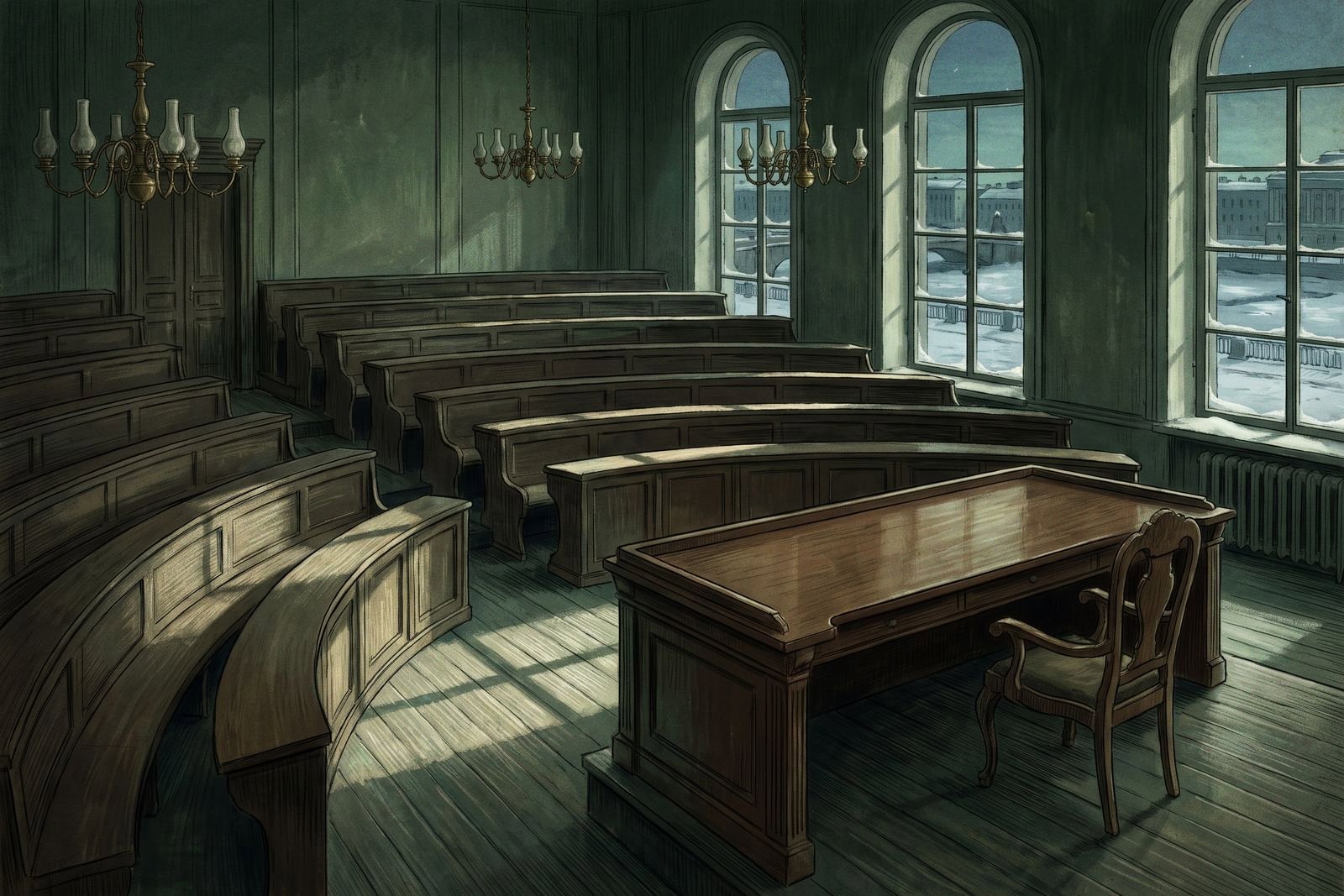
The brass plate on the small chapel beside the Catherine Canal, in the city now called Petrograd, records two deaths and one survival. A Cossack of the imperial escort and a boy from the crowd were killed on this embankment on 13 March 1881. Tsar Alexander II, whom the bombs were meant for, got up off the paving with bruises. In our history he never got up. The second bomb burst at his feet, and he died in his palace that afternoon, with a reform he had signed that morning still in his interior minister's folder. This is the history of what came out of that folder.
1881–1882The Carrot and the Gallows
Ignaty Grinevitsky, a student with a five-pound bomb wrapped like a parcel, waits by the canal railing a little after two in the afternoon for the Tsar's carriage to come back from the troop review. The carriage is closed and armoured, with a Cossack beside the coachman and six more riding behind. Its route is no secret. The conspirators know the Tsar drives home either by the canal or by the street where their mine lies under a cheese shop, and today it is the canal.
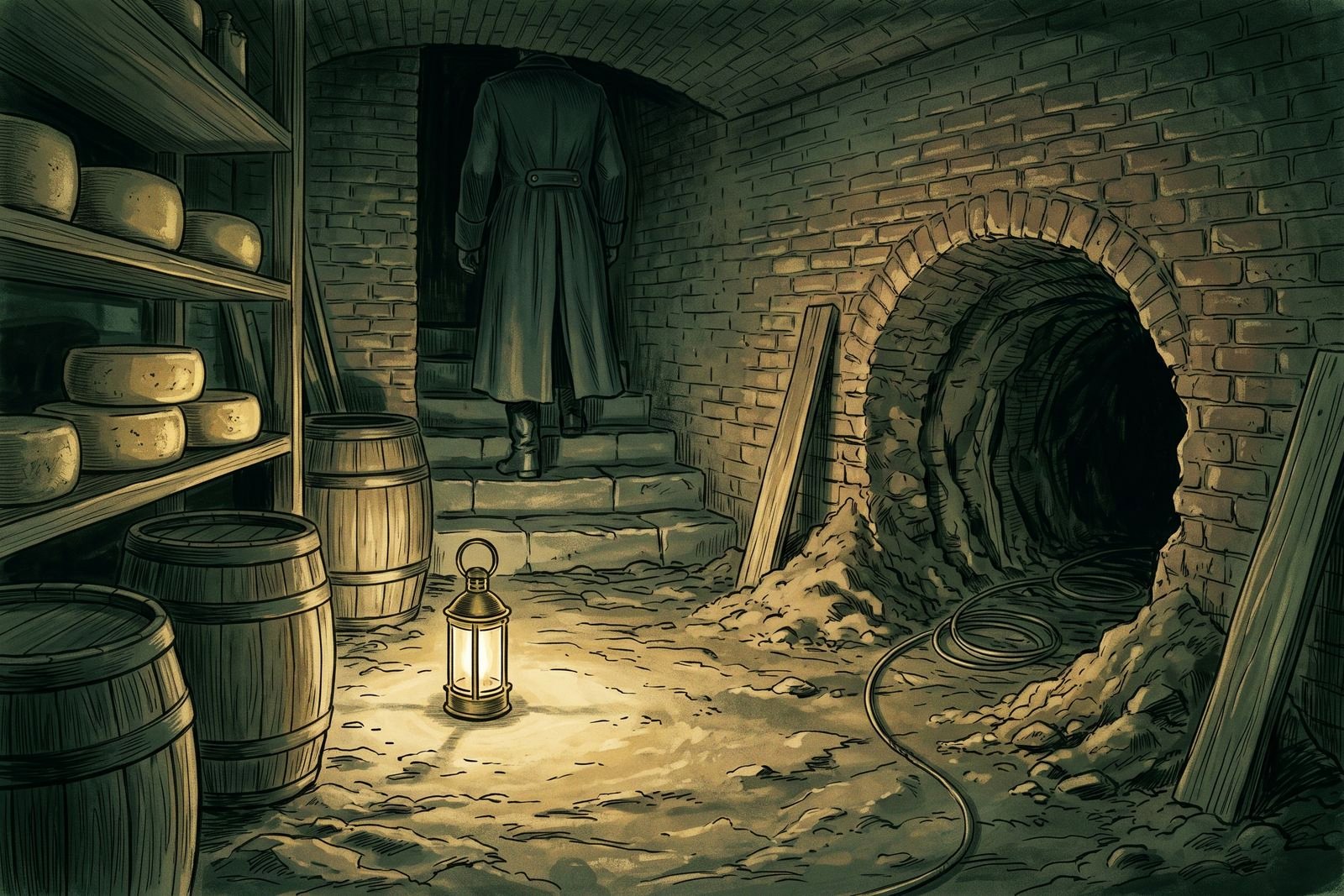
At about a quarter past two Nikolai Rysakov throws the first bomb under the wheels. The crack carries across the ice. The back of the carriage splinters, and a Cossack and a boy go down on the packed snow and stay down. Alexander climbs out, unhurt, to look at them. Grinevitsky throws half a second late. His bomb bursts among the escort's horses instead of at the Tsar's feet, and it knocks down the student, several riders and the emperor together. Alexander is lifted into a police sledge, bruised and bleeding, and driven to the palace alive. Grinevitsky dies that evening in the court stables infirmary. The escort was as small as before and the route as predictable. The second man mistimed his arm.
That morning, after long hesitation, Alexander had signed the report of his interior minister, Mikhail Loris-Melikov, on bringing elected men into the drafting of laws, and fixed a council of ministers for four days later. The signature stands. At the council on 20 March Konstantin Pobedonostsev attacks the scheme as a first step toward a constitution, and the heir takes his side. The emperor, stiff in his chair, takes his minister's. Within days the government's newspaper prints the announcement. Men elected by the zemstvos, the provincial and district councils, and by the town councils will sit with an advisory voice in commissions drafting laws on subjects the Tsar selects. They may not propose a law. Katkov's newspaper in Moscow warns against "parliamentary games", and the liberal papers print addresses of thanks.
In his cell Rysakov talks. The arrests that follow his interrogation empty the conspiracy's flats within a fortnight. Gendarmes find the mine under the cheese shop, sealed and ready, and take the woman who drew the throwers' positions and gave the signal. The People's Will had survived a railway mine under the wrong train and dynamite beneath the palace dining room. It does not survive one frightened comrade.
A special court condemns five, among them the plot's leader, arrested two days before the attack, and Rysakov himself. The addresses of thanks turn into petitions for mercy. Alexander refuses them. A soldier and a child died on the embankment, and he had hanged the man who fired at him in 1866. The five hang on a parade ground in the capital five weeks after the canal.
A sixth, Gesya Gelfman, is pregnant. She becomes the first cause the new public takes up as its own: zemstvo boards that had written asking how their delegates would be chosen now write asking for her life, and her sentence is commuted. The record of this world does not say what became of her child.
In the week after Easter a tavern brawl in Elisavetgrad, a grain town in the south, turns into an attack on Jewish shops and homes. On 7 May a pogrom, a riot against the Jews, breaks out in Kyiv and runs for three days into the villages. Loris-Melikov's own ministry orders police and troops to put it down. How long local officers stood by first is as disputed here as in our record. What changes is the following week. No manifesto of unshakeable autocracy appears on 11 May, no minister resigns, and no successor arrives at the interior ministry with an official line blaming the Jews. Through the summer and autumn the councils meet in extraordinary session to elect delegates. The delegates reach the capital in the last week of January 1882.
1882–1889Seven Winters
The rescript gives the Commission one power, to advise, and fills its benches from bodies that already exist. That decides who sits. The zemstvo assemblies seat peasant deputies beside the gentry, but the Commission has no peasant seats: each council sends whom it likes, and it sends landowners, doctors and lawyers. The western provinces have no zemstvos and send nobody. Neither does the Caucasus. Loris-Melikov, an Armenian, made his name as a general there, and he now presides over a reform that cannot reach the country he knows best.
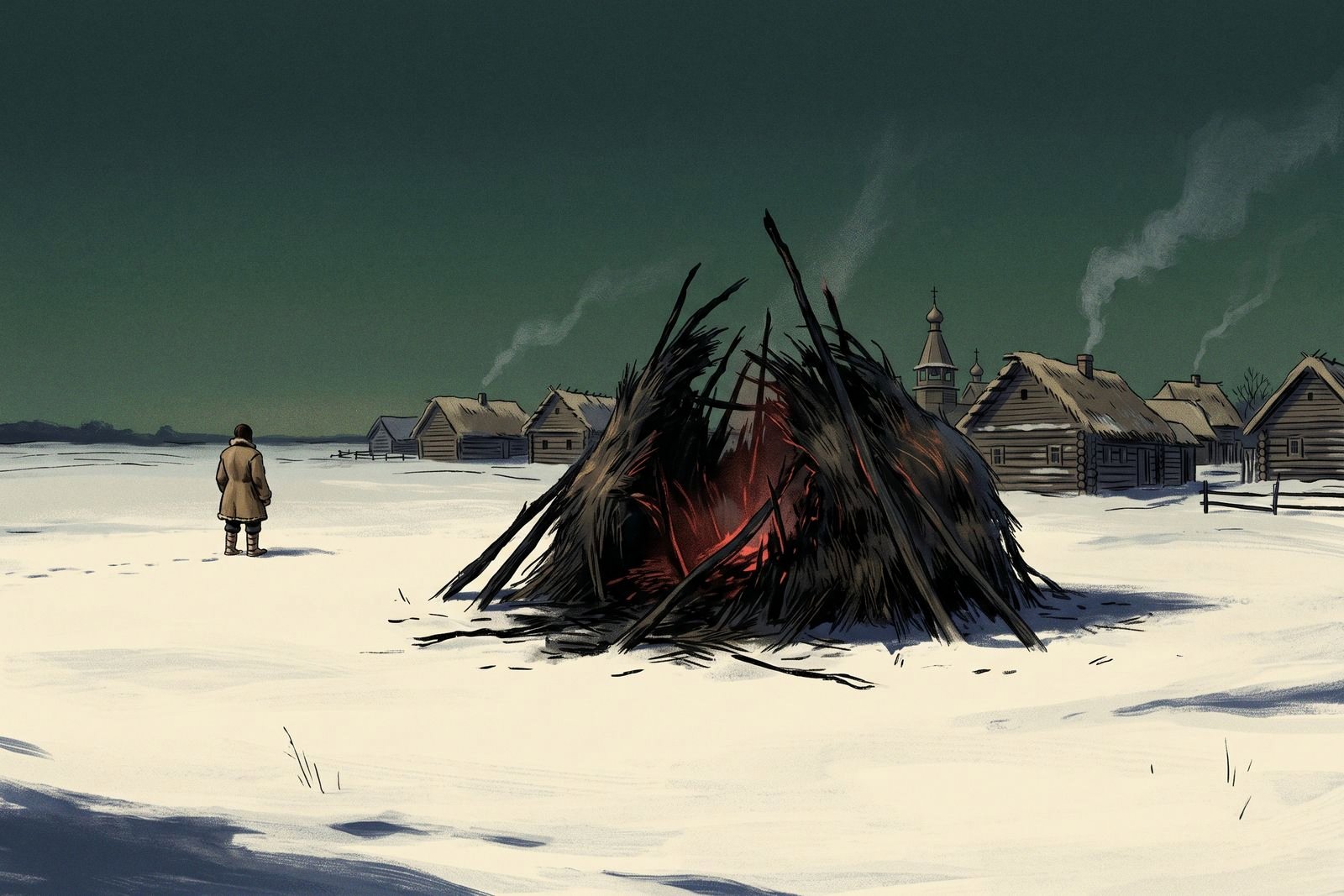
In a village in Tambov province the elder, Fyodor, who is slow with print and past forty, forty-four that winter, hears the news from a pedlar in the new year. Within a month the village has decided what it means. The Tsar, the story runs, has called the masters to the capital to share out their land. This is the black repartition, the general redistribution peasants have awaited since the emancipation of 1861. His neighbours stop paying their redemption dues, the yearly instalments on that land, and wait. The same rumour outruns the police across the black-earth provinces, and the first winter session opens on reports of refused payments and burnt ricks.
The delegates cannot give land, and the rescript does not let them ask for it. They give money. The poll tax goes in stages and is gone by 1885, and the dues are cut. To pay for it the delegates endorse a state vodka monopoly a decade early, higher excise on sugar and tobacco, and domestic bonds. In Fyodor's village the dues fall in the same winter that a bottle at the tavern costs more. The Commission sits every winter, seven sessions by 1889, and prints its reports, which clerks read aloud in the village offices.
In Elisavetgrad, Rivka, a widow who sells cloth from a cart to the villages and has turned thirty-eight, spends the rest of 1881 rebuilding a looted shop. The regulations of May 1882 that barred Jews from settling anew in the countryside, and would have ended her rounds, are never issued here. She keeps her villages. The other drapers in town keep their grievance, which grows sharper for having nowhere to go. The riot wave dies during 1882 at about a hundred incidents, against more than 250 in our record. People still leave. Rivka's elder son sails for America in 1886, and Jewish emigration from the empire will run at about three-fifths of the flow we know.
Later in 1882 Alexander crowns his morganatic wife empress. The heir's circle withdraws from court business and fuses the family insult with its hatred of the Commission; the succession law still bars her son. Abroad, Russia accepts the union of Bulgaria in 1885 instead of overturning it, and the league of the three emperors is renewed in 1887. Germany never closes its exchange to Russia's loans, and its banks keep paying for Russia's railways.
The remnant of the People's Will prints leaflets calling the Commission a sham, and fewer students read them. A second, successful bomb in 1882 or 1883 was considered and set aside for want of throwers, since the students who would have carried it are standing for zemstvo clerkships. Alexander II dies in 1889, and the Commission passes to the son who sided against it in 1881.
1889–1906The Budget in Print
In 1889 Alexander III comes to the throne. He does not abolish the Commission. Seven printed sessions and a vanished poll tax would set every zemstvo against him in his first year, and the villages credit the delegates with the cut in dues. He packs it with appointed members until the elected men are outnumbered on their own benches.
Where there are no zemstvos his hands are free. The western provinces are Russified by decree in the early 1890s, which ends any prospect of councils there. Jewish pupils meet quotas in the secondary schools and universities, and in 1891 the Jews of Moscow are expelled. The Commission protests in print and cannot block a line.
The famine of 1891–92 gives it a fight. The finance ministry has been forcing grain abroad to buy gold, and the Commission's relief reports set the hungry districts beside the export tables. In 1892 it wins a formal review of the budget, advisory still. The landowners among its members soften the tariff of 1891 and push the gold standard back to 1900, at a compromise parity. The ministry still builds factories, but more slowly and with more money from Germany than from France. Heavy industry comes out thinner, and the shell shortage of 1914 starts here.
Alexander III signs a political accord with France in 1891. The military convention that came next in our record would need loans, and the loans must now be defended in print while German capital is still open. The convention is unratified when he dies in 1894, and his son inherits a free hand between Germany and France.
The young Tsar turns down a provincial zemstvo's plea for legislative powers in 1895. Abroad, the printed budget does its work. In 1901 an elder statesman from Japan comes to the capital offering Manchuria for Korea. The finance minister and the Commission's finance delegates, who have read the cost of the eastern railway line by line, back the exchange. A timber concession on the border river dies in committee, and with it the war with Japan in 1904 and the fleet sunk in the straits. Russia keeps Port Arthur and its railway across Manchuria, and Japan annexes Korea in 1910.
At Easter 1903 a pogrom breaks out in Kishinev. Jews are killed and their houses wrecked, and nothing in this world prevented it. This time the rioters are prosecuted.
Peasant risings in 1902 and strikes from 1903 to 1905 find no lost war to blame and no massacre at the palace gates to rally round. The harvest failure of 1905 does the rest. Each time, the only body the government can negotiate with is the zemstvo bloc of the Commission. The basic laws of May 1906 make it a legislative Assembly with the vote on the budget, and ministers answer to it for money. A peasant curia, a separate electoral college, is added, and the western provinces and Russian Poland receive seats. Among the Assembly's first acts is a relaxation of the rules on where Jews may live.
1907–1922February Without October
The Assembly's resettlement law of 1907 pays the fare of Grigory, Fyodor's second son, from Tambov to the steppe around Akmolinsk; he is thirty-one. He takes a plough, a wife and a claim on pasture the Kazakh herders used in winter. Within a decade Akmolinsk has a Slavic majority, and in 1916 the herders rise against the claims and the call-up, as they did in ours.
The free hand ends in the Balkans. Austria annexes Bosnia in 1908, and Russia, short of shells, has to swallow it. The Assembly's pan-Slav majority does not forgive the humiliation. A military convention with France follows in 1910 and an accord with Britain in 1911. A Russia neutral in 1914 does not hold up against those same Balkans, where a free hand between Germany and France does nothing to restrain Austria. French money has had four years to build strategic railways, and the losses of 1914 and 1915 are heavier than ours. Grigory is called up in his late thirties. The capital becomes Petrograd. After the defeats of 1915 an Assembly majority forms the cabinet, decrees liquidating the farms of German colonists pass, and Germany occupies Poland.
In March 1917 the bread riots and the garrison mutiny come as in our record. The order to the garrison, though, comes from a war ministry answerable to the Assembly, and no soldiers' council issues the order that put the regiments under committees. The Tsar abdicates. His brother Michael accepts a regency until a constituent assembly can meet. In May the Assembly legalises the peasants' seizures of land against state bonds, and the trenches empty behind the news. Grigory walks most of the way back to Akmolinsk. After the summer offensive fails, the liberal coalition gives way to an agrarian socialist cabinet, which obtains an armistice that autumn. When the Bolsheviks rise in Petrograd in November, the garrison is already on the trains home with land and peace, and does not follow them.
On 18 January 1918 the constituent assembly proclaims the Russian Democratic Federative Republic, and Michael lays down the regency. A crowned constitution under him lasting to our day would have foundered that month, on an agrarian socialist majority and on a crown that would have had to sign the separate peace of March. That peace gives up Poland and the Baltic lands while Germany installs a puppet Ukraine, and Germany's own armistice in November annuls it.
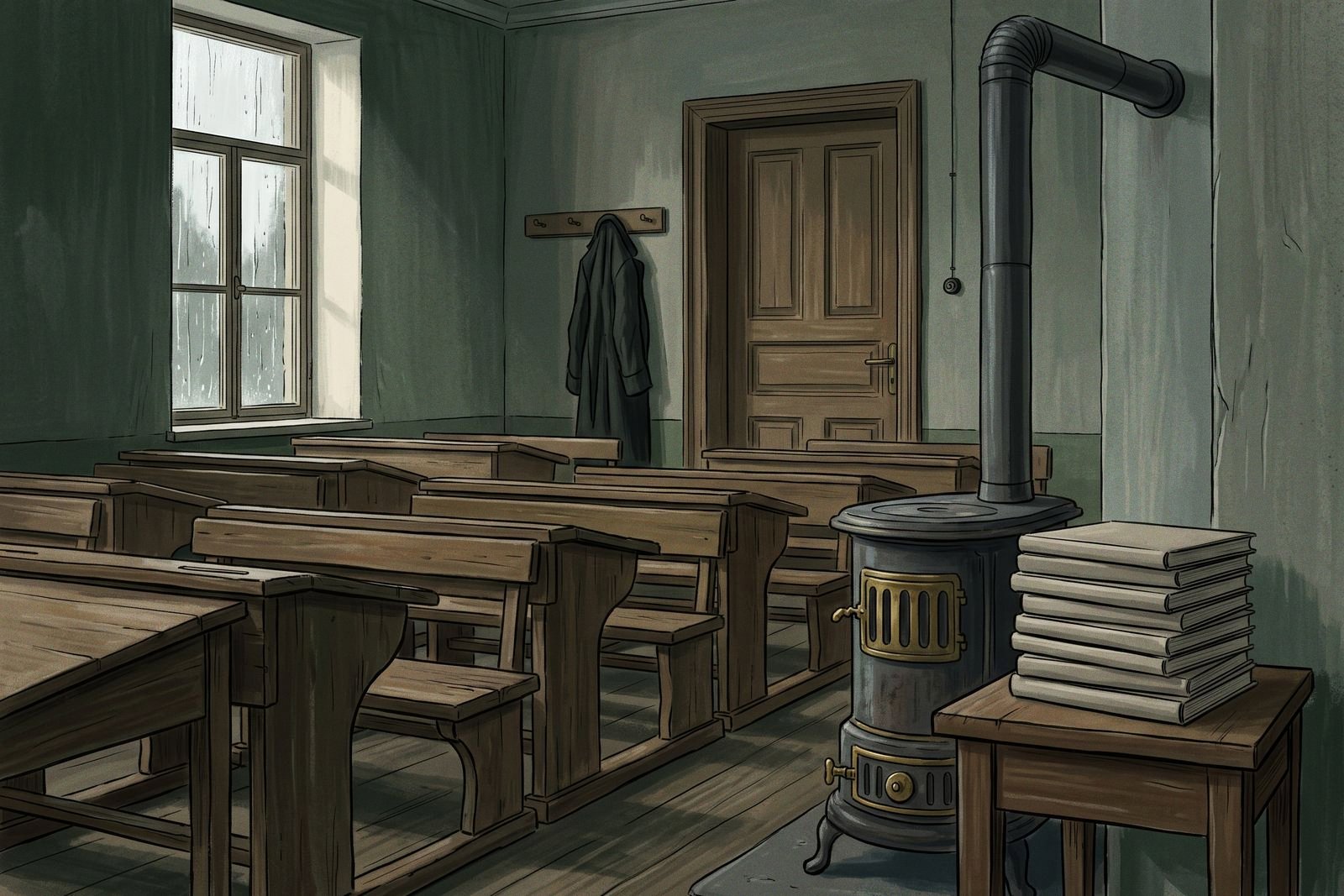
At eight on a wet autumn morning in 1919, Rivka's grandson unlocks the first state Yiddish school in Elisavetgrad and counts the primers stacked beside the cold stove: forty, printed in Kyiv. He is twenty-five. That year's pact with Kyiv's council carries its 1918 law on national-personal autonomy into the Republic, with state Yiddish schools, a Jewish communal council and a protected Yiddish press. The zone of settlement that once confined Jews had fallen in 1917. Outside, the district is still at war. Between 1918 and 1920 armies and bands in Ukraine kill fifteen to twenty thousand Jews, in towns where the autonomy law already stood. The Republic that wrote it could not hold the roads to its schools. Twenty-six of his forty pupils come that morning.
The victors brand Petrograd a defector, shut it out of the peace conference and keep it from the League until 1926. They let Japan occupy the coast beyond Manchuria from 1918 to 1922, and Japan leaves holding Port Arthur and the southern railway. The war with Poland in 1919–20 ends on a line that leaves much of the western borderland to Poland. Finland and the Baltic states are recognised in 1920. Fighting in the southern steppe and the Caucasus goes on until 1921.
1929–1947The Moratorium and the Amur
At the Odessa grain exchange a clerk chalks the wheat price on a slate by the harbour door at ten each morning. Through the sleet of the winter of 1930 the brokers watch the figure fall while the cranes stand idle and the ships wait in the roads. Grain is how the Republic pays its debts, and it kept every one of them. Claiming continuity with the empire, it took on the tsarist loans, the war debt and the land bonds of 1917, since a state that repudiated them would have found no one left to lend to it. When the price collapses the payments go with it. In 1931 Petrograd declares a moratorium on the prewar foreign bonds.
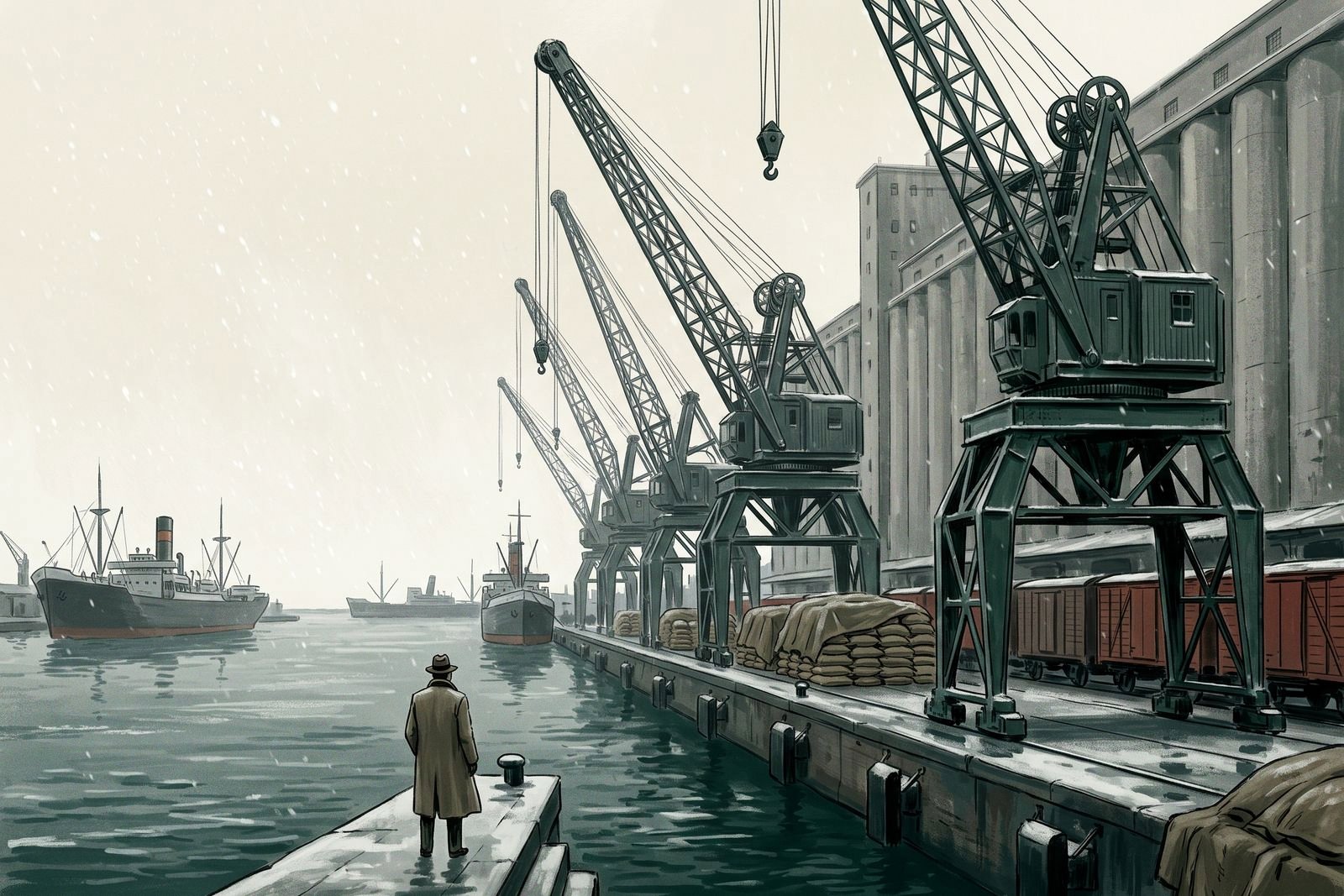
From 1932 an emergency government of generals and agrarian party leaders rules by decree. It prorogues the Assembly and narrows Kyiv's autonomy. A Republic riding out the slump with its parliament intact is hard to credit: every indebted farming state in the east of Europe turned authoritarian in the 1930s, and this one had no reason to be spared.
In Germany the slump arrives without the thing that most fed the far right in the world we know. There is no Bolshevik state, and so no mass communist party paid from Moscow and no émigré legend of Jewish Bolshevism for agitators to carry. The old field marshal's circle settles in 1932 and 1933 on a presidential regime backed by the army. Hitler is never made chancellor, and his party has split by 1934.
The murder of Europe's Jews does not happen in this world. The Jews of Poland and of the old empire's south-west live through the 1930s in their millions, under quotas, boycotts and decree governments.
The army's Germany takes Austria by plebiscite in 1938 and fights Poland over Danzig in 1939. A conference of four powers ends the short war by giving it the city and a road across the corridor, and no general war follows in Europe. With France standing, Japan has no opening into French Asia, and the physicists who drove the bomb in our history never become refugees. Japan and America stay at peace, and no atomic bomb falls on a city.
Japan, in Manchuria since 1931 and in China since 1937, strikes north instead. The Amur War of 1939–41 is the Republic's alone. It holds its eastern port and the river line with supplies from America and Britain, but loses the northern half of its island off the coast and accepts an armistice in 1941. Discredited, the generals yield, and full parliamentary rule returns in 1942. An oil embargo by America, Britain and the Republic from 1941 brings down Japan's militarist cabinet in 1943. Japan leaves China proper by 1946 and returns Manchuria in 1947, and is never occupied. The parliament of 1942 inherits the decrees that narrowed Kyiv's autonomy and leaves them standing.
1947–1991The Tsarist Seams
In Akmolinsk province the district land office keeps two registers, one for households settled under the law of 1907 and one for families who were there before it. By 1950 the first is the longer.
Beyond the steppe the century's great divisions never form. With no communist rival and no ruined Europe to rebuild, there is no Cold War, no western alliance and no American aid plan. Empires dissolve a decade or two later than in our world, and the largest becomes a dominion federation in the 1950s. Around 1958 the Palestine mandate ends in a binational federation with a Jewish canton on the coastal plain. A Jewish state in 1948 lacks the numbers: a smaller emigration from Russia after 1881 and no genocide in Europe leave the settlers of the 1940s without the population or the moral claim. Korea wins its independence whole, by treaty, in 1965. A European Customs Union forms in 1968. The first nuclear test is America's, around 1952, and so is the first satellite, in 1966.
The Republic's own south leaves along seams the empire drew. The old protectorates of the emir and the khan go by treaty in 1962. A Turkestan republic with an undivided cotton valley follows in 1971, and its irrigation begins to shrink the inland sea at its edge. A Kazakh republic named Alash forms in the southern steppe in 1974. The record of this world does not explain why it came three years after Turkestan, when the two movements had shared presses and platforms.
The Slavic-majority north stays federal, with a Kazakh autonomy and a clause on exchanging populations that neither side accepts as written. When the clause takes effect Grigory's granddaughter, then twenty-nine, is a surveyor in the Akmolinsk office. Her work is the two registers. She lists which households may claim passage south and which northern farms Kazakh families may claim in return, and the appeals against her lists take eleven years to clear. Her grandfather's allotment is on the first register.
Georgia leaves in 1981 on the precedent of its independence of 1918. Azerbaijan goes in 1991 under a treaty sharing its pipeline revenue, because the oil fields of the Volga and the far north had long made its own secondary. No other state comes apart that year, since there is no union here to dissolve. The Armenian enclave inside Azerbaijan stays an autonomy guaranteed by treaty. Armenia, needing protection on its western border, stays federated.
1991–2026The Referendum Season
A cashier at the exchange counter in Petrograd's airport changes dollars and marks into convertible roubles. Poland and the Baltic states sit in the European Customs Union, which never adopted a common currency. Japan is still an empire and Korea is whole. The Jewish canton sends deputies to a federal Palestinian parliament. America's cities went unattacked in 2001, and Iraq was left alone. With no Jewish state to oppose and no holy war in the mountains to export, Islamist politics grew without an American war to feed them. Computing came up through telephone monopolies, office-machine makers and Japan's firms, and consumer networks have spread only since about 2005. No one has stood on the Moon.
The census of 2026 counts about 300 million citizens. No famine was made in Ukraine's villages, and no camp system was built in the north. The Volga Germans, the Crimean Tatars and the Chechens were never loaded onto trains, and each holds an autonomy; the first two print their own schoolbooks. The Republic's dead lie elsewhere, in the pogroms of 1918–20, on the steppe in 1916 and along the Amur. Incomes sit at the level of southern Europe, and a lobby of smallholders, heirs of the land law of 1917, can bring down a grain minister.
The news is Kyiv. Its autonomy referendum campaign invokes the Odessa grain trade, the autonomy law of 1918 and the emergency decrees of the 1930s that curtailed it, and the farm lobby fears a separate grain tariff for Ukraine. Trains south pass towns with state Yiddish schools and Yiddish signs over the grain brokers' doors. The Assembly, debating the vote, counts its descent from about thirty-five years of sittings between 1882 and 1917, legislative only from 1906.
On the Catherine Canal the brass plate on the chapel names a Cossack and a boy. In the museum beside it, next to the facsimile of Loris-Melikov's signed note, a card gives the boy's name, and almost no visitor stops to read it. In Moscow a morning paper that claims descent from Katkov's warns the Assembly against letting Kyiv hold its vote.
1881Second bomb bursts short on the Catherine Canal; Alexander II survives
At about 2:15 pm Nikolai Rysakov's bomb damages the carriage and kills a Cossack of the escort and a boy in the crowd. The Tsar gets out unhurt, as recorded. Ignaty Grinevitsky throws a half-second late. His bomb bursts among the escort, not at the Tsar's feet. Grinevitsky and several escort men are fatally or gravely wounded. Alexander is thrown down and bruised, then driven to the Winter Palace alive. That morning he had signed Loris-Melikov's report and fixed the Council of Ministers for four days later. The signature now stands. Survival is the fruit of chance, not of better security: the route was known, the escort small and the tunnel on Malaya Sadovaya undetected. The Malaya Sadovaya mine is found in the days after the attack, when arrests follow Rysakov's interrogation.
7 SOURCED CAUSES
1881Council of Ministers debates the project; the Tsar confirms it and the announcement is published
Konstantin Pobedonostsev attacks the scheme as a first step toward a constitution, as he did in the real council. The heir, Grand Duke Alexander, sides with him. With the emperor alive and freshly marked by the attempt, the Special Council's February approval is upheld. The government announcement drafted by Loris-Melikov is published in the Government Messenger within days. It calls for elected zemstvo and city representatives to sit, with advisory voice only, in commissions drafting laws on subjects the Tsar selects. Lawmaking initiative remains with the monarch. Sources on the plan's scope remain as divided as the dossier shows. In practice the announcement creates one general commission with preparatory sub-commissions, not a national assembly.
6 SOURCED CAUSES
1881Canal conspirators hanged on the Semenovsky parade ground
The Special Tribunal of the Ruling Senate condemns Zhelyabov, Perovskaya, Kibalchich, Timofei Mikhailov and Rysakov. The assault killed a Cossack and a child, and Alexander II had sent Karakozov to the gallows in 1866. On these grounds the Tsar refuses clemency despite liberal petitions. Gesya Gelfman is reprieved for pregnancy. Grinevitsky has already died of his wounds. Narodnaya Volya's Executive Committee survives in fragments and declares the rescript a sham. It no longer draws the recruits it did in 1879-80, because part of its student milieu turns to the coming zemstvo elections.
4 SOURCED CAUSES
1881Elisavetgrad pogrom, then Kiev; Loris-Melikov's ministry orders suppression
In the week after Easter a tavern brawl in Elisavetgrad grows into an attack on Jewish shops and homes. It is followed on 7 May by three days of rioting in Kiev and the surrounding villages. These outbreaks run as in recorded history, under Loris-Melikov's own Interior Ministry, which orders police and troops to suppress them. The state's role in the local tolerance of the violence remains disputed. The divergence lies in what follows, not in these first riots.
4 SOURCED CAUSES
1881No manifesto of autocracy: Loris-Melikov, Abaza and Milyutin stay in office
Alexander III does not reign, so no Manifesto on Unshakeable Autocracy is issued and there is no ministerial crisis. No Ignatiev ministry follows, and there is no official line blaming the Jews for the spring disorders. The provincial zemstvo assemblies and city dumas are convoked in extraordinary sessions through the summer and autumn to elect delegates. Senators' inspection reports from 1880 are laid before the drafting commissions as working papers.
6 SOURCED CAUSES
1882First winter session of the Imperial Drafting Commission; Princess Yurievskaya crowned empress
The elected delegates sit alongside officials in St Petersburg for the first of what become annual winter sessions, seven by 1889. The poll tax is abolished in stages by 1885 and redemption dues are cut. The delegates endorse the means of paying for this: a vodka monopoly brought forward a decade, higher sugar and tobacco excises and domestic bonds. They relieve the village with one hand and tax its drink with the other. Later in 1882 Alexander crowns his morganatic wife, Ekaterina Yurievskaya, empress. The heir's circle withdraws from the Council and fuses its family grievance with opposition to the Commission. The 1797 succession law still excludes Georgy Yurievsky. No Temporary Regulations are issued in May 1882. Jews keep the right to settle and trade in the countryside, which sharpens rivalry with Christian townsmen. The riot wave dies out during 1882 at roughly 100 incidents instead of the recorded 250 or more. In 1885 Russia accepts Bulgaria's Philippopolis union under Alexander of Battenberg, nephew of the late Empress Maria. There is no Russian-backed coup in 1886, and the Three Emperors' League is renewed in 1887. There is no Lombardverbot, so German banks keep financing Russian railways. Alexander Ulyanov's 1887 plot never forms.
6 SOURCED CAUSES
1889Alexander II dies; Alexander III narrows the Commission but cannot abolish it
The new emperor packs the Commission with appointed members and Russifies the western provinces, where there are no zemstvos. He imposes school quotas on Jews and orders the 1891 expulsion of Jews from Moscow. The Commission protests in print but cannot block these measures. He does not abolish a body that the countryside publicly credits with redemption relief. Jewish emigration continues, but over 1881-1914 it will run at about 60 per cent of the real outflow. Pinsker's circle and Hovevei Zion start smaller.
4 SOURCED CAUSES
1892Famine fight with the Finance Ministry wins the Commission an advisory budget review
The 1891-92 famine becomes the Commission's first great quarrel with Vyshnegradsky's grain-export drive. Its printed relief reports win it a formal but still advisory review of the budget. The agrarian gentry soften the 1891 tariff and delay the gold standard to 1900 at a compromise parity. Witte still industrialises, but more slowly and with more German than French capital. The result is weaker heavy industry and lower shell output in 1914. Alexander III signs the 1891 political accord with France. With German capital still open and loans scrutinised in print, the military convention remains unratified at his death in 1894. Nicholas II inherits a free hand between Berlin and Paris.
3 SOURCED CAUSES
1901Ito mission yields a Manchuria-for-Korea exchange; no Russo-Japanese War
During Ito Hirobumi's St Petersburg mission, Witte and the Commission's finance delegates back the exchange, having read the Far Eastern budget in print. The Yalu timber concession dies in committee. There is no war and no Tsushima. Russia keeps Port Arthur and the Chinese Eastern Railway, and Japan annexes Korea in 1910. At home, Nicholas II had rejected the Tver zemstvo's 1895 plea for legislative powers. The Poltava-Kharkov peasant risings of 1902 and the strikes of 1903-05 leave the Commission's zemstvo bloc as the only interlocutor.
3 SOURCED CAUSES
1906Fundamental Laws make the Commission a legislative State Assembly
After the 1905 harvest failure and strikes, the Commission becomes a State Assembly with the budget vote, and ministers answer to it on money. From 1911, by convention, the premier needs an Assembly majority. The franchise adds a peasant curia, the nine western provinces and a Kingdom of Poland delegation. The Assembly relaxes Jewish residence rules. From 1907 an Assembly-backed land and resettlement law moves millions to Siberia and the northern steppe, giving Akmolinsk and Semipalatinsk Slavic majorities. The steppe revolt of 1916 still comes. At Easter 1903 the Kishinev pogrom had still erupted, and its rioters were prosecuted.
4 SOURCED CAUSES
1914Russia enters the Great War by a Balkan road
The 1908-09 Bosnian annexation crisis humiliates Russia, and the Assembly's pan-Slav majority ends the free hand. A Franco-Russian military convention follows in 1910 and an Anglo-Russian accord in 1911. Russia goes to war over Austro-Russian Balkan rivalry, not an 1894 alliance. Only four years of French strategic-railway money have been spent, so losses in 1914-15 are heavier. The capital is renamed Petrograd. The 1915 ministerial crisis ends in an Assembly-majority cabinet. The liquidation decrees against German colonists pass, and they are repealed in 1917. Germany occupies Poland from 1915.
2 SOURCED CAUSES
1917Nicholas abdicates; Grand Duke Michael becomes regent; armistice in September, Republic in January
Bread riots and a garrison mutiny break out as recorded. Because an Assembly cabinet already governs, the garrison order comes from the War Ministry. There is no Order No. 1. Michael accepts a regency pending a Constituent Assembly. In May the Assembly legalises peasant land seizures against state bonds, which also empties the trenches. After the failed June offensive the liberal coalition falls to an agrarian-socialist cabinet under the invented premier Pavel Surovtsev, which obtains an armistice in September. A Bolshevik rising in Petrograd in November fails against a garrison already going home with land and peace. On 18 January 1918 the Constituent Assembly proclaims the Russian Democratic Federative Republic, and Michael lays down the regency. The March 1918 separate peace cedes Poland, Lithuania and Courland, and Germany installs a puppet Ukraine. The November armistice annuls that peace. A 1919 federal pact with the Kyiv Rada carries Kyiv's January 1918 law on national-personal autonomy into the federal Ukrainian land: state Yiddish schools, a Jewish communal council and a protected Yiddish press. The Pale has already fallen in March 1917. The 1918-20 fighting in Ukraine still brings pogroms, with roughly 15,000-20,000 dead. The Entente brands Petrograd a defector and excludes it from Versailles and from the League until 1926. It tolerates a Japanese occupation of the Russian Far East from 1918 to 1922, which ends with Japan holding Port Arthur and the southern railway. The Russo-Polish war of 1919-20 ends on a Riga-type line that leaves Vilna, Grodno and western Volhynia to Poland. Finland, Estonia and Latvia are recognised in 1920. Fighting on the Don and in the Caucasus lasts until 1921.
4 SOURCED CAUSES
1939Amur War in the east; a short German-Polish war over Danzig in the west
The Republic claims continuity and so keeps the tsarist debt, the war debt and the 1918 land bonds. The 1929 grain collapse forces a 1931 moratorium on prewar foreign bonds. From 1932 an emergency government of invented generals and agrarian-party leaders rules by decree. It prorogues the Assembly and curtails Kyiv's autonomy. With no Bolshevik state, there is no Moscow-funded mass KPD and no émigré channel carrying the Judeo-Bolshevik thesis into Munich. Hindenburg's circle settles in 1932-33 on a Reichswehr presidential regime, Hitler is never chancellor and the NSDAP splits by 1934. Germany takes Austria by plebiscite in 1938. In 1939 it fights Poland over Danzig, and a four-power conference cedes Danzig and a corridor road to Germany. There is no general European war and no Holocaust. Japan, which has held Manchuria since 1931 and invaded China in 1937, strikes north. Russia holds Vladivostok and the Amur line with American and British supplies but loses northern Sakhalin, and an armistice follows in 1941. Discredited, the generals yield, and full parliamentary rule returns in 1942. An Anglo-American-Russian oil embargo (1941-43) topples Japan's militarist cabinet in 1943. Japan leaves China proper by 1946 and returns Manchuria in 1947. It is never occupied.
3 SOURCED CAUSES
1962Bukhara and Khiva leave by treaty; the south begins to separate along tsarist lines
The protectorates of Bukhara and Khiva depart first. A Turkestan Republic, with Tashkent and an undivided Ferghana, follows in 1971. Its own cotton irrigation slowly shrinks the Aral Sea. A Kazakh Alash Republic forms in the southern steppe in 1974. The Slavic-majority north stays federal, with a Kazakh autonomy and a contested population-exchange clause. Georgia leaves in 1981 on its 1918 precedent. Azerbaijan leaves in 1991 under a pipeline revenue-sharing treaty, since Volga-Ural and West Siberian oil have made Baku secondary. Karabakh remains a treaty-guaranteed autonomy inside Azerbaijan. Armenia stays federated for security against Turkey. Abroad, there is no Cold War, NATO or Marshall Plan. Korea gains independence, undivided, by treaty in 1965. The Palestine Mandate ends around 1958 in a binational federal Palestine with a Jewish canton on the coastal plain. A European Customs Union forms in 1968. The first nuclear test, American, came around 1952, and the first satellite, also American, in 1966.
2 SOURCED CAUSES
2026Census counts about 300 million citizens as Kyiv prepares its autonomy referendum
The Republic has seen no famine, collectivisation, Gulag or German war. Volga Germans, Crimean Tatars and Chechens were never deported and hold their own autonomies. Per-capita income stands at a Southern-European level, and a smallholder farm lobby dominates grain politics. Kyiv's referendum campaign invokes the Odessa grain trade, the 1918 autonomy law and the curtailment of the 1930s. Poland and the Baltic states sit in the European Customs Union, which has no common currency. No human has stood on the Moon. Consumer networks have been spreading since about 2005.
3 SOURCED CAUSES
1882Seven winter sessions of the Imperial Drafting Commission; poll tax abolished; Alexander II dies in 1889
The Commission founded on the rescript signed on 13 March 1881 meets each winter from 1882, seven sessions by 1889. The poll tax is gone by 1885 and redemption dues are cut. The relief is paid for by an early vodka monopoly, higher sugar and tobacco excises and domestic bonds that the delegates endorse. Alexander II crowns Ekaterina Yurievskaya empress in 1882. The heir's circle around Pobedonostsev withdraws from the Council and fuses dynastic grievance with opposition to the Commission. Abroad, Russia accepts the 1885 Bulgarian union under Alexander of Battenberg. There is no 1886 coup, the Three Emperors' League is renewed in 1887 and there is no Lombardverbot, so German capital keeps building Russian railways. The 1887 Ulyanov plot never forms, because the student milieu has a legal outlet. Alexander II dies in 1889. Alexander III packs the Commission with appointees and Russifies the zemstvo-less west, but he cannot abolish a body the villages credit with redemption relief.
5 SOURCED CAUSES
1882The riot wave dies at about 100 incidents; no May Laws; Jewish emigration runs at 60 per cent of the recorded outflow
Elisavetgrad and Kiev broke out as recorded, under Loris-Melikov's own ministry. The divergence lies in what follows: no Ignatiev ministry, no official line blaming the Jews and no Temporary Regulations. Jews keep the right to settle and trade in the countryside, which is an internal outlet, and the wave dies in 1882 at about 100 riots rather than 250 or more. The cost is sharper rivalry with Christian townsmen in Kherson and Kyiv provinces. The later pressures still land. Alexander III imposes school quotas and the 1891 Moscow expulsion, and Kishinev erupts at Easter 1903, though its rioters are prosecuted. Emigration continues at about 60 per cent of the real figure, and Hovevei Zion stays small. Mass migration to America is altered in scale but not averted.
5 SOURCED CAUSES
1892Budget review, no Russo-Japanese War, and a State Assembly by the Fundamental Laws of 1906
The 1891-92 famine wins the Commission an advisory budget review. The gentry soften the 1891 tariff and push the gold standard back to 1900. Witte still industrialises, but more slowly and with German money. The French military convention stays unratified in 1894. Russo-Japanese War: averted. During Ito's 1901 mission, finance delegates who had read the Far Eastern budget in print back the Manchuria-for-Korea exchange, and the Yalu concession dies in committee. 1905 Revolution: altered. There is no Tsushima and no Bloody Sunday cascade. Instead the 1902 risings, the 1903-05 strikes and the 1905 harvest failure leave the zemstvo bloc as the only interlocutor. In 1906 the Commission becomes a legislative State Assembly with the budget vote and peasant, western and Polish seats. From 1907 its resettlement law gives Akmolinsk and Semipalatinsk Slavic majorities.
4 SOURCED CAUSES
1914Great War by a Balkan road; February without October; the Russian Democratic Federative Republic
First World War: unchanged in outbreak, altered in route. The Bosnian humiliation of 1908-09 turns the pan-Slav Assembly toward a 1910 French convention and a 1911 British accord. With only four years of railway loans spent and shell output weak, losses in 1914-15 are heavier. Russian Revolution: February unchanged, October averted. The bread riots and mutiny come as recorded, but an Assembly cabinet issues the garrison order, so there is no Order No. 1. Grand Duke Michael becomes regent. The May land law and Surovtsev's September armistice send the garrison home, and the November Bolshevik rising fails. The Republic is proclaimed on 18 January 1918. The March 1918 separate peace is annulled by the November armistice, and the 1919 pact with the Kyiv Rada entrenches Yiddish schools and a Jewish communal council. The costs: exclusion from Versailles and from the League until 1926, Japan in Port Arthur, a Riga-type Polish border, and the 1918-20 Ukrainian pogroms of about 15,000-20,000 dead.
4 SOURCED CAUSES
1929Depression and decree rule in Petrograd; no Hitler, no Second World War, no Holocaust; the Amur War in the east
Great Depression: unchanged. The 1929 grain collapse forces a 1931 moratorium on the tsarist debt the Republic had kept by claiming continuity. From 1932 invented generals and agrarian leaders rule by decree and curtail Kyiv's autonomy. Nazi seizure of power: averted. With no Bolshevik state there is no mass Moscow-funded KPD and no émigré Judeo-Bolshevik thesis reaching Munich. Hindenburg's circle builds a Reichswehr regime, and the NSDAP splits by 1934. Second World War: averted in Europe. Germany takes Austria by plebiscite in 1938 and fights a short war over Danzig in 1939, settled by a four-power conference. The Holocaust never happens, and the Jews of Poland and the Russian south-west survive in their millions. In Asia the war is altered: Japan strikes north in the 1939-41 Amur War and takes northern Sakhalin. The discredited generals yield to parliament in 1942, an oil embargo topples Tokyo's militarists in 1943, and Japan leaves China by 1946 and Manchuria in 1947, never occupied.
3 SOURCED CAUSES
1947No Cold War; slow decolonisation; the south leaves along tsarist seams
Cold War, NATO and the Marshall Plan: averted, since there is no Soviet rival and no ruined Europe. Decolonisation: altered and slowed by a decade or two. India becomes a dominion federation in the 1950s. Palestine ends around 1958 as a binational federation with a Jewish canton, and no 1948 war or Jewish state follows. Korea gains independence whole by treaty in 1965. European integration: altered. There is no ECSC, and a European Customs Union forms in 1968. Space race: averted. The first American satellite goes up in 1966. Within Russia, Bukhara and Khiva leave in 1962, followed by Turkestan in 1971, Alash in 1974, Georgia in 1981 and Azerbaijan in 1991 under a pipeline treaty. Armenia stays federated. The Soviet collapse of 1991 is averted, having no subject.
2 SOURCED CAUSES
2001No September attacks or Iraq war; consumer networks arrive late; Kyiv readies its autonomy vote
The 2001 attacks and the Iraq war are averted. With no Israel and no Afghan jihad, Islamist politics grow from Egyptian and Saudi roots without an American war to feed them. Digital age: altered and delayed. Without ARPA, computing grows through telephone monopolies, IBM and Japanese firms, and consumer networks spread from about 2005. In 2026 the Republic's census counts about 300 million, with no famine, Gulag or deportations behind them. Kyiv's referendum campaign reaches back to the curtailments of the 1930s.
3 SOURCED CAUSES
Every one of these worlds was weighed against the one you have just read. Here is where each of them breaks.
Survivors of the People's Will regroup and kill Alexander II with a second, successful bomb in 1882 or 1883.
We weighed it because the terror did not end with the arrests of March 1881, and a remnant of the conspiracy kept printing and plotting. It fails in the early 1880s for want of throwers. Once elected delegates sit in the capital from January 1882, the students who would have carried the bomb are standing for zemstvo clerkships instead. A successful attack would also hand the throne to the heir before the Commission had any following in the provinces, and return the empire to the course it actually took. That road was defensible, but it made a smaller world than the one we owed our reader, and we chose the survival over the reset.
Alexander III abolishes the Commission of elected delegates as soon as he takes the throne in 1889.
We weighed it because the new Tsar had opposed the Commission since the council of March 1881 and had fused it with his family's grievance over his father's second marriage. It breaks in 1889 itself. Seven winter sessions had been printed and read aloud in village offices, and peasants credited the delegates with the end of the poll tax and the cut in redemption dues, so abolition would set every zemstvo against him in his first year. It would also put the empire back on its known course, and we judged that too close to our own history to be worth the telling. He narrows the body instead, packing it with appointed members until the elected men are outnumbered on their own benches.
The anti-Jewish riots of Easter 1881 never break out, or Loris-Melikov's order to put them down becomes the point where this history turns.
We weighed it because the pogroms of spring 1881 shaped Russian Jewish life for a generation, and sparing them was tempting. The riots began in a tavern brawl in Elisavetgrad in the week after Easter, from local and seasonal causes that a surviving Tsar in the capital does not reach, and a Jewish woman, Gesya Gelfman, still stands among the condemned in the newspapers. Loris-Melikov also held the interior ministry during both the Elisavetgrad and Kyiv outbreaks in our own history, so his orders to police and troops cannot be the difference. The divergence begins only after May 1881: no manifesto of unshakeable autocracy, no new minister with an official line blaming the Jews, and no May regulations in 1882. The riot wave dies out at about a hundred incidents, against more than 250 in ours.
Russia and France conclude their political accord and military convention on the schedule of 1891 to 1894, as in our history.
We weighed it because the alliance is one of the fixed points of European history before 1914. In this world it breaks in the mid-1880s: Russia accepts the union of Bulgaria in 1885, the league of the three emperors is renewed in 1887, and Germany never closes its exchange to Russian loans. With Berlin's banks still paying for Russian railways, and every foreign loan now defended in print before the Commission, the convention stays unratified when Alexander III dies in 1894. Keeping the old schedule would have meant matching our history without a cause inside this one. The accord of 1891 survives as a signature, and the military bond waits until 1910.
Russia and Japan go to war over Manchuria and Korea in 1904 exactly as in our history.
We weighed it because the rivalry in the Far East is real in every version of this century. It breaks in 1901, when Ito Hirobumi comes to the capital offering Manchuria for Korea, an offer he made in our history too. Here the finance minister has allies: delegates who have read the cost of the eastern railway line by line in the printed budget since 1892. They back the exchange, the timber concession on the Yalu dies in committee, and with it go the war and the fleet lost at Tsushima. Keeping the war was defensible, but it made a smaller world than the one we owed our reader, and we chose to let the printed budget earn its first result abroad.
Russia stays neutral in 1914, or the Great War does not happen at all.
We weighed this seriously, since a Russia with a free hand between Germany and France in the 1890s looks like a Russia with no reason to fight. It breaks in 1908 and 1909, when Austria annexes Bosnia and Russia, short of shells, has to swallow it. The pan-Slav majority in the Assembly does not forgive the humiliation. The Bulgarian settlement loosened the alliances of the 1880s, but the rivalry with Vienna in the Balkans runs on into the 1910s untouched. A convention with France follows in 1910 and an accord with Britain in 1911, and Russia goes to war in 1914 on French-built railways, with losses heavier than in our record.
Grand Duke Michael reigns as a constitutional monarch after 1917, and his crown survives to 2026.
We weighed it because Michael's acceptance of the regency in March 1917 made a crowned constitution briefly real. It breaks in January 1918. The constituent assembly returns an agrarian socialist majority with no use for a throne, and the crown would have had to put its name to the separate peace of March, surrendering Poland and the Baltic lands. No dynasty outlives that signature. We kept Michael for ten months, as regent from March 1917 until he lays the office down on the day the Republic is proclaimed.
The Assembly, older and better rooted than any Russian parliament of our history, simply outvotes the Bolsheviks in 1917 and 1918.
We weighed it because thirty-five years of sittings seemed to give Russian parliamentary life a weight it lacked in our world. It fails on the evidence of January 1918: the Bolsheviks were outvoted then too, and dispersed the constituent assembly by force. Votes do not stop a garrison, and the age of an institution is not by itself a turning point. What decides it in this world is land in May 1917 and an armistice in September, which put the garrison on the trains home before the November rising. The Bolsheviks fail because no soldier is left to follow them.
The new Russian Republic repudiates the tsarist loans and war debts in 1918.
We weighed it because the Bolsheviks did exactly this in our history, and a revolutionary state carrying the empire's bills looks like an odd creature. It fails in 1918 on law and credit. An Assembly that claims continuity with the empire cannot disown the empire's signature, and a state that repudiated would find no one left to lend to it. The Republic takes on the tsarist loans, the war debt and the land bonds of 1917, and pays them out of grain. The break comes in the 1930s instead, when the wheat price collapses on the Odessa exchange and Petrograd declares a moratorium on the prewar foreign bonds in 1931.
The Republic rides out the grain collapse of 1929 with its parliament and Kyiv's autonomy intact.
We weighed it because the Republic had come through war and revolution with its Assembly standing, and a clean passage through the slump was tempting. It breaks in the early 1930s. Every indebted farming state in eastern Europe turned authoritarian in that decade, and this one lives on grain exports that lose most of their value after 1929. Sparing it would have been a gentler world than the evidence allows, and we chose to charge the Republic the price its neighbours paid. From 1932 generals and agrarian party leaders rule by decree, prorogue the Assembly and narrow Kyiv's autonomy, and when parliament returns in 1942 the decrees on Kyiv stay on the books.
Hitler still comes to power, Germany still invades Russia in 1941, and Russia joins the Allies in 1942.
We weighed it because these are the dates and the war every reader knows. It breaks in 1932 and 1933. With no Soviet state there is no mass communist party paid from Moscow to frighten German voters and no legend of Jewish Bolshevism for agitators to carry, and Hindenburg's circle settles on an army-backed presidential regime rather than the chancellery for Hitler. An eastern front in 1941 would also run through the old zone of Jewish settlement, the very lands this history spares. Keeping the war as it was would have made a world too close to our own, and we took the other road.
Japan still attacks the United States, the Pacific War runs its course, and atomic bombs still fall on Japanese cities.
We weighed it because Japan's army in this world is as expansionist in the 1930s as in ours. It breaks in 1940 and 1941. France does not fall, so French Indochina offers Japan no opening to the south, and the sequence of embargo and surprise attack in the Pacific never begins. With no racial laws in Germany, the physicists who drove the American bomb project stay at their European universities instead of arriving as refugees. Japan strikes north at the Republic instead, and the first nuclear test is American, around 1952, over no city.
Kazakhstan and Uzbekistan emerge in the twentieth century as successor states with their Soviet names and borders.
We weighed it because those two states are how most readers picture Central Asia after empire. Their names and frontiers were drawn in the national delimitation of 1924, which never takes place here, since there is no Soviet government to draw them. What governs instead are the administrative units of the empire and the Slavic settlement of the northern steppe begun under the resettlement law of 1907. The protectorates of the emir and the khan leave by treaty in 1962, a Turkestan republic with an undivided cotton valley in 1971, and a Kazakh republic named Alash in 1974, while Akmolinsk and the north stay federal. The borders of our world fail in the 1920s because no one in this one sits down to draw them.
The internet, the chip industry of California and the Moon landing arrive on the schedule of our history.
We weighed it because these technologies seem to follow from physics and money rather than from politics. They do not survive the 1950s. ARPA, the Air Force's chip purchases for the Minuteman missile and the Apollo program were all American answers to Sputnik and the Soviet rivalry, and with the rivalry gone the budgets go too. In this world the first satellite is American and flies in 1966, computing grows through telephone monopolies, office-machine makers and Japanese firms, and consumer networks spread only after about 2005. No one has stood on the Moon.
A Jewish state is founded in Palestine in 1948.
We weighed it because Zionism predates 1881 and a Jewish community in Palestine grows here as in our history. It breaks in the 1940s on numbers. Emigration from the empire after 1881 runs at about three-fifths of the flow we know, which weakens Russian Zionism at its source, and with no Nazi Germany there is no Fifth Aliyah of German Jews in the 1930s and no genocide to give the settlers their moral case. The community of the 1940s lacks both the population and the claim. The mandate ends instead around 1958 in a binational federation, with a Jewish canton on the coastal plain.
Alexander III extends elected zemstvo councils to the western provinces in the 1890s.
We weighed it because the western provinces were the gap in the Commission's benches from the start, sending no delegates for want of councils. It fails in the early 1890s on the Tsar's own policy: Alexander III Russifies the region by decree between 1889 and 1894, and in provinces without zemstvos his hands are free. Councils in which Polish landowners would hold the majority are the last thing that programme allows. The west waits until the basic laws of May 1906, when the new franchise gives the western provinces and Russian Poland seats in the Assembly directly.
Everything before the hinge rests on these readings. Under each title, the passage retained.
- Alexander II | Britannica
the most important being the emancipation (1861) of the serfs
- 5 attempts on Alexander II's life - Russia Beyond
by February 1880, he amassed about 32 kilos of dynamite in the basement
- Narodnaya Volya | Britannica
Narodnaya Volya was organized in 1879 by members of the revolutionary Populist party, Zemlya i Volya
- Perovskaya, Sofia Lvovna | Encyclopedia.com
becoming the first woman in Russia to be executed for a political crime
- The Enemy Within: The Assassination Attempt on Alexander II - Aspects of History
Eleven people died in the explosion 30 wounded.
- Loris-Melikov: Russia, 1880-1 | History Today
delegated virtually dictatorial powers over the Russian Empire to General Loris-Melikov
- Mikhail Tariyelovich Loris-Melikov | Encyclopedia.com
On the morning of March 13, 1881, Alexander II signed the report presented by Loris-Melikov
- Lenin, The Persecutors of the Zemstvo (1901) - Marxists Internet Archive
a commission of Zemstvo representatives with advisory powers only
- Alexander II - Spartacus Educational
An armed Cossack sat with the coach-driver and another six Cossacks followed on horseback.
- Czar Alexander II assassinated | HISTORY
two legislative commissions made up of indirectly elected representatives
- Loris-Melikov Constitution | Britannica
after much hesitation, the tsar finally signed the proclamation announcing his intentions (March 1, 1881)
- Assassination of Tsar Alexander II - IMCTC Magazine
he passed away approximately forty-five minutes later
- Murder of Alexander II on 1 March 1881 - Virtual Russian Museum
Alexander II died the same day at 3:35 pm in the Winter Palace.
- Alexander II: love and death in Imperial Russia - Historia Magazine
One of his Cossack bodyguards is killed, as well as a boy in the crowd.
- Czar Alexander II of Russia Assassinated | EBSCO Research Starters
a student named I. Grinevitskii of Narodnaya Volya (the People's Will), a revolutionary group, threw a bomb
- April 3: The Pogrom Wave, 1881-2 | Jewish Currents
two years of widespread pogroms were instigated, or at least tolerated
- Pogroms - YIVO Encyclopedia
A serious pogrom occurred in Kiev, on 26 April (7 May); it lasted for three days
- Pogroms, Pre-Soviet Russia | Encyclopedia.com
a tavern brawl in the city of Elisavetgrad (in the province of Kherson) escalated into a serious riot
- Pogrom Strikes Jews of Kyiv | CIE
The Kiev pogrom lasts 3 days, causes 2 deaths and extensive damage to the Jewish community.
- Avrutin, 'Pogroms in Russia's Borderlands, 1881–1884', in Pogroms: A Documentary History (OUP)
More than 250 anti-Jewish riots erupted in the Russian Empire between 1881 and 1884.
- Manifesto on Unshakeable Autocracy (1881) - Alpha History
Six weeks after the assassination of Tsar Alexander II, his son and successor, Alexander III, issued the Manifesto
- Malaya Sadovaya Street - Saint-Petersburg.com
Fyodorov's Restaurant offered a glass of vodka and a boiled pork sandwich for just 10 kopeks
- Narodnaya Volya - Wikipedia
Narodnaya Volya emerged in Autumn 1879 from the split of an earlier revolutionary organization
- Aleksandr Kvyatkovsky - Wikipedia
Land And Liberty broke into two factions as the result of an internal dispute over tactics in August 1879
- Stepan Khalturin - Wikipedia
11 Imperial Guards were killed and 46 more people were badly injured by the explosion
- Mikhail Loris-Melikov - Wikipedia
In office 6 August 1880 – 4 May 1881
- Loris-Melikov's constitutional reform - Wikipedia
the project would be discussed in 4 days by the Council of Ministers
- Pervomartovtsy - Wikipedia
tried by the Special Tribunal of the Ruling Senate on March 26-29 and sentenced to death by hanging
- Yuri Bogdanovich - Wikipedia
On the day before the assassination (February 28) the shop was raided, but the tunnel was not discovered.
- Eliseyev Emporium (Saint Petersburg) - Wikipedia
By 1 March the preparations were complete, but the Czar did not pass that way on that day
- Timofey Mikhailov - Wikipedia
The group had purchased a shop in the Sadovaya ostensibly for the sale of cheese
- Nikolai Kibalchich - Wikipedia
prepared four explosive projectiles that were used in the assassination of Alexander II
- Assassination of Alexander II of Russia - Wikipedia
Of the four assassins coordinated by Sophia Perovskaya, two actually committed the deed.
- Ignacy Hryniewiecki - Wikipedia
Died: March 13, 1881 (aged 24—25) Court Stables Infirmary, St. Petersburg
- Kiev pogrom (1881) - Wikipedia
the Tsarist government actively and repeatedly issued orders to the police, and military to suppress them
- Andrei Zhelyabov - Wikipedia
Zhelyabov is the protagonist of Yuri Trifonov's novel The Impatient Ones (1973).
A life in this world — an archival fiction
The tar will not go into the seam in this cold. It sits on top like goose fat on yesterday's soup, and I have to breathe on the knife and work it with my thumb until the thumb cracks. Vera Savelyevna's nephew says tar is tar. He has never pressed a seam in his life.
The boat lies on her side under the fortress wall with the others, keels to the river. 114 on the bow. I painted it again in February, when there was nothing else to paint. Mitrich says a man who paints his number twice in one winter is a man who is afraid somebody will forget it. Mitrich has not painted his since the Turkish war, and you can read it only if you already know.
The ice is grey and has gone soft at the edges. The fir-tree path the police stuck out across it in January is sinking tree by tree, and nobody walks it now except boys for a dare. Out past the third tree there is a blue galosh frozen in, a woman's, standing up by itself as if the woman had stepped out of it and gone on.
At the landing the talk is the goblet. When the ice clears, the old man, the commandant, gets into his cutter with a crystal cup and rows across to the Palace, and the Sovereign drinks Neva water and sends the cup back filled with silver. Then the gun goes, and then we go. Two hundred roubles, Savka says, every year, you can set your watch. Mitrich says this year it will be gold, after the canal, because a man who was nearly blown into the water will want to thank the water. Savka says a man nearly blown up gets careful with his money. I say nothing. When the old man crosses, I cross. That is all I need from the Sovereign, and he has never once failed me in it.
Across at their pontoon the Finland Company kettles are laid up, being painted white. Grishka is in there somewhere with a shovel. He told me once his kettle burns a sazhen of birch between the Summer Garden and the Mining Institute. Let it burn. A kettle goes where its timetable says. I can put a gentleman down at any step on this river, and hold the boat steady for his lady, and take her hand if he's slow about it.
Grishka ate with me Sunday at the cookshop on the Bolshoi, as he does. Cabbage soup, bread, a piece of beef for him because he is growing yet, or should be. He said nothing through the soup and nothing through the beef. That is how it is with him. A boy who can hold his tongue in front of his father will get on. I told him the tar was bad this year and the widow's nephew couldn't add, and I told him about Savka's gold, and he nodded.
When he went he left one of their tickets under his spoon. Finland Light Steamer Company, five kopecks. For five kopecks I take a man across. I put it in my cap. It is thin paper and will do for the pipe.
The letter from Vytegra came Tuesday. The volost clerk writes it, so it smells of the volost, and it goes the way his letters go: Avdotya Mikhailovna bows to the ground, Praskovya bows to the ground, the cow is alive, the priest's roof fell in. Then the passport money, three roubles forty. And fifty kopecks, it says, toward the man who will go to the Tsar's commission for the land.
There is no commission. Fedot the elder heard it at the Pokrov fair from a man selling tin crosses, and now the whole village is going to put fifty kopecks each into Fedot's hat so that Fedot can ride to Petersburg and drink it. I read that line twice and felt lighter. The passport money I will send after Easter, when I have fares. The fifty kopecks I will refuse, and I will say why in plain words, and the clerk will read it out at the volost, and they will all hear that Osip Kuvshinov has lived in the capital long enough not to be taken for a goose.
My passport runs out on St Thomas Sunday. I looked. It is in the booklet in the clerk's own hand.
Parasha's man is still willing, Avdotya says. His mother is less willing. If his mother wants a dowry laid on the table by a boatman who hasn't rowed a fare since November, then she is the sort of woman who
The rest was the priest's roof again. There was nothing about when I am coming home. The clerk must have been short of paper.
Wednesday's service went on into the dark. Every parish in the city still tacks the thanksgiving moleben onto the end, for the deliverance, so after we have stood for Christ we stand again for the canal. Six weeks we have been thanking God for that. I have thanked Him, and I don't doubt He heard me the first time.
The deacon names our Most Pious Autocrat, Emperor Alexander Nikolaevich, and then the Heir Tsesarevich Alexander Alexandrovich, and at the back two old women start up about whether the princess will get slipped into the litany by Easter, the other one, the one he keeps. I stand there with my knee aching and think that if there is a coronation of anyone at all, there will be a holiday, and they roll barrels out onto the embankments, and a boatman can get across to one of them faster than a cabman.
No crape on anybody this year. At the church door a man sells the picture of it, The Miraculous Deliverance of the Sovereign on the Ekaterininsky Canal, fifteen kopecks, with the smoke painted pink like a cloud at a christening. In the tavern the Tsar-Liberator has a new paper ribbon pasted under him, PRESERVED BY THE HAND OF GOD, 1 MARCH 1881, and next to him the government's sheet from the Vestnik, and the flies have been at the sheet all week.
Saturday the dvornik had my passport out of me again, on the stairs, holding it up to the lamp as if I might have drawn it myself. He asked after Lavrenty, who shares the corner and copies for the Technological. When does he come in, does anybody come to see him, does he read in bed. I said he comes in late and snores like a Finn and reads nothing but his own copying. The dvornik laughed. Twenty kopecks for tea. He always laughs, and it is always twenty.
Wednesday evening I went to the widow's to go over the receipts.
On the way, by the chapel box on the Catherine Canal, the one they have set up for the thanksgiving chapel with the Duma's wax on the slot, Gavrilov the overseer was standing with his hands behind him, looking at nothing, the way he does. I dropped in a kopeck. It rang in there. He nodded to me and I nodded to him. A kopeck for luck before a reckoning. Anybody would.
She has the receipts in a tin that used to hold Popov's tea. Her nephew writes them on the backs of wine-shop invoices because paper is paper to him too. On the front: Madeira, two bottles, Lafite, one. On the back: received from O. T. Kuvshinov on account of the yalik No. 114, three roubles. By my count I owe fourteen. By the nephew's, eighteen. He has put in something for the carpet on the stern bench, which was there when I bought her, and something he calls wintering.
She poured tea and pushed the jam at me, cherry, and did not look at the receipts once. (The geraniums on her sill stink in the heat off that stove. I have never said so.) She said her nephew is a careful boy. She said on Easter a person shouldn't argue over kopecks, and I should come on Easter morning and we would sit down and look at it together properly, with the kulich.
Every time I come she has a new reason to put off the last payment. It was Christmas, then it was when the ice went, now it is Easter. A woman alone has to be sharp, and she is sharp, and she thinks if she lets it run, the wintering will run too. I said I would come Easter morning. I said, looking at it properly, we would find it came to fourteen. She laughed and gave me more jam.
The ice goes Thursday.
It starts in the night with a sound under the window like a cart on a bad road that never gets past the house. By morning the whole river is moving, grinding at the Troitsky piers, heaving up at the fortress corner and sliding down again. The galosh is gone. Everything is gone. By noon there is black water in lanes.
At two the gun. The old man's cutter comes out from under the fortress with eight oars and a flag, and he sits in the stern holding the cup up in both hands like the Gifts, and they row him across to the Palace steps, the only boat allowed to put in there, and we stand on the bank with our caps in our fists and nobody says a word till he is across.
Then we run the boats down.
My hands have forgotten nothing. The river pulls at the oars the way it always has in April, heavy and cold and full of itself, and she answers well, she doesn't leak a drop at the seams I did with my thumb. First fare is a clerk from the Mint with a parcel. Twelve kopecks. I put them in the tin cup and they sound better than the chapel box.
But I can't put him down where I want. There is a paper pasted at the landing, has been since March: UNTIL FURTHER ORDER, BOATS ARE FORBIDDEN TO LAND AT THE PALACE EMBANKMENT STEPS BETWEEN THE HERMITAGE AND THE ADMIRALTY. And there are chains across the granite where I had my stand eleven years, the best steps on the river, where the Palace clerks come down at six and the footmen at eight and nobody asks the price. Now we go down to the Admiralty and fight the Vasilyevsky boats for the steps there, and the clerks walk to the bridge.
Afternoon, two students on the stern bench, on my carpet. One of them has the Vestnik and reads out of it for the other, loud enough for the whole river, delegates of the zemstvo assemblies, preparatory commissions, something about the voice of the land. The other one says, carrot and gallows, and they both laugh like horses.
Carrot and gallows. It is the cabbies. They hang a carrot off the shaft-bow to get the nag going, and the bow over a nag's neck is a gallows, if you want to look at it that way. Students will laugh at anything with a cab in it. Neither of them has the fare for one.
When I tell it at the landing, Mitrich says delegates means a new licence. A man goes round with a book, he says, and every boat pays him another rouble for the voice of the land. Savka says Mitrich thinks every word in the paper is a rouble. I paid my licence in January. The receipt is folded behind my badge. I would like to believe there can't be another. I half believe Mitrich.
Twice Thursday a thin one in a green scarf crosses with me, fortress side to the Admiralty, each time with a bundle done up in oilcloth on his knees, which he keeps both hands on. Each time he pays with a twenty-kopeck piece and gets out before I can find his change. A good fare.
Gavrilov is at the Admiralty steps at dusk, the way he is at the chapel box, as if he has been there a long time and doesn't mind it. He asks how the first day went. He asks who I've had. Clerks, I say, a priest's wife, the students with their paper. He asks about the paper. Then the young one in green, where did I take him on, what was in the bundle, did he talk to anybody. Oilcloth, I say, square, about so, heavy the way books are heavy, twice, the fortress side both times, he doesn't wait for change. Gavrilov laughs at that. The young ones never wait for change, he says. He asks if I'll be on the water tomorrow and I say where else, and he says good, good, and gives me a papirosa.
He has a way of asking that makes a man remember more than he knew he'd noticed. It passes the hour while the light goes. And a man who keeps a landing has to be civil to the man who can take it away.
At evening word comes down the embankment: the cup came back full. Savka heard gold. Mitrich heard it was two hundred like every year. I counted eleven fares, a rouble and six kopecks.
Friday, Good Friday, a thin day on the water, everyone in church or at the Shroud. Nine fares. The young one in green doesn't come. Gone home for the holiday, I expect. They all have a mother in Tula or somewhere who bakes for them.
Two roubles and a half. Fourteen less two and a half. If the river holds a week I can walk into her kitchen on Thomas Sunday and put it down on the oilcloth.
For Grishka, I tell myself on the bank, pulling her up. A boat of his own, with nobody's nephew writing on Madeira. What does a stoker own? His shovel is the Company's.
The Ladoga ice comes down in the night.
Thursday's was our own ice, the city's, grey and tired. This comes out of the lake white and thick as a church step, with whole firs in it, and a length of somebody's fence, and a dead dog going round and round. It fills the river bank to bank and stops, and the river goes shut again like a door.
We haul the boats back up at first light. My knee gives on the stones and Mitrich takes the stern without a word. A week, Savka says. Two, Mitrich says, three in '76. Out at their pontoon the kettles lie iced in with their fresh white paint. They can't go either. I take some comfort in that.
At midnight I don't go to church. I go down to the bank. The bells start all over the city at once, and the people come out of our church on the Bolshoi with their candles, and somebody shouts Christ is risen to nobody in particular, and the fortress fires.
The guns go off over the ice, over the Palace with its chained steps, over the kettles, over 114 lying on her side in a row with the others, her number facing up at the sky, where I painted it twice.
In the morning I will take the widow the kulich my landlady baked and the eggs she dyed brown in onion skins, tied in a kerchief, and we will look at it properly. Fourteen. Two roubles seventy in my cap, and the steamer ticket. Fourteen by my reckoning, which is the right one.
The gun again. I count it, and I stand there till the last one goes over.