The Bricked Gate Jamb
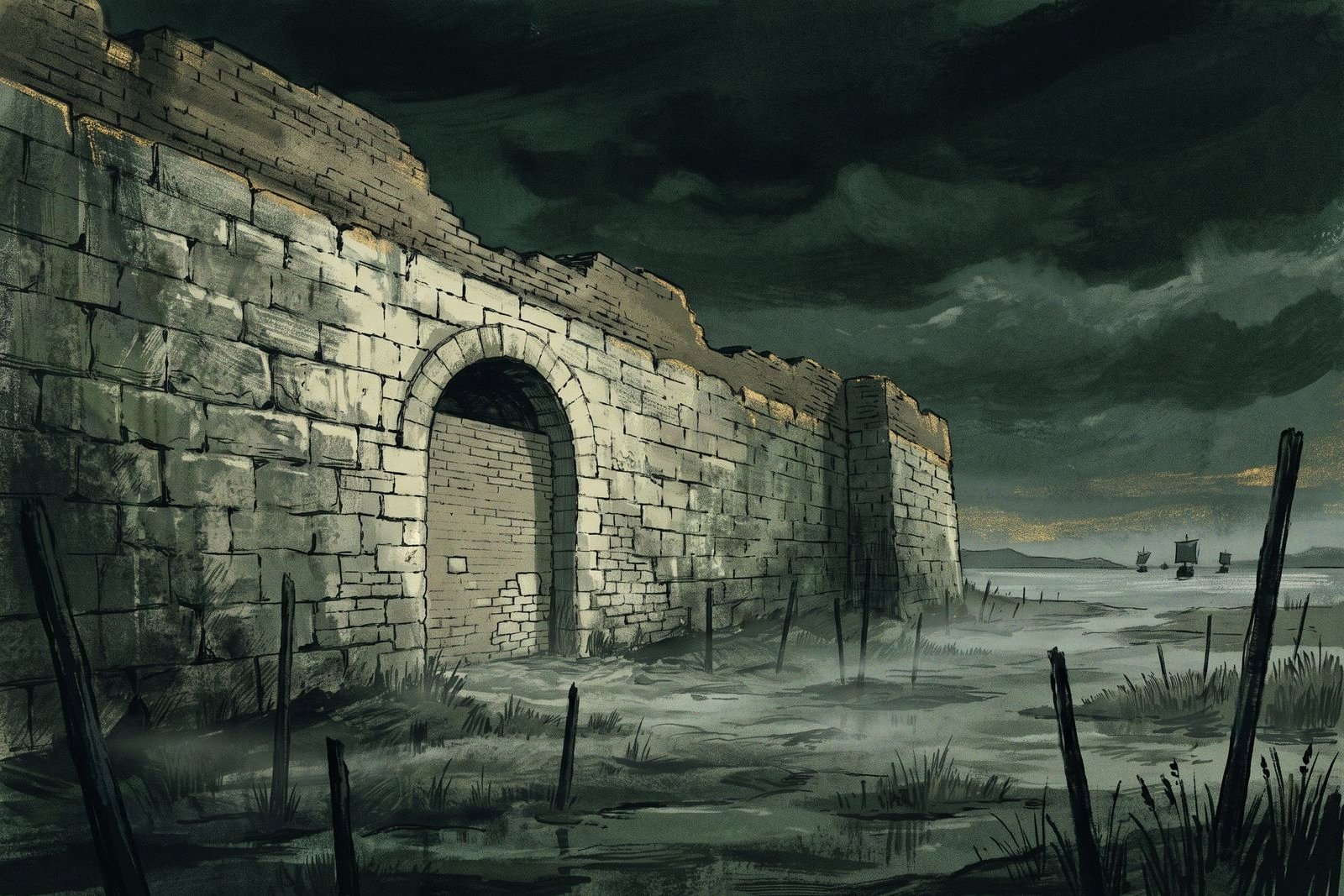
What breaks at Wilusa is an agreement. The captains anchored in the bay have no king over them, only a plunder-share sworn ten seasons back, and in the tenth summer it stops paying. The date of that summer is a convention and stays one: the modern brackets run from 1270 to 1190, and in this world no burnt layer was ever cut to narrow them.
c. 1180–1140 BCEThe Ships Stand Out of the Bay
On the wet flat by the Karamenderes, in an August with no wind, the crews are burning their brushwood shelters before dawn because they are leaving and will not be back for the poles. A third of them have the marsh fever. Their water comes from the river; the town's comes from the karst springs under the mound, which is the whole arithmetic of a blockade here. The weakest gate was bricked shut a generation ago and the curtain patched, so storming means street fighting inside a town built to be entered slowly, house by one-room house crammed into the old lane behind the wall. East, the Levantine coasts are opening and softening. The captains weigh a wall against a cargo. No named king decides it. The crews are Aegean-speaking, and that is a statement about language and nothing else. A later Greek audience calls them Achaeans on majority opinion, not on any document. No text in any archive records this siege at all.
Inside, survival is not victory. Zidanza, a bronze-caster of the lower town, spends that autumn taking fittings off the sanctuary doors and the gate faces, because the pithoi sunk to their rims in the floors have been drawn to the bottom and two sowings on the plain have been missed. Grain comes on credit through the client king of the Seha River Land and other creditors of the Hittite periphery, and an unburned town settles debt the only way it can: passage and anchorage rights in the Straits pledged and never redeemed, votive metal melted, dependents pledged, and the outer strips of the best alluvium signed over to the creditors' men. Kuwattalla, widowed in the sixth year, keeps the house and loses the field; her rent goes over the water thereafter to a man she never meets.
Hattusa sends nothing. No Hittite force has come here in three generations, not since the column dispatched after Manapa-Tarhunta's own attempt on Piyamaradu failed. The accommodation sworn about 1176 cites as precedent an old quarrel between Hatti and Ahhiyawa over Wilusa, amicably resolved, a clause that survives to us only as a restoration across a broken passage.
By the third winter Zidanza's brother Hulli has gone down the coast with the wheel-throwers, taking Grey Ware technique and bronze-working into Aeolian workshops, the same grievance the chanceries had recorded before. And several hundred ships' worth of unpaid men reach mainland harbours whose palaces were legitimate because they distributed. The mainland destructions keep their dates and change their shape.
The rent on the outer strips is still owed at the next harvest, and to a creditor whose grandsons will never see the plain.
c. 1140–600 BCEScrap, Thracians, and a House That Keeps Its Name
Zidanza's grandson works a walled yard by the south road, sorting broken weapons, gate nails and sling bullets by hand into baskets, and the sound of the tenth-century town is a hammer on cold metal at all hours. Tin has stopped coming. An intact town sitting on sorted scrap becomes the recasting yard of the northeast Aegean, and by 900 the yards are running bloomeries on charcoal off Ida, in direct competition with the shipwrights for the same woodland. The hillsides thin. Nobody plants any.
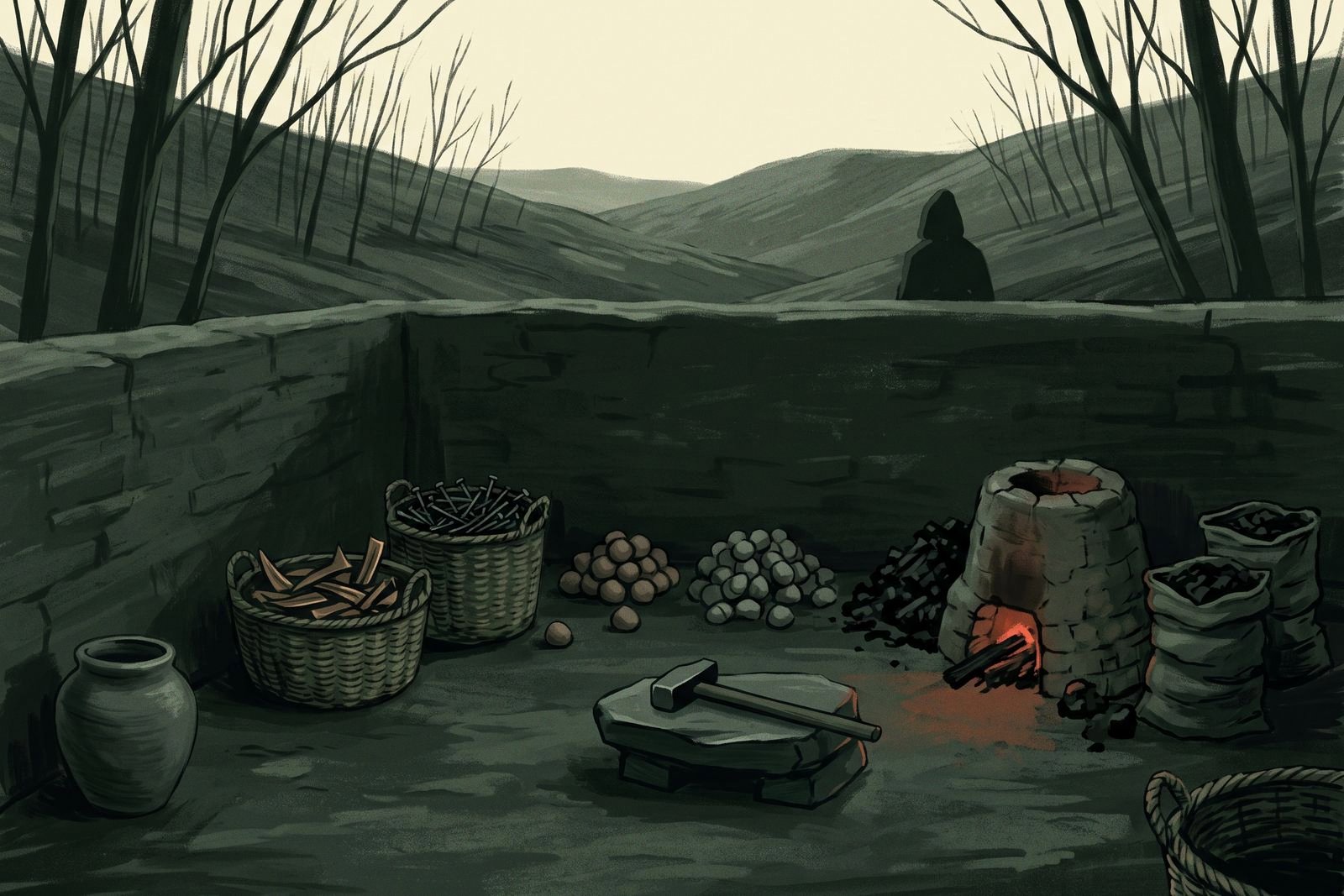
The lower town, some two hundred thousand square metres of it, had emptied by a third under blockade and debt. It refills from the north shore. Bithys, whose family crosses in the ninth century, works one of the pledged strips as a tenant of heirs in Lydia; the later Greek writers will call his kind Treres and Bithynians and describe the crossings as an invasion, which is not what a lease looks like from the furrow. The kaza economy sets in its long form: emmer and barley off the alluvium, wool and horses off the hills, tunny and mackerel runs cured in salt at the beach.
The house on the mound behaves as Hatti's southeastern vassals do at Carchemish and Tabal, though Hatti is gone. It keeps the dynastic name, the cult of the citadel goddess, the wall circuit, and a hinterland that later writers still call unusually large for the region. The kings claim to hold the lock of the Straits and levy water, anchorage and pilotage. Every shipmaster who can find another beach denies it, and the claim's modern estimate of a fifteen-thousand-square-kilometre territory is the king's own arithmetic, not an audited one. Hieroglyphic literacy survives in the seal habit, one of the biconvex bronze seals bearing a woman's name, and by 700 the place is trilingual by function: the chancery keeps Luwic, the villages speak Thracian, Greek is what you use on the beach with whoever has landed.
From 780 the Aeolians and later the Milesians arrive expecting a mound and find a state. They take upland and inland sites, or they hold treaty-ports at the river mouths on sufferance, with their own magistrates, paying rent and military service and holding no title to the plain, which has been in creditor hands since the siege. Periander does not arbitrate the Sigeion and Achilleion quarrel around 600; the resident power decides it in its own favour, both promontories kept as royal harbours with Greek tenants, and what survives in the literature is an Athenian complaint about the terms.
Then, from the seventh century, the kings begin cutting Greek letters beside their Luwic formulae, naming the land Wilusa and the citadel Ilios in the same text. Nobody will ever have to look for this city.
c. 660–405 BCEThe Sailing-Away
At the anchorage quarter, on a beach of drawn-up hulls and drying nets, a singer works through the wrath poem in the evening and it ends where it ends: the funeral of Hector, in the tenth year of a siege that is still standing when the last line falls. Nothing in it requires a fall, and what has no subject is the keystone of the Cycle. Where the Little Iliad and the Iliou Persis would sit, the rhapsodes carry an Apoplous, the sailing-away, and the Odyssey's tradition swells instead on returns, on quarrels over unpaid shares, on captains drowned coming home with nothing. There are sixty lines about a wooden horse nowhere in Greek. No potter paints a sack; the repertoire of the burning citadel, the dragged old man, the child thrown from a wall, simply does not exist to be painted.
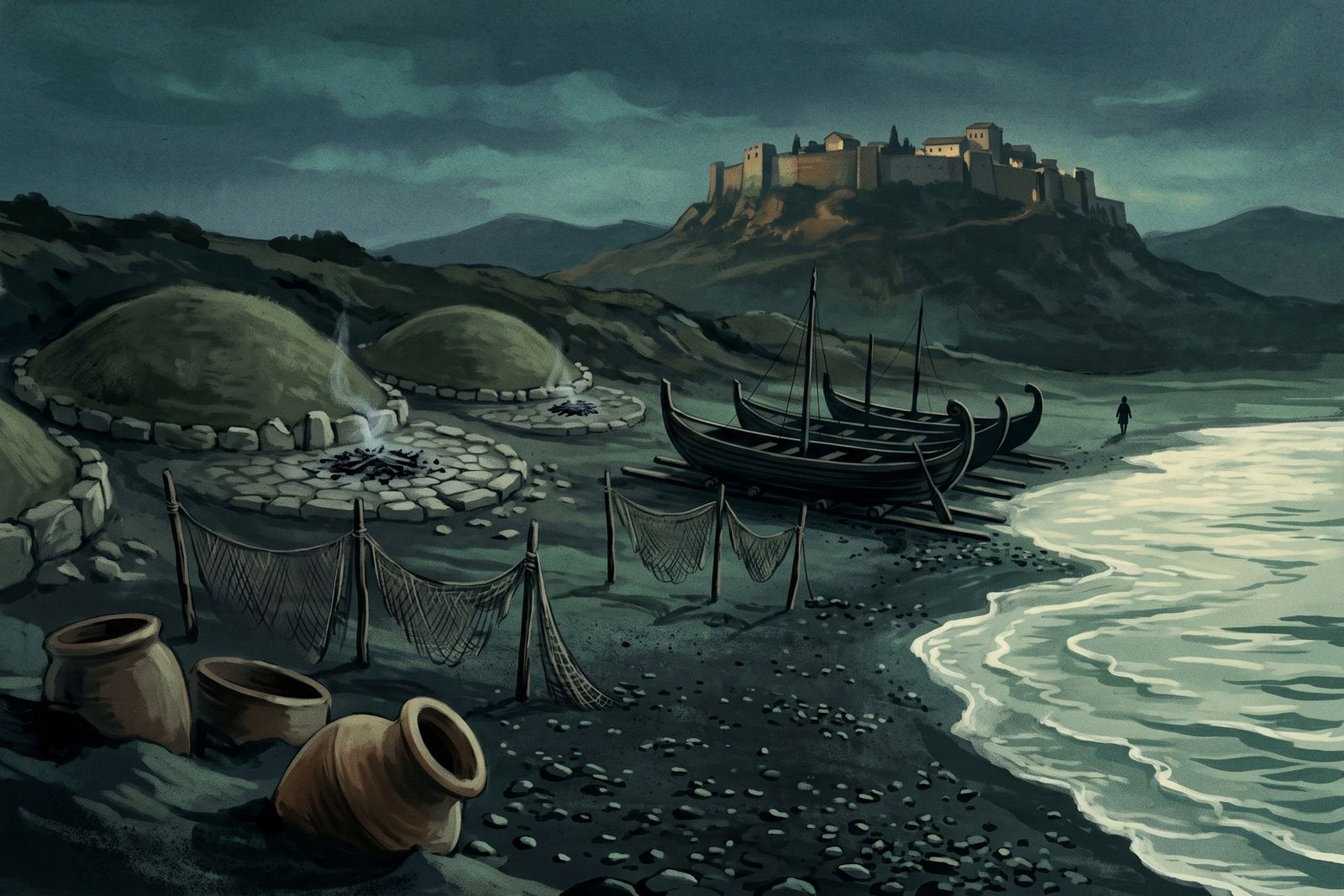
The shore tumuli become hero-graves of a failed coalition, venerated by Greek settlers within sight of a living city that denies the whole story and sings its own version of the summer the ships left. The prophecy at Iliad XX, that the line of Aeneas will rule the Trojans, is fulfilled at home: the Aeneadai reign in the Troad and at Skepsis, and the West's most portable refugee never travels.
Athens kills the men of Melos in 416 all the same and sells the women. What it does not have, the following spring, is a play about the women of a sacked city, because Attic tragedy never built that repertoire: no Troades, no Hecuba, no Andromache, and in the Agamemnon no captive prophetess. The theatre of annihilation is Theban, and the Persians is a norm rather than a famous exception.
After Sardis falls in 545 the Great King does with the Straits what he does with Caria: keeps the dynasty, takes the revenue. The house becomes a tribute-paying vassal of Hellespontine Phrygia, answerable for the crossings, and Xerxes' bridging at Abydos in 480 is negotiated with it, his sacrifices performed in the sanctuary of a subject city rather than in an abandoned grove.
The fifth-century consequence is fiscal and it lands on Piraeus. Athens' grain runs past a resident non-Greek toll authority behind a Bronze Age wall. Every spring the League must choose: assess it, subsidise it, garrison the far shore, buy the rights out, or besiege the thing, each option costed in talents and in ships held on station through the sailing season. The Hellespontine district is the largest and least stable in the phoros lists, and the ten per cent levied at the exit in 410 is collected in open competition with the dynasty's own dues.
In 405 the fleets fight in that channel under the walls, and the house sells water and pilotage to whichever side is winning that week. It has learned that the passage is worth more by the amphora than by the inscription.
334 BCE – 324 CEInviolable, Poor, Petitioning
In the spring of 334 a young Macedonian climbs to the citadel sanctuary, sacrifices to the goddess his Greeks read as Athena Ilias, exchanges armour, and grants the city freedom and immunity with a promise of greatness. He also declares the Bronze Age curtain inviolable, which is sound sense with the Persian fleet still at sea behind his line of march. The bricked-up gate is left bricked, as a relic, and the guides begin showing it that summer. Nobody proposes reopening a door closed against an attack that came and went eight centuries before.
Lysimachus is the one who hurts. After 301 his synoikism drains named Troad villages into Alexandria Troas, transfers their land revenue with them, and pulls dressed stone out of the outer circuits for the new harbour works. Bithys' descendants find their village on a list; the strip they have leased for six hundred years now feeds a mole twenty miles down the coast. Two towns then compete for one hinterland and one usable harbour, which is why a continuously inhabited royal site spends five hundred years being a modest place with a very large wall.
Rome's kinship with it was diplomatic long before it was literary: Hellanicus, the defection of Segesta in 263, the decree at Lampsakos in 196. None of it ever required a sack. The syngeneia survives into awkwardness: the mother city is a small Anatolian-Greek town with a Luwic-descended dynasty holding a competing view of the family tree, and it sends embassies asking for grain remission and a roof for the temple. After Magnesia the Senate grants freedom and immunity.
In 85 BCE Fimbria storms it. His men kill in the streets and the sanctuary, fire the lower town, and carry off what can be sold; the population that survives is scattered into the slave markets of the province. Because the place is a kin-state and not a ruin, the thing is prosecuted as sacrilege in Roman courts and argued for a generation, and the Julio-Claudians pay to rebuild what Fimbria burned. Rome also acquires, out of that argument, a legal pretext for intervening in Hellespontine affairs decades before Actium.
There is no Aeneid. Augustan epic takes the returns and the Latin foundation instead, with the Hesiodic strand making Latinus a son of Odysseus as its live rival, and Roman writers are left without the device that let them admire Greek civilisation while denying descent from Greeks.
Meanwhile the Skamandros prograded across the old embayment. By the first century the mound sits inland behind its own silt, and the maritime business is transacted at the Sigeion roadstead and at Dardanos, where Roman moles and warehouses go up.
In 324 imperial surveyors walk that roadstead with instructions to find a capital. The site their predecessors would have called poor and harbourless has three centuries of endowment and a stone quay.
324–717The Capital on the Plain
The masons laying out the new city work in a wheat plain in winter, and what they complain about, in the one letter that survives, is the water: it will have to come across open country on arches, because there is no Golden Horn here and no double narrows, only a broad mouth and a long shore. The capital is founded in 324, dedicated in 330, and keeps the ancient toponym. Byzantium is made its arsenal, customs city and second port.
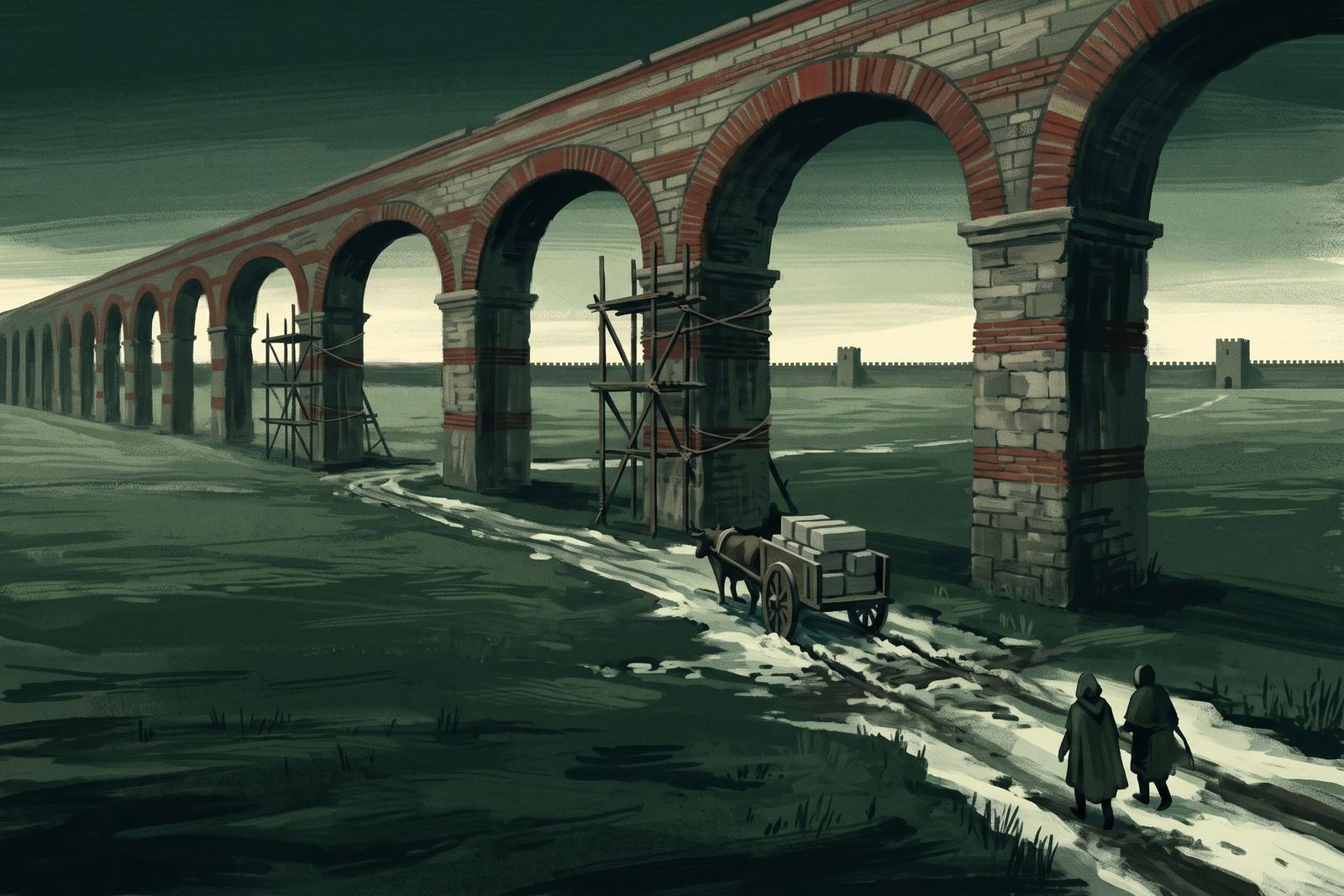
The archaic acropolis above it is not rebuilt but fenced as a venerated temenos, the circuit and the bricked gate preserved inside it, and an emperor sets a Latin inscription over the gate recording that Alexander ordered it kept. The fencing is why unburned Bronze Age floors survive at the citadel edge with a pavement over them.
The land wall completed in 413 has to be thrown across a plain with no flanking sea to anchor it. It is longer, dearer and thinner than anything the engineers would have built on a peninsula, and contemporaries say so in writing at the time.
The bill falls due between 615 and 626. Sasanian armies that had no way past Chalcedon in another world simply come overland here, and there is no water to stop them. The wall is turned in the second week. The lower city burns for three days. The churches are stripped, the imperial mausolea broken open, and the people of the capital are killed in the streets or roped out of the gates in columns toward Persia. This is the destruction of the largest city in the eastern Mediterranean and the killing or enslavement of most of the people in it, and the surviving accounts count the dead by quarters because no one could count them by name.
The court, the patriarch and the relics cross to Byzantium in open boats through the winter. Its walls are rebuilt under duress through the 620s and 630s, and the treasury pays in one generation what Constantine had declined to buy. When the Arab fleets come in 674 and again in 717 they break on the Bosphorus peninsula, its chain and its walls, exactly as recorded. The forced relocation saves the empire, and the founder's ancestral piety turns out to be the most expensive act of genealogy in history. Constantinople's biography begins three centuries late, as refugee property.
And the sack of Ilion happens after all, eighteen hundred years behind schedule, with named generals and dated dispatches, and becomes Christendom's master image of a fallen city.
717–1953The Refugees' Europe, and a Walled Kaza
In a Burgundian monastery a chronicler writing within living memory of 626 gives the Frankish kings an exile ancestry out of the ruined capital on the Straits, because the catastrophe is recent, documented and prestigious. Burgundian and later British houses follow; the Table of Nations and Jordanes' Gothic scheme carry the rest. There is no Dares and no Dictys, so the Latin West never acquires an eyewitness it can prefer to Homer: no Benoît, no Troilus, no Troynovant, no Hector among the Nine Worthies. Secular pedigrees are thinner and shallower everywhere, so kings lean harder on ecclesiastical donation and translatio for legitimacy, and the Church's grip on royal lands, tithes and immunities is measurably firmer for six hundred years.
The Ottomans cross at Gallipoli in 1354 and take the Bosphorus capital in 1453. At the Asian mouth they find a walled kaza with a customs post beside a ruin field. Mehmed's Straits programme of 1462 and 1463, Kilitbahir and Kale-i Sultaniye, absorbs the old wall and its dues; the mosque built at the customs post that decade sets its northeast plinth on a bricked gate jamb of unknown date, which the masons take for late Roman. The conquest's rhetoric runs on inheritance, Kayser-i Rum and the Second Alexander. The line about Asia avenging Troy upon Europe is never composed, because there is no crime for it to invoke.
The absences accumulate quietly in the dictionaries. No wooden horse, so no Trojan horse in software: the term of art is a mole program, and nothing gets called an Achilles' heel. A Cassandra who is right about an anticlimax and disbelieved, which makes a weaker figure of speech and a rarer one. Berlioz writes something else and Racine writes no Andromaque; on the map of North America nobody thought to put down a Troy or an Ilium, and no Trojan goes on a package.
The discipline pays too. There is no lost city, so there is no merchant with a gold hoard in 1873 and no founding spectacle for archaeology, no popular proof that the heroic age was material. The Homeric Question is argued with texts and no spade. Aegean prehistory begins in 1906 with the Boğazköy archives, which name Wilusa five times and never mention a siege. The identification the archaic kings cut into stone needs no defence, so the Karabel relief stays a footnote in the epigraphy of Mira, and Troad topography rests on a survey report of 1910.
In April 1915 the Anglo-French argument for the Asian shore wins on the strength of the town's roads, quay and rail spur, and the landing goes in at brigade strength. It fails on the same mines, the same broken ground and the same defence, at a heavier cost in men and lighters. Two shores fill with cemeteries.
The Greek quarter is moved inland that year for military security. In 1923 Lausanne makes the move permanent and mutual: families who had farmed the outer strips as tenants for eleven generations are put on boats with what they can carry, and Nazmiye, nineteen, arrives from Kavala into a house whose ovens are still warm in the wrong sense. Both sides are moved by treaty and neither is asked.
On 18 March 1953 the Yenice-Gönen shock flattens the mudbrick centre. The town is rebuilt in concrete on reused footings in a single season, ashlar from the circuit going into culverts and tea-garden walls, and three thousand years of quarrying finish at once. The new street over the mosque plinth is called Kale Sokak.
1953–2026Kale Sokak
Hatice, sixty-one, granddaughter of Nazmiye, farms eleven dönüms of the outer strips under a tomato contract, and what she needs in May is a street the lorries can use. The Karamenderes was drained and piped in the seventies; the ferry road, the quarry and the bridge across the mouth, open since 2022, keep the kaza near ninety thousand where a ferry economy would have emptied it. Her nephew commutes to Istanbul; the toll he pays is billed in euros against a lira nobody trusts, and the treasury covers the guarantee shortfall. The passage the archaic kings claimed to own is a directorate now, with pilotage advisories and convoy slots, and under Montreux it has carried no belligerent warship since February 2022, only grain hulls, gas carriers and tankers of uncertain ownership.
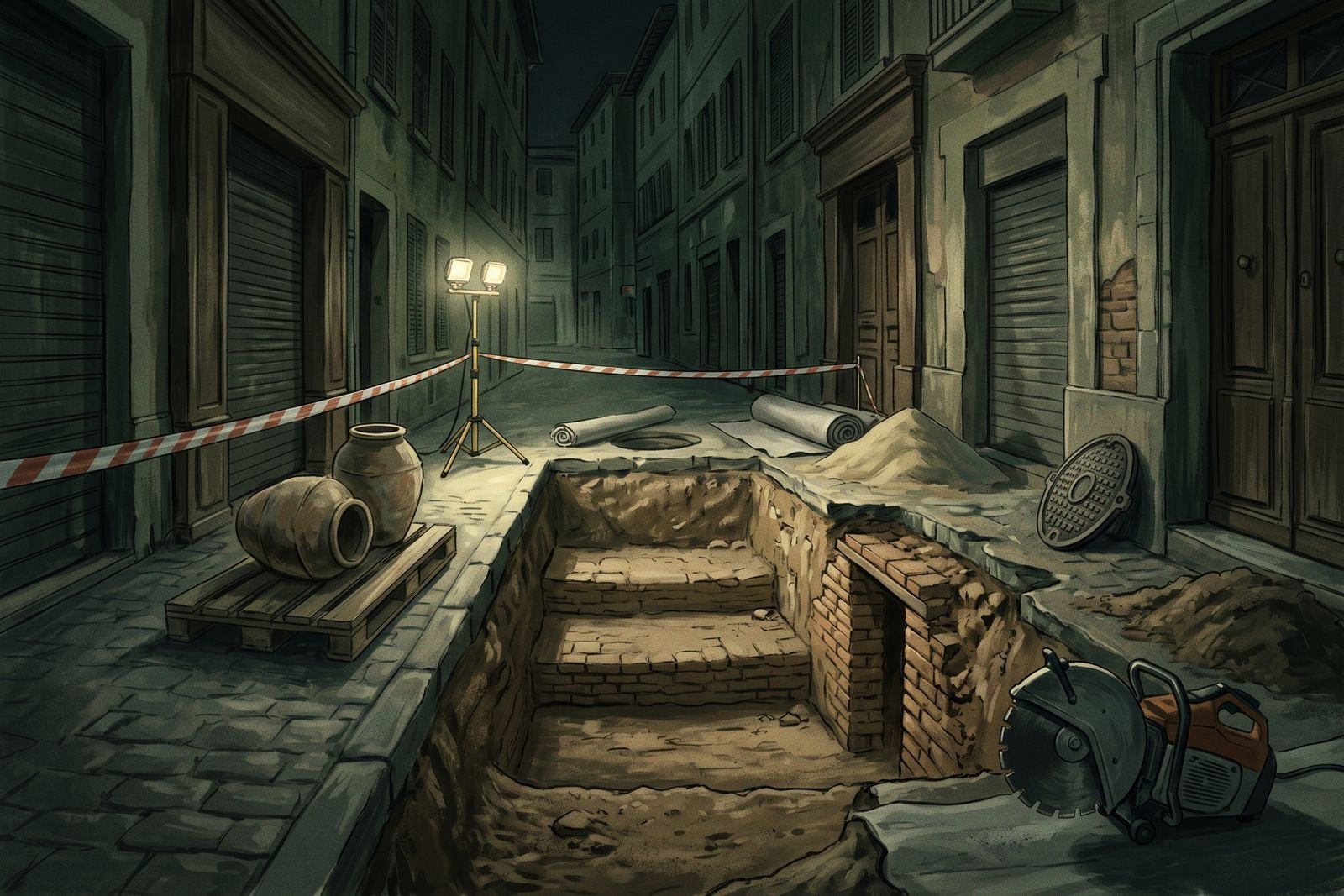
The 2023 building-code enforcement drove the renewal cycle, and the renewal cycle put a services trench under Kale Sokak last autumn. The contractor hit mudbrick: two and three levels of floors, unburned, a bricked jamb, storage pithoi emptied to the bottom, and a scatter of slingstones fallen from a parapet to the wall foot rather than stacked for use. No ash. No arrowheads in a burnt layer, because there is no burnt layer, and no bones in the street.
In April the conservation board rules under Law 2863: record it, do not open it. A fortnight of drawing and photogrammetry, the pithoi lifted, the jamb left where it is, geotextile and washed sand, asphalt by the second week of May. Bekir, whose grandfather set ashlar in the culverts in 1953, lays it. Two hundred slingstones go into three crates in the museum depot under a provisional accession number nobody has finalised. The ministry inspector and the opposition-run municipality argue jurisdiction for three weeks; the compensation case over the renewal blocks is adjourned to autumn.
The summer sounding is forty square metres, ministry permit, provincial and university money, no foreign institute; no foreign institute has a claim here. Grey Ware and handmade coarse ware of the sort known from Cyprus and southern Italy; continuous unburned occupation; four charcoal samples that calibrate across a century and a half at two sigma. The report says the deposit is consistent with prolonged blockade and will not diagnose more than that. It was a war the city did not lose, and it does not follow that it was the war. There is no stratified column in the northeast Aegean against which to date a floor closer than a century. Nobody ever needed to dig one.
In July the heritage file is re-scoped. The Bronze Age component is dropped on integrity, the circuit having been quarried from Lysimachus to Bekir's grandfather, and what goes forward is the ruin field of the first New Rome with the destruction of 626 as its nominated significance. The local paper runs the old quarrel as a planning story: whether the kings on the mound ever controlled fifteen thousand square kilometres, or a spring and a beach. In November a Munich auction of Troad bronzes and a Luwian-style seal clears with a formality letter and no lawsuit, since no gold was ever carried out of this district to teach the courts a template.
In September the delegation from Néo Ílion, outside Alexandroupoli, comes over on the island visa scheme and sits through the festival recitation of the Apoplous in Turkish verse, then hears it read in Greek. The cross-border grant that pays for the bilingual walking route between the 626 wall line and the Asian-shore cemeteries comes from the same cooperation budget that turns back the boats leaving the coast south of the kaza on calm nights.
Above the last street the acropolis is unfenced pasture inside its late-antique wall, and a schoolteacher shows visiting classes the bricked gate that Alexander is said to have ordered kept. She is probably right about the gate. The jamb underneath it, the thing that made the siege slow enough to fail, lies under new asphalt on Kale Sokak, and its position is marked by a manhole cover, so that the tomato lorries can pass.
1180The plunder league breaks in its tenth season and the ships stand out of the bay
The besieging force at Wilusa is not a royal expedition but a league of freelance captains of the Piyamaradu type, held together by a plunder-sharing agreement and nothing else; in its tenth season the agreement fails. Three things act together. The camp is pitched on the marshy Karamenderes flat and is sick, while the defenders hold the karst spring system under the citadel, which is what makes blockade survivable. The weakest gate has been bricked up and the curtain patched for a generation, so storm means street fighting for a town organised to be entered slowly. And the collapse horizon is opening richer, softer coasts east and west. The crews re-embark for Cyprus, the Levant and the western islands. No named king decides this; unnamed captains simply weigh a wall against a cargo. The date is a convention and nothing more: the same event is bracketed by modern scholarship between 1270 and 1190, and that bracket never closes in this world.
10 SOURCED CAUSES
1179An unburned town, two lost harvests, a debt paid in rights — and the crews who came home with nothing
Survival is not victory. The pithoi sunk to their rims in the floors are drawn to the bottom, two sowings on the plain have been missed, and grain is bought abroad through the client king of the Seha River Land and other creditors of the Hittite periphery. The debt is settled the only way an unburned town can settle it: passage and anchorage rights in the Straits pledged to the creditor and never redeemed; votive and fitting metal melted out of the citadel sanctuary and the gates; outer strips of plain land signed over to the creditor's men and to incomers; dependents pledged against grain. That leaves a permanent stratum of outside landlords on the best alluvium. Within three or four seasons the metalworkers and a group of wheel-throwers defect down the coast — the same grievance the Manapa-Tarhunta letter records — carrying Grey Ware technique and bronze-working into Aeolian and East Greek workshops, which is the only positive material trace an event with no destruction layer can leave anywhere. Meanwhile several hundred ships' worth of unpaid retinues reach mainland harbours whose palaces were legitimate because they distributed. The mainland destructions keep their dates and change their shape, and mobile crews go east and west earlier and in greater numbers than in the recorded sequence.
7 SOURCED CAUSES
1140Scrap, bloomeries, and Thracians in the empty lower town
With tin supply broken across the eastern Mediterranean, an intact town sitting on sorted scrap — fittings, broken weapons, the sling-bullet heaps of the siege — becomes the recycling and re-casting yard of the northeast Aegean, and by the tenth century a bloomery node, charcoal off Ida competing against the shipbuilding timber trade for the same woodland. The lower town of some 200,000 square metres, thinned by ten years of blockade and by debt emigration, refills from across the water: Thracian agrarian settlers of the sort whose crossings the later Greek sources call Treres and Bithynian, working the pledged outer strips as tenants of absentee creditors. The economy of the citadel is grain and emmer off the Karamenderes alluvium, wool and horses off the Troad hills, and the tunny and mackerel runs with salt-fish curing; anchorage, water and pilotage fees are a contested secondary line, and the claim to hold 'the lock of the Straits' is the ruling house's own, asserted in its inscriptions and denied by every shipmaster who can find a beach elsewhere.
7 SOURCED CAUSES
c. 900–760 BCEA Luwic dynasty of the Straits, on the pattern of Carchemish and Tabal
Hattusa is gone, but its northwestern vassal behaves as its southeastern ones do: the house on the mound keeps the dynastic name, the cult of the citadel goddess, the wall circuit and a hinterland that later writers will still describe as unusually large for the region. Hieroglyphic literacy survives in the seal habit — the same practice that leaves a woman's name on a bronze biconvex seal in the real post-fire layer — and is used for royal display on stone. By about 700 the polity is trilingual by function rather than by policy: Luwic in the citadel, the chancery and the sanctuary; Thracian in the villages of the plain and the hill pasture; Greek on the beach, in the anchorage quarter granted to captains and traders who pay rent and service for it.
5 SOURCED CAUSES
c. 780–600 BCEGreek settlement of the Troad meets a state, not a mound
Aeolian and later Milesian colonists arrive to find the best coastal position occupied by a functioning kingdom with a Bronze Age curtain wall. They take inland and upland sites, or they exist as treaty-ports on sufferance at the river mouths and roadsteads, paying anchorage, rent and military service, with their own magistrates but no title to the plain — whose outer strips have been in creditor hands since the siege debts. Because the mound is inhabited, none of it is available for the foundation legends that in the recorded world attach to an empty ruin. The Sigeion–Achilleion quarrel, which Herodotus has Athens and Mytilene submit to Periander's arbitration around 600, is instead decided by the resident power in its own favour: both promontories are held as royal harbours with Greek settlers as tenants, and the arbitration that survives in the literature is a Greek complaint about the terms.
4 SOURCED CAUSES
c. 700–520 BCEThe dynasty adopts the alphabet, and Ilios is never a lost city
From the seventh century the kings of the Straits inscribe in Greek letters beside their Luwic formulae, naming the land Wilusa and the citadel Ilios in the same texts. The identity that in the recorded world had to be argued from Hittite tablets, from historical geography and finally from Hawkins's 1997 reading of the Karabel relief is instead simply legible on stone from the archaic period onward, and Karabel is a footnote in the epigraphy of Mira. Two costs follow. Western Anatolian historical geography is settled by the 1910 surveys rather than by a re-reading in 1998, so the discipline never has that quarrel; and because nobody ever needs to search for a lost city, the mound is not excavated as a type-site. The Aegean Late Bronze Age therefore has no stratified northeast reference sequence, and in 2026 the chronology of the twelfth century is looser than in our world, not tighter — a ninety-year bracket that no ceramic column has been dug to narrow.
6 SOURCED CAUSES
c. 660–415 BCEAn Apoplous where the Iliou Persis stood; Attic theatre without captive women
The wrath poem survives close to recognisable: the Iliad ends at Hector's funeral in the tenth year of a stalled siege and never narrates a fall, so nothing in it requires one. What has no subject is the keystone of the Cycle. In place of the Little Iliad and the Iliou Persis the rhapsodes carry an Apoplous — the sailing-away — and the sixty lines on the wooden horse do not exist in the Odyssey, whose tradition swells instead on the returns, the quarrels over unpaid shares, and the shipwrecks of captains who came home with nothing. Iliad XX's prophecy that Aeneas' line will rule the Trojans is fulfilled at home: the Aeneadai reign in the Troad and at Skepsis, the West's most portable refugee never travels, and no Etruscan potter models Aeneas carrying Anchises. The shore tumuli are venerated by Greek settlers as the graves of a failed coalition — a hero-cult of failure conducted in sight of a living city that denies the whole story and sings its own song of the summer the ships left. Athens accordingly has no captive-women repertoire: no Troades in 415, the year of Melos, no Hecuba, no Andromache, no Cassandra in the Agamemnon. The theatre of the annihilated city is Theban, and the Persians becomes a norm rather than an exception.
4 SOURCED CAUSES
545–405 BCEPersia farms the passage; Athens must assess, subsidise, garrison, buy or break Ilion
After Lydia falls, the Great King does with the Straits what he does with Cilicia and Caria: he keeps the dynasty and takes the revenue, and the house on the mound becomes a tribute-paying vassal within Hellespontine Phrygia, responsible for the crossings. Xerxes' bridging at Abydos in 480 is negotiated with that house; his sacrifices are performed at the shore tumuli and in the citadel sanctuary of a subject city, not in an abandoned sacred grove. The fifth-century consequence is fiscal. Athens' grain artery runs past a resident non-Greek toll authority behind a Bronze Age wall, and the Delian League must choose every year between assessing it, subsidising it, garrisoning the opposite shore, buying its rights or besieging it — each option costed in talents and in ships kept on station through the sailing season. The Hellespontine phoros district is the largest and least stable, the tenth levied at the exit of the Straits in 410 is collected in competition with the dynasty's own dues, and Aegospotami in 405 is fought in that channel under its walls, with the local house selling water and pilotage to whichever fleet is winning.
3 SOURCED CAUSES
334–281 BCEAlexander declares the curtain inviolable; Lysimachus caps the town
In 334 Alexander does what his record has him do: he sacrifices to the citadel goddess, read by his Greeks as Athena Ilias, dedicates and exchanges armour, grants the city freedom and immunity and promises it greatness. The Bronze Age curtain is proclaimed inviolable and the gate bricked up before the siege is left bricked as a relic and shown to visitors; razing the strongest fortification behind his line of communication while the Persian fleet is at sea would have been perverse, and he does not. The demolition and depopulation belong, as in the recorded world, to Lysimachus: his synoikism after 301 drains named Troad villages into Alexandria Troas, transfers their land revenue, and pulls stone from the outer circuits for the new harbour works. Thereafter Ilion and Alexandria Troas compete for one hinterland and one usable harbour, which is why a continuously occupied royal site is nevertheless a modest place for the next five centuries.
4 SOURCED CAUSES
263 BCE – 14 CERome's mother city is a real address: poor, tax-paying and petitioning
The Trojan kinship of Rome is diplomatic long before it is literary — Hellanicus, the defection of Segesta in 263, the Lampsakos decree of 196 — and none of it ever needed a sack. So the syngeneia survives and becomes both stronger and more embarrassing: the mother city is a small Anatolian-Greek town on the Dardanelles with a Luwic-descended dynasty holding a competing view of the family tree, which sends embassies, petitions for grain remission and a temple roof, and is granted freedom and immunity by the Senate after Magnesia. Fimbria's sack in 85 BCE is therefore not a routine atrocity in a Mithridatic campaign but sacrilege against a living kin-state, argued in Roman courts and repaired by Julio-Claudian endowment; and Rome acquires a legal pretext for intervening in Hellespontine affairs decades before Actium. There is no Aeneid: Augustan epic takes the returns and the Latin foundation as its subject, with the Hesiodic strand making Latinus a son of Odysseus its rival, and an openly Greek-derived ancestry leaves Roman writers without the device that let them admire Greece while denying descent from it. Meanwhile the Skamandros prograded across the old embayment: the mound is inland, and the city's maritime business is transacted at the Sigeion–Achaeion roadstead and at Dardanos, with Roman moles and warehouses built there in the first century.
4 SOURCED CAUSES
324–413 CENew Rome is founded on the Straits and keeps the ancient name
Constantine's search for a capital begins, as the sources say it did, near Ilion and Sigeion, and the deterrent they report — a poor and harbourless site — has been removed by three centuries of imperial endowment to a kin-city and by the Roman harbour works at its outports. In 324–330 the new capital is laid out on the plain and the roadstead below the ancient mound, keeping the old toponym as its name; Byzantium becomes its arsenal, customs city and second port. The ancient acropolis is not rebuilt but fenced as a venerated temenos with the archaic circuit and the bricked gate preserved inside it, which is why undisturbed Bronze Age floors survive at the citadel edge. The costs are structural and permanent: no Golden Horn, no double narrows, water carried by aqueduct across open country, and a capital on the Asian shore with the whole Anatolian land route at its back. The land wall completed in 413 must be thrown across a plain with no flanking sea; it is longer, dearer and thinner than the Theodosian line of the recorded world, and contemporaries say so.
4 SOURCED CAUSES
615–717 CEThe sack of Ilion, and the most expensive act of genealogy in history
The bill for the site falls due in the Sasanian land campaigns. Persian armies that in the recorded world stopped at Chalcedon here have no water to stop them: between 615 and 626 the open-plain wall is turned, the lower city burns, the churches and the imperial mausolea are stripped, and the population is killed or carried off. The court, the relics and the patriarch cross to Byzantium, whose fortifications are rebuilt under duress through the 620s and 630s, and the treasury pays for in one generation what Constantine declined to buy. The Arab sieges of 674–678 and of 717 then break on the Bosphorus site exactly as recorded, on the same peninsula, chain and walls — so the forced relocation is the empire's salvation and the founder's ancestral piety the costliest genealogy ever indulged. Constantinople's biography is three centuries shorter and begins as refugee property. And the sack of Ilion happens after all, eighteen centuries late, with named generals and dated dispatches, becoming the Christian world's master image of a fallen city — the slot our world filled with the Iliou Persis.
3 SOURCED CAUSES
1462Europe descends from the refugees of the Second Rome; the Straits keep a walled kaza
Fredegar's chronicler writes within a generation of a real and documented catastrophe, so the West's one prestige ancestry that is neither Roman nor Biblical attaches to the refugees of the Hellespontine capital rather than to Priam's city; Frankish, Burgundian and later British houses claim exile lineages of 626, while the Japhetic Table of Nations and Jordanes' Gothic-Scythian scheme carry the rest. Dares and Dictys as we have them do not exist, so the Latin West has no pro-Trojan 'eyewitness' to prefer to Homer: no Benoît, no Troilus and Criseyde, no Troynovant, no Hector among the Nine Worthies. Secular pedigrees being thinner and more recent, royal legitimacy leans harder on ecclesiastical donation and translatio, and the Church's leverage over royal lands, tithes and immunities is measurably greater across the whole medieval period. When the Ottomans cross at Gallipoli in 1354 and take the Bosphorus capital in 1453, the Asian mouth holds a walled kaza with a customs post beside the ruin field of the first New Rome; Mehmed's Straits programme of 1462–63, Kilitbahir and Kale-i Sultaniye, incorporates its wall and its dues. The registers available to his Greek admirers are inheritance, Kayser-i Rum and the Second Alexander; the 'Asia avenging Troy against Europe' line of the conquest's rhetoric has no Bronze Age crime to rest on and is simply not written.
4 SOURCED CAUSES
1915A two-shore Gallipoli, a population exchange both ways, and an earthquake that rebuilds the town
The garrisoned district town at the Asian mouth — roads, quays, a rail spur to the quarry, and a late-Roman ruin field commanding the plain — supplies precisely the objective the Kum Kale diversion lacked, so the Anglo-French argument for an Asian-shore operation is won in the winter of 1915 and the landing is attempted in force in April. It fails on the same mines, the same broken ground and the same Ottoman defence, at a heavier cost in men and lighters, and the Çanakkale campaign is remembered on both shores, with two sets of cemeteries and, in 2015, a two-shore centenary. The Greek quarter of the town is moved inland for military security in 1915; Lausanne formalises the departure in 1923, and muhacirs from Drama, Kavala and Kozani are settled in the vacated houses, while the exiles found Néo Ílion outside Alexandroupoli. On 18 March 1953 the M7.2 Yenice–Gönen earthquake flattens the mudbrick centre; the town is rebuilt in concrete on reused ancient footings, ashlar from the circuit enters tea-garden and retaining walls, and three millennia of quarrying reach their conclusion in a single building season.
3 SOURCED CAUSES
1953A trench under Kale Sokak, and a town whose exhibits are the wrong catastrophe
Because no gold was ever carried out of the Troad in the 1870s — there was no unlooted lost city to loot — Ottoman export controls and republican antiquities law arrive later and weaker, more Anatolian material sits in European museums, there is no trophy-art dispute, and nothing on the mound is fenced. Karamenderes drainage and irrigation turn the district into contract grain and tomato country; the ferry road, the quarry, refugee-descended smallholdings and, after the bridge opened in 2022, commuting keep the population from draining away. The 2020s municipal renewal cycle, the grandchild of 1953, is what finally cuts a section: in 2024–25 a services trench under Kale Sokak clips the acropolis edge below the late-antique temenos pavement and Ottoman fill and exposes two and three levels of unburned floors, a bricked gate jamb, storage pithoi drawn to the bottom, and slingstones fallen from the parapet to the wall foot rather than stacked on a walk. It is consistent with a long blockade and diagnostic of nothing, and no ceramic reading dates it closer than a century — which is also why the tentative-list file has been stuck for years. The ministry inspector, the university, the shopkeepers' committee and a compensation claimant argue the point in three separate registers. Nobody has asked for the two hundred sling bullets: the museum's halls are 626 and 1915, and a section confirming a story no one ever doubted overturns nothing.
8 SOURCED CAUSES
2026The conservation council rules: record the trench, do not open it
The regional conservation board, sitting under Law 2863, refuses the university's request to widen the Kale Sokak cut and orders instead a fortnight of rescue documentation: the section drawn and photogrammetrically modelled, the two and three unburned floor levels sampled, the drawn-down pithoi lifted, the bricked gate jamb left in situ, geotextile and washed sand over everything, asphalt by the second week of May so the tomato lorries have the street before contract harvest. The roughly two hundred slingstones go into three crates in the museum depot with a provisional accession range. ANCHOR RULED — the post-2023 Kahramanmaraş building-code enforcement and the municipal renewal cycle it accelerated: UNCHANGED, since the divergence touches neither the fault nor the code; that programme is precisely what put a services trench through an acropolis edge no archaeologist had ever asked to dig. The opposition-run municipality and the ministry's inspector spend three weeks arguing jurisdiction; the compensation claimant's case over the renewal block is adjourned to autumn.
5 SOURCED CAUSES
2026One season, forty square metres, and a bracket that will not close
A joint sounding beside the temenos pavement — ministry permit, provincial and university money, no foreign institute, because there is no foreign institute with a claim here — confirms what the trench showed: continuous unburned occupation, wheel-made Grey Ware alongside handmade coarse ware of the kind known from Cyprus, southern Italy and the Greek mainland, no ash horizon anywhere in the exposure. Four charcoal samples calibrate to a span of roughly a century and a half at two sigma. The preliminary report's operative sentence is that the deposit is consistent with prolonged blockade and diagnostic of nothing. This is the structural cost banked three millennia ago: nobody ever had to search for this city, so nobody ever dug it as a type-site, and the northeast Aegean has no stratified ceramic column against which a floor can be dated closer than a century. There is no Blegen volume, no Cincinnati sequence, no $36.00 set of Troy IV in the library — the standard reference for Troad topography remains a 1910s survey report and the epigraphy of the archaic kings.
8 SOURCED CAUSES
2026The heritage file is re-scoped to the wrong catastrophe
At the World Heritage Committee's 2026 session the Turkish delegation carries forward the two-shore Çanakkale campaign landscape file — the process itself UNCHANGED, since nothing in the divergence touches the 1972 Convention or Türkiye's use of it — while the stalled İlyon nomination is quietly rewritten. Its Bronze Age and archaic component is dropped on integrity: the circuit was quarried continuously from Lysimachus to the 1953 rebuilding, its ashlar is in tea-garden walls and culverts, and the acropolis is grazed, unfenced pasture. What remains in the file is the ruin field of the first New Rome and its open-plain land wall, with the destruction of the 620s as the nominated significance. The province's own tourism literature follows: the town markets a sack it can date to the month and a landing it can date to the hour, and keeps a single case of pottery labelled with a two-century range.
3 SOURCED CAUSES
2026The lock of the Straits is a fee schedule and a euro-denominated toll
The passage the archaic kings claimed to own is administered by a state directorate: compulsory pilotage advisories, tanker convoy scheduling, and the Montreux regime — UNCHANGED, no driver touched — under which the Straits have been shut to belligerent warships since February 2022, so the channel below İlyon in 2026 carries grain hulls, LNG and shadow-fleet tankers and no cruisers. The bridge across the mouth, open since 2022, still bills its guaranteed passages in euros against a lira that has lost most of its purchasing power since 2021, and the treasury still tops up the shortfall; the district argues about that in the same breath as fertiliser prices. Commuting to Çanakkale and to Istanbul over the bridge keeps the kaza's population near ninety thousand where the twentieth century's ferry economy would have drained it. The ferry remains cheaper and slower, and the pier queue on Friday evenings is the town's real census.
3 SOURCED CAUSES
2026Néo Ílion comes over on the visa scheme; the Apoplous is recited on both shores
The Greek–Turkish thaw dated from the 2023 Athens Declaration holds: UNCHANGED, because it rests on earthquake diplomacy, migration management and trade, none of which this divergence reaches. Its local content is divergent. The island visa-on-arrival scheme and a cross-border programme grant co-fund a bilingual walking route linking the 626 wall line to the Asian-shore 1915 cemeteries, and the September delegation from Néo Ílion outside Alexandroupoli — descendants of the quarter cleared inland in 1915 and formalised out in 1923 — sits through the municipal festival's recitation of the Apoplous, the poem of the summer the ships gave up, in Turkish verse, with a Greek text read after it. The uncomfortable half of the two-shore programme is the coast south of the kaza, where boats still leave for the Greek islands most calm nights, and the same coastguard cooperation that funds the route interdicts them.
3 SOURCED CAUSES
2026A world of displacement stages Persians and Antigone, because the other play was never written
The touring and workshop theatre that in our world reaches for captive Trojan women — for Syrian, Ukrainian and Gazan displacement alike — has no such vehicle here: the Cycle's keystone has no subject, and Attic tragedy never built the repertoire. The 2026 season in Istanbul, Athens and the festival circuit is therefore the Persians (a norm, not an exception, in this tradition) and an enlarged Theban cycle; the anti-war canon is about besiegers who fail and cities that survive their own bad decade. Classicists argue what they call the Apoplous problem — why an epic tradition that could sing a ten-year siege never sang a fall — in the register ours reserves for historicity. The wars of the 2020s and the Syrian returns since December 2024 are UNCHANGED; only the texts held up at the vigils differ, and the town's own festival poem is one of them.
3 SOURCED CAUSES
2026A Munich sale of Troad material passes with a letter and no lawsuit
A European auction of Grey Ware, bronze fittings and a biconvex Luwian-style seal from a nineteenth-century private collection goes through after a formality note from the Turkish ministry. Türkiye's restitution campaign continues UNCHANGED for Pergamene and Lydian material, where documented removals give it a case; it is ALTERED here for want of a precedent, because no gold was ever carried out of the Troad in the 1870s — there was no lost city to loot — so export control and antiquities law arrived later and thinner in this district, more of it left, and no trophy dispute ever taught the courts a template. The visible consequence in the kaza is that nothing on the mound is fenced, metal-detector prosecutions are rare and local, and the museum's Bronze Age acquisitions come mostly from confiscations at the bus station.
3 SOURCED CAUSES
Every one of these worlds was weighed against the one you have just read. Here is where each of them breaks.
The siege is lifted and the city empties anyway, the mound abandoned within a generation and the world back on its familiar course by 1100 BCE.
We weighed it because the whole eastern Mediterranean is under strain in these decades, and a small Anatolian town might simply have been carried off by that current. It breaks in the two generations immediately after 1180, on the evidence of the mound itself: after an actual general fire, rebuilding began at once on the same wall lines, with seals still in circulation and imports still landing. A town that keeps its curtain, its full storage jars and its karst springs has strictly better odds than one that has just been stormed and burned. The road was defensible, and we set it aside because it is a smaller world than the one this hour owes its reader: the divergence would have been absorbed before anyone downstream could feel it.
Wilusa emerges from the lifted siege as a sea power, its kings taxing and policing the Dardanelles as a great state of the twelfth century.
We weighed it because the position is genuinely a lock, and a town that wins a siege looks like a town about to expand. It breaks in the twelfth century on money rather than on arms: the traffic that made the Straits worth holding is exactly what disappears with the palace systems, and the Mycenaean imports thin out to nothing in the same decades. A dynasty with no shipping to tax is a dynasty with a wall and a spring. We kept the amplitude and moved it four centuries later, into the Iron Age kingdom that runs recasting yards on scrap and claims dues nobody can enforce, which is both truer to the material and better to watch.
The surviving city hellenises on the schedule our world's ruin followed, bilingual by 750 BCE, Greek-speaking by 650, an ordinary Aeolian town by the sixth century.
We weighed it because that is what happens along this coast, and the temptation to keep a known outcome is strong. It breaks across the decades from 780 to 650, when the Aeolian and later Milesian arrivals reach the Troad: in our world they find an empty mound available for settlement, and here they find a functioning dynastic state that holds the plain and the cult. The force that keeps the native register alive is institutional, not sentimental, since Luwic was still being written in the fourth and second centuries, Lycia turned Greek only after the 330s, and Strabo records four languages in use at Cibyra in the first century BCE. A walled house with a chancery, a seal habit and an unbroken citadel cult is the last place a language dies, so we let the kings cut Greek beside their own formulae from the seventh century instead of surrendering to it.
Alexander, sacrificing on the citadel in 334 BCE, orders the Bronze Age curtain pulled down as a quarrel formally closed.
We weighed it for a single evening and dropped it on three grounds. It invents an act against a public record that survives in some detail, the sacrifice, the exchange of armour, the grant of freedom and immunity and the promised temple. It is also militarily absurd in 334 and 333, with the Persian fleet still at sea and Memnon operating behind the Macedonian line of communication, which is precisely when a general leaves a standing wall standing. Beyond that, the demolition existed only to clear a path to a later beat about a town with no ruin to sell, and the Troad already has a documented demolisher and resettler in Lysimachus after 301, whose synoikism does the damage we needed.
A Hittite relief column marches into the northwest and lifts the siege itself, on the precedent of the operation that Manapa-Tarhunta's letter records.
We weighed it because it is the one Hittite move against Wilusa for which any text survives at all. It breaks at the divergence, in the 1180s: Hattusa's authority in the northwest is intermittent and mediated through client kings, its reach is slower than the trouble it answers, and the column sent after Piyamaradu in the earlier episode of this quarrel failed. By this decade the Hittite state is at the end of its own resources and sends nothing anywhere. It would also hand the grammatical subject of the hour to an imperial army, when the thing that actually gives way here is a plunder-share sworn among captains with no king over them.
Rome never claims Trojan descent at all, its foundation genealogy rerouted through Diomedes, Philoctetes and Evander alone.
We weighed it as the clean cut, and the record refuses it: the kinship is diplomatic long before it is literary, present in Hellanicus, operative in the defection of Segesta in 263 and in the decree at Lampsakos in 196, and at no point in those two centuries does it require a sacked city. Deleting it also changes very little, because Europe simply substitutes other pedigrees and the third and second centuries reconverge within a generation. Survival is the more divergent road: a mother city that is alive, small and petitioning the Senate for grain remission and a roof for its temple, with a Luwic-descended dynasty holding a competing view of the family tree. We kept the strand that makes Latinus a son of Odysseus as its live rival rather than its replacement, and the price is an awkward kinship the Romans have to argue in court after 85 BCE.
The hexameter tradition never produces the Iliad we have, crystallising instead around the returns and losing the wrath poem entirely.
We weighed it and found it an unpaid step. The poem of the wrath ends at Hector's funeral, in the tenth year of a siege still standing, and it never narrates a fall; the wooden horse is not in it. Nothing in a lifted siege forbids that poem, so removing it in the eighth and seventh centuries would be a cost with no cause. The surgical version does more for less: the Iliad stands, the Little Iliad and the Iliou Persis have no subject and are replaced by an Apoplous, and by the fifth century Attic tragedy has never built the captive-women repertoire, so Athens kills the men of Melos in 416 with no play about it the following spring.
Constantine founds his capital at Byzantium exactly as he did, the surviving city on the Dardanelles noted in a line and left behind.
We weighed it longer than any other road here, and it is the one place where keeping our world would have cost us most. The reported reason he abandoned his start near Ilion and Sigeion in the 320s is that the site was poor and harbourless, and three centuries of kin-city endowment, Roman moles and warehouses at the Sigeion roadstead and Dardanos remove exactly that reason. Waving the surveyors past a stone quay while listing the twentieth century as unchanged is convergence with nothing holding it up. The road was defensible and we took the other one, because a capital founded on the plain in 324 is the hinge that carries the rest of the hour.
The empire splits the difference from 330: coronations, dynastic tombs and the ancestral temple on the Straits, with the administration, the fleet and the customs staying at Byzantium.
We weighed this as the elegant compromise and rejected it as the lesser of two workable roads. It buys ceremony and some fine detail, and between 330 and the 620s it moves no event whatever, because the walls, the fleet and the treasury remain where they always were. The full foundation on the plain buys the same detail and then a land wall thrown across open country in 413, a Sasanian army that comes overland in 626 with no water to stop it, and a court crossing to Byzantium in open boats. That is what gives us Europe's master image of a fallen city and a medieval genealogy market rewired around a catastrophe within living memory.
The Roman East is annihilated outright in the 620s, with no relocation, an Islamic frontier on the Thracian plain by 700 and nothing recognisable after it.
We weighed it and set it aside, not for caution but for a missing premise. The advantages of the Bosphorus site, the peninsula, the chain and the narrows, are precisely why a court under duress ends up there in the 620s and 630s, so annihilation requires the further assumption that the Heraclian state could not move two hundred kilometres, and nothing supports it. It would also cut the ground from under everything after 700 and leave thirteen centuries to be invented from nothing. What we kept is the bill: the walls rebuilt under duress in one generation, and the treasury paying what Constantine had declined to buy.
The lifted siege of 1180 BCE reaches into the twentieth century, redrawing NATO membership, the coups, Cyprus in 1974 and the currency crises.
We weighed it because the alternative looks like a failure of nerve, and we could find no chain of cause running from a Bronze Age withdrawal to the 1950s or 1974. Manufacturing one would have been a worse fault than the convergence it was meant to cure. We banked the divergence instead where drivers genuinely exist: a heritage law with no 1873 gold hoard behind it and therefore no template in the courts, a 1915 landing that goes in on the Asian shore and fills two coasts with cemeteries, a customs lineage on the Straits that runs from archaic dues to a modern directorate, and a town whose ruins are all of the wrong catastrophe. The price is that the twentieth century looks familiar in its headlines and strange in its paperwork.
The trench under the modern street becomes a global sensation, the town that finally proved the poem right.
We weighed the reversal and it fails on what this world already knows. From the seventh century BCE its own kings cut the name of the city into stone, and the epic tradition here always said the ships sailed away, so by 2025 there is no contested proposition for forty square metres of unburned floor to settle. The sharper form of the same turn survived and we used it: the place is full of ruins and pilgrims, none of them Bronze Age, the heritage file goes forward on the destruction of 626, and the only physical trace of the siege the poem describes is two hundred slingstones in three crates under a provisional accession number.
The hour turns on an invented crime or an invented sentence: a captain's treachery in the bay, a king bought, words placed in Mehmed's mouth or Kritoboulos's.
We weighed nothing here, because we do not do it, and it turned out we never needed to. Every hinge in this hour is carried by terrain, institutions and offices: the withdrawal of the 1180s by a plunder-share that stops paying in its tenth season, the fall of 626 by the absence of a peninsula and a wall too long to hold, the absorption of the old circuit in 1462 and 1463 by a fortification programme and a customs post. The one place the temptation was real is the Ottoman conquest, where our world offers a line about Asia avenging Troy upon Europe. In this world there is no crime for that line to invoke, so we left the silence in the open rather than fill it.
Everything before the hinge rests on these readings. Under each title, the passage retained.
- Troy VII (ca. 1300-1050 B.C.) — Interactive Map Troy, Archaeology Magazine
up to three feet of blackened debris covers the site
- Manfred Korfmann, 'Was There a Trojan War?', Archaeology (2004)
several armed conflicts in and around Troy at the end of the Late Bronze Age
- Was There a Trojan War? — Archaeology Magazine
all circumstantial evidence points to armed conflicts around 1200 B.C.
- Troy and the Trojan War: Archaeology, History and the Epic Traditions — Mycenaean Greece and Homeric Tradition
human bones lay unburied in the streets just inside the South Gate and also in two of the houses
- Lesson 27: Narrative — Aegean Prehistoric Archaeology (Dartmouth)
Blegen began by arguing for a date of ca. 1240 B.C. but later raised this to ca. 1270.
- Talanta XLVI–XLVII (Burgersdijk, Stronk, de Weerd, eds.)
The VIIa layer dates to 1300-1190 BC (LH IIIB-IIIC transition) and ends with a destruction
- The Trojan War: History or Myth? — Judith Starkston
The most vulnerable of the gates into the citadel was walled up
- Stratigraphic Phases of Ancient Troy — Madain Project
Large storage jars (pithoi) buried in floors suggest preparations for siege or stockpiling.
- Was the Trojan War Real? What Archaeology Actually Found at Troy
bronze arrowheads and sling stones scattered in patterns consistent with siege warfare
- Troy Was Real. Here Is What the Archaeology Actually Shows.
rooms subdivided, storage jars sunk into floors, signs of overcrowding
- New Troy Excavation Yields Fresh Evidence of Epic War — Ancient Origins
burned ruins, broken weapons, and human remains buried in haste
- Review of Blegen et al., Troy: Settlements VIIa, VIIb and VIII — American Historical Review 64.2 (1959)
Princeton University Press for the University of Cincinnati. 1958. Pp. xxvi, 328; xxviii, 380 plates. $36.00 the set.
- F. H. Stubbings, review of Troy vol. IV — The Classical Review 9.3 (1959), 278–280
Princeton: University Press (London: Oxford University Press), 1958. Cloth, 288s. net.
- Alaksandu Treaty — Wikidata (catalogue entry, CTH 76)
applies to jurisdiction · Wilusa ... catalog · Hittite texts · catalog code · CTH 76
- Wilusa (Wilios/Troia): Centre of a Hittite Confederate (academia.edu)
addressed 23 times in the text, which comprises 21 clauses, as 'Alaksandu'
- J. D. Hawkins, 'Tarkasnawa King of Mira', Anatolian Studies 48 (1998)
This can be shown to give the name of Tarkasnawa, King of Mira
- Hittite Monuments — Karabel
Hawkins, J.D. 'Tarkasnawa King of Mira,' AnSt 48, 1998: 1–31.
- Karabel relief and hieroglyphic Luwian inscription (Koç University Digital Collections)
Tarkasnawa, King of Mira (land). (Son of) Alantalli, King of Mira land.
- Migration and Integration at Troy from the End of the Late Bronze Age to the Iron Age
attesting to limited habitation by some survivors of the destruction
- Alaksandu — Wikipedia
a king of Wilusa who sealed a treaty with Hittite king Muwatalli II ca. 1280 BC
- Manapa-Tarhunta letter — Wikipedia
The letter is particularly notable for its mention of Wilusa, generally identified with Troy.
- Manapa-Tarhunta — Wikipedia
CTH 191 Letter from Manapa-Tarḫunta to the Hittite king
- Piyama-Radu — Wikipedia
a notorious local troublemaker called Piyamaradu is harrying Wilusiya
- Tawagalawa letter — Wikipedia
the Hittite king refers to former hostilities between the Hittites and the Ahhiyawans over Wilusa
- Late Bronze Age Troy — Wikipedia
Older structures were again reused, including Troy VI's citadel walls.
A life in this world — an archival fiction
MEASURER, HOUSEHOLD
The office is made by a shortage and ends with it. It is filled out of the trades that have no work while the shortage lasts, which in the towns of the Straits means chiefly the potters, and above all the makers of sunk jars, since nobody commissions a floor jar in a year when there is nothing to put in one. What follows is the work as it was taught, in the second person, that being the manner of the instruction. The recensions differ in small things. The measurer named in the fuller one is Kukkunni. The women of his household are not named, which is usual, and neither is his son.
I. THE ROUND
You go up before light, because the first of them will be at the door of the store before light, and because it is better that they find you already there with the stone off the lid than that they watch you walking up the lane.
You take the north lane, past the gate that is walled. The brick in it is newer than the stone on either side and a different colour, so that even in the dark you would know where you were by the change under your hand if you trailed your fingers along it, which you do not, being a grown man. The boys have scratched at it at shoulder height, the way boys will scratch anything soft that stands still. Nobody has ever said anything to you about the gate and you have never said anything about it to anyone. It is a wall now. You go past it.
At the store you lift the stone off the wooden lid and set it down where you set it down every day, not on the lid, on the floor beside it, because a stone put back on a lid you are still opening is a stone that comes down on your fingers. The lid comes up. The clay on the rim carries the household woman's seal, pressed twice, the two round faces of it with the signs in the middle. You break it with your thumb. You cannot read the signs and there is no reason you should. The sign is not for you. It is for whoever might come in the night, and it does its work by being there.
The grain is two hands deep. It has been two hands deep since the spring and it will not be more than three before the boats come up.
You take the scoop by the notch. The lip is notched at the level, and you fill to the notch and no further, and you level it with the flat of your hand and not with your thumb, the way you were shown. The tokens sit in two bowls. You move one token from the full bowl to the empty for every scoop that leaves the jar, and at the end of the round the empty bowl tells you what you have done, and the steward counts it against his own count, which he keeps in his head and which has never once come out short of yours.
They come in the order they come in, which is the order of the lane, and you serve them in it and do not make favourites, and if a woman comes twice you say so out loud, kindly, so that the ones behind her hear that it is said and not that it is muttered.
Before the second of them is served, you say the sentence. You say it early. You say, my boy was on the parapet with a bow when it happened. You say it while the scoop is going down, so that it does not sound like a thing you came to say. The first of them will have heard it, and the second, and the third, and it does no harm. A house measured out to by a man who lost his boy that way is a house that has been measured out to properly. It goes up the lane ahead of you like a token already moved. You do not have to carry it yourself.
Then you put the lid down, and the stone on the lid, and you go down and the day is your own.
The compilers note that the measurer did not hold the seal. He broke it, and the woman of the household set it again in fresh clay at evening. That was the whole of the arrangement.
II. THE PIT AND THE SHED
In the afternoon you go down to the pit, out through the lower town, and there is no dignity in the walk so you may as well take it slowly.
The lanes near the springs are lived in, and the lanes near the gates, and after that it is gardens. Pens where there were doorways. Thistles as high as a boy. Your cousin's house was the third along from the well and there is a fig there now and somebody's goat tethered to it, and the goat is not your cousin's, and you have stopped saying whose it should be, because the saying of it makes you the sort of man who says such things.
The pit has cattle tracks puddled through it, deep ones, filled brown, and the thorn fence has a gap in it wide enough to drive through and has had since the season the herd was cut out off the plain. You mean to mend it. Mending it is two days and a boy, and the two days you have, and the boy you had.
The clay is good clay. It has always been good clay. It comes up grey and works up grey and there is nothing wrong with it that a sieve does not fix.
Nobody has ordered a sunk jar in six years. That is not the clay and it is not the work, the work being the same work it was. It is that the people who have come in off the plain and the shore keep their grain in sacks and baskets, like people who expect to be moving again, and that the houses that could pay for one have got mean, and a man who has been mean once finds it easy after.
In the shed there are forty-one bowls from the second firing, and thirty have gone out of true at the rim, and eleven are worse than that. The kiln has never done this before. It did not do it when the men who knew the draw of it were here, and they are not here, they went off to a coastal court for a house each and their keep, and a word went to the Great King's chancery about it and a word came back, and they are still there. There is a sentence out of Hattusa that everyone in the lane can say by heart, and they say it at each other across doorways when they want the last word about grain, and it has not fetched one potter home. So you have a kiln that was set by men eating another man's mutton, and forty-one bowls, and thirty of them will hold water and eleven will hold ash.
The shore woman is at her door as you come by with two of them under your arm, scouring a pot with sand. Handmade thing, black with the fire, lugs on it like ears. She has three children in the yard and a fourth on her hip and the whole family smells of salt fish, which is what they do, they take fish down to the beach when the boats water there.
You put the two bowls up on the wall for her. Second quality, you tell her, and I am telling you so, and the price is what second quality is.
She takes them and turns them and puts a thumb in the rim where it dips.
Water, she says. They would do for water.
They would do for anything, you say.
Not on the fire, she says. It sits in there, that shape. It wants a flat.
And she names what she will give, and it is a day's labour for the pair, which is not far off insult, and you take it, because eleven of the forty-one are ash-holders and she is not the one who warped them.
Then you tell her, at some length, what has happened to people's taste. You say it civilly. You say that in your father's day nobody would have put a wheel-made bowl and a pot rolled up by hand on the same shelf, and that a pot rolled up by hand is what a woman makes when there is no potter within a day's walk, and that there are potters here, and that people have come in from the plain and the shore in these last years with their own way of doing things and have not troubled to learn ours, and that this is a matter of manners.
She goes on scouring while you say it. She says, this one cooks well.
The compilers append the customary paragraph on second-quality ware. Warped stock from a second firing was sold from the shed at between a third and a half of the shed price for first quality, or exchanged at the door for a day of labour, fish, or a fleece in poor condition; it went for water, for dry goods, for pens and byres, and in the poorer lanes for everything. The handmade pots that appear in the same houses from about this period were not cheaper than the shed price by very much. They were cheaper by a day.
III. THE SMITH
The lump is owed you. You swept the metal for it yourself with the rest of them, at the wall foot, the season after, arrowheads and the small stuff off the slings, and you carried it in seconds of your own firing as the makeweight, and the smith said a lump.
He has half of it ready and a hand on it and reasons for the other half, and the reasons are three. One, the crucible. Two, a man in the citadel with a claim ahead of yours and a seal behind him. Three, and he comes to this one last and quietly, the metal was not as clean as it looked and there was more slag off it than either of you would have thought, which may even be true.
There is a bitch in his yard that will not look at you (she looks at everybody else).
You stand there with your hand out and the half in it, warm from where his hand was, and you say that it is for your daughter's portion.
Ah, he says. Winter?
Winter.
Good, he says. Good. Then he says, and it is kindly meant, it is meant as one man setting a thing gently in front of another, he says: you had it hard, that year. That was the year they carried your boy out of the lane. Third month, was it. There were four out of that lane in the one week.
He is holding the tongs. He has stopped work to say it.
My son was on the parapet, you say, with a bow, when it happened.
And he says, ah. And he nods, and he turns the tongs over, and he lets it stand. He was carrying himself that week, that lane and the next, everybody was carrying, and a man who was carrying does not argue with a man about where a boy was standing.
You go from there to the priest with a piece off the daughter's portion.
You go because a death like the one you say it was wants offerings said over it in the second year and the fifth, and you have said them in the second, and you are not going to be the man who did not say them in the fifth, and they cost metal, and the metal is not lying about anywhere except under the corner jar.
You weigh out what is right. It is not a lot. It is enough that when you put the rest back you can feel where it is gone.
The compilers record here the contested paragraph. Some hold that offerings of this kind, at these intervals, were customary throughout the standing towns for men dead in arms; others hold them a local excess of the Straits, taken up in imitation of the citadel houses by families with no cause for them, and note that the metal came out of portions. Historians disagree, and the entry does not decide it.
IV. THE HEARTH
Barley in the black pot with the lugs, which is a good pot and cooks well and came into the house you do not now remember how, and it sits on the hearth stones as if it grew there.
Your wife on one side of it and your son's widow on the other. They have settled something between them before you came in. Whatever it was is not lying about the room anywhere. It has been picked up and put away.
Your wife stirs and does not look up and says that the family down by the second spring, the shore people, the decent ones, the man with the two boats or the share in two boats, they were saying at the well.
They were saying what, you say.
Nothing, she says. Talking. The younger one has his own hearth this year.
Your son's widow is scouring, which is what she does at that hour, sand and the flat of her wrist and the pot going round.
You do not refuse it. You say that the offerings are not finished. You say the fifth year is a year for finishing things and not for beginning them, and that when the year is out one can look at the world again, and that it would be a strange household that put a woman out of its own door in the middle of a rite it was paying for.
Your wife says, nobody said out.
Nobody said out, you agree.
And the widow says nothing at all, and goes on with the sand, and the sand goes round and round.
Afterwards you get the lamp and count the portion by it, on the floor, with the door shut.
Nine measures is what you told the groom's mother in the spring. A fleece. The bronze. The jar.
You count eight and a half.
You count it twice, and it is eight and a half both times, and you sit back on your heels and think about the smith, who owes you a half lump and has reasons, and about the shed, and about the eleven that will hold ash, and you decide that it will come right before winter, and that there is no sense in saying anything to anybody about a thing that will come right before winter.
V. THE GROOM'S MOTHER
She comes up on a fine day and she is not a fool and you did not think she was.
You have the jar out of the fleece before she is through the door, set on the chest, with the chipped handle turned to the wall, which takes no arranging, which is simply where a jar goes when the light is on the other side.
She admires it properly. That is the thing about her: she does it at length and she does it well, and there is no hurry in her, and she comes close and does not touch it and then does touch it, one finger on the shoulder where the bands run.
Your father's day, she says. My mother had a small one. Painted like that, the octopus on it, the arms going round.
Bought new, you say. He bought it new off the beach when there were four ships in and he could pick.
You do not see these new any more, she says. Nobody sees these new any more. Your father's day.
She says it twice, that, and you take both times as praise and the second better than the first.
Then she sits and talks. She talks about the captain who waters at the beach, who is civil, who has been civil for three years, whose men buy her people's fish at a fair rate and pay in metal when they have it and in passage when they have not, and who is cousin, or as good as cousin, to the broker in the Seha River Land through whom the grain comes when it comes, and who is therefore a man it is worth being pleasant to on a beach.
She talks about the hostage boys in the citadel (there are four of them, or five), who walk about the lanes like sons of the house, and who are sons of the house in every way that matters until somebody decides otherwise, and one of whom she has fed twice, because he was standing there.
She talks about the price of days of passage at the Straits and what it was two years back.
And you sit and hear it as a woman talking round and round the fact that her boy is marrying up, and you let her have the pleasure of it, and you look at the jar with her, and you say nothing about the handle, which is turned to the wall, and which she has not asked about, and which she will see when she sees it, and by then there will be a wedding on the other side of it.
She goes away pleased. You are pleased. Two people are pleased and one jar has been admired and none of it costs anything.
See PORTION, MARRIAGE. See also IMPORTS, PAINTED, DECLINE IN THE FREQUENCY OF; and note there the observation that by this generation such a vessel in a house of no rank dated the house rather than raised it.
VI. THE DOOR
Your daughter goes out for water in the evening with the jar on her hip, and stops in the doorway, which she does not usually do.
She says: you needn't send the painted one.
You start to tell her what the painted one is.
She says: the bowls stack. I can carry the bowls.
And you laugh at her, warmly, because she is a good girl and thrifty and does not want to be a burden to her father in his fifth year of a bad market, and you tell her the jar is going, that it is spoken of, that it is expected, that a portion is not a portion without something in it the other house cannot match.
She says, that's good.
And goes.
She is at the well a long time. She is at the well as long as anyone is at the well.
VII. THE END OF THE OFFICE
The grain comes up in the autumn through the client kings on the coast, and it is paid for in hides and metal and days of passage, and the treasury would rather have kept the metal, and everyone in the lane knows the shape of the bargain if not the size of it, because the broker is somebody's cousin and the cousin has a mouth.
You fill the jars to the shoulder. It takes four days. It is the best work you have done in five years and nobody watches you do it.
On the fifth morning the steward is at the store before you, which has never happened, and he thanks you.
He does it correctly. That is the word for it. He says the household is content, that the tallies were never short, not once, not by a token, and that this was known and remarked on. He gives you a measure of barley and a hide, which is not nothing, which is in fact what is given.
Then he puts out his hand for the scoop, to be kept with the tokens, and you give it to him, because it is his, and it goes into the chest with the two bowls and the lid comes down.
The woman of the household will keep her own tallies now, as she did before, with her own seal, which she has never at any point stopped having.
You say, if there is a poor spring.
He says, if there is a poor spring.
On the way down you go along the parapet walk because it is the shorter way and because you are entitled to walk on it. The patching along the top is lighter than the stone under it and will be for years yet. The sling bullets are stacked in cones along the inside of the wall where they were swept and stacked, and they have been counted this month and will be counted next month, and a good half of the grey ones in the third cone are your own kiln-fired seconds out of the year they wanted anything round and hard, which was a good year for a man who had nothing else to sell.
A boy is taking three of them off the top of a cone for birds. He sees you and stops.
Go on, you tell him. They're mine.
He does not know what that means and takes the three and runs.
The compilers observe, without further comment, that measurers were appointed for the duration of a shortage; that the office carried no seal, no land and no succession; and that no list of them survives from any of the standing towns, there being no occasion on which such a list would have been made.
VIII. NIGHT
The two rooms. The widow asleep in the second one, or lying in it.
You lift the corner jar off the floor, which wants your back and both arms, and put the bent piece back under it, the ingot bronze, weighed once on borrowed scales in front of three witnesses so that nobody in any year to come can say it was less than it was. Then the jar down on it again.
Then the fleece, because you are already on the floor and the lamp is already lit.
The crack at the handle has run. In the spring it stopped where the handle joins, a finger's width of it, a thing you could put your nail in and lose the nail. If it had stayed. Now it has gone down into the shoulder past the second band, and when you turn the jar the line of it keeps going and then stops in the paint where you cannot see whether it has stopped. You put your thumb on it for a while.
Then you wrap it again, chip turned in, fleece over the mouth, the whole thing set back against the wall where it is out of the way of feet, and you say nothing about it to anybody, not that night and not afterwards, and in the morning you go down to the groom's mother and set the date, and she gives you fish, and the two of you agree that the weather has been kind.
That night, alone, with the lamp still going and the door of the second room shut, you say it aloud to the room to hear how it sounds.
My son was on the parapet with a bow.
It comes easily. It comes very easily now.
See RITE, ORDINARY; and see there the note on the autumn field outside the walls, the rows, the offerings the same as any year, and the impossibility, at this distance, of telling one grave in it from another.