The Sargasso Line
27 October – 3 December 1962Three Ships' Books
On 27 October 1962, at about seven in the evening, some four hundred miles out in the Atlantic, a Soviet submarine with flat accumulators comes shallow inside four thousand yards of an American anti-submarine carrier turning into the wind to recover aircraft, and fires the one torpedo aboard with a ten-kiloton warhead in it. The weapon functions roughly five hundred metres off the carrier's starboard quarter. The two destroyers that have been signalling the boat all day with practice charges are destroyed outright, some six hundred and fifty men, a handful picked up in the dark. Randolph is whipped, her shafts sprung, flooding aft, her island and flight deck swept; abandonment takes four hours. B-59 is destroyed by her own weapon with all hands, which is why this world has no Soviet survivor and no Soviet witness. The man who in our record lived to write down what was said in that control room was aboard her.
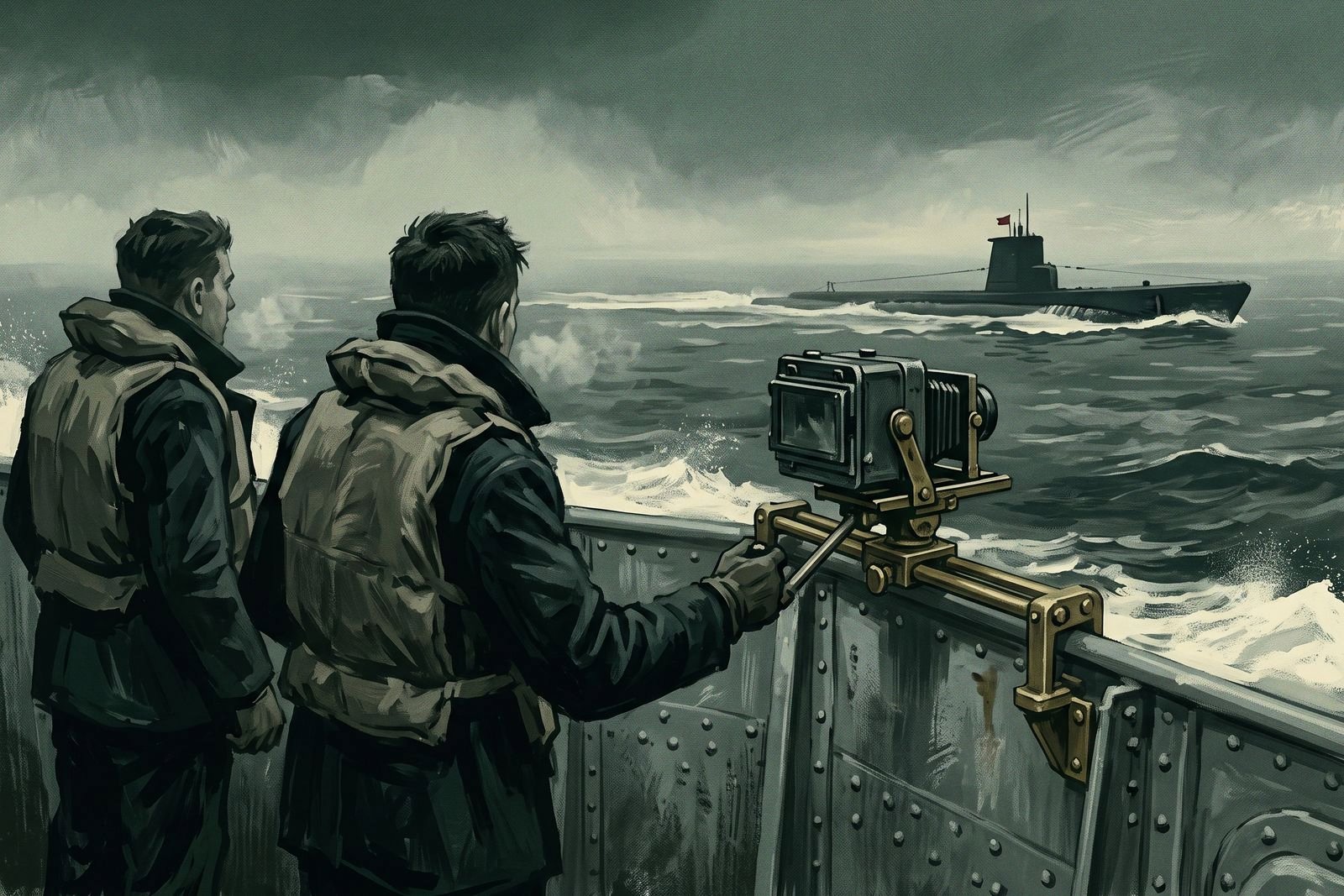
For an hour neither capital knows whose weapon it was. Both fleets carry nuclear anti-submarine ordnance; the task group's flash traffic is garbled and arrives out of order, and in Moscow as in Washington the first rational reading is that the other side has opened at sea. The Atlantic Fleet goes weapons-free against submerged contacts inside the quarantine line that night, and signalling by practice charge is ordered discontinued as useless. The Navy's provisional bulletin of the morning of 28 October, compiled from three shattered ships' books, gives 3,200 dead and missing.
Moscow says nothing for forty hours, because Moscow cannot verify anything: the boat is gone and the brigade is out of contact. Denial is the institutional default, and the broadcast of that afternoon calls the American account unverified. What holds the President through those hours is negative evidence, argued in his committee and available to him in the room: no movement in the rocket forces, none around Berlin, and behind it the day's queue of independent accidents, a U-2 pilot shot down over Cuba, another lost over Siberia and escorted home by interceptors carrying nuclear missiles. The reading is accident.
The invasion is ordered on the night of 28 October and rescinded before the transports clear the Virginia capes. The Joint Chiefs put their dissent in writing, and it stays on the file and in the civil-military argument for two years. What goes in on the 29th is the limited strike: the battery that killed the U-2 pilot, two others, and the harbour works at Mariel to which the submarine brigade had been sent. Between sixty and ninety Soviet servicemen are killed by American bombs, the first such deaths of the Cold War; two American aircraft are brought down. That same day the Soviet defence minister signals that every warhead on the island goes to central custody and that none may be mated or moved except on receipted written order from Moscow. It is the first Soviet document to put a floor under nuclear release.
The disavowal is broadcast on 30 October and extracted, not offered: a boat out of communication, under explosive attack in conditions its crew could not distinguish from war, acted without authority. The whole calendar slides two days behind our own. London gold shuts for two trading days at the start of November and reopens on emergency swap lines; the marine market writes a nuclear exclusion into hull and cargo cover, dated 27 October 1962. On 6 November the President revokes in writing every standing delegation of nuclear release below his own office and orders coded locks on deployed warheads within thirty months. The casualty figure is revised four times in ten days, down to about 1,400, and the papers print the corrections small. Randolph is towed toward Bermuda, surveyed, found uncleanable and scuttled in deep water east of the island on 12 November with her own nuclear depth bombs still aboard. The quarantine is lifted on 22 November and the last warheads leave Cuba on 3 December.
December 1962 – November 1963Tidewater and the Subpoena
Tidewater buries three ships' companies through a wet winter. At eight in the evening in a parish hall in Portsmouth, a folding table carries a mimeographed list with the rates set against the names, and the women who come read down the steward branch first, because the steward branch of a 1962 carrier is Black and Filipino and the cemeteries of southern Virginia are still segregated, in the winter before Birmingham. Manila reads its own citizens' names in a casualty list from a Soviet-American shooting it had no part in, while the bases agreement with Washington is under negotiation; the terms get harder. Six months' pay is what a sailor's widow is entitled to, and the arithmetic is done aloud in those halls until Congress enacts group life insurance for servicemen two years earlier than our world managed it.
About 1,700 men are decontaminated at Norfolk and at Guantánamo, several hundred of them acutely exposed. The Navy's medical bureau opens a numbered register of them that winter and tells them to come back in the spring for bloodwork.
The Senate seats its joint inquiry in January with power to subpoena the Navy's operational records, and the argument it holds in public is whether a grenade-sized charge is a signal or an attack. The Navy Department's position that the charges were legible is contested before Christmas by a serving destroyer officer's letter to the committee. The record of this world never explains why an anti-submarine carrier closed a datum she had spent a day driving toward exhaustion; the committee asks four times and gets four answers. The inquiry's spring report does establish what our world did not learn until the 1990s, that Soviet tactical warheads sat on Cuba undetected the whole time, and that finding is why the American undertaking not to invade never takes treaty form.
At Nassau in December the British get Polaris, as in our record, because the air-launched missile was already dead on cost. What they extract in addition is machinery: written consultation, a planning group standing up in 1964, after a Commons that spent November asking whether American weapons in England make Britain the target of decisions taken alone in Washington. The plan for mixed-nationality crews carrying warheads at sea dies in 1963 rather than 1965; it is unsellable four months after a crew nobody could reach fired one. The French veto of British entry to the common market lands in January on schedule, with better evidence attached, and France leaves the integrated command in 1966 as she does in our world.
The teleprinter link between the two governments opens in February, four months earlier than ours. The test ban is signed in July on our date, with a protocol drafted out of the Senate inquiry obliging each side to notify unexplained detonations and lost units. Dallas is unchanged.
1964–1967Two Lessons, Both Funded
The prohibition is four lines long and absolute: no explosive device may be used to signal a submerged boat of unidentified armament. Around it the Convention on Rules of Contact at Sea, signed in 1964, sets minimum trailing distances, bans hold-down prosecution, gives a boat the option of a one-way identity squawk, exempts declared deterrent patrol areas, and obliges both navies to report lost units. Compulsory transponders are refused by both, and refused for the same reason: the lesson their staffs drew from the four boats that were all located is that a findable submarine is a dead submarine. The same paper accelerates the Soviet ballistic-missile boat programme. A registry at Bern logs the first alleged breaches in 1966.
The other lesson is funded in the same years by the same men. A ten-kiloton burst at sea was absorbed, and the world negotiated past it in seventy-two hours; that is an argument for nuclear anti-submarine weapons as ordinary ordnance. Both fleets load them routinely, the Atlantic alliance rewrites its strategy in 1965 and 1966 around graduated response, and limited nuclear options are ratified in 1968, six years before our world reached them. Coded locks are on deployed American warheads by 1965. The custody inspectorate's first inspector is a retired officer brought in from outside the operating commands, and he spends his first year being shown magazines by men who outrank him and resent the errand.
Khrushchev is removed in the spring of 1964, months before our date, and the charge sheet carries the Caribbean: a public admission that Soviet warheads sailed without a written release floor. A three-man arrangement holds into 1966 with a naval-industrial patron in it, and the classified verdict that American anti-submarine forces were a hundred times stronger than their own buys the fleet its ocean programme. The steel and the skilled men come out of agriculture. Fertiliser plants slip, Canadian and Australian grain purchases are larger from 1963 and repeated in 1965 and 1967, bullion goes out to pay for them, and hard-currency dependence arrives a decade before oil can cover it.
Johnson wins in November 1964 by eight to ten points rather than sixteen. The campaign is fought over three thousand sailors and Castro still in place, three thousand being the number the country learned first and never gave up. Without a supermajority there is no blank cheque and no resolution handed over after an incident in the Gulf of Tonkin: the war in Vietnam is funded by annual authorisation with troop ceilings written into the text. Medicare passes, and the voting rights act of 1965, and the second wave of domestic legislation is cut back. The war now comes up for a vote every spring, with a printed price.
1966–1975The Published Bill
A machinist's mate from Norfolk, twenty-six when he was hosed down on a pier at Guantánamo, holds a register number in the low six hundreds and a place in a longitudinal study run against the survivors of Hiroshima. His compensation comes out of a survivors' act in 1965; the statute that follows in 1967, general and federal, is seized within a year by ranchers downwind of the Nevada test site, by the men who worked in the shafts, and by Marshallese petitioners who have been asking since 1954. Our world waited until 1990.
The annual authorisation turns out to be an annual referendum. Escalation still follows the attack on the American base at Pleiku, but there is no half-million men in 1967; the 1968 bill is amended into a withdrawal timetable, American ground combat ends in 1970, conscription is reformed early, and Saigon falls in the winter of 1973 into 1974. In every session somebody quotes the finding about a crew reasoning about world war from acoustic evidence alone. The bill lands early everywhere else too: the tax surcharge in 1966 rather than 1968, sterling devalued in 1966, the retreat from east of Suez announced the same year and complete by 1969, gold split into two markets in 1966 because everyone had seen in November 1962 how much holding the peg cost, convertibility suspended and the dollar floated in 1969, two years ahead of ours and with a milder inflation peak. The community shelter programme collides with the war bill and is capped in 1967, which leaves Northeast cities and Navy towns sheltered and the South and West not.
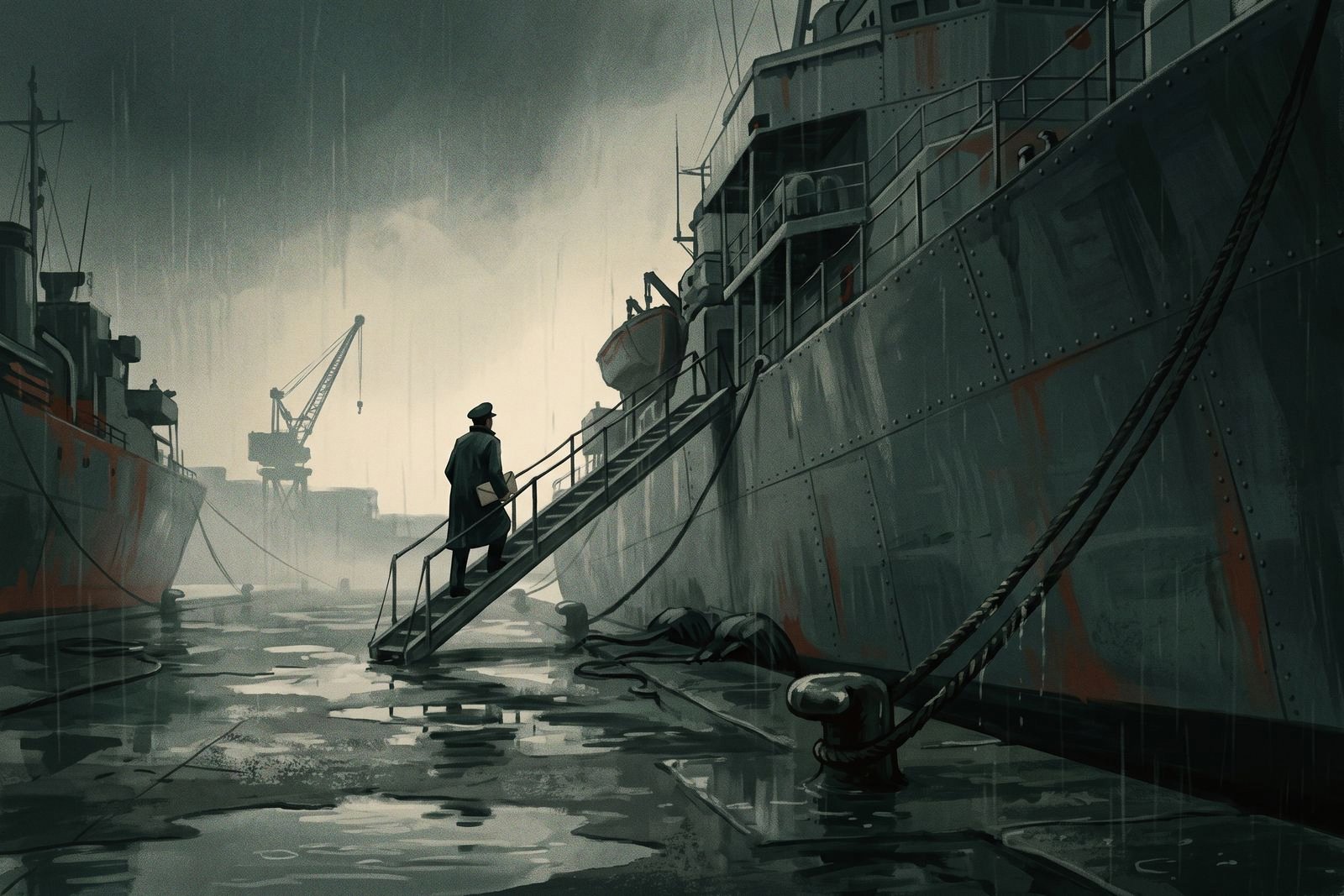
At six in the morning at a naval port south of Tokyo, a Japanese customs inspector with a clipboard and a sealed manifest walks the deck of an American destroyer, and the non-introduction of nuclear weapons stops being a private understanding between governments. The Japanese parliament writes inspection of port calls into law after the fish markets collapsed in November 1962; the American Pacific basing map is redrawn around it, and the terms for the return of the southern islands in 1972 are harder.
The non-proliferation treaty is unchanged in text and date, and West Germany signs sooner because the mixed-crew scheme died in 1963 and consultation was delivered instead. The holes widen anyway. Extended deterrence has been publicly discredited by a night when Washington decided alone, and Sweden, neutral and unguaranteed, does not abandon its warhead programme: an underground test in 1972 makes it the seventh weapon state, outside the treaty, at the cost of a Nordic decade of pressure and consultations demanded of Finland in 1973. India tests in 1971. Britain goes the other way and redeems its opposition's pledge: fourth and fifth boats cancelled in 1965, the force assigned to the alliance without national release in 1967, warhead production ended in 1972. The strategic arms talks split in two, an anti-ballistic-missile treaty in 1970 and offensive limits only in 1973. Cuba, bombed by one patron and disowned by the other, takes Peking's argument and several materially poorer years, and is bought back from 1970 at a sugar price far above six cents; when Soviet submarine support appears at Cienfuegos, the 1964 Convention gets its first live test and the thing is settled by teleprinter in six hours.
1975–1994The Box, the Coal and the File
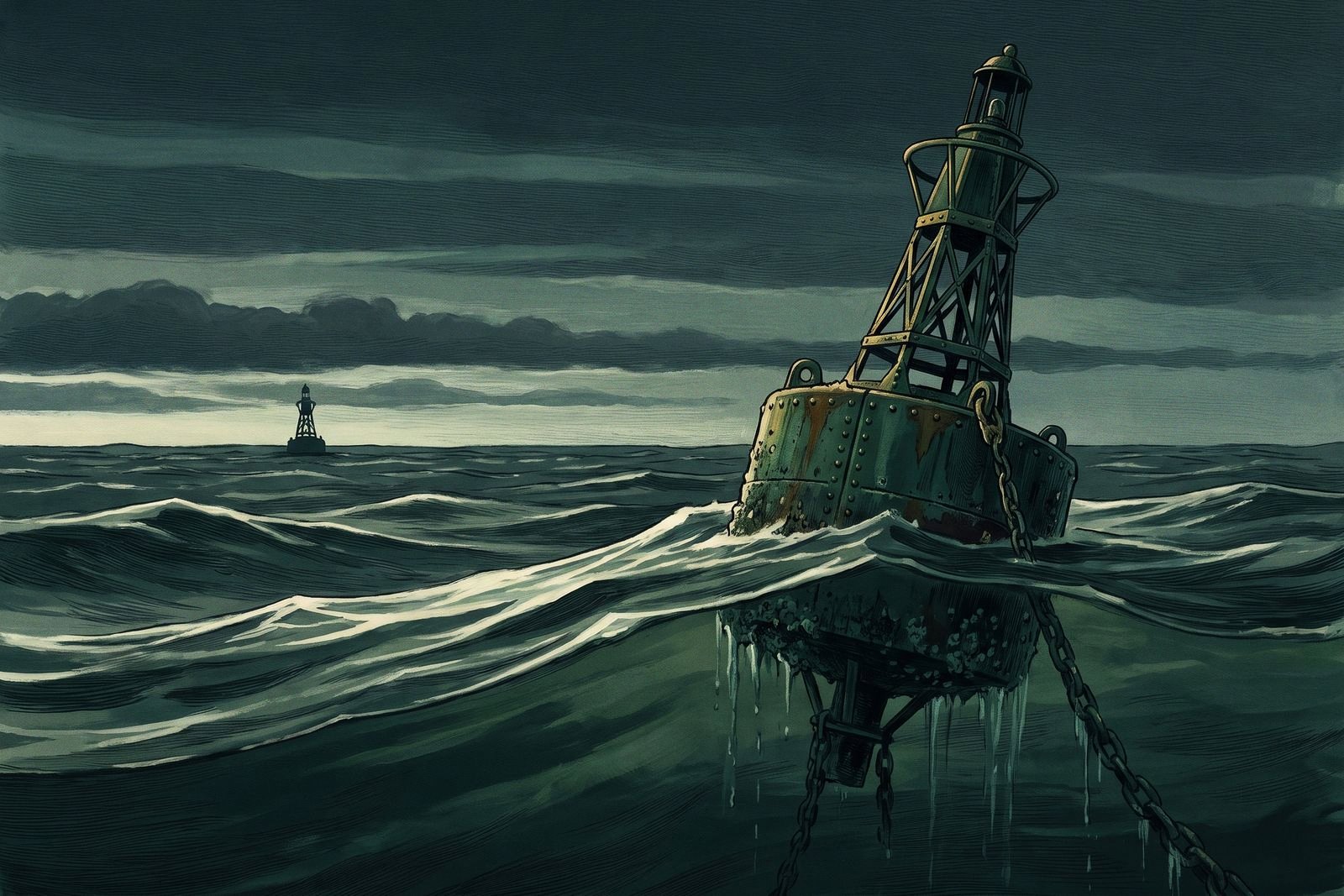
In the spring of 1978 a fisherman from an out-island of the Bahamas, fifty-one years old, lands the first legal catch off the eastern banks in sixteen years, having spent the years to his country's independence filing claims against two governments and collecting from neither in full. The ban was never only superstition. American nuclear depth bombs went down with the carrier, the box east of Bermuda is buoyed for that reason and remains buoyed, and the Sargasso is where the eels of two continents spawn, which is why the discount on a Bahamian landing outlives the advisory.
A third of coastal reactor orders are never placed, because no board will site one downwind of a public exposure register. Appalachian and western coal carry the load, with residual oil in the Northeast. The consequences are paid honestly: a heavier import bill in 1973, an angrier acid-rain politics a decade early, a mining workforce a third larger than ours, and a higher cumulative American carbon path that is still argued over in 2026. The milk and seawater monitoring network built in 1962 arrives in the same season as the argument about pesticides and produces a federal environmental data agency before 1970; the ocean time series it anchors off Bermuda matures a decade early, which is why this world's carbon record starts where ours only estimates. The reactor accident of 1979 and the one at Chernobyl in 1986 happen on their dates, from their causes, and change little that was not already decided. The nuclear carrier commissioned in 1977 is named Randolph; the general who was to have had that hull waits for the next one.
The Soviet Union dissolves in December 1991 on nationalities, oil and productivity, none of which this divergence touched, and arrives at the end with less grain and more steel afloat. The reciprocal withdrawals of 1991 are only partial: sea-based tactical weapons stay, because both navies have spent thirty years arguing they are ordinary. The American programme to buy up loose warheads is earlier and larger, voted by a Congress that has lived since 1962 with the phrase about a boat that could not hear its own government.
The brigade file is published in Moscow between 1993 and 1995. It contains the separate interrogations at Polyarny, the instruction that no discussion of a nuclear torpedo took place, and two documents that do not agree with each other: a pension list paying seventy families and a memorial marker carrying seventy-eight names. The record cannot even fix whether the boats sailed from Kola Bay or Sayda Bay.
At eleven on a wet morning in October 1994, a granite wall is dedicated in Norfolk after a thirty-year campaign by the widows' and survivors' association. It carries 2,061 names, the prompt dead and those who died later of injuries and of radiation, with the place of death cut beside each one. A steward's widow from Portsmouth, sixty-six, who buried her husband in 1962 in a cemetery that would not take white burials, finds his rate spelled correctly at the third attempt. The published file gives her nothing about the men on the other side except an admiral's remark to the officers of a surviving boat, that it would have been better if they had gone down with their ship.
1995–2026Called In By Number
The fisherman dies in 2004 at seventy-seven, and his grandson runs charter parties out to the buoyed box, where the marker light is maintained by a joint fund neither government describes as compensation. Cuba comes through the 1990s poorer than ours, because the dependency was deeper, and a rafter crisis several times the size of ours forces full normalisation in 1995 and repeal of the embargo by Congress in 1997. The price Havana names is the naval lease, wound down between 1999 and 2001. Caimanera is a container port with a Cuban coast guard pier where the American gate stood, and 28 October remains an official grievance against both capitals. September 2001 is unchanged, the divergence touching none of its causes; the detention argument that follows runs through Diego Garcia, through Afghanistan and through the federal courts, because there is no camp in Cuba to fill.
The anniversaries are commemorations, not revelations. There was never a suppressed story to break here, only a contested vote that nobody lived to describe. The 2008 crisis and the 2020 pandemic run as ours. Russia's invasion of Ukraine in 2022 is unchanged in cause and course and altered only in vocabulary: every nuclear threat is answered with an exhibit from 1962, and both schools reach for the same exhibit. The hardened data link that descends from the 1963 teleprinter has survived every rupture including that one. European deterrence runs through Paris alone; Britain is a conventional power hosting American weapons under the consultation treaty of 1963, and the Commons is again asking whose decision they answer to. Finland joined the alliance in 2023. Sweden did not apply, having had its own warheads since 1972.
Every bill of lading on earth carries the marine nuclear exclusion dated 27 October 1962; brokers call it the Sargasso line and no shipper has ever bought it out. Basements in Boston and Norfolk still carry the shelter signage that federal housing code required until 1971, and half of them are laundry rooms. Miami to Havana is ninety minutes without a licence. In January 2026 three prosecutions in the Barents Sea inside the Convention's stand-off distances, one of them against a boat of unidentified armament, are being argued at Bern as breaches rather than filed as routine, because both navies kept the weapons the 1991 initiatives left alone.
The medical register is still open. Four men remain, all in their eighties, called in by number rather than name each spring for bloodwork.
What 2026 knows is the muster roll, because a navy that pays pensions keeps one. What the file cannot establish is what was said in that compartment, in what order, and whether the third consent came from the political officer or from the brigade's chief of staff. That officer was aboard another boat that week. He surfaced when ordered, was escorted home on the surface at two cables with the cameras running, and told a Moscow conference in 1997 only that a boat out of contact ought to come up and try for orders. He died the following year of a reactor he had served in during 1961, uncommended and unphotographed. There are two walls: one in Norfolk with 2,061 names and a place of death cut beside each, and one at Polyarny with a date and no position.
A work of fiction. Everything after the divergence is constructed; real people act only in the documented extension of their public record. The box at the top gives what actually happened.
1962B-59 fires her nuclear torpedo into the Randolph anti-submarine group
After a day-long hold-down prosecuted by USS Beale and USS Cony with helicopters overhead, B-59 comes shallow with her accumulators flat as Randolph turns into the wind to recover aircraft and closes the datum. The T-5 is fired at roughly 4,000 yards and functions about 500 m off the carrier's starboard quarter. Beale and Cony are destroyed outright, some 650 dead with a handful of survivors picked up in the dark. Randolph is whipped, her shafts sprung, flooding aft, island and flight deck swept by base surge; about 700 of her company are killed by shock, flooding and surge. Abandonment takes four hours in darkness. B-59 is destroyed by her own weapon with all hands; no Soviet survivor and no Soviet witness exists.
11 SOURCED CAUSES
1962Atlantic Fleet goes weapons-free at sea; the Navy's first bulletin says 3,200
CINCLANTFLT signals Task Force 136 and all Atlantic anti-submarine units that submerged contacts inside the quarantine area may be attacked without further authority; signalling by practice depth charge is ordered discontinued the same night as useless. The Navy's provisional casualty bulletin of the morning of 28 October, compiled from three shattered ships' books, gives 3,200 dead and missing. It is the figure the wire services carry all week and the number the country learns first and never quite gives up.
5 SOURCED CAUSES
1962Forty hours of Soviet silence: TASS calls the American account unverified
Rusk's demand is put to Ambassador Dobrynin within hours; Moscow cannot answer because it cannot verify. The boat is gone, the 69th Brigade is out of contact, and the institutional default is denial. TASS states on the afternoon of 28 October that the American account is unverified, that no Soviet weapon has been reported fired, and that the hold-down of Soviet vessels must stop. What holds Kennedy through those forty hours is negative evidence, argued in ExComm and available to him: no change in Soviet alert posture in Germany, none in the strategic rocket forces, none around Berlin - on top of the same day's pattern of accidents, Anderson shot down over Banes and Maultsby lost over Chukotka. The reading in the room is accident, not war.
6 SOURCED CAUSES
1962The limited strike: Banes, two batteries and the Mariel port works
The strike ExComm had pre-agreed for the Anderson shoot-down goes in, widened by one target: the Banes SA-2 site, two other SAM batteries, and the harbour works at Mariel to which the submarine brigade had been deployed. It is not free. Between sixty and ninety Soviet servicemen are killed by American bombs on Cuban soil, the first such deaths of the Cold War; Cuban and Soviet gunners, alerted since 27 October, bring down two American aircraft. Washington announces the strike as retaliation for Anderson and for the Sargasso, and states that it is complete and not a prelude to invasion.
4 SOURCED CAUSES
1962Malinovsky withdraws every warhead in Cuba to central custody at Bejucal
With American bombs falling on Soviet positions and Pliyev's FKR cruise missiles and Luna rockets sitting in precisely the release gap the Sargasso has just exposed, Defence Minister Malinovsky signals that every nuclear warhead on the island is to be moved to central custody at Bejucal and that no warhead may be mated or moved except on receipted written order from Moscow. It is the first Soviet document to put a written floor under nuclear release, and it becomes the template for the naval order of November.
4 SOURCED CAUSES
1962Moscow's disavowal, broadcast as a concession; the whole calendar slides two days
Radio Moscow reads a government statement: a submarine out of communication with its command, under explosive attack in conditions its crew could not distinguish from war, acted without authority; the Soviet government disclaims the act, offers condolences and announces that the missile bases in Cuba will be dismantled under verification. It is extracted by the strike, not offered as a courtesy, and it is a public admission that Soviet warheads sailed without a written release floor - a sentence that will be quoted against Khrushchev for the rest of his tenure. Kennedy's assurance against invasion is given in the exchange but withheld from treaty form, conditional on inspection that Havana has not granted. The withdrawal and quarantine calendar runs two days behind our record throughout: quarantine lifted 22 November, the last warheads out of Cuba on 3 December.
5 SOURCED CAUSES
1962The three surviving Foxtrots are ordered up and taken home on the surface
To prove no second weapon is in the water, Moscow orders B-4, B-36 and B-130 to surface, show their pennants and transit northeast on the surface. American destroyers escort them clear of the cordon at two cables, photographing continuously; B-36 (pennant 911) is filmed for the newsreels. The boat already crippled by mechanical failure is met by the salvage tug Pamir. The brigade's mission to plant a submarine presence at Mariel, materially lost before 27 October against anti-submarine forces its own commanders called a hundred times stronger, ends in a public parade of its inferiority.
5 SOURCED CAUSES
1962Gold: London closes for two days and the Pool's defence is visibly spent
A documented first use of a nuclear weapon produces the ordinary reflex into metal against a Gold Pool one year old. The London market closes for two trading days; the Pool sells heavily on reopening; the window is held only by emergency Federal Reserve swap lines and an accelerated Roosa bond tranche placed in Switzerland and Italy. The peg holds - and every finance ministry in the Atlantic has now seen how much it cost to hold it. In the same fortnight the London marine market writes a nuclear-risk exclusion into hull and cargo cover, dated 27 October 1962; it is adopted in New York and Hamburg before Christmas and no cargo on earth is insured against this class of loss thereafter.
3 SOURCED CAUSES
1962Four revisions in ten days; 1,700 men washed down; the hull scuttled off Bermuda
The 3,200 of 28 October is revised four times in ten days, downward, to about 1,400 prompt dead and missing - a correction the newspapers print small and the country does not absorb. About 1,700 survivors and salvage and rescue crewmen are decontaminated at Norfolk and Guantanamo, of whom several hundred are acutely exposed; the Bureau of Medicine and Surgery opens a numbered register of them, the beginning of the longest-running exposure cohort in American medicine. Randolph is towed toward Bermuda, surveyed, found uncleanable, and scuttled in deep water east of the island on 12 November. Families of the three ships' companies begin meeting in Tidewater parish halls in the second week of November.
3 SOURCED CAUSES
1962Kennedy revokes delegated release in writing and orders coded locks on deployed warheads
By national security action memorandum and by letter to the chairmen of Armed Services and of the Joint Committee on Atomic Energy, the President revokes all standing pre-delegation of nuclear release below his own office, directs that every deployed American warhead be fitted with a coded lock within thirty months, and orders a custody inspectorate under the Secretary of Defense with a first inspector named from outside the operating commands. The Navy is simultaneously directed to report on nuclear anti-submarine weapons afloat - a review the operating fleets will use, within a year, to argue the opposite case.
4 SOURCED CAUSES
1962Mikoyan in Havana: inspection refused, and 28 October becomes a grievance against both capitals
Anastas Mikoyan arrives to a government that has been bombed by one patron and publicly disowned over by the other. Castro refuses on-site inspection, publishes his conditions, and in a speech in mid-November names both the American bombs at Mariel and the Moscow broadcast of 30 October as insults to Cuban sovereignty. Some 40,000 Soviet troops remain on the island with no departure date and no treaty-form American guarantee to justify them; the warhead convoys move to Bejucal under Soviet guard and out through Mariel in December. Cuban officials begin, quietly, to receive the Chinese embassy's argument that the deployment was adventurism followed by capitulation.
4 SOURCED CAUSES
1962A Senate joint inquiry with subpoena power is authorised into the conduct of the hold-down
Armed Services and Foreign Relations agree a joint select inquiry, to sit from January, with power to subpoena the Navy's operational records: who authorised practice depth charges as a signal, whether the State Department's Submarine Surfacing and Identification Procedures of 24 October ever reached the boats, what Assistant Secretary Sylvester's boarding statement was meant to accomplish, and why an anti-submarine carrier closed a datum it had spent a day driving toward exhaustion. The Navy Department's initial position - that the charges were grenade-sized and legible - is contested in open session before Christmas by a serving destroyer officer's letter to the committee.
5 SOURCED CAUSES
1962Moscow imposes its own floor at sea, and closes the file on the brigade
A Navy directive on the Bejucal model requires receipted General Staff authorisation for any arming of a naval nuclear weapon and orders nuclear torpedoes offloaded from boats on ordinary patrol; a fleet study of very-low-frequency reception at depth is commissioned. The surviving crews are held at Polyarny, interrogated separately, and instructed that no discussion of a nuclear torpedo took place; an admiral tells the assembled officers of one boat that it would have been better to go down with the ship. Northern Fleet Headquarters is ordered to draft the Anadyr participation report for a Moscow debriefing in the new year - the document that will carry the verdict that American anti-submarine forces were a hundred times stronger than ours, and that will not mention the weapon.
6 SOURCED CAUSES
1962Streets, fish markets and base politics: the world reacts to a weapon that was used
London sees the largest anti-nuclear crowds since 1958 and the Commons spends three days asking whether the Thor sites and the projected Polaris facilities make Britain the target of decisions taken alone in Washington - a question sharpened by the collapsing Skybolt programme and put to Macmillan before he leaves for the Bahamas in December. The NATO Council demands consultation machinery in writing. In Japan, wholesale fish prices collapse on the Lucky Dragon pattern within ten days of the first fallout reports from the Sargasso; the Diet debates a resolution requiring inspection of American port calls, and non-introduction begins turning from private understanding into enforceable policy. At the Council in Rome, in its first session, American and French bishops circulate the Tidewater casualty lists in the drafting rooms; the defence of deterrence by possession loses its Anglo-American sponsors there in the space of a month.
4 SOURCED CAUSES
1962Quarantine lifted; technical talks opened on a direct link and on unauthorised use
With the missiles at sea and the IL-28 question settled, the quarantine is lifted two days behind our calendar. In the exchange that closes it, Washington and Moscow agree to open technical talks on a direct teleprinter link between the two governments and on reciprocal measures against unauthorised or accidental use - notification of unexplained detonations and of lost units, and rules of contact at sea. Both delegations proceed from the same finding, differently stated: that a crew reasoning about world war from acoustic evidence alone had no way to ask.
4 SOURCED CAUSES
1962Nassau buys consultation instead of the MLF; the hotline runs early and the test ban carries a notification protocol
Skybolt's cancellation is unchanged — it was already dead on cost — and Polaris is sold at Nassau as in our record, but the price Macmillan extracts from a Commons that spent November asking whether Thor and Polaris make Britain the target of decisions taken alone in Washington is written consultation machinery; the Nuclear Planning Group stands up in 1964. The Multilateral Force is averted, dying in 1963 rather than 1965: mixed-nationality crews carrying warheads at sea is unsellable four months after a crew out of contact fired one [fo_communication_blackout]. De Gaulle's EEC veto lands unchanged in January 1963, with better evidence; France leaves integrated command on schedule in 1966. The Washington–Moscow teleprinter opens in February 1963 rather than June. The Limited Test Ban is signed in July 1963 as in our world but with an added protocol, drafted out of the Senate joint inquiry, obliging notification of unexplained detonations and of lost units [f_northern_fleet_report]. The inquiry's spring report discloses what our world did not learn until the 1990s — Soviet tactical warheads sat on Cuba undetected throughout [f_warheads_in_cuba_59_days] — which is why no-invasion never takes treaty form. Dallas is unchanged. Servicemen's Group Life Insurance is enacted two years early: six months' pay against 1,400 dead in one evening is politically unsurvivable.
4 SOURCED CAUSES
1964The Convention on Rules of Contact at Sea, coded locks — and nuclear anti-submarine warfare made ordinary
Two lessons are drawn from the same evening and both are funded. The never-again school gets the plumbing: coded locks fitted to deployed American warheads by 1965 under a custody inspectorate whose first inspector is a retired officer from outside the operating commands, all delegation revoked in writing, receipted General Staff authorisation on the Soviet side, and the 1964 Convention on Rules of Contact at Sea. The Convention is drafted to what the inquiry's finding supports and not more: an absolute prohibition on explosive signalling against a submerged boat of unidentified armament [fo_signalling_by_explosive], mandatory stand-off trailing distances and a ban on hold-down prosecution [f_asw_holddown_taskgroup], a one-way identity-and-distress squawk at the boat's option, declared deterrent patrol areas exempt, and a standing duty to notify lost units. Compulsory transponders are refused by both navies, whose capital case for sea-based deterrence is that the hull cannot be found — the same logic accelerates the Yankee class [fo_strategic_asymmetry_at_sea]. The usability school gets the doctrine: ASTOR, the W44 and forward-loaded SUBROC normalised rather than exceptional, Soviet equivalents fielded faster, MC 14/3 written in 1965–66 around a demonstration that a nuclear shot was absorbed and negotiated past in seventy-two hours, and limited nuclear options ratified in 1968 rather than 1974. A registry at Bern logs the first breaches by 1966.
5 SOURCED CAUSES
1964Khrushchev removed early on a naval indictment; Johnson wins narrowly and never gets a Tonkin Resolution
Presidium canvassing runs through the winter of 1963–64 with the Caribbean disavowal on the charge sheet as a public admission that Soviet warheads sailed without a written release floor [fo_ambiguous_nuclear_release]. Removal comes in spring 1964, months early, and the balance differs: Shelepin's stock is higher for having pressed the naval indictment, a three-man arrangement holds into 1966 with a naval-industrial patron, and Brezhnev is primary only by 1968. The classified verdict that American anti-submarine forces were a hundred times stronger [f_northern_fleet_report] wins Gorshkov his ocean fleet, and the steel and skilled labour come out of the agricultural investment surge: the March 1965 plenum is trimmed, fertiliser plants slip, Canadian and Australian grain purchases are larger from 1963 and repeated in 1965 and 1967, bullion sales are heavier, and hard-currency dependence arrives before oil can cover it. In Washington, Johnson wins November 1964 — unchanged in outcome, altered in margin — by eight to ten points on 'three thousand sailors and Castro still there' against 'the war we did not fight', the number the country learned first and never quite gave up. Without a supermajority there is no blank cheque: Vietnam is funded by annual authorisation with troop ceilings written in. Medicare and the Voting Rights Act pass anyway; the 1966 second wave is cut back.
4 SOURCED CAUSES
1965The published war bill: surcharge in 1966, sterling devalued in 1966, the dollar floats in 1969 — and the irradiated get a statute
An annual authorisation is an annual referendum and an annual published price. Escalation still follows Pleiku, but there is no half-million in 1967; the 1968 authorisation is amended into a withdrawal timetable, American ground combat ends in 1970, the draft is reformed early and Saigon falls in 1973–74. 'Reasoning about world war from acoustic evidence alone' is quoted in every session [fo_communication_blackout]. The bill arrives early throughout: the tax surcharge in 1966 rather than 1968, sterling devalued in 1966, East of Suez announced in 1966 and complete by 1969, the two-tier gold market in 1966 after the Pool's defence was seen to be spent in November 1962, convertibility suspended and the dollar floated in 1969 — two years early, with a milder inflation peak. The community shelter programme, funded out of bomber and dispersal accounts at 1.5–2 billion a year, collides with the war bill and is capped in 1967, leaving Northeast cities and Navy towns sheltered and the South and West not. The 1,700-man Norfolk and Guantanamo cohort becomes the century's engine: the Randolph Survivors Act of 1965, a longitudinal study run against Hiroshima's, and by 1967 a federal radiation-compensation statute seized by Nevada downwinders, test-site workers and Marshallese petitioners — a quarter-century before our 1990 Act.
4 SOURCED CAUSES
1967The NPT arrives on time into wider holes: Sweden tests in 1972, Britain gives up its warheads, Cuba is bought back at a punitive price
The NPT is unchanged in date, 1967 text and 1969 signature, and West Germany signs sooner because the MLF died in 1963 and consultation was delivered instead. But extended deterrence has been publicly discredited — Washington decided alone in 1962 — so the treaty's holes widen. Sweden does not abandon the FOA programme: a neutral with no guarantee reads the Sargasso as proof that only your own warhead protects you, and an underground test in 1972 makes Sweden the sixth weapon state, outside the treaty, at the cost of FCMA consultations demanded of Finland in 1973 and a Nordic crisis running the decade. India tests in 1971–72. Japan hardens non-introduction into enforceable law with inspection of port calls, forcing a different Pacific basing geography and harder Okinawa terms in 1972. Britain redeems Labour's pledge instead of abandoning it: fourth and fifth boats cancelled in 1965, the force assigned to NATO without national release in 1967, warhead production ended in 1972 — a legal weapon state owning no weapons. SALT splits: ABM in 1970, central offensive limits only in 1973–74. Cuba, bombed by one patron and disowned by the other, turns to Peking from 1963 through materially poorer years, then is re-purchased from 1970 at a sugar price far above 6.11 cents; Cienfuegos becomes the 1964 Convention's first live test, settled by teleprinter in six hours.
4 SOURCED CAUSES
1973Coal instead of coastal reactors; the ocean series matures early; the Union still dissolves
A third of coastal reactor orders are never placed — no board will site one downwind of a public exposure register — and the load is carried by Appalachian and Powder River coal and Northeast residual fuel oil, gas being under wellhead control and barred from new baseload after 1978. The consequences are honest: a larger 1973–74 import bill, an earlier and angrier acid-rain politics, a bigger mining workforce, and a higher cumulative American carbon path still argued over in 2026. The 1962 milk and seawater monitoring network, arriving with Silent Spring, produces a federal environmental data agency before 1970 and a Bermuda-anchored ocean time series whose carbon-dioxide and radiocarbon records mature a decade early; the London Dumping Convention comes early and at-sea nuclear dumping ends sooner; French Pacific testing is a mass protest issue from 1966. Three Mile Island in 1979 and Chernobyl in 1986 are unchanged in cause and date, and change little that was not already decided. The Soviet Union still dissolves in December 1991 on nationalities, oil and productivity — the divergence touched none of those drivers — but arrives with less grain and more steel afloat. The Presidential Nuclear Initiatives are only partial: sea-based tactical warheads are never fully withdrawn. Nunn-Lugar is earlier and larger, from a Congress that has lived since 1962 with the phrase 'a boat that could not hear its own government'.
4 SOURCED CAUSES
1992The Norfolk wall, the Soviet file, and the end of the Guantanamo lease
Russian archives open and the 69th Brigade file is published in 1993–95: the separate interrogations at Polyarny, the instruction that no discussion of a nuclear torpedo took place, the admiral's remark that it would have been better to go down with the ship [fo_naval_honour_and_secrecy, f_b59_crew_reception_home]. It settles nothing about the three-man vote, because no Soviet witness survived the burst [f_three_officer_rule]; the brigade chief of staff who might have spoken is one of the seventy-eight names on the Russian memorial at Polyarny [f_arkhipov_life_dates]. In Norfolk the wall is dedicated in 1994 after a thirty-year fight by the survivors' and widows' association: 2,061 names, prompt dead plus those who died later of injuries and radiation. Cuba's deeper Soviet dependency makes the post-1991 collapse worse; a balsero crisis several times ours forces full normalisation in 1995 and congressional repeal of the embargo in 1997. The Guantanamo lease is wound down between 1999 and 2001 as the price. September 2001 is unchanged — the divergence touches none of its causes — but the detention argument that follows runs through Bagram, Diego Garcia and the federal courts, because the lease has been surrendered and there is no camp in Cuba to fill.
5 SOURCED CAUSES
2002Sixty-four years of the two lessons: Paris alone in Europe, an armed Swedish neutral, and nuclear depth bombs still at sea
The fortieth and sixtieth anniversaries are commemorations, not revelations — there was never a suppressed story to break, only a contested vote nobody lived to describe [f_suppression_and_1997_conference, f_havana_2002_disclosure]. The digital age is broadly unchanged, except that the 1971 notification centre's teleprinter descends into a hardened bilateral data link that survives every rupture, including 2014 and 2022. The 2008 crisis and the 2020 pandemic run as ours. Russia's 2022 invasion of Ukraine is unchanged in cause and course, altered in vocabulary: every nuclear threat is answered with an exhibit from 1962 by both schools at once. European deterrence runs through Paris alone, Britain being a conventional power hosting American weapons under the consultation treaty of 1963; Finland joined NATO in 2023, Sweden did not apply, having had its own warheads since 1972. Because the Presidential Nuclear Initiatives were partial, both navies carried nuclear anti-submarine weapons into the 2000s and Russia still does, which is why the January 2026 Barents incidents — three prosecutions inside the 1964 Convention's stand-off distances, one of them of a boat of unidentified armament — are being argued at the Bern registry as breaches rather than filed as routine.
5 SOURCED CAUSES
Every one of these worlds was weighed against the one you have just read. Here is where each of them breaks.
Both governments read the burst off the carrier as an opening shot, and the general war plans run in the first days of November 1962.
We weighed this road first, because it is the one the world already half expects from that evening. It breaks inside forty-eight hours of 27 October 1962, on the conduct of the President himself: hours before the torpedo he had refused to strike the missile battery at Banes after an American reconnaissance pilot was shot down, and that day had already produced a stray aircraft over Siberia and a pile of unrelated failures. A man with that day behind him has the frame to read one more catastrophe as an accident, and the absence of any movement in the Soviet alert posture in Europe gives him the evidence to do it. It is also a road that ends in 1962 and leaves no century to unroll, which decided the matter for us.
The United States executes its Cuba invasion plan between 29 October and 5 November 1962, landing on the island rather than turning the transports around.
We took this road seriously enough to put it in the chronology as a decision made and then unmade. It breaks in the first week of November 1962, on the tactical warheads already ashore on Cuba, undetected by American intelligence and held by local commanders working in exactly the gap in written release authority that produced the torpedo in the first place. An invasion in that week is not a limited war for eight days; it is the general war of the road above, reached by a slower route. What survived is the near miss: the plan ordered on 28 October, rescinded inside a day, and the written dissent the Joint Chiefs filed, which sits between the White House and the Pentagon until 1964 and poisons civil-military relations for the rest of the decade.
Moscow claims the shot, presenting the torpedo as deliberate retaliation for two days of American depth charges on a submerged boat.
We considered giving the Soviet government the courage of ownership, and it fails in the last week of October 1962 on Khrushchev's own resolved position. He had already decided to withdraw the missiles; owning the burst costs him that withdrawal and everything he means to buy with it, while disowning it costs him only an admission that Soviet warheads sailed without a written release floor. That is an admission a general secretary can survive for eighteen months, and in this world he survives it exactly that long. We took the harder middle instead: forty hours of saying the American account is unverified, then a concession extracted by the strike of 29 October.
The program names the third officer aboard the submarine who gave the consent the historical record denies, or invents him where the record is silent.
We rejected this both on principle and on craft. All three men in that control room are destroyed with the boat on 27 October 1962, and when the Russian archives open between 1993 and 1995 the published file gives a muster roll, a staff list and two irreconcilable head counts, and not one line of what was said or in what order. Naming a man there would put the whole divergence inside a character nobody can check, when it belongs in an institution and a procedure. An unrecoverable consent is also the better closing image, and it sits in the same hole as the surfacing instructions the surviving papers cannot agree ever reached the boats.
Vasili Arkhipov is aboard the boat destroyed on 29 October 1962 and dies without ever being asked what he would have done.
This is the sharper irony, and we spent some time on it. It breaks in 1997, at the Moscow conference where the old man in the bad suit says that a boat out of contact ought to surface and try for orders, and again in the file published in the mid-1990s, both of which the chronology needs in order to close on silence rather than on a body count. Killing him removes the thirty-six years of being uncommended, which is the point the whole architecture is built to reach. We gave the road one beat of narration and kept him alive until August 1998.
The 1964 convention on contact at sea obliges any submerged boat to answer a transponder challenge within two miles, on pain of prosecution.
We wanted this clean rule and could not make either navy sign it. It breaks in the mid-1960s on the capital arithmetic both staffs draw from the Caribbean: a submarine that can be found is a submarine that is dead, which is the same finding that accelerates Soviet missile-boat construction and protects the Polaris patrols. No naval staff signs away the anonymity of its second strike in the middle of building one, and both refuse compulsory transponders inside a fortnight of the talks opening. What survives is the weaker instrument the chronology actually carries: stand-off distances, an absolute ban on signalling a boat with explosives, an identity squawk a captain may use or not, and an exemption for declared deterrent patrol areas.
The powers answer the burst with a naval denuclearisation treaty in the 1960s, taking nuclear weapons out of the world's fleets altogether.
We tested this against the reasoning the burst actually produces in both admiralties between 1964 and 1968, and it does not survive it. A ten-kiloton weapon functioning at sea was absorbed, apologised for and negotiated past in seventy-two hours, which every staff reads as proof that nuclear anti-submarine ordnance is usable rather than unusable, and both fleets already carried it in 1962. The road returns in part in 1991, when the unilateral withdrawals of tactical weapons leave sea-based anti-submarine warheads aboard because thirty years of doctrine call them ordinary. That partial withdrawal is the price, and it is why 2026 in this world is more dangerous than ours and not less.
Washington and Moscow sign central limits on offensive missiles in 1970, five years of shock having brought the strategic talks in early.
We would have liked the early treaty and the arithmetic forbids it. It breaks in 1969 and 1970 on the Soviet side of the table: a freeze at 1970 numbers freezes Soviet inferiority in the middle of a build-out this Kremlin has more reason than ours to finish, having written down in its own fleet report that American anti-submarine forces were a hundred times stronger. The instrument that can be signed early is the one that costs Moscow least and Washington wants most, so the missile defence treaty lands in 1970 and central offensive limits wait until 1973. The gain is three years on defences, not on warheads.
The loss of one carrier to one torpedo ends the large deck: the United States Navy turns to attack submarines and dispersed escorts through the later 1960s.
We weighed the obituary of the type and it breaks in 1965, on a war that demanded decks off Vietnam every month, and on the Navy's standing answer that a hull lost to a nuclear weapon implies general war and proves nothing about conventional ones. A 1944 hull out of the reserve fleet is also cheap to replace beside the air group and the trained anti-submarine crews that went down with it. What legitimately changes is smaller and duller: more escorts, dispersal written into task force doctrine, and an attack-submarine programme brought forward and enlarged. We kept those and left the carriers where they were.
The lunar programme is delayed to pay for a national fallout shelter system after 1,400 dead in one evening.
This road holds for thirteen months and breaks in December 1963. After Dallas the lunar programme becomes a memorial to a dead president and is the single line no committee will cut, whatever the shelters need. The chronology funds the shelters out of the strategic bomber and dispersal accounts instead, where the money is real, and the published war bill caps the programme in 1967. That leaves the Northeast cities and the Navy towns sheltered and the South and West not, which is a sharper picture than a finished system would have been.
Cuba's government falls in the 1990s under a subsidy withdrawal deeper than the one our record delivered.
We set this aside because the factor that held the island together between 1991 and 1994 was coercive capacity rather than calorie count. A state that came through a thirty-five per cent contraction in our record comes through a worse one here, poorer and no less governed. The divergence is spent instead on a rafter crisis several times the size of ours, full normalisation in 1995, repeal of the embargo in 1997 and the winding down of the Guantánamo lease between 1999 and 2001. That changes 2026, down to where the detention argument of 2002 has to be conducted, more than a change of regime would have.
An altered Cuban-American electorate in Florida rewrites American presidential outcomes from November 2000 onward.
We set this one aside as unbuildable rather than as too small. The causal chain from a torpedo in October 1962 to a margin of some five hundred votes in November 2000 runs through four decades of independent variables, and any line we drew would be assertion dressed as consequence. What we did instead was change the institutional facts around that state: a Cuban-American population that arrives earlier, larger and less uniform in its politics, an embargo repealed in 1997, and no detention camp on the island in 2002. The rest we left where the record leaves it.
The powers make a comprehensive ban on nuclear testing the monument to the dead carrier, signing it in 1963 instead of the partial ban.
We weighed this as the obvious memorial and it breaks in 1963, on the two problems a casualty list does not solve: distinguishing an underground test from an earthquake by seismic means, and the on-site inspections the Senate needs and Moscow will not grant. France and China stand out for reasons of status, not because either misunderstands nuclear danger, and 1,400 dead sailors do not alter status. The pressure the burst really generates goes somewhere else in this world, inland and domestic, once irradiated American sailors become a compensable class with lawyers and a federal register. That is the road we took, and it produces a radiation compensation statute in 1967, a quarter of a century before ours.
The consequences are held in check: Vietnam runs at the same scale to the same end, the 1964 election lands as it did, and the years from 2001 to 2026 are left as our own.
Every one of those holdings is defensible taken alone, and that is precisely what made them unusable together. Once the chronology changes the war authority of 1964, funds the war by annual authorisation with troop ceilings in the text, discredits extended deterrence in public and cancels a third of the coastal reactor orders, those levers cannot be pulled between 1964 and 1968 and then forbidden to move anything downstream. It was the safer road and we could have taken it honestly; it was simply a smaller world than the one this chronology owes its reader, differing from ours by a noun, a fishing advisory and two treaties. We let the levers propagate, and accepted that the war ends in 1970, Saigon falls in 1973, and Sweden holds warheads it never gave up.
Everything before the hinge rests on these readings. Under each title, the passage retained.
- The Underwater Cuban Missile Crisis at 60 | National Security Archive
four Soviet Foxtrot-class diesel submarines, each of which carried one nuclear-armed torpedo, left their base in the Kola Bay
- Recollections of Vadim Orlov (USSR Submarine B-59) | National Security Archive
Orlov's account includes the controversial depiction of an order by Captain Valentin Savitsky to assemble the nuclear torpedo.
- Deck Log Book [Excerpts] for U.S.S. Beale, DD 471, October 1962 | National Security Archive
the eventual surfacing of submarine C-19 (B-59) on the evening of 27 October (local time)
- The Cuban Missile Crisis @ 60: Nuclear Crisis Lasted 59 Days, Not Just 13 | National Security Archive
Soviet nuclear warheads arrived in Cuba on October 4, 1962, and did not leave until December 1.
- OCR of the Document | National Security Archive
a group of eleven United States Navy destroyers and the aircraft carrier USS Randolph located the B-59
- The Soviet naval officer who refused to fire his nuclear torpedo (PDF hosted by National Security Archive)
He argued that the depth charges were not lethal — they were detonating to one side of the hull
- The Soviet naval officer who refused to fire his nuclear torpedo during the Cuban Missile Crisis
The vote was two-to-one in favor of firing a nuclear torpedo at an American aircraft carrier
- The Submarines of October | Naval History Magazine, October 2022
The temperatures in the compartments was 45–50 C, up to 60 C in the engine compartment.
- Black Saturday Declassified | Naval History Magazine, June 2021
Nothing about the Arctic-insulated Foxtrot submarines was designed for operating in subtropical climates.
- Vasili Arkhipov: The Soviet Officer Who Averted Nuclear War | History Hit
himself, as captain of the B-59, the political officer Ivan Semonovich Maslennikov, and the flotilla chief of staff
- 55 Years After Preventing Nuclear Attack, Arkhipov Honored With Inaugural Future of Life Award
temperatures onboard climbed above 45ºC (113ºF), many crew members fainted from carbon dioxide poisoning
- Did You Know? This One Soviet Submarine Nearly Started World War III | The National Interest
On October 23, Defense Secretary McNamara authorized U.S. ships to use special Practice Depth Charges, or PDCs.
- How 1 Russian Submarine Nearly Started World War III | The National Interest
on October 22, President Kennedy moved to impose a blockade, which he called a "quarantine"
- The B-59 Submarine Incident - Traces of Evil
Savitsky's orders, issued by Admiral Vitaly Fokin on 30 September, permitted nuclear deployment only with Moscow's approval
- Editorial: The man who saved the world | Peace News
12 US warships surrounded a submerged Soviet submarine, the B-59, a began dropping hand grenades and practice depth charges
- What could've happened if the Cuban missile crisis had turned into all-out nuclear war
ordered to use it only if American forces blew a hole in the hull or orders came down from Moscow
- Dragon Lady Down | Air & Space Forces Magazine
Maj. Rudolf Anderson, piloting another U-2 over Cuba, was shot down by a Soviet surface-to-air missile
- In 1962, A Lost U-2 Spy Plane Nearly Triggered World War III - Jalopnik
U.S. forces worldwide were at DEFCON 2, just one step below imminent nuclear war.
- This week in diplomatic and military history: October 27 | Clements Center
The pilot, Major Charles Maultsby, became disoriented by the aurora borealis and strayed into Soviet air space.
- Cuban Missile Crisis: Black Saturday, Agreement, and Lessons Learned | Defense Media Network
an Anti-Submarine Warfare (ASW) group was hounding the submarines of the Soviet 69th Torpedo Submarine Brigade
- Soviet and Russian Torpedoes Since 1945 | Naval Submarine League Archive
The yield was estimated "arbitrarily" at 3 kilotons.
- Deep Trouble: The Secret History of Soviet and Russian Nuclear Torpedoes | GlobalSecurity.org
Detonating 35 meters below the surface, the 10 kiloton explosion destroyed two decommissioned destroyers
- Soviet nuclear torpedo test (1955) | Internet Archive
The first nuclear test fired at Novaya Zemlya was an underwater test of the RDS-9 warhead deployed on the 53-58 (T-5) torpedo.
- October 27, 1962 Archipov – Historical Easter Eggs
One admiral told them "It would have been better if you'd gone down with your ship."
- You (and almost everyone you know) owe your life to this man | National Geographic
starting a chain of inadvertent developments, which could have led to catastrophic consequences
- Soviet submarine B-59 - Wikipedia
10 torpedo tubes; 22 torpedoes, including one nuclear torpedo with a 10 kt warhead
- Vasily Arkhipov - Wikipedia
Launch authorization required the agreement of all three senior officers.
- Vasily Arkhipov | Military Wiki
Arkhipov eventually persuaded Savitsky to surface and await orders from Moscow.
- Vasily Arkhipov: The Man Who Saved the World | Wikipedia Daily
Vasily Arkhipov was born into a peasant family in Staraya Kupavna, near Moscow.
- Opération Kama — Wikipédia
Le 25 octobre 1962, les procédures de surfaçage américaines sont communiquées par Moscou aux sous-marins soviétiques.
- Nuclear torpedo | Military Wiki
detonated with a force of 4.8 kilotonnes twenty meters under the surface of the bay
- The Cuban Missile War (Literature) - TV Tropes
Here, Arkhipov is incapacitated, and the captain goes through with the launch, destroying the aircraft carrier USS Randolph
- The Cuban Missile War Timeline | alternatehistory.com
A single 15 kiloton nuclear torpedo is launched from the B-59.
- Great Nuclear War | Alternative History Fandom
A frustrated American commander orders US Forces to drop a nuclear depth charge on it
- Nuclear War (1962 Cuban Missile Crisis Escalates) | Alternative History Fandom
Hundreds of Nuclear Bombs were launched during this war destroying numerous cities around the world
- An alternate history of the Cuban Missile Crisis (review of Resurrection Day)
Thus begins Brendan DuBois's skillful alternate history of the Cuban Missile Crisis, Resurrection Day.
- In the Cuban Missile Crisis, an alternate history of nuclear war (review of When Angels Wept)
When Angels Wept is one of the most remarkable works of alternate history I've ever come across.
A life in this world — an archival fiction
GETTING OUT THERE
Rock Island depot if you come by rail, and then you walk up. The bluff is why everything you will be asked to look at sits under a house on a slope. Every cellar has one wall that weeps and one that doesn't, and the sump goes at the low corner whatever the plan set says.
The bureau car is a '58 with a two-way radio that works on the Fulton Street side of the courthouse and nowhere past Wisconsin Avenue. Take your own car and put in for mileage at eight cents. They pay it in about five weeks.
Nineteen years nobody ever asked me to write down how it's done. They are asking now because the counter took two hundred and six applications since the fifth of November and there is one of me.
THE COUNTER (second floor, eight to four-thirty, closed noon to one)
Since October the counter hours are mine on top of the route.
What lives on the counter: the OCD booklets, Family Shelter Designs, stacked to about your knee, and the protection-factor table in the back of every one of them dog-eared by somebody who came in, read it, and walked back out without a permit. The mimeographed amendment to Section 1408, adopted the fifth of November, ventilation and water storage for domestic shelters, and if you hold the sheet up to the window you can still smell the fluid on it. The tally pad. Form B-14, Application for Permit, Domestic Fallout Shelter, carbon triplicate, white to the file, yellow to the applicant, pink to Civil Defense over at the armory, and if you forget the pink the fellow over there telephones you at home during supper.
Three dollars for the permit. They always have the three dollars.
For ruling a line down a plan set you want something stiffer than a rule, and the second front page of the Journal Star folds to about the right thickness. That is the page with the ship's-company lists, parish by parish, and it runs longer some days than others. You skim it the way you skim the closing hogs. Four Peoria County names the week after and one of them a Hulett, no relation, the chief checked. Some days there is four inches on the Chinese quitting in India up in the corner and the crew list under it running a column and a half.
Back pages are shelter men and dehydrated food, page after page. One outfit's copy is set in inch-high type, THEY HAD NOWHERE TO GO, and I don't mind telling you whoever wrote that knew his business.
On your tally, when they come around at budget time and want to know why the counter hours ran to fifty-one in a week, you write all these permits since the Randolph.
Above the file cabinet, the calendar. Hulett's retirement is circled in grease pencil, the first of March. He circled it himself in September and has not mentioned it once since. Grade eleven goes with the chief inspectorship and the pension is figured on grade eleven. Outside the Fulton Street door there is a parking space with his name stenciled on the curb and the stencil wants repainting in the spring. My daughter marries in June and the difference between grade nine and grade eleven is nine hundred and forty dollars a year, which is a hall, a band, and the flowers, and I have spent it four or five times coming up those stairs.
THE ROUTE: CELLARS OF THE WEST BLUFF (allow the full day)
The etiquette is fixed and you do not vary it. Knock twice. Not three, three is a bill collector. Ask for the cellar light before you ask for anything else, because half these houses the light is a pull chain at the bottom of the stairs and you will be down four steps in the dark with the case in your hand. Set the case on the step, never the floor, and open it there.
In the case: smoke candles, the vane anemometer, the manometer, the folding rule with the tip worn round, a stub of chalk. You want four cubic feet a minute per person, you want a sump or a floor drain that goes somewhere, and you want a blower a woman of sixty can crank twenty minutes without stopping. That is the whole of it. Four cubic feet a minute, fourteen days of water, and at the end of the fourteen days the ordinance quits and the booklet quits and a man is.
Anyway. Four cubic feet.
Light the candle at the intake and watch. Air is stupid and honest. It goes where it goes and it does not care what the contractor told anybody up in the kitchen.
Mrs. Wiedemann's on High Street, the seventeen-gallon canned-water drum with the CD triangle is already doing service as a step stool under the fuse box, which means it has been up and down those stairs, which means it is not full, and you say nothing because it is not in the ordinance. Up in the joists over the stair there is a child's shoe, one shoe, laced. Her blower is an imported thing, thirty-nine ninety-five, and somebody has been at the vane with tin snips to make it fit the duct. Trimmed vane, no free area left to speak of, and it draws maybe half of what the plate claims. You fail it. Failing it takes nine seconds and writing it up takes twenty minutes at the kitchen table over a cup of coffee you did not want.
Note this down, since it is the practical part. The widow does not talk. Twice out of three she says almost nothing at all and the brother-in-law does the whole of the talking, or the son-in-law, or the fellow from the lodge. The salesman's card is thumbtacked to the fuse box where the meter reader will see it. Bloomington outfit, mostly. They work the obituaries and the crew lists both. They carry a sample of screen, eight-gauge, in the trunk to hand a man to hold, because a man holding something will listen twice as long.
They want them, these women. You will hear men say the families are being sold something they don't want. That is not what I see out there.
Milk is forty-seven cents and the number is printed on the slip under the dairy's name, right alongside the price, and there is nothing to be done with the number so you don't do anything with it. The A&P has had no crawfish tails in the case since the end of October. The sports page carries the perch report and one column over, some days, the Public Health box east of the Bahamas with the landings ruled out inside the line. Perch are fine. Perch are a lake fish, for God's sake.
WHERE THE MEN DRINK: ZICK'S, AFTER FOUR
Draught is a quarter and there is a boiled egg on the bar if you want one, which you don't. (Zick's is the son. The father was Zick too.)
There is a coin can on the bar, taped at the seam, RANDOLPH FAMILIES RELIEF lettered on it by somebody's wife. You put your change in without looking at the can. If the bartender thanks you, look at the mirror behind him and let it go by.
When the car radio quits past Wisconsin, or when Kohlmeyer sends a plan set back the third time over a note he never once wrote down, somebody down the bar says it's a boat that could not hear its own government. That gets its laugh every time and will go on getting it another ten years. Kohlmeyer has the engineering degree from Bradley and is thirty-four years of age and has never in his life lit a smoke candle in a cellar with a woman standing on the steps behind him.
Wednesday, Fahnestock at the far end says the gravel came in nice on Antoinette Street, he drove past it. He means nothing by it, he is a man who notices a driveway. The table's timing goes half a beat wrong, the way it goes when somebody mentions a fellow's brother who drinks, and then Fahnestock is on to the perch and the ice going out late and here comes the beer.
I have never taken money. Nineteen years, not a dollar, not a five in a Christmas card, and the two times it was put in front of me I handed it back and finished the inspection and passed the job, because the job was right. A truckload of gravel between working men is not money. A furnace tune-up in October when the man's truck is on your street anyway is not money. Venison is not money and the turkey from Mullane Brothers is a turkey. Order the second one and go home to your supper.
EVENINGS. ANTOINETTE STREET.
The mantilla is on the hall hook by six every morning now and gone off it by twenty past. Daily Mass at St. Bernard's. The parish had its day of prayer and fasting the second week and Sunday last was standing room on an ordinary Sunday, no feast, nothing. The kitchen radio stays on for the Council sitting in Rome and Lorraine has it going while she does the potatoes, men in Latin, and she leaves it going when she takes herself upstairs. Her nerves. She has slept poorly since October and the Mass settles her. There is powdered milk in the cupboard now, three boxes, and nobody has said a word about the milk.
Thursdays Donnie takes the car. Something at the Y. You ask what at the Y and he says at the Y, and puts his fork back in the noodles, and Lorraine passes the bread. He is seventeen and he has his father figured for a man who stamps papers. Fine. Let him have it Thursday nights and every other night. I want the keys back before ten, that's the whole of what I want, and I say so, and it comes out harder than I meant it, and Lorraine gets up to see about the radio.
OUT PAST AVERYVILLE: THE MULLANE JOB
North on Adams, over the tracks, half a mile past where the sidewalk quits, and it is a farm cellar with a house sitting on top of it. Allow the whole afternoon and wear the boots.
Give the pour its due. Eight inches, poured, no block, forms came off clean, and there is a bench with a lip on it so the canned goods don't walk in a shake. Mullane's men know how to work in a hole four feet wide. It is done right and you could sit down in that room and be reasonably content.
The exhaust is tied into the coal flue. House furnace shares the flue, gas conversion, and the thimble where the old coal pipe went is capped with a tin plate and two screws. Light the candle, crank the blower, stand back at the stair. The smoke leaves the shelter and comes down the flue and out at the thimble, out past that tin cap, and pools in the cellar at about knee height. Forty seconds and you have the whole of it. You run the anemometer anyway, because thorough is thorough and because it gives your hands something.
The plan set goes on the kitchen table and to make room for it Mrs. Behrens moves two things. One is a sugar bowl. The other is a letter from the Bureau of Naval Personnel, and the letter gives no place of death, it says lost, it does not say where, it is not permitted to say where, and clipped to the corner of it is the stub of the death-gratuity check, six months' pay, endorsed on the back to Mullane Brothers Concrete, Peoria, Illinois.
She sets the letter on the sill behind the sugar and asks me will it pass.
In the pocket of the brown coat, in the closet on Antoinette Street, there is an invoice from Mullane Brothers dated the eleventh of August, one load of gravel, forty-one dollars and fifty cents. I have not paid it and he has not asked.
You hear yourself tell her you want to come back with better instruments. She says she'll have coffee on.
SECOND VISITS
The trade will tell you two visits are a courtesy and three are a nuisance. In a case with any doubt in it, go back. Take the day.
Out Friday and again Monday night after dark, because a flue reads different when the house is cold and the wind is coming up off the river. Recalculate the free area of the intake three times and get eleven and a half square inches and then eleven and a half again. Hold the manometer at the thimble in a crosswind and it gives you what it gave you. Telephone the state office in Springfield and a man named Wayne something looks up flue sharing and calls you back the following afternoon and reads you a paragraph you already knew the sound of. Read 1408 four separate times and then 1408(c) on its own, twice, looking for the sentence that lets a capped coal thimble stand as a separate flue, and it is not in there, and read the amendment too in case the November language moved it, and it did not.
Then sit in the car with the dome light on and read the thing once more.
What you will notice is that you are tired, and that the brown coat is the warmer of the two and you have had it on all week.
THE HOLIDAY, AND THE MONDAY AFTER
Thanksgiving at my sister's. The chair on the window side is empty because the call-up got extended into December and the boy is at Fort Sill and sent a postcard about the food. My brother-in-law says the grace and then goes on saying it, adds the ones overseas, adds the ones at sea, adds the ones lost at sea, and it runs a good two minutes longer than a grace has any business running with the gravy sitting there going cold.
My jaw is set through the whole of it and there is no way in the world to say why, so I eat the turkey. It is a Mullane turkey. Half the street had one.
Monday morning, twenty past nine, Hulett comes to the counter for the ledger and says while he is standing there that Kohlmeyer will be going down to the Commissioners in January. Says it the way a man tells you the boiler inspector is out sick. Told to me first, ahead of the others.
Nobody in the room looks up. Vollmer keeps typing. The grease-pencil circle is still up there on the calendar over the file cabinet, the first of March, and it will stay up there until somebody hangs the 1963.
You say that's fine, Ed, and you find him the ledger.
The Commissioners like a degree. Nine of them sitting there and a man of thirty-four with Bradley on his paper walks in and there is your chief inspector. Nineteen years of cellars does not print on a card.
CLOSING HOURS AT THE COUNTER
Four-fifteen. Get the B-14 out and fill it in the long way, all three copies, press hard because the second carbon is worn thin.
Two rubber stamps live in the top drawer with the pencils. You have used APPROVED some thousands of times and you like the sound it makes and the way the ink beds down on the yellow copy.
Ink the other one. It has not been out of that drawer since the spring. Remarks line: exhaust flue not separate, Sec. 1408(c). Pink to Civil Defense.
Next morning, out past Averyville, wire the STOP WORK card to the cellar door with a roofing nail through the eye. Fifth time in nineteen years. Mrs. Behrens is at the window with the coffee pot and you take your hat off to her and get in the car.
Then home. Coat on the hall hook next to the mantilla. The radio is going for Rome and Lorraine has the powdered milk out in the yellow pitcher and the potatoes are on and Donnie is upstairs with the ball game.
You do not tell her.
Sit down. Don't ask her what time she's out in the morning. You have asked every night for a month and she has told you every night for a month and it is not a thing that wants asking. She sets the pitcher down and goes back to the stove, and the kitchen is quiet except for the men in Latin, and you let it stay quiet.