The Grandparents' Field

The exchange post reaches Innsbruck in the winter of 1867. Anton Kerner von Marilaun, three months into the chair of botany, cuts the string on Bd. IV of the Brünn Verhandlungen and finds, bound after a table of Moravian rainfall, forty-five pages on peas. He reads them because his own Alpine crosses have been producing constant intermediates he cannot account for, and because the arithmetic on page 12 is the first he has seen that predicts anything. In February he writes to Brünn for seed.
1867–1885Innsbruck Sows, and the Abbot Files an Appeal
Behind the glasshouses at Innsbruck, in the wet spring of 1868, Kerner puts in his first row of Pisum and repeats it in 1869 with a student counting pods aloud. In 1870 he reports to the Zoological-Botanical Society in Vienna that the ratios hold, with the botanic garden's ledgers behind him. Carl von Nägeli in Munich, who has been growing peas since 1866 and finding no agreement at all, answers in print in 1871: the results are empirical and not rational, and they describe a peculiar hybrid, nothing more. It is the quarrel that carries the pamphlet out of Moravia. Nobody had troubled to dispute it before; Munich taking the trouble to refute it makes it worth sowing, and by 1873 it is being sown at Jena, at Hohenheim and in a nursery outside Erfurt.

The man whose numbers they are has other mornings. The chapter of St. Thomas elects Mendel prelate on 31 March 1868, and he writes to Nägeli that the office will cost him a good deal of time and effort. The hawkweed letters run on to 1873, their contradictions filed as an oddity of the genus. By 1871 he keeps weather registers and bees. From 1874 the monastery is locked in a sequestration fight with the imperial authorities over the religious-fund levy on its estates, and the founder of a science spends his best hours on an assessment appeal, drafting valuations of fields at Kunitz while Munich and Vienna argue about what happens in them. The abbey's money is impounded. It endows nothing.
The money that does the endowing comes from sugar. The Bohemian and Moravian beet cartel measures its selections in polarimeter degrees and wants better; the Hanna barley trade wants malt that behaves the same in every kiln. They lobby the new Agriculture Ministry and the Hochschule für Bodenkultur, and in 1873 a trial and hybridisation garden opens at Brünn under the agricultural society, pointedly not under the abbey. Ludwig, twenty-three, a clothier's second son with no head for the loom, is taken on to emasculate flowers with forceps. Carlsberg follows in 1875 with brewery money and barley.
Not wool, though the town is built on it. Australian and River Plate fleece ruins the Moravian flockmasters in these same years; the Brünn clothiers re-tool on imported wool and do very well. The money never leaves the city. It changes hands inside it, which is why heredity has to be paid for by beet, barley and orchard.
Mendel dies of Bright's disease in 1884. The chapter inventories his notebooks and the Munich letters in 1885, and the province keeps them.
1871–1898The Units, the Arithmetic and a Pressed Hawkweed
In Bremen a practising physician, Wilhelm Olbers Focke, compiles hybrid literature at night for a decade, and his Pflanzenmischlinge of 1881 puts the Brünn ratios into the hands of every reviewer from Kew to Cambridge. The reviewers notice what the breeders had not bothered to state: particulate transmission answers Fleeming Jenkin's objection of 1867, that a favourable variant would be diluted away in the blending. Selection is therefore not swamped, and the eclipse that might have swallowed it never quite closes. Whether Darwin himself possessed or read anything out of Brünn is not documented; the accounts differ and none of them establishes reading. The old man does not convert. His readers do.
Arguing 3:1 against 2.9:1 requires arithmetic, and the arithmetic requires fields. At Rothamsted, at Svalöf after 1886, at Hohenheim, plots are replicated and then deliberately randomised to separate the soil from the seed, and goodness-of-fit tests of the chi-square kind become instruments of the agricultural station twenty years before anyone thinks to point one at a hospital ward. There is little in a hospital worth randomising before the sulfa drugs, and the men who build the tests say so. The German vocabulary travels with the method, untranslated, into Swedish and English practice: Anlage, Spaltung, Reinzucht.
Vienna founds the first chair of Vererbungslehre in 1890, and Kerner presides at the ceremony. Nägeli dies in 1891, still dissenting. What he understood and refused, as against what he never understood, is argued to this day off ten one-sided letters and a four-word marginal note, and the record does not settle it.
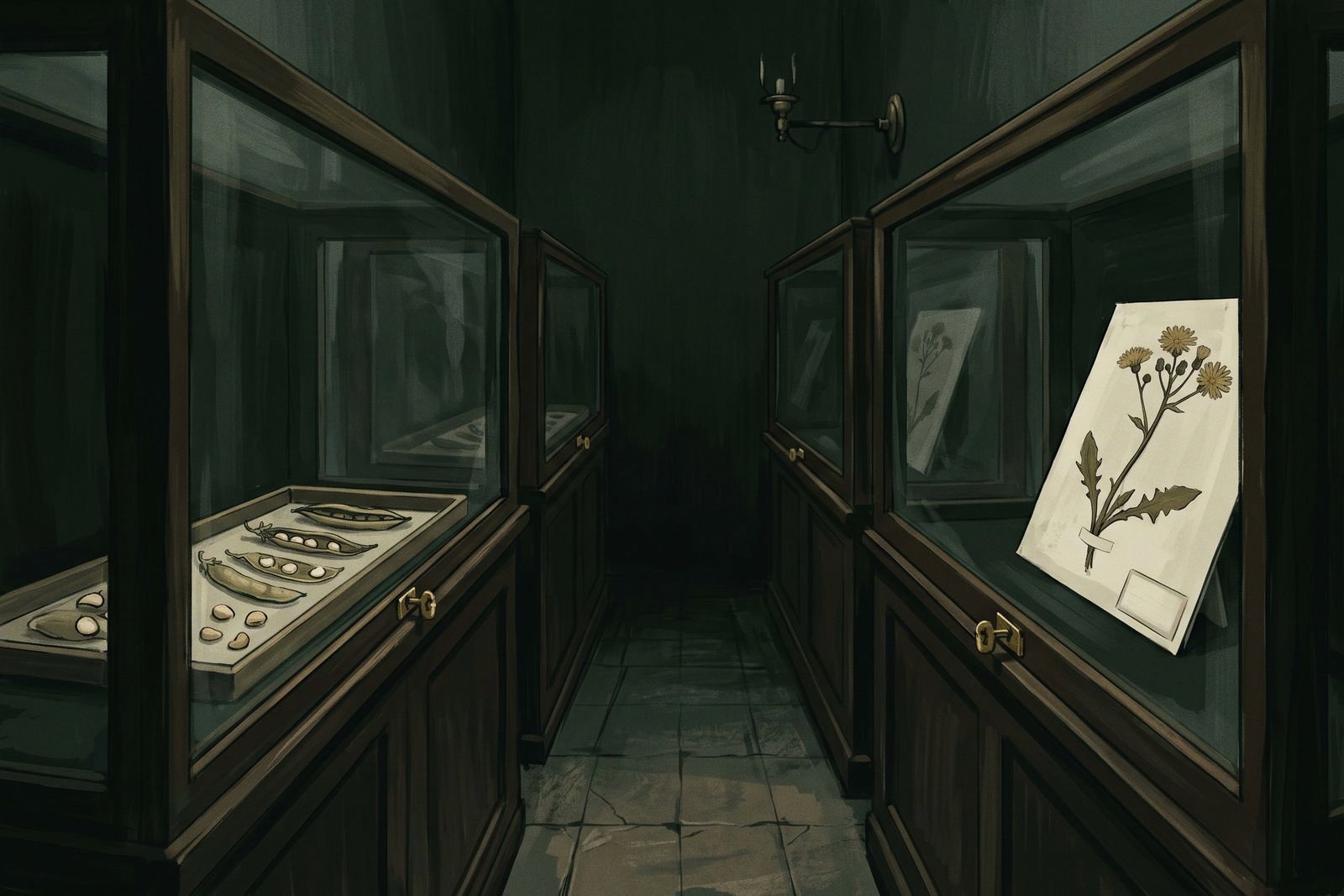
The same year a Zurich thesis establishes that Hieracium reproduces largely without fertilisation. The Brünn garden puts two cases in its corridor: peas on the left, a pressed hawkweed on the right, twenty years between Nägeli's answer in print and the finding that dissolved it.
The first international congress meets at Vienna in 1893 and leaves a stone in the monastery garden, cut in German and Czech, with the Czech half rather smaller. Paris follows in 1897. At Copenhagen in 1896 Johannsen clips de Vries's Pangen down to Gen, and the field has its noun.
Ludwig is head gardener now, with a daughter, Theresia, who reads the plot books to him because his eyes have gone. The workhorse organisms are settled in these years by what the gardens can house: peas, snapdragons, four o'clocks, oats, and the mouse.
In 1896 the legislature of Michigan takes evidence on an operative statute for institutional inmates.
1890–1909The Arithmetic Gets a Statute Book
In Windhoek the district office begins refusing to register marriages between German settlers and Herero or Nama women in the 1890s, and the commissioned hybridity studies that justify the refusals are printed before the century turns. The war of extermination that the colonial troops wage against the Herero and the Nama from 1904, and the camps at Shark Island, come out of land, cattle and General von Trotha's orders. They are not caused by a table of ratios. What the ratios supply, before and after, is the administrative language in which the survivors' children are classified and dispossessed, and that language is in place a decade sooner than the killing.
The pattern repeats wherever a legislature is least constrained. Australian colonial parliaments argue child removal and 'absorption' in breeders' arithmetic before Federation. Cape and Transvaal measures cite pedigree tables; French administrators in Indochina and West Africa litigate the status of métis children on descent instead of on paternal recognition. In the United States the Dawes allotment rolls of 1893 onward write blood quantum into land title, so that a fraction on a clerk's schedule decides what a family may sell and what it may inherit, and racial-integrity classification statutes pass in Southern states in the 1890s. The clerks take from the science a form of words that sounds like measurement.
Indiana enacts an operative sterilisation statute in 1899. The early ones die in state courts on due-process and class-legislation grounds; a state board circulates a model act with notice, hearing and appeal written into it, and in 1913 the Supreme Court sustains that version on a custody rationale. Abdominal surgery on women is dangerous until the 1920s, so for a generation the knife is a vasectomy and the patient is male: prisoners, epileptics, the already institutionalised. Frank, nineteen, is cut at an Indiana reformatory in 1912. The ledger records the date, the surgeon's initials and the word "consented".
Rome condemns the operations in the 1900s, and the condemnation carries because the founder was an Augustinian prelate and the Church owns his garden. Catholic Europe and Latin America abstain. Moravia, where the science began, never sterilises anyone.
The American door shuts first. The literacy-test bill passes both houses in 1896, is vetoed on 2 March 1897, and this time the Senate finds its votes and overrides. A family-descent schedule joins the Ellis Island manifest in 1903; national-origins quotas are legislated in 1907–09 by the committees that wrote the marriage statutes. Arrivals fall by more than half. Stefania, nineteen, of Brody in Galicia, sails from Trieste for Buenos Aires in 1908 because the ticket for New York is no longer worth buying.
Northern mills, short of hands, send agents south, and Black southerners begin leaving for Chicago and Detroit from about 1906.
1909–1931Grandparents on the Form, Nitrogen in the Shell
Anežka is twenty-four and copying registration forms at the district office in Kremsier when the Moravian Compromise of 1905 comes into effect with a grandparents' field on it. The electorate was to have been divided by declaration; fifteen years of Vienna chairs have persuaded both national parties that descent is the objective criterion, and each expects to profit. She fills in four boxes per voter and files them in oak cabinets. Bukovina copies the form in 1910, Galicia in 1914. Nobody destroys the cabinets.
The conscript examinations are by 1900 the largest pedigree collections on earth, and they feed the French panic about depopulation and the German argument about Wehrkraft. When the war comes in July 1914 nothing in the ratios has touched the alliances or the Balkan quarrel, and the armies march on the same railway timetables. Attrition moves. Forty years of selected beet, rye and potato raise the German baseline, so the fall of 1916 starts higher: single-gene blight resistance bred from wild Solanum holds and then breaks against new races, leaving copper spray as the answer. The turnip winter is displaced rather than abolished; the home front holds perhaps one winter longer, which the two sides argue about at the armistice and for twenty years after. Hospital serology, running since the 1890s, has cross-matching and citrated stored blood a decade further along in August 1914. More wounded men live. The pension rolls are longer, and the queues outside the pension offices become the physical constituency for the argument that the war has bred the nation downward.
Theresia's son Karl comes home to Brno in 1919 with one lung and a job in his grandfather's garden. The state he left has been replaced; the cabinets have not. The minority treaties of 1919 are argued over grandparents rather than mother tongue, and the Sudeten arithmetic of the next decade runs off them.
Maize takes longer than the enthusiasts promise. Single-cross seed is sold from about 1901 and fails on cost, the inbred parents yielding too little; the double cross fixes that and firms sell from 1908 at five to ten times the price of a farmer's own crib corn, out of isolated fields detasselled by hand. German breeders control recognised Original-Saatgut by re-purchase before the register act of 1911; the American seed trade kills free congressional seed distribution and gets a protective act in 1915. Yields climb into a market with cheap land and no acreage control, and by 1929 the Corn Belt has had twenty years of it on top of collapsed land values, record mortgage debt and hundreds of rural bank failures a year. A surplus-disposal act passes before the Crash, and acreage control with it.
The ninth congress meets at Berlin in 1929 and resolves that character is multifactorial and that no statute can be founded on the ratios. Thirty-seven American states have statutes that year, and none is repealed.
1929–1945Registers Older Than the Regimes That Use Them
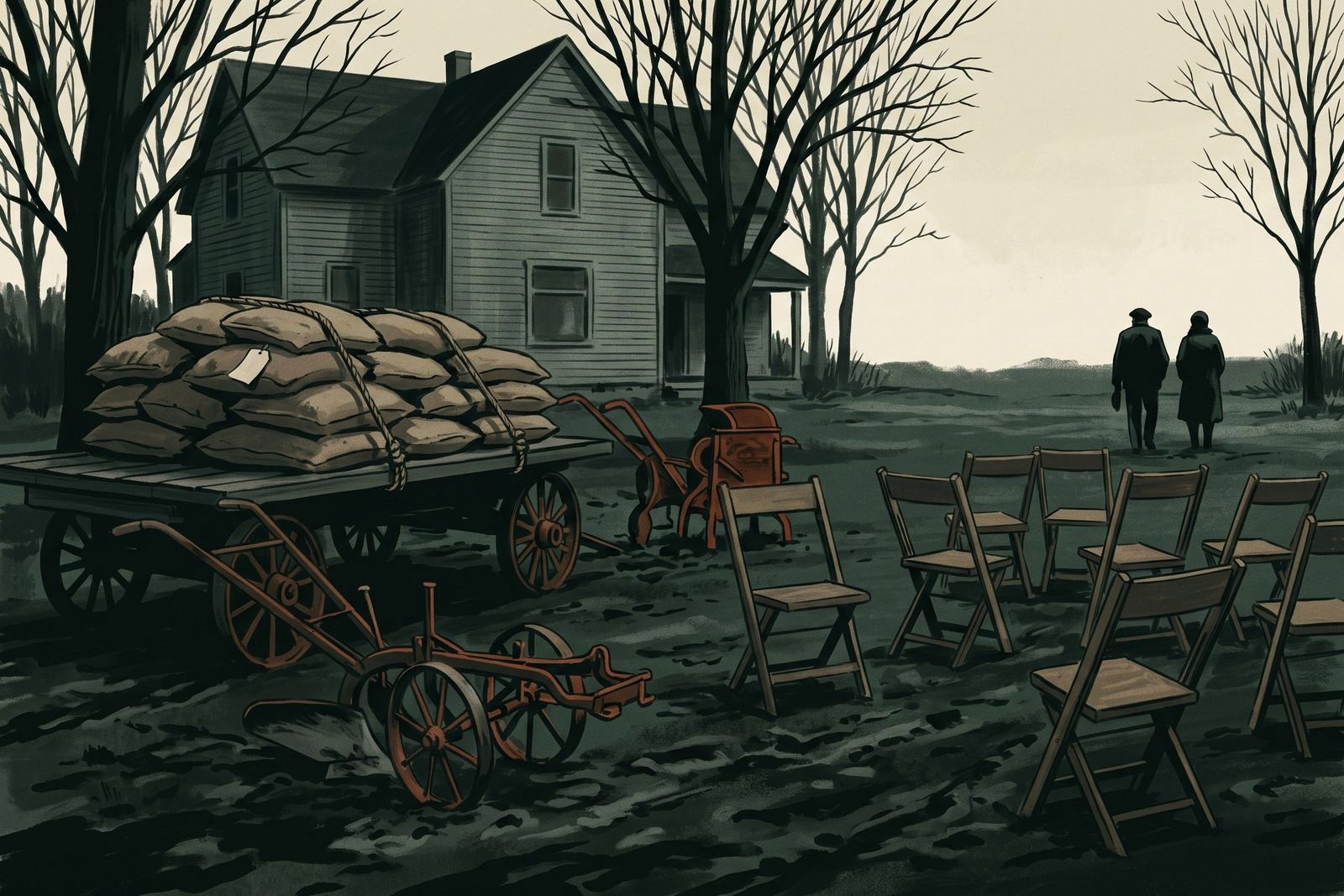
At a farm auction outside Cedar Falls in the spring of 1930 the seed bags go first and the mortgage still stands. The banking sequence of 1930–33 carries a heavier rural weight; grain prices sit lower for longer; the German agrarian crisis broadens the country vote for the NSDAP in 1928 and 1930 without altering the arithmetic of January 1933. In Palestine, where the emigration that could not reach New York has been arriving since 1909, the Yishuv of 1914 was already twice what anyone planned for; open revolt comes in the mid-1920s, a partition commission reports around 1930 and is shelved, and the White Paper closes the door in 1931.
The seizure of power, the war and the intention behind the destruction of European Jewry are unchanged by any of this. The appetite for laws of human transmission was loud in Macmillan's Magazine in 1865, before there was a mechanism to serve it.
What the older science changes is the toll, and it changes it upward. The Jewish population of Poland, Lithuania, Hungary and Romania is several million larger, because America closed in 1897 and the Levant in 1931 and those families stayed. The identification apparatus is forty years old and continental: Habsburg descent cabinets in the district offices of the successor states, hereditary counselling files, parish and civil Familienbücher kept in pedigree form since the 1880s. In Western and Central Europe the binding constraint on capture was never intention but identification, and where the forms exist the capture rate rises: the Netherlands, Bohemia and Moravia, Austria, Norway. Roma and Sinti families are worked out of a Munich card index begun in 1899 and a printed register of 1905 that has been kept genealogically for nearly forty years. Where there is no counselling tradition and no descent register, improvised registration in 1942 and 1943 fails as it failed elsewhere, and proportionally fewer are taken. The counting commissions after the war put the increment in the low millions and argue about it still.
Anežka is sixty-one in 1942, retired, when a German official asks the Brno district office for the 1905 cabinet. The office has it.
1945–1973Expulsion, a Split Verdict, and a Convention
Karl and his family are put on a train out of Brno in the summer of 1945, with the rest of a quarter of the city, and the garden's plot books go with the house. The Verhandlungen had ceased publishing in 1920; the exchange ledger, opened in 1861 and listing a hundred and twenty-odd societies, closes with a blank page and a change of language. The Augustinian house of St. Thomas is seized in the monastic liquidation of 1950, and the notebooks inventoried in 1885 pass into a state archive, which is the only reason they still exist.
In Moscow the session of 1948 ends in a split verdict. Michurinism keeps the horticultural stations and the newspapers; the agronomic institutes survive under a Russified vocabulary, because the collection tradition of the Bureau of Applied Botany dates from 1894, is domestic, and is credited inside the Party with the grain of the Five-Year Plans. Individuals are still destroyed. The science is not. The consequence runs for forty years: no emergency purchases in 1963, no great grain sale in 1972, and a détente bargained without a food lever. Russia and Ukraine are leading exporters from the 1970s.
Czechoslovak Michurinism, imported as politics, eclipses the Brno institute from 1949; the eclipse lifts around 1956, after two renamings and two purges of the Czech staff. Rehabilitation arrives with the centenary of the lectures in 1965, in front of the bilingual stone of 1893, which has been chiselled over twice.
UNESCO issues its statement on race in 1949. The American quota, legislated in 1907, is repealed in the late 1950s on the civil-rights logic that matured a decade early, and settlement from Mexico, the Philippines and Korea begins accordingly sooner.
Sixty years of clinic pedigrees and Familienbücher have meanwhile produced an actuarial hereditarianism to sit beside the legislative kind: premiums loaded on a grandparent's ailment since the 1900s, contested claims, a body of insurance case law written in German and still cited. In 1973 the Council of Europe opens a convention making the personal pedigree file the property of the patient and forbidding underwriting upon it. The United States does not sign.
1973–2026The Queue Nobody Budgeted For
Birgit is twenty when she is sterilised in a Swedish county hospital in 1958, under a statute of 1934 that descends from an argument of 1899. She is eighty-eight now and has a numbered ticket in her hand.

The repeals ran from the mid-1980s to about 2000, the compensation acts from 2005: Sweden, Denmark, Norway, Switzerland and some thirty American states, appropriations calculated on a few thousand claimants each. The totals reach the several hundred thousands, and the funds collapse within two years. The fight becomes proof. The women cut after 1950 have medical files; the men cut between 1899 and 1915 have institutional ledgers, a date and a set of initials, and in 2011 a great-nephew of Frank's files a photocopy of one page and is refused for want of a physician's record. The 2008 crash freezes several state funds until 2012. At every commemoration a delegate from Ireland or Chile or Quebec observes that no such office exists there, and a Czech archivist notes that Moravia never sterilised anyone.
Grain politics runs east. The Russian drought and export ban of 2010 lands on importers whose procurement has faced that way for two generations, and Cairo's bread queues are hotter in the winter before the uprisings, whose causes are policing, unemployment and succession. The seed-marketing overhaul of 2013–16 keeps the German headings in the trial protocols. GDPR folds the 1973 convention into Article 9; Britain leaves the Union over free movement and the euro, and retains the convention in its 2018 schedule. When edited births are announced in Shenzhen in 2018 the Council of Europe amends a treaty it already has, inside eighteen months, banning heritable modification and the commercial ranking of embryos by score. Thirty-eight states sign by 2021. The scoring firms take European customers by post, and file their compliance notices in Dublin.
Vaccination begins in late November 2020 on an authorisation pathway descended from drug regulation of the 1930s, and finishes faster; the counting commissions put the difference near a million lives and are argued with. Refusal clusters in northern Sweden, in three Swiss cantons and in three American states map onto the districts with the heaviest surgical records, where the grievance against public medicine is inherited and specific.
The invasion of February 2022 acquires an agronomic ledger when shells fall on the Kharkiv collection, and the lost accession numbers are read out in the FAO chamber. Since 2023 the most requested holding in the Brno state archive has not been the pea notebooks under glass. It is the 1905 registration forms with the grandparents' field, ordered by great-grandchildren of Stefania's brothers in São Paulo and by Ukrainians in Chernivtsi, because a legible box beats a burnt parish register. Two parliaments are debating closing the route, in the word the forms use. The abbey plaque, rewritten in 1993, 2003 and 2011, is scheduled for its fourth revision.
In Stockholm the compensation office is on the ground floor and opens at nine. Birgit's ticket says 41. The man ahead of her is holding a photocopy of a ledger page from 1912, in a plastic sleeve, with the initials circled in biro.
1867Kerner von Marilaun repeats the pea crosses at Innsbruck; Nägeli answers in print
Anton Kerner von Marilaun, called to the Innsbruck chair of botany in 1867, receives Bd. IV of the Brünn Verhandlungen through the society's exchange traffic and reads it because his Alpine hybrid work had produced constant intermediates he could not explain. He sows Pisum in spring 1868 and again in 1869, and reports agreement with the ratios to the Vienna Zoological-Botanical Society in 1870, with a botanic-garden plot behind him. Nägeli, who had grown Pisum from 1866 without agreement, publishes his dissent in 1871 — the results are empirical, not rational, and hold only for a peculiar hybrid — and it is the quarrel, not the mailing list, that makes a provincial pamphlet metropolitan. Mendel himself, elected prelate on 31 March 1868, tells Nägeli the office will cost him time; the hawkweed correspondence runs to 1873, its contradiction filed as a species anomaly, and by 1871 he keeps only weather registers and bees. He performs no further crosses.
13 SOURCED CAUSES
1872Beet sugar and Hanna barley pay for a hybridisation garden; the founder's last decade goes to a tax appeal
The paying constituency arrives before the professors do. The k.k. Ackerbauministerium (1868) and the new Hochschule für Bodenkultur (1872) are lobbied by the Bohemian–Moravian sugar-beet cartel — the empire's largest export industry, whose selection is measured in polarimeter degrees — and by the Hanna malting-barley trade supplying the Bohemian brewers. A trial and hybridisation garden opens at Brünn in 1873 under the agricultural society, deliberately not under the abbey: from 1874 the monastery of St. Thomas is locked in a sequestration fight with the k.k. authorities over the religious-fund levy on its estates, and cannot fund anything. The Carlsberg Laboratory, founded 1875, becomes the second pole, brewery money buying pure line work on barley and yeast. Mendel dies of Bright's disease in 1884, having published nothing further on hybrids; his notebooks and correspondence are inventoried by the chapter in 1885 and largely retained by the province.
8 SOURCED CAUSES
1875The biometry quarrel comes a generation early, and brings the randomised field trial with it
Because segregation is on the table from 1870, the fight between continuous-variation men (Nägeli's school, and the statistical wing around Galton's circle in London) and the ratio men runs from the mid-1870s rather than after 1900. Adjudicating 3:1 against 2.9:1 requires arithmetic: correlation coefficients, goodness-of-fit tests of the chi-square type, and above all replicated, randomised plot layouts to separate soil from seed. These become agrarian instruments of the 1880s and 1890s at Rothamsted (established 1843), Svalöf (1886) and Hohenheim, and the German vocabulary — Anlage, Spaltung, Reinzucht — travels untranslated with them into English and Swedish practice. The honest bound: there is almost nothing worth randomising in a hospital before sulfonamides in 1935, so the clinical payoff is deferred; but sulfa and then penicillin are assessed by controlled comparison from their first year, and statutory drug regulation follows roughly fifteen years earlier than in our record.
5 SOURCED CAUSES
1878Chairs, a compendium, and the word coined at Copenhagen
Kerner takes the Vienna chair of botany in 1878. Focke's Pflanzenmischlinge (1881), the standard compendium of hybrid literature, carries the Brünn ratios into Jena, Cambridge and the Kew–London reviewing circuit, where reviewers note that particulate transmission answers Fleeming Jenkin's 1867 objection that a favourable variant would be swamped by blending. The consequence is that the eclipse of selection never fully sets in: the 1880s argument is about the units, not about whether selection can work. Vienna founds the first chair of Vererbungslehre in 1890, Kerner presiding at the ceremony; Nägeli dies in 1891 still dissenting, Kerner in 1898. The workhorse organisms are fixed by these gardens and by the Vienna Vivarium: Pisum, Antirrhinum, Mirabilis, oats and the mouse. There is no fly room in this world — the 1919 irradiation experiments are done on mice and snapdragons. Johannsen at Copenhagen clips 'Pangen' in 1896 to give the field its noun.
6 SOURCED CAUSES
1885The arithmetic becomes colonial and racial law before it becomes medicine
A working two-factor scheme, in circulation since 1870 and taught in Vienna from 1890, reaches the least constrained legislatures on earth two decades early — and does so in the years of the scramble, of Plessy, and of allotment. German South-West Africa's prohibitions on mixed marriage and the hybridity studies commissioned to justify them arrive in the 1890s rather than after 1905. Australian colonial and then state 'protection' statutes, with their child-removal and 'absorption' provisions, are argued in the language of breeders' arithmetic before Federation. Cape and Transvaal segregation measures, and the Union legislation after 1910, cite pedigree tables. French colonial administrators litigate the status of métis children on descent rather than on recognition. In the United States, blood quantum is written into the Dawes allotment rolls of 1893–1906, deciding land title and inheritance, and racial-integrity classification statutes appear in Southern states in the 1890s rather than 1924. Almost nothing in the science compels these laws; it supplies them a form of words that sounds like measurement.
4 SOURCED CAUSES
1897The American door closes a generation early, and the Levant fills instead
The literacy-test bill passes both houses in 1896 and is vetoed on 2 March 1897; the House overrides, and in this world hereditarian testimony with arithmetic behind it moves the handful of Senate votes needed, so the Senate overrides as well before adjournment. A family-descent schedule is added to the Ellis Island manifest in 1903 and a national-origins quota is legislated in 1907–09 by the same committees that produce the marriage statutes. Arrivals in 1900–14 fall by well over half. Northern industry, short of European hands, recruits in the South: the Great Migration of Black southerners begins around 1906–08 rather than 1916, southern tenancy loses labour before mechanisation, and the northern Black electorate is larger and earlier, so the urban Democratic coalition of 1928–36 forms on different arithmetic and civil-rights litigation moves forward roughly a decade. Emigration from the Russian Empire, Galicia and the Mezzogiorno is redirected to Argentina, Brazil, Canada, Britain (under a harsher Aliens Act after 1905) and the Ottoman Levant. The Yishuv of 1914 is roughly twice its real size; open revolt in Mandate Palestine comes in the mid-1920s, a partition commission reports about 1930 and is shelved, and a White Paper regime shuts the door in 1931 rather than 1939.
3 SOURCED CAUSES
1896Sterilisation statutes arrive before the intelligence test, and Rome condemns them early
Michigan and Kansas debate operative statutes in the later 1890s; Indiana's is enacted in 1899. Three constraints shape who is cut. Safe abdominal surgery on women scarcely exists before the 1920s, so the programme to 1915 is overwhelmingly male vasectomy, reaching the convicted, the epileptic and the already institutionalised, and only inverts to female salpingectomy after 1920. Binet–Simon (1905, Goddard's translation 1908) is untouched by the divergence, so mass 'feeblemindedness' screening is a post-1910 phenomenon everywhere. The first statutes die in state courts on due-process and class-legislation grounds; a state board circulates a model act with notice, hearing and appeal written in, and the Supreme Court sustains that version in 1913 on an institutional-custody rationale. Thirty-five to forty states have statutes by 1929; totals run into the several hundred thousands before repeal, with Vienna and Zurich models exported to Hartford rather than the reverse. Because the founder of the science was an Augustinian prelate and the Church owns his garden, Rome condemns surgical sterilisation in the 1900s and the diocesan consanguinity dispensation files — Europe's best pedigree archive — are fought over from the 1880s; the 1917 Code answers the carrier argument. Catholic Europe and Latin America abstain; Protestant Scandinavia, Switzerland, the United States and later Germany legislate. Moravia, the homeland of the science, never sterilises anyone.
6 SOURCED CAUSES
1882The Habsburg lands write descent onto the electoral form
Charles-Ferdinand University splits into Czech and German institutions in 1882, and the new science is nationalised from birth: a Prague Czech-language school quarrels with Vienna over the legacy of a German-speaking Moravian abbot from the 1890s, so the Brünn plaque dispute is forty years old before any peace treaty. The institutional turn comes in 1905. The Moravian Compromise, which in fact divided the electorate into German and Czech rolls by declaration, is drafted instead on descent — a grandparents' field on the registration form — because fifteen years of Vienna chairs have given both national parties what they take to be an objective criterion, and each expects to gain by it. Bukovina follows in 1910, Galicia in 1914. Cadastral cabinets of registration forms accumulate in the district offices. The successor states inherit them in 1918–20; the minority treaties of 1919 are argued over grandparents rather than mother tongue; the Sudeten arithmetic of the 1930s runs off them.
5 SOURCED CAUSES
1900Hybrid maize, seed statutes, and a farm depression that arrives early and deep
Single-cross seed is offered commercially about 1900–03 and fails: the inbred parents yield too little seed and the bag costs too much. The double cross solves the cost problem and firms sell from 1908, at five to ten times the price of crib corn, out of isolated multiplication fields worked by hand detasselling. Adoption is slower than the enthusiasts promise, because with cheap land and no acreage control a farmer has weak reason to buy seed every spring — and yields rise anyway. Breeders' associations in Germany control recognised Original-Saatgut by re-purchase before the register act of 1911; the American Seed Trade Association wins its fight against free congressional seed distribution a decade early, securing a protective act in 1915 — which perversely reduces the incentive to sink capital into inbred lines. By 1929 the Corn Belt has had two decades of yield gain on top of the post-1920 land-value collapse, record mortgage debt and hundreds of rural bank failures a year: a surplus-disposal act of the McNary–Haugen type passes in some form before 1929 and acreage control is legislated before the Crash. The 1930–33 banking sequence carries a heavier rural component; world grain prices are lower for longer, deepening the German agrarian crisis of 1927–30 and broadening the rural NSDAP vote in 1928 and 1930 without altering 1933.
3 SOURCED CAUSES
1914The same war, fought from a higher baseline and with better blood
Nothing in the pea ratios touches the July Crisis, the alliances, or the military decision in the West in 1918. What changes is attrition. Forty years of selected beet, rye and potato raise the German pre-war baseline, so the home front falls from a higher place; the potato failure of 1916 is partial rather than catastrophic, because single-gene blight resistance bred from wild Solanum crosses since the 1880s works and then breaks against new races of the pathogen, leaving Bordeaux mixture (1885) as the workable answer. Nitrogen still goes to explosives and fodder still collapses: the Turnip Winter is displaced, not abolished, and the home front holds perhaps a winter longer, which is argued over at the armistice and afterwards. An established heredity discipline running hospital serology since the 1890s puts cross-matching and citrated stored blood a decade further along in August 1914; wound mortality falls, and the disabled-veteran cohort and pension roll are correspondingly larger. The conscript examinations — the Musterung, the conseil de révision — are already the largest pedigree databases on earth by 1900, feeding French depopulation panic and German Wehrkraft debate from the 1880s; after 1919 the 'dysgenic loss' argument has a physical constituency in the pension queues.
3 SOURCED CAUSES
1910Two green revolutions, one of them shelved for a generation
The temperate one arrives on time and makes things worse. Fertiliser-responsive short-strawed wheats come out of the Italian and Swedish breeding channels in the 1910s and 1920s and meet Haber–Bosch nitrogen (1913, untouched by this divergence); European and North American yields rise into a market already drowning, feeding the interwar surplus and the acreage-control politics above. The tropical one is bred and then sits on the shelf. Short-strawed, disease-resistant lines suited to Mexico, the Punjab and Anatolia exist in trial plots from the 1920s and 1930s and are not planted at scale for a generation, because the binding constraints are ammonia capacity, tubewells, rural electrification, credit, extension services and a guaranteed procurement price, and pea ratios touch none of them; the great diffusions therefore occur roughly on our schedule. The famine ledger is mostly a negative. Ireland precedes the divergence, and its post-1850 problem was tenure, rents and emigration. Russia in 1891–92 was drought plus absent reserves plus an export policy; Ukraine in 1932–33 was requisition; Bengal in 1943 was price, procurement and shipping. Genetics moves none of them.
3 SOURCED CAUSES
1930A split verdict in Moscow, and its long consequences for grain
The Russian field is not a German import here: it is the continuation of the imperial acclimatisation and collection tradition of the Bureau of Applied Botany (1894), with pre-revolutionary chairs and domestic prestige. Its product in the 1920s and 1930s — domestically multiplied hybrid maize and rust-resistant frontier spring wheats — is credited inside the Party with the grain of the Five-Year Plans. Michurinism still rises on patronage and class politics, and the purges still take individuals; but the 1948 session ends in a split verdict, the agronomic institutes surviving under a Russified vocabulary while Michurinism keeps the horticultural stations and the propaganda apparatus. Soviet grain self-sufficiency holds through the 1950s and 1960s: there are no emergency purchases in 1963 and no great grain robbery in 1972, so détente is bargained without the grain lever and American farm prices of the 1970s run differently. The terminal Soviet crisis of the 1980s is fiscal, military and national rather than alimentary, and 1989–91 happens on its own causes. Russia and Ukraine are among the world's leading grain exporters from the 1970s rather than the 2000s. In China, the 1958 package lacks close planting and deep ploughing, having no Michurinist agronomy to import wholesale; the Great Leap famine remains a catastrophe of procurement, cadre falsification and the backyard furnaces, but its mortality is lower by something on the order of a third.
3 SOURCED CAUSES
1933The apparatus is older, the toll is higher, and the reckoning is weaker
The seizure of power, the war and the cause of the Holocaust are unchanged: the appetite preceded the mechanism, and instrumentation is not motive. The increment, as reckoned by the postwar counting commissions, lies in three places. The base population of Eastern European Jewry is several million larger, because America closed in 1897–1909 and the Levant in 1931. The identification apparatus is forty years older and continental — Habsburg descent cabinets in the district offices of the successor states, hereditary counselling clinics, parish and civil Familienbücher — and identification, not intention, was the binding constraint in Western Europe, so capture rates rise in the Netherlands, Bohemia, Austria and Norway. Roma persecution runs off a Munich Zigeunerzentrale card index of 1899 and a Zigeuner-Buch of 1905 that have been kept in pedigree form since the 1880s. The counter-vector is real: states with no counselling tradition and no descent register lose proportionally fewer, and improvised registration in 1942–43 fails where it failed before. The reckoning afterwards is weaker than ours, not stronger, because the sterilisation statutes outside Germany are older, milder in reputation and demonstrably pre-fascist: repeal runs from the mid-1980s to about 2000, and compensation acts begin around 2005.
4 SOURCED CAUSES
1945The Brno institute survives expulsion, liquidation and a political eclipse — barely
Germans were roughly a quarter of Brno's population in 1930; the expulsions from May 1945 remove the readership, the donors and the pulpit of a German-language scientific library at a stroke, and the institute's periodical ceases. The Augustinian house of St. Thomas is seized in the monastic liquidation of 1950. Czechoslovak Michurinism, imported as politics rather than grown as science, eclipses the institute from 1949; because Moscow's 1948 verdict was a split one, the eclipse ends around 1956 rather than 1965, but the institute is renamed twice and its Czech staff purged twice in eleven years. The notebooks and correspondence inventoried in 1885 are routed into a state archive rather than a monastery cupboard, which is why they survive at all and why they are displayed under glass. Rehabilitation comes with the centenary of the lectures in 1965; restitution quarrels between the order, the city and the state follow 1993. The German-language endowment that funds the guest lectureship after 1990 comes from Austrian and German heritage and expellee foundations — which is precisely why the commemorative plaque has been rewritten three times and why the resentment about it is mutual and specific.
5 SOURCED CAUSES
1900Actuarial hereditarianism, a convention of 1973, and a shorter pandemic
Sixty years of Familienbücher and clinic pedigrees before 1930 produce actuarial hereditarianism alongside the legislative kind: life premiums loaded on a grandparent's ailment from the 1900s, contested claims, and a body of insurance case law written in German and still cited. The Council of Europe convention of 1973 on personal pedigree files splits the Atlantic market: in Europe the file is patient property and may not be underwritten upon, in the United States it may. The molecular-industrial base is roughly a decade older — contract fill-finish and lipid-formulation capacity larger in 2020, and a standing emergency-authorisation pathway descended from the 1973 lineage and from early drug regulation. Vaccination in the winter of 2020–21 therefore begins some weeks earlier and scales faster; the counting commissions and actuarial bodies put the difference on the order of a million fewer deaths globally, unevenly distributed and disputed.
3 SOURCED CAUSES
2005Compensation offices open, and the queue is a hundred times longer than expected
Sweden, Denmark, Norway, Switzerland and some thirty American states legislate lump-sum payments for surgical sterilisation. Because the statutes ran from 1899 and the totals reach the several hundred thousands, appropriations calculated on a few thousand claimants collapse within two years; proof standards become the fight, since the 1900–1915 male vasectomy cohort left institutional ledgers rather than medical files. The 2008 financial crisis is ruled unchanged — it is a housing and banking event the divergence never touches — but it freezes several state compensation funds until 2012. Catholic Europe and Latin America, which never legislated after Rome's condemnation in the 1900s, say so at every commemoration.
4 SOURCED CAUSES
2010A Russian export ban with fifty years of dependency behind it
Russia and Ukraine have been the leading wheat exporters since the 1970s, not the 2000s, so the drought and export ban of 2010 lands on importers whose procurement has been oriented east for two generations. The 2010–11 food price spike is sharper in Cairo, Algiers and Amman. The Arab uprisings of 2011 are ruled unchanged in cause — policing, unemployment, succession — and altered only in the bread line's temperature. In parallel, the FAO seed-treaty quarrels over who owns a collected wild trait celebrate their eightieth year: the collecting programmes began in the 1930s as the answer to the first uniformity epidemics.
3 SOURCED CAUSES
2013European seed law rewritten, and the pedigree file folded into data law
The Common Catalogue tradition descends from the German register act of 1911, so the seed-marketing overhaul of 2013–16 is a fight not over whether to register but over farm-saved and heritage varieties; the compromise keeps the German headings — Reinzucht, Spaltungszahl — in the trial protocols. GDPR is ruled unchanged in occurrence and altered in content: Article 9 absorbs the Council of Europe convention of 1973, making the pedigree file patient property across the Union and forbidding underwriting on it. Brexit is ruled unchanged; its causes are free movement after 2004 and the euro crisis, and Britain retains the convention in its 2018 retained-law schedule.
3 SOURCED CAUSES
2018Edited embryos in China meet a treaty that already exists
CRISPR is ruled unchanged: it comes out of bacteriology and sequencing, which the divergence does not touch, and the announcement of edited births in Shenzhen in 2018 happens on schedule. What differs is the response. Instead of five years of committee work, the Council of Europe opens an amending protocol to the 1973 convention within eighteen months, banning heritable modification and — the contested clause — commercial ranking of embryos by polygenic score. Thirty-eight states sign by 2021. The United States, whose federal genetic-privacy act of the 1990s exempted life and long-term-care underwriting, does not, and its scoring firms take European customers by post.
3 SOURCED CAUSES
2020The pandemic ends some weeks earlier, and the refusal map follows the surgical map
COVID-19 is ruled unchanged in origin, spread and lockdown politics. The molecular-industrial base is roughly a decade older: contract fill-finish and lipid capacity are larger, and the emergency-authorisation pathway descends from a drug-regulation lineage fifteen years senior to ours. Vaccination begins in late November 2020 and scales faster; counting commissions put the difference near a million fewer deaths globally, disputed and unevenly spread. The counter-current is local and documented: refusal clusters in the Swedish north, the Swiss cantons and three American states track the districts with the heaviest sterilisation records, where families have a living grievance against public medicine.
2 SOURCED CAUSES
2022The corridor is the war's second front, and a gene bank burns at Kharkiv
The invasion of February 2022 is ruled unchanged in cause. Its grain consequence is heavier: half a century of Russian and Ukrainian export primacy means North African and South Asian importers have no alternative supplier bench, so the Black Sea initiative of 2022 and its lapse in July 2023 move prices further than in our record, and the Polish, Hungarian and Slovak import bans of 2023 are angrier because Central Europe's own surplus is larger. Shelling damages the Kharkiv collection, begun in the 1930s and older and deeper than any other; the accession lists lost are read out in the FAO chamber, which is how the war acquires an agronomic ledger.
2 SOURCED CAUSES
2023Grandparents' forms from 1905 decide who gets an EU passport
The descent cabinets of the Moravian Compromise of 1905, Bukovina 1910 and Galicia 1914 sit in district archives in Brno, Chernivtsi, Lviv and Klagenfurt. Since the simplified-naturalisation laws of the 2010s they have become citizenship evidence: a legible grandparents' field beats a lost parish register. Applications from Ukraine after 2022 and from Latin America run into the hundreds of thousands. The European populist wave of 2023–25 is ruled unchanged in cause — migration, energy prices, inflation — but two parliaments now debate closing the descent route, in the same word the forms use. The Brno abbey plaque, rewritten in 1993, 2003 and 2011, is scheduled for a fourth revision.
4 SOURCED CAUSES
2024An American immigration fight on arithmetic no European wave produced
The 2024 election and the enforcement programme of 2025–26 are ruled unchanged in outcome and in their politics of the southern border. The composition beneath them is not. The quota legislated in 1907–09 was repealed in the late 1950s, a decade early, on the civil-rights logic that also matured early; Latin American and Asian settlement therefore begins a decade sooner, while the Italian, Polish and Yiddish-descended Northeast is a third the size we know. In 2026 a Senate bill to extend the 1990s genetic-privacy act to life insurance dies in committee for the fourth time, and the scoring firms file their compliance notices in Dublin.
3 SOURCED CAUSES
Every one of these worlds was weighed against the one you have just read. Here is where each of them breaks.
Carl von Nägeli in Munich reads the Brünn pages in 1867, is persuaded, and Munich teaches segregation from the following season.
We weighed it because a single influential convert is the cheapest way to make a science, and Nägeli was the best-placed man in Europe to be that convert. It breaks in the same decade it starts, on two things at once: a settled theoretical taste that dismissed the ratios as empirical and not rational, and five years of his own pea plots in which nothing agreed. Conversion would need both a change of mind and a change of experimental luck, which is one miracle more than we allow ourselves after the first. It would also cost us the engine of the whole century that follows, since it is Munich taking the trouble to refute Brünn in print in 1871 that turns forty-five pages on peas into a contested metropolitan question rather than a quiet provincial acceptance. We kept his refusal, and we kept him dissenting to his death in 1891.
Darwin obtains the Brünn proceedings, grasps the ratios, and the later editions of the Origin carry particulate inheritance in his own hand.
We weighed it because it is the version most often imagined, and because the answer to Fleeming Jenkin's 1867 argument that a favourable variant would be diluted away sits waiting in Mendel's arithmetic. It breaks at once, in the 1860s, on the record: the accounts of what Darwin owned differ, none of them establishes reading, and we do not put a book in a man's hands to make a century work. We routed the same result the long way instead, through Focke's compilation of 1881 and the reviewers from Kew to Cambridge who noticed what the breeders had not bothered to state. The old man does not convert in our account. His readers do, and the eclipse that might have swallowed selection never quite closes.
The chapter of St. Thomas passes Mendel over in 1868, or he declines the office, and he spends the next sixteen years in the garden with his crosses.
We weighed it as the humane road, and it is the one most readers would choose for him. It breaks in the 1870s on the abbey's money: elected prelate on 31 March 1868, he wrote to Nägeli that the office would cost him a good deal of time and effort, by 1871 he is keeping weather registers and bees, and from 1874 he is drafting field valuations against the imperial levy on the monastery's estates. To free him we would have to remove the sequestration fight, which is the same fight that impounds the abbey's funds and forces heredity to be paid for by beet, barley and orchard money. It also costs us the Church hinge, since an Augustinian prelate as founder is why Rome condemns the sterilising operations in the 1900s rather than the 1930s, and why Moravia never sterilises anyone. We left him with the rain tables while Innsbruck and Vienna quarrelled about his ratios.
The science is founded in English at Cambridge around 1870, with Brünn cited as a footnote and the German pamphlet a curiosity.
We weighed it and found nothing wrong with it, which is the trouble. It was set aside not because it fails in any decade but because it is too near the ground we already stand on: an Anglophone genetics, English textbooks, English vocabulary, and a reader who learns nothing from the difference. The other road was equally defensible and much larger, so we took it, and we took its consequences with it, including the loan-words that travel untranslated into Swedish and English practice and are still printed on a Viennese hospital form in 2026. That was our choice of the two, made in the open, and not a fault found with Cambridge.
Europe avoids the war of 1914 altogether, or fights it with different allies, because forty years of hereditary science have redirected the politics of population and national strength.
We weighed it because the conscript examinations become the largest pedigree collections on earth by 1900, and they feed the French alarm about depopulation and the German argument about fighting strength. It breaks in the 1910s: no chain runs from a ratio of three to one in a pea plot to the July Crisis, the naval race or the Balkan settlement, and the armies march on the same railway timetables in the same month. We spent the difference where it can be traced instead, in the attrition. Forty years of selected beet, rye and potato start the autumn of 1916 higher, blight resistance holds and then breaks against new races, and cross-matching with citrated stored blood is a decade further along in August 1914. The price is longer pension rolls, and the queues outside the pension offices become the constituency for the argument that the war has bred the nation downward.
An earlier genetics changes the German seizure of power in 1933, or the cause and the intention behind the destruction of European Jewry.
We weighed it because it is the question the whole century puts, and because it is tempting to make a science responsible for what was done in its name. It breaks in the 1930s on chronology and on money: the appetite for laws of human transmission was loud in Macmillan's Magazine in 1865 and in Hereditary Genius in 1869, before any mechanism existed to serve it, and reparations, the agrarian collapse and the arithmetic of January 1933 are untouched by pea plots. The science here is instrumentation, not motive. So we held cause and intention constant and moved only what instrumentation moves, which is identification, and the toll goes up rather than down: descent cabinets forty years old in the district offices, pedigree family books kept since the 1880s, a Munich card index of Roma and Sinti families begun in 1899. Where the forms exist the capture rate rises, where improvised registration is attempted in 1942 it fails as it failed in our world, and the counting commissions put the increment in the low millions.
No sterilisation or racial-classification statutes are ever enacted, because the institutes have known since about 1902 that character is carried by many factors and not one.
We weighed it because it is what the science actually established, and early. It breaks across the 1900s and the 1920s on the plain fact that legislatures do not run on findings, they run on a form of words that sounds like measurement, and clerks had that form of words a generation sooner. The ninth congress at Berlin resolves in 1929 that no statute can be founded on the ratios, and in that same year thirty-seven American states have operative laws and not one is repealed. That gap between what is known and what is enacted is the most solid thing in this account, and closing it would be both false and flattering to the profession.
Lysenko wins outright in Moscow in 1948 and Soviet genetics is proscribed for seventeen years, exactly as it was in our world.
We weighed it and carried it for some distance before it broke in the 1950s on its own hinge. The case for proscription here rests on a lexical argument, that the field carries a German name and a German vocabulary, and that is thin material on which to liquidate a working science in the world's largest agricultural state, especially one credited inside the Party with the grain of the Five-Year Plans. It also has the effect of returning the Soviet Union to our own grain politics, the emergency purchases of 1963 and the great sale of 1972, and handing détente back its food lever. We took the divided outcome instead: the horticultural stations and the newspapers go to Michurinism, the agronomic institutes survive under a Russified vocabulary, and individuals are still destroyed. The price is that Russia and Ukraine are exporters from the 1970s and the lever never exists.
Soviet genetics is never touched at all, and there is no Michurinist interval, because a science with the harvests behind it cannot be purged.
We weighed it as the mirror of the road above, and it overcorrects in the 1930s and 1940s. Lysenko rose on patronage and class politics under Stalin, not into an empty space left by a science that had failed to deliver, and having delivered has never protected anyone in those years. The honest shape is the split of 1948, where the institutes keep the work and lose the words, and where the men who did the work are still shot or sent east. Czechoslovak Michurinism, imported as politics rather than as agronomy, eclipses the Brno institute from 1949 and lifts around 1956 after two renamings and two purges of the Czech staff.
Breeders equipped with a working genetics in 1900 deliver the Green Revolution in the tropics in the 1920s and 1930s, thirty years early.
We weighed it because the plant breeding really is available that early, and semi-dwarf architecture is not a difficult idea. It breaks in the Punjab of the 1950s on capital rather than on genetics: a semi-dwarf wheat returns nothing below roughly 40 to 60 kilogrammes of nitrogen per hectare, the Haber-Bosch process is chemistry and untouched by any of this, and the yield response of 1965 to 1970 also required tubewells, rural credit, an extension service and a guaranteed procurement price. What we kept is the sadder half of it, a generation of varieties bred and then shelved, waiting for the fertiliser and the credit to arrive on their own schedule.
With genetics thirty-four years ahead, molecular biology arrives a full generation early and the structure of the gene is settled in the 1920s.
We weighed it and it breaks in the 1940s and 1950s on physics, which this divergence does not touch. X-ray crystallography, computing and microelectronics arrive when they arrive; without them an earlier genetics can pose the question of structure but cannot answer it, and the answer moves by two or three years rather than by thirty. We kept saying so throughout, because the things that do not move are what earn the things that do.
The great famines of the twentieth century are averted, or blunted, by four decades of extra breeding behind the world's staple crops.
We weighed it case by case and it breaks on policy in each one: the Russian drought of 1891 and 1892 with an export policy on top of it, the requisitions of 1932 and 1933, the price and shipping decisions of Bengal in 1943, the procurement quotas and falsified cadre returns of 1959 to 1961. Grain in the country does not feed people whom a government has decided not to feed, and higher baseline yields change the size of the surplus taken, not the taking. Only the Great Leap moves at all in our account, and only because Michurinist agronomy is missing from the package of 1958. That is a small gain and we did not enlarge it.
The account opens in the Stockholm compensation office in 2026, with the numbered ticket, and works backwards to a monk cutting the string on a parcel in 1867.
We weighed it because that ground-floor office is the strongest thing here and there is an obvious temptation to lead with it. We set it aside on form. What we keep is a local chronicle, which reports in sequence and does not conclude, and a frame built backwards from 2026 would announce at the top of the page what the hundred and sixty years are supposed to mean. The ticket is stronger as the last thing the register happens to record than as a thesis, so it stays at the foot, where it was found.
The map is redrawn: a Habsburg state survives the war, Czechoslovakia does not divide in 1993, and a different union assembles in the west.
We weighed it and found no chain running from an arithmetic of heredity to the July Crisis, to 1938, to 1989 or to the Slovak question, so it breaks in the 1910s and again in the 1980s for want of a mechanism. We took our amplitude in demography, law, language and the grain trade instead. Keeping the borders is also what makes the changes legible: the descent cabinets of the 1905 Moravian Compromise outlive the monarchy that ordered them, the republic that inherited them and the occupation that asked for them in 1942, and that only reads if the states around them fall in the order they fell.
A hinge is placed on a named living person doing something the record does not show them doing.
We weighed nothing here, because the rule is absolute and predates any of this. The modern material is where the pull is strongest, and it is strongest in the colonial registers, the insurance case law and the embryo scoring, where a single named official would make a paragraph land. So the edited births announced in Shenzhen in 2018 are carried by an unnamed clinic and by jurisdictions, the scoring firms are firms and file in Dublin, and every public actor named in this account is dead and acting inside a documented record. The private lives we follow, from Ludwig's forceps to Birgit's ticket, are typical rather than real and carry no hinge at all.
Everything before the hinge rests on these readings. Under each title, the passage retained.
- Mendel, Darwin, and Fisher (1865-1965) — Notes and Records of the Royal Society
On 8 February 1865, Mendel read a paper entitled Versuche über Pflanzen-Hybriden before the Naturforschender Verein in Brünn.
- How Gregor Mendel's pea plant experiments created modern genetics — National Geographic
Mendel outlined his findings to roughly 40 attendees in two presentations at the Natural Science Society of Brünn
- 1865: Mendel's Peas — National Human Genome Research Institute
Mendel read his paper, "Experiments in Plant Hybridization" at meetings on February 8 and March 8, 1865.
- Mendel, Gregor. 1866. Versuche über Pflanzen-hybriden (Electronic Scholarly Publishing facsimile/translation)
Verhandlungen des naturforschenden Vereines in Brünn, Bd. IV für das Jahr 1865, Abhandlungen, 3–47.
- Versuche über Pflanzen-Hybriden — Smithsonian Libraries, Heralds of Science
The article originally appeared in: Verhandlungen des naturforschenden Vereines in Brünn Bd. 4, Abhandlungen.
- Mendel, Gregor Johann: Versuche über Pflanzen-Hybriden — Springer (Kindlers Literatur Lexikon entry)
Versuche über Pflanzen-Hybriden, in: Verhandlungen des naturforschenden Vereines in Brünn 4, 1866, 3–47.
- Details — Versuche über Pflanzen-Hybriden — Biodiversity Heritage Library
(1865-1866) Verhandlungen des naturforschenden Vereines in Brünn · Bd.4 (1865-1866) 3-47
- Holdings: Verhandlungen des naturforschenden Vereines in Brünn — Villanova Digital Library
Versuche uber Pflanzen-Hybriden and Meteorologische Beobachtungen aus Mahren und Schlesien fur das Jahre 1865
- MendelWeb Notes
The Society had been in existence only since 1861, and Mendel had been among its founding members.
- Mendel and His Legacy — Villanova University
Mendel ordered forty reprints of his paper which he sent to various scholars throughout Europe at the end of 1866
- Gregor Mendel — Genetics, Peas, Experiments — Encyclopaedia Britannica
He had ordered 40 reprints, the whereabouts of only eight of which are known.
- Gregor Mendel (1822-1884) — CSHL DNA Learning Center
exchanged with the publications of at least 120 other associations and societies, and was available in many libraries
- The Mendel-Nägeli letters, circa 1866-73 — The Scientist
On New Year's Eve, 1866, Gregor Mendel wrote to the prominent Swiss botanist Carl Nägeli
- Full Breadth of Mendel's Genetics — GENETICS (Oxford Academic)
Mendel's first letter to Nägeli, written on New Year's Eve 1866, was a covering letter for the reprint
- Hieracium — an overview — ScienceDirect Topics
The Mendel–Nägeli correspondence actually consists of 10 letters written by Mendel like scientific papers.
- Pea Stories. Why was Mendel's Research Ignored in 1866 and Rediscovered in 1900? — Springer
He dispatched several copies of it to leading experts in biology and botany but apparently, hardly anyone took notice
- Gregor Johann Mendel: From peasant to priest, pedagogue, and prelate — PNAS
Cyrill Napp died on 22 July 1867.
- F. C. Napp und J. G. Mendel: Ein Beitrag zur Vorgeschichte der Mendelschen Versuche — Theoretical and Applied Genetics
the centenary of the election of Mendel to succeed Napp as abbot (31. 3. 1868)
- Remembering Johann Gregor Mendel: a human, a Catholic priest, an Augustinian monk and abbot — Molecular Genetics & Genomic Medicine (invited commentary)
brethren have elected him abbot unanimously in 1866 after the death of Cyrill Napp
- Mimush Sheep and the Spectre of Inbreeding — Journal of the History of Biology
Headquartered in the "Moravian Manchester" Brünn (nowadays Brno), the centre of the textile industry
- Francis Galton — Hereditary talent and character, Macmillan's Magazine (galton.org bibliography)
Hereditary talent and character. Macmillan's Magazine (12 1865):157-66, 318-27
- Hereditary Genius: An Inquiry into its Laws and Consequences — Nature review
"HEREDITARY GENIUS" was first published in 1869 ... preceded in 1865 by the papers in "Hereditary Talent and Character"
- Proceedings of the Natural History Society of Brünn — Wikipedia
organized in 1861 by Franz Czermak, Jacob Kalmus, Alexander Makowsky, Johann Nave, and Gustav von Niessl
A life in this world — an archival fiction
März.
The Fastenmarkt on the 12th, in weather that kept the old women home. Butter 16 Kč the kilo and hard to shift, eggs 9 Kč 60 the dozen and going at that, piglets from 110 to 160 the pair, fifteen crowns under last year and nobody pretending otherwise. Rye at 132 the quintal. The Wallach with the wooden spoons stood where he stands every year and sold none that this paper saw. Three stalls stood empty that were let and paid for, and the market clerk has been told about it twice.
The road-metal contract for the Heinzendorf stretch went to Pawlik of Wagstadt at 4 Kč 20 the cubic metre delivered. A man can only quote that price if he knows where the stones are coming from. This paper knows where they are coming from: the old cut above the brickworks that the district said last autumn was not to be worked. The stretch is to be done before the June coaches. It is always to be done before the June coaches.
The Körkommission sat at the Odrau yard on the 19th and 20th. Eleven bulls brought, nine licensed, one refused for the hocks and one on Anlage grounds, the shoulder fault standing twice in the sire's papers and once in the dam's line. That was Trziska's, out of the Kravařský bull he paid too much for in 1927, and Trziska shouted in the yard for a quarter of an hour and asked whether a man's cattle were to be judged by a sheet of paper. The commission ate at the Grüner Baum and left at four. Trziska shouts most springs. Last spring it was the girth measurement. His Körschein of 1927 with the red overprint is nailed up in his byre where the coach parties can see it if they ask, and they do not ask.
Among the association's notices: the milk-recording returns of the Odrau district went complete to Neutitschein on the day appointed, twelve months running, carbon and covering sheet, signed A. Nitsche, Kontrollassistent. The association's letter of thanks was read out and is on the board at the co-op, pinned at three corners. It is generally known that the pensioned inspector's post at Neutitschein falls vacant in the autumn, and that our recorder considers himself in the running. He has mentioned it at the Grüner Baum, twice on the same evening, and mentioned also that he was passed over in 1922 and again in 1926.
Deaths: Veronika Klein, 81, of the Niedergasse. Births: to the Rosners a boy, to the Sowas a girl. The Raiffeisen board meets on the 4th of April and the accounts are with the printer.
April.
The co-op meeting on the 6th ran to twenty past ten because of Streit of Wolfsdorf. Streit's herd stood at 3.28 for March, Kunz's at 3.51, and Streit asked the chairman whether the sample bottles are watched from the byre to the table, and whether a man who eats four suppers a fortnight in the same three kitchens can be expected to see straight over an acid bottle. He did not say a name. Nobody needed one.
The chairman put it to the recorder. The recorder said, standing, that the butyrometer has no relations in this district. The bull fund came next.
For the record, since this paper is asked: in the fortnight in question the recorder took his supper at Kunz's, at Grussmann's, at the widow Peschke's and at Kunz's again. The hand centrifuge was clamped to Frau Kunz's kitchen table with the family standing round it and the lamp brought over, and Kunz at the recorder's elbow while the acid went in. The tin tags were read out loud from the bottles by the Kunz boy, who is nine. The figures stood. The herd averages for April are printed below in the usual place. Kunz stands at 3.62, a tenth over March. Kunz keeps his coffee warm on the back of the range from six o'clock, and Streit's wife does not make coffee at all.
Otherwise: the Landwirtschaftliches Wochenblatt of the 11th gave half a column to the Berlin resolutions on mental capacity and the rest of the page to hog prices, and at the co-op the page was passed round for the hog prices. The Erfurt catalogue came in the same post. Fodder beet, the F1-Kreuzung at 46 Kč the kilo against 15 for the open line, and Grussmann read both figures aloud in the voice he keeps for the land tax and then ordered four kilos of the cheap. He says his own crib has fed him thirty years.
The Hraběta paternity case at the district court is settled. The court went by the doctor's card and not by the two witnesses, and the costs fell where everyone expected. What is said at Kretschmer's is that a card now stands higher than a neighbour's word, and the men saying it are the two who were the witnesses. Two more of our girls have gone into service in Thurgau. Rosalia Hübner is back from the same canton and has her stamped certificate, and the banns go up after Whitsun.
Road metal on the Heinzendorf stretch: begun.
Juni.
Three coaches from Vienna on the 22nd and a society from Berlin on the 24th, forty-one persons, with a brass band that played in the yard of the birth-house and a wreath with ribbons a metre long. The Brno institute's ribbon from last year is still propped against the shed wall where the rain gets at it, and the lettering has gone from it, and somebody might carry it indoors. The parties took beer at Kretschmer's, ninety litres over the two days. That and the road metal is the whole of what Heinzendorf gets out of the business.
The plaque. This paper has said before and says again that the order of the names on the plaque is not a matter for the district office and not a matter for the societies from Vienna either. The house stood as Heinzendorf No. 58 when the child was carried over to be baptised, the register says Heinzendorf, the tax book says Heinzendorf, and a plaque that puts Hynčice above it is telling the register it was mistaken. Herr Vaněk at the school takes the other view and takes it loudly. The matter was raised again at the parish committee on the 26th and referred, as always, and meanwhile the mason has been paid for the frame and not for the letters.
Also from Wagstadt: the threshing machine at Bittner's stands with a cracked drum and has stood since the 8th, and the man from the works at Prerau came out, looked at it, and went away again to write. Bittner has the whole Wagstadt round contracted for August.
The recorder was at Bittner's door on Sunday the 15th, wheeling his bicycle, the lamp bracket tied on with wire since Easter. He was not asked in, or was not there long enough to be, and was heard at the door to say that Martinmas is Martinmas. His sister came out after him as far as the gate and stood there with her hand on the post. She was a Nitsche before she was a Bittner. He rode home the Heinzendorf way. It is his round, eleven times a month. The coaches were still in the yard as he passed.
Hay: good, and got in dry, the one thing to be said for June.
Juli.
The association advertised the salaried post on the 3rd. Applications to Neutitschein by the 15th of September with the usual papers, birth certificate, testimonial from the district committee, service record, and this year a completed family sheet on the printed form. The stationer Blaschke has them in the window at nine crowns, the good ones with the stiff cover, squares for the four grandparents and a ruled space under each for ailments and cause of death. He sold eleven in July. Nine of them were confirmation presents and went out of the shop wrapped, next to prayer books, and two were not.
The recorder bought one on the 8th (a Tuesday) and carried it home in its paper sleeve. Frau Zwilling, who does the washing in the Kirchengasse, says it has been on the dresser since, in the sleeve, with the insurance receipts under it. She says it is nobody's business, and she is right. The closing date is in September, and eleven sheets in a month is a figure worth having in the column.
Postman Schindler complains of the third week of July, when the Troppau envelopes go out over the whole district, the maintenance accounts from the institution, and they are heavier than they need to be for what is in them. The rate has gone up by eleven crowns a quarter. Those who pay in three instalments pay the first before the harvest and the second in August, a bad month for it. The envelope for the Kirchengasse is addressed to A. Nitsche and has been these six years, the man at Troppau being his wife's mother's brother and no blood of his at all. Frau Nitsche was a Reinelt. She has not gone over since '24. Her people there have stopped expecting her.
Storm on the night of the 19th, three roofs in the Niedergasse and the hop poles at Kunz's flat. The 5.14 to Wagstadt is discontinued from the 1st of August to the 10th of September for the harvest traffic, and the timetable slips are at the station and nowhere else, so the co-op has asked for one to pin up and has been told to send a man for it.
Butter 15 Kč 50. Eggs 8 Kč 40. Nothing rising.
August.
The harvest went in fast and short. Rye down again, and the mill is buying at a price it will not print.
The recorder did the whole twenty-two-farm circuit through the harvest weeks with the boy carrying the sample rack, fourteen bottles and the acid. The boy is fourteen and did not put it down between Wolfsdorf and Klein-Petersdorf, an hour and a quarter of walking with the rack in one hand. At the co-op on the 17th the recorder said, to Grussmann and to whoever else was standing there, that the trade will keep a family if a man is exact in it, and that the boy has the hands for the acid, and that he has never yet broken a butyrometer. Grussmann said the price of a butyrometer and the talk went to hogs.
Word from Wagstadt on the 14th: the drum is mended and back on its bed, and the works charged 1,900 Kč, and the season is lost, Bittner's round having gone to the Wolf brothers at Neudörfel, who came with two machines. Bittner has the machine and the rounds are let for next year and next year is next year.
At the post office on the 19th the recorder sent a money order to the institution at Troppau. Fräulein Peschke, who counts because it is her work to count, says it was the second of three, and says also that it was made up at the counter out of a pocketbook and a purse, which took some minutes and held up the queue, and that the man behind him was Streit of Wolfsdorf, who said nothing at all and looked at the counter.
Herd averages for August below. The district stands at 3.44. The evening milk of this district has been thin since anyone can remember. Kunz stands at 3.63.
Fair on the 24th. Two hirings, both girls, both for Troppau kitchens at 180 the month with the Sunday afternoon.
September.
The recorder went to Neutitschein on the 4th by the early train to put his candidacy in person, in the good coat, and was back on the 8.40 in the evening. He has since told the story in three places. This paper has heard it twice and has seen the paper he brought back with him, because he shows it.
In the anteroom the clerk called him Nitschke. Asked whether he was the one from Heinzendorf, he said he was the one from Odrau. The clerk went out. He came back and asked it a second time in the same words.
His folder was already lying out on the table, being the folder they keep since a man is hired, and it was open. He asked twice whether it was his. The clerk had gone for the secretary, so he read it upside down and then the right way up. There is the letter of thanks in it, and the returns log, and the complaint of Streit of Wolfsdorf in April, which he did not know was in it. And under those, stapled at the top left, is his hiring sheet of the 15th of May 1911, made out when he sat the examination at nineteen, with the association's doctor's hand on it in ink gone brown, height, chest, sight, and the printed Erbgang field filled in across two lines, more than the field was ruled to hold, and a later hand in pencil beside it, from '24 or thereabouts, saying the Troppau maintenance stands in his name.
The secretary came in and was civil and said the post had been filled on the 1st, that the papers of the successful man were in order, and that the family sheet had not in the event been called for, the appointment having been made on the district committee's recommendation. The successful man is Vlček of Fulnek, three years in the service there. The secretary's sister is married at Fulnek.
The recorder asked for a certified copy of his own sheet and was told four crowns the page, two pages, and he paid eight crowns and took the receipt, and it is the eight crowns he tells about. Four crowns a page for a man's own sheet, he says, that they wrote out themselves without asking him, and he was in the room while they stamped it. He has said since at the Grüner Baum, at Kunz's and at the co-op that the post went to a man who writes better Czech. Nineteen years, he says, and not one return ever back for correction. He says it in the same words each time.
The copy passed round the table at Kunz's on the 21st with the coffee. Grussmann held it up to the lamp for the stamp and said the stamp was crooked. Nobody said anything about the second page.
Michaelmas rents paid, mostly.
Oktober und November.
The Martinmas list stands below in the usual form: hirings, sales, and the notes fallen due at the Raiffeisen, longer this year by nine names.
Before that: on the 3rd and the 6th the recorder called at Kunz's and at Grussmann's, and at Kunz's stayed to supper and had the good coffee and the smoked meat, and asked, and was told that there is nothing lying idle at Kunz's this year, what with the pigs. At Grussmann's he was not asked to sit down and did not ask at all. He tried the co-op fund on the 9th and was told the fund is for stock.
The note at the Raiffeisen fell on the 11th, being the surety for the Bittner machine at Wagstadt, principal 14,000, and was not met, and was renewed for a year at eight and a half where it stood at seven. The clerk Fiedler wrote in the new date and the two names went on again in the same order, Bittner first and Nitsche second. The ink was the same ink. It took eleven minutes. Fiedler says he had four such that morning and two of them cried and this one did not.
The boy Josef went to Bittner at Wagstadt on the 15th as a hand for the winter half-year, to work off the difference, keep and no wage, home at Christmas and at Easter, which is what the arrangement between brothers-in-law generally comes to. The sample rack on the circuit is therefore carried by nobody, and the recorder has gone back to the two trips over the long stretch, out and back, an hour and a quarter each way, or he straps the rack on the bicycle and goes slow. The lamp bracket is still wired.
On the evening of the 12th he weighed the evening milk at Kunz's, spun the samples on the kitchen table with the family round it as usual, and the figure went into the Leistungsbuch at 3.7 where the month had been running 3.6. The green Anlagenblatt in the second cow's page has the Rückschlag column ruled and empty, as it has been since the heifer was entered, and there is nothing in this world to put in it, and Kunz says so every time the book comes out.
Dezember.
Butterfat averages for the district, November: 3.41, against 3.48 in November of last year, which the association puts to the fodder and this paper puts to the price of the fodder.
The plaque at Heinzendorf: unresolved, referred to the district office on the 14th, the mason's account now standing over from June and drawing interest at nobody knows whose expense. The wreath ribbon from Brno is off the shed wall. Kretschmer's girl has it tied to her handlebars.
Körkommission, autumn sitting, Odrau yard, the 21st of November: seven presented, five licensed, one refused for the feet and one on Anlage grounds, the fault in the dam's line, and the owner said nothing whatever, which is a change.
Prices: butter 15 Kč, eggs 7 Kč 80 the dozen, rye 118, piglets 95 to 130 the pair. Nothing has risen since July.
Small advertisements: a hand centrifuge, Gerber pattern, with rack, twelve butyrometers and the stand, little used; also a bicycle, sound, lamp bracket wanting; apply Nitsche, Kirchengasse, Odrau, evenings, Sundays after ten. Blaschke has four family sheets left in the window at nine crowns, and one that he sold in July is on a dresser in the Kirchengasse, in its paper sleeve, with the insurance receipts under it.